February 24, 2011
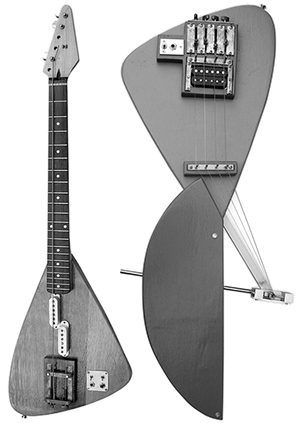
Yuri Landman (b. 1973) is a Dutch luthier (someone who makes or repairs stringed instruments) who has made several experimental electric string instruments for a list of artists including Lee Ranaldo of Sonic Youth, Liars, Jad Fair of Half Japanese and Liam Finn. He has also been active as a comic book creator, musician, and singer.
Posted in Art, Technology |
Leave a Comment »
February 23, 2011
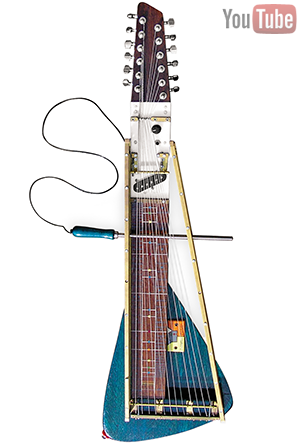
The Moodswinger is a twelve string electric zither with an additional third bridge designed by Dutch luthier Yuri Landman. The rod which functions as the third bridge divides the strings into two sections to cause an overtone multiphonic sound. In 2006 Landman was contacted by the noise band Liars to make an instrument for them. Although it closely resembles an electric guitar, it is actually a zither, as it has neither frets nor a proper neck. The pickup and electronics are built into the neck instead of in the body like usual electric guitars.
After Liars received their Moodswinger, they started recording their fourth album ‘Liars.’ The song ‘Leather Prowler’ is played with the Moodswinger, in many reviews confused with a piano. In 2008 the Moodswinger II was released as a serial product. Jessie Stein of The Luyas owns a copy. In 2009 Landman created a derivative version of the instrument called the Home Swinger, for workshops at festivals, where participants built their own copy within four hours.
Posted in Art, Technology |
Leave a Comment »
February 23, 2011

Here Comes Science is a 2009 children’s album from Brooklyn-based band They Might Be Giants, packaged as a CD/DVD set. The album is the third in their line of educational albums, following 2005’s Here Come the ABCs and 2008’s Here Come the 123s. It is the band’s 14th studio album and fourth children’s album.
Posted in Art, Education, Science |
Leave a Comment »
February 23, 2011

‘Ghost sign‘ is a term for old hand-painted advertising signage that has been preserved on a building for an extended period of time. The signage may be kept for its nostalgic appeal, or simply indifference by the owner. They are also called ‘fading ads’ and ‘brickads.’ In many cases these are advertisements painted on brick that remained over time. Many ghost signs still visible are from the 1890s to 1960s. Such signs were most commonly used in the decades before the Great Depression.
As signage advertising formats changed, less durable signs appeared in the later 20th century, and ghost signs from that era are less common. Kathleen Hulser of the New York Historical Society, said, ‘[The signs] evoke the exuberant period of American capitalism. Consumer cultures were really getting going and there weren’t many rules yet, no landmarks preservation commission or organized community saying: ‘Isn’t this awful? There’s a picture of a man chewing tobacco on the corner of my street.’
Posted in Art, Language, Money |
Leave a Comment »
February 23, 2011

Britpop is a subgenre of alternative rock that that grew out of the British independent music scene of the early 1990s and was characterized by bands influenced by British guitar pop music of the 1960s and 1970s. The movement developed as a reaction against various musical and cultural trends in the late 1980s and early 1990s, particularly the grunge phenomenon from the United States. In the wake of the musical invasion into the UK of American grunge bands, new British groups such as Suede and Blur launched the movement by positioning themselves as opposing musical forces, referencing British guitar music of the past and writing about uniquely British topics and concerns.
These bands were soon joined by others including Oasis, Pulp, Supergrass, Sleeper and Elastica. Britpop groups brought British alternative rock into the mainstream and formed the backbone of a larger British cultural movement called ‘Cool Britannia.’ Although its more popular bands were able to spread their commercial success overseas, especially to the United States, the movement largely fell apart by the end of the decade.
Posted in Art, Language, World |
Leave a Comment »
February 23, 2011

Cool Britannia is a media term that was used during the mid-to-late 20th century to describe the contemporary culture of the United Kingdom. The term was prevalent during the 1990s and later became closely associated with the early years of ‘New Labour’ under Tony Blair. It is a pun on the title of the British patriotic song ‘Rule, Britannia!’
The phrase ‘Cool Britannia’ was first used in 1967 as a song title by the Bonzo Dog Doo Dah Band. The phrase reappeared in the mid-1990s as a registered trade mark for one of Ben & Jerry’s ice-creams (vanilla with strawberries and chocolate-covered shortbread). The ice cream name and recipe was coined in early 1996 by an American lawyer living in London, Sarah Moynihan-Williams, as a winning entry in a Ben and Jerry’s ice cream competition. The phrase was quickly adopted in the media and in advertising.
Posted in Art, World |
Leave a Comment »
February 23, 2011


Nasser Bouzida (also known as The Bongolian) is a member of Big Boss Man, an electric funk quartet formed in the U.K. in 1998. The original lineup was and still is Bouzida on organs, percussion and occasional vocals, Scott Milsom on the bass guitar, Trevor Harding on the electric guitar and Nick Nicholls on drums.
Posted in Art |
Leave a Comment »
February 23, 2011

Reggie Watts is a New York-based comedian and musician.
Watts’ shows are mostly improvised and consist of stream of consciousness stand-up in various shifting personae, mixed with loop pedal-based a cappella compositions.
Posted in Art, Humor |
Leave a Comment »
February 23, 2011
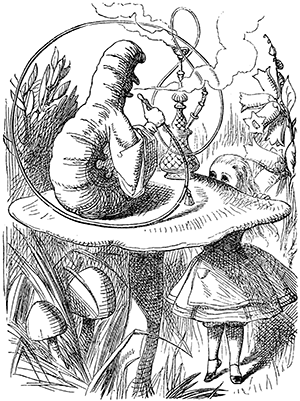
In Douglas Hofstadter’s book ‘Gödel, Escher, Bach,’ Tumbolia is ‘the land of dead hiccups and extinguished light bulbs,’ ‘where dormant software waits for its host hardware to come back up.’ The concept is introduced in the dialogue ‘Little Harmonic Labyrinth’ (based on the piece of the same name by Bach). In a later dialogue ‘A Mu Offering’ (named after Bach’s ‘Musical Offering’), a Tortoise gets rid of a knot in a string by tying a second one, and both disappear to Tumbolia; apparently, this is ‘The Law of Double Nodulation’ (a parody of the law of double negation).
The return of the two knots from Tumbolia prompts the speculation that some ‘layers of Tumbolia’ are more accessible than others. It is mentioned that ‘pushing’ or ‘popping’ potion can be used (drunk by the characters) to navigate up and down the various levels of Tumbolia. Tumbolia is compared to the Zen view of life after death, using the image of a snowflake, a self-contained subsystem of the universe, dissolving into ‘the larger system which once held it.’ Finally, in the book’s last dialogue, Hofstadter (himself appearing as a character) tells us that Tumbolia is where dreamed characters go when the dreamer wakes up.
Posted in Art, Death, Philosophy |
Leave a Comment »
February 23, 2011

‘Gödel, Escher, Bach: An Eternal Golden Braid’ (GEB) is a book by cognitive scientist Douglas Hofstadter, described by the author as ‘a metaphorical fugue on minds and machines in the spirit of Lewis Carroll.’ On its surface, GEB examines logician Kurt Gödel, artist M. C. Escher and composer Johann Sebastian Bach, discussing common themes in their work and lives. At a deeper level, the book is a detailed and subtle exposition of concepts fundamental to mathematics, symmetry, and intelligence. Through illustration and analysis, the book discusses how self-reference and formal rules allow systems to acquire meaning despite being made of ‘meaningless’ elements.
It also discusses what it means to communicate, how knowledge can be represented and stored, the methods and limitations of symbolic representation, and even the fundamental notion of ‘meaning’ itself. In response to confusion over the book’s theme, Hofstadter has emphasized that GEB is not about mathematics, art, and music but rather about how cognition and thinking emerge from well-hidden neurological mechanisms. In the book, he presents an analogy about how the individual neurons of the brain coordinate to create a unified sense of a coherent mind by comparing it to the social organization displayed in a colony of ants.
Posted in Art, Philosophy, Science |
Leave a Comment »
February 22, 2011
Wonder Showzen is an American sketch comedy television series that aired between 2005 and 2006 on MTV2. It was created by John Lee and Vernon Chatman of PFFR, a Brooklyn based art collective. The show’s format is that of educational PBS children’s television shows such as Sesame Street and The Electric Company (e.g. use of stock footage, puppetry, and clips of children being interviewed). However, Wonder Showzen parodies the format in a very adult-oriented manner. In addition to general controversial comedy, it satirizes politics, religion, war, sex, and culture with black comedy.
Posted in Art, Humor |
1 Comment »
February 22, 2011

The EMP Museum (formerly the Experience Music Project) is an a nonprofit institution dedicated to popular culture (from the art of fantasy, horror cinema, and video games to science fiction literature and legendary costumes from screen and stage). Founded by Microsoft co-founder Paul Allen in 2000, the museum has numerous public programs including ‘Sound Off!’ an annual 21 and under battle-of-the-bands that supports the all-ages scene and ‘Pop Conference’ an annual gathering of academics, critics, musicians and music buffs. In addition EMP in collaboration with the Seattle International Film Festival presents the ‘Science Fiction and Fantasy Short Film Festival,’ which takes place annually every winter at the world renowned Seattle Cinerama.
The Science Fiction Museum and Hall of Fame was founded by Paul Allen and Jody Patton in 2004. It incorporated the formerly independent Science Fiction and Fantasy Hall of Fame established in 1996. EMP is located on the campus of Seattle Center, adjacent to the Space Needle and the Seattle Center Monorail, which runs through the building. The structure itself was designed by Frank Gehry, A concert venue capable of holding up to 800 guests, Sky Church (named in honor of Jimi Hendrix) boasts 70-foot ceilings, state-of-the-art sound and lighting, and a mammoth indoor HD LED screen.
Posted in Art |
Leave a Comment »



 The Daily Omnivore