February 23, 2011
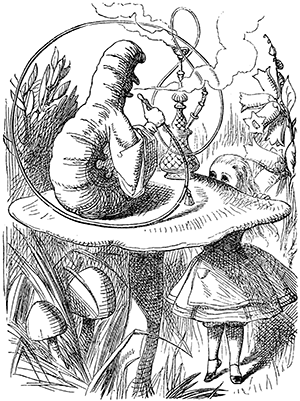
In Douglas Hofstadter’s book ‘Gödel, Escher, Bach,’ Tumbolia is ‘the land of dead hiccups and extinguished light bulbs,’ ‘where dormant software waits for its host hardware to come back up.’ The concept is introduced in the dialogue ‘Little Harmonic Labyrinth’ (based on the piece of the same name by Bach). In a later dialogue ‘A Mu Offering’ (named after Bach’s ‘Musical Offering’), a Tortoise gets rid of a knot in a string by tying a second one, and both disappear to Tumbolia; apparently, this is ‘The Law of Double Nodulation’ (a parody of the law of double negation).
The return of the two knots from Tumbolia prompts the speculation that some ‘layers of Tumbolia’ are more accessible than others. It is mentioned that ‘pushing’ or ‘popping’ potion can be used (drunk by the characters) to navigate up and down the various levels of Tumbolia. Tumbolia is compared to the Zen view of life after death, using the image of a snowflake, a self-contained subsystem of the universe, dissolving into ‘the larger system which once held it.’ Finally, in the book’s last dialogue, Hofstadter (himself appearing as a character) tells us that Tumbolia is where dreamed characters go when the dreamer wakes up.
Posted in Art, Death, Philosophy |
Leave a Comment »
February 23, 2011

‘Gödel, Escher, Bach: An Eternal Golden Braid’ (GEB) is a book by cognitive scientist Douglas Hofstadter, described by the author as ‘a metaphorical fugue on minds and machines in the spirit of Lewis Carroll.’ On its surface, GEB examines logician Kurt Gödel, artist M. C. Escher and composer Johann Sebastian Bach, discussing common themes in their work and lives. At a deeper level, the book is a detailed and subtle exposition of concepts fundamental to mathematics, symmetry, and intelligence. Through illustration and analysis, the book discusses how self-reference and formal rules allow systems to acquire meaning despite being made of ‘meaningless’ elements.
It also discusses what it means to communicate, how knowledge can be represented and stored, the methods and limitations of symbolic representation, and even the fundamental notion of ‘meaning’ itself. In response to confusion over the book’s theme, Hofstadter has emphasized that GEB is not about mathematics, art, and music but rather about how cognition and thinking emerge from well-hidden neurological mechanisms. In the book, he presents an analogy about how the individual neurons of the brain coordinate to create a unified sense of a coherent mind by comparing it to the social organization displayed in a colony of ants.
Posted in Art, Philosophy, Science |
Leave a Comment »
February 22, 2011

Wonder Showzen is an American sketch comedy television series that aired between 2005 and 2006 on MTV2. It was created by John Lee and Vernon Chatman of PFFR, a Brooklyn based art collective. The show’s format is that of educational PBS children’s television shows such as Sesame Street and The Electric Company (e.g. use of stock footage, puppetry, and clips of children being interviewed). However, Wonder Showzen parodies the format in a very adult-oriented manner. In addition to general controversial comedy, it satirizes politics, religion, war, sex, and culture with black comedy.
Posted in Art, Humor |
1 Comment »
February 22, 2011

The EMP Museum (formerly the Experience Music Project) is an a nonprofit institution dedicated to popular culture (from the art of fantasy, horror cinema, and video games to science fiction literature and legendary costumes from screen and stage). Founded by Microsoft co-founder Paul Allen in 2000, the museum has numerous public programs including ‘Sound Off!’ an annual 21 and under battle-of-the-bands that supports the all-ages scene and ‘Pop Conference’ an annual gathering of academics, critics, musicians and music buffs. In addition EMP in collaboration with the Seattle International Film Festival presents the ‘Science Fiction and Fantasy Short Film Festival,’ which takes place annually every winter at the world renowned Seattle Cinerama.
The Science Fiction Museum and Hall of Fame was founded by Paul Allen and Jody Patton in 2004. It incorporated the formerly independent Science Fiction and Fantasy Hall of Fame established in 1996. EMP is located on the campus of Seattle Center, adjacent to the Space Needle and the Seattle Center Monorail, which runs through the building. The structure itself was designed by Frank Gehry, A concert venue capable of holding up to 800 guests, Sky Church (named in honor of Jimi Hendrix) boasts 70-foot ceilings, state-of-the-art sound and lighting, and a mammoth indoor HD LED screen.
Posted in Art |
Leave a Comment »
February 22, 2011

Beatlemania is a term that originated during the 1960s to describe the intense fan frenzy directed toward The Beatles during the early years of their success. It is similar to the much earlier term Lisztomania used to describe fan reaction to the concerts of pianist Franz Liszt. Beatlemania became common in the United States after The Beatles performed on The Ed Sullivan Show in 1964.
It was characterized by intense levels of hysteria demonstrated by fans both at the actual concerts and during the band’s travels to and from hotels, concert venues, and the like. The extent of Beatlemania in the United States is evidenced by their single and album sales. The Beatles had the number one single for 59 weeks during their six and half years spanning from ‘I Want to Hold Your Hand,’ in 1964 to ‘Let It Be’ in 1970.
Posted in Art, Sex |
Leave a Comment »
February 22, 2011
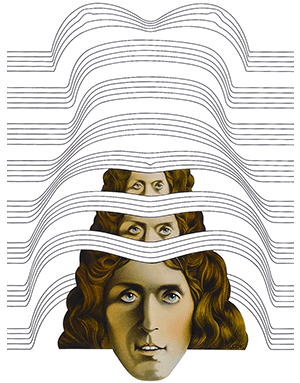
Lisztomania [list-uh-mey-nee-uh] is a term used to describe the intense fan frenzy directed toward Hungarian composer Franz Liszt during his performances. The phenomenon first occurred in Berlin in 1841 and was later coined by German poet Heinrich Heine in a feuilleton (newspaper supplement) in 1844. Liszt’s playing was reported to raise the mood of the audience to a level of mystical ecstasy. Admirers would swarm over him, fighting over his handkerchiefs and gloves. Fans would wear his portrait on brooches and cameos.
Women would try to get locks of his hair, and whenever he broke a piano string, admirers would try to obtain it in order to make a bracelet. Some female admirers would even carry glass vials into which they poured his coffee dregs. According to one report: ‘Liszt once threw away an old cigar stump in the street under the watchful eyes of an infatuated lady-in-waiting, who reverently picked the offensive weed out of the gutter, had it encased in a locket and surrounded with the monogram ‘F.L.’ in diamonds, and went about her courtly duties unaware of the sickly odor it gave forth.’
Posted in Art, Sex |
Leave a Comment »
February 22, 2011
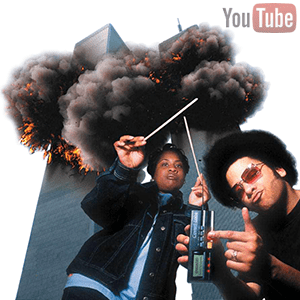
The Coup is a political hip hop group based in Oakland, California. It formed as a three-member group in 1992 with emcees Boots Riley and E-Roc along with DJ Pam the Funkstress. E-Roc left on amicable terms after the group’s second album. The duo is politically Marxist in its music and aligns itself with other radical hip-hop groups such as Dead Prez. The group’s music is characterized by electronic sounds and bass-driven backbeats overlaid by humorous, cynical and sometimes violent lyrics criticizing capitalism, American politics, patriarchal exploitation, and police brutality, among other things.
In Novemeber 2001, The Coup released ‘Party Music’ to widespread praise and condemnation. The original album cover art depicted Pam and Boots standing in front of the twin towers of the World Trade Center as they are destroyed by huge explosions, and Riley is pushing the button on a guitar tuner. The cover art was finished in June 2001. In response to the uncanny similarity of the artwork with the WTC attack of 9/11, the album release was held back until alternative cover art could be prepared.
Posted in Art, Money, Politics |
Leave a Comment »
February 21, 2011


A platonic [pluh-ton-ik] solid is a three dimensional shape where each face is built from the same type of polygons, and there are the same number of polygons meeting at every corner of the shape. There are only five Platonic Solids: Tetrahedron, Cube, Hexahedron, Octahedron, Dodecahedron, and Isosahedron. The shapes are often used to make dice, because dice of these shapes can be made fair. 6-sided dice are very common, but the other numbers are commonly used in role-playing games. Such dice are commonly referred to as D followed by the number of faces (d8, d20 etc.).
The tetrahedron (4 sided), cube (6 sided), and octahedron (8 sided), are found naturally in crystal structures. In meteorology and climatology, global numerical models of atmospheric flow are of increasing interest which use grids that are based on an icosahedron (20 sides,refined by triangulation) instead of the more commonly used longitude/latitude grid. This has the advantage of better spatial resolution without singularities (i.e. the poles) at the expense of somewhat greater numerical difficulty.
Posted in Art, Language, Science |
Leave a Comment »
February 21, 2011

Shoefiti is the practice of throwing shoes whose shoelaces have been tied together so that they hang from overhead wires such as power lines or telephone cables or onto trees or fences. This practice plays a widespread, though mysterious, role in adolescent folklore in the United States. Soldiers leaving the military often paint a pair of combat boots yellow or orange and toss them over a power line or telephone wire near the barracks or unit to which they were assigned.
Posted in Art, Games, Humor |
Leave a Comment »
February 21, 2011


Canard [kuh-nahrd] is the French word for duck. The word also can mean an unfounded or false, deliberately misleading fabrication, a false report, rumor or hoax. That usage derives from the phrase ‘vendre un canard à moitié’ (‘to half-sell a duck’), thus, from some long-forgotten joke, ‘to cheat.’ The Canard Digérateur, or Digesting Duck, was an automaton in the form of a duck, created in 1739 by Jacques de Vaucanson (the French inventor credited with creating the world’s first true robots, as well as the first automated loom).
The mechanical duck appeared to have the ability to eat kernels of grain, and to metabolize and defecate them. While the duck did not actually have the ability to do this – the food was collected in one inner container, and the pre-stored feces was ‘produced’ from a second, so that no actual digestion took place – Vaucanson hoped that a truly digesting automaton could one day be designed.
Posted in Art, Language, Technology |
Leave a Comment »
February 21, 2011

Matthew Lillard (b. 1970) is an American actor known for his roles as Stu Macher in ‘Scream,’ Stevo in ‘SLC Punk,’ and Shaggy Rogers in the ‘Scooby-Doo’ film series – he has taken over the providing the voice of Shaggy in the cartoon series since the reboot ‘Mystery Incorporated.’ Lillard made a dramatic turn in Alexander Payne’s critically acclaimed comedy-drama ‘The Descendants.’
Lillard attended Foothill High school in Santa Ana, California and later the American Academy of Dramatic Arts in Pasadena, California, with fellow actor Paul Rudd, and later, the theater school Circle in the Square in New York City. While still in high school, he was co-host of a short-lived TV show titled ‘SK8 TV.’ After high school, he was hired as an extra for ‘Ghoulies 3: Ghoulies Go to College’ (1991).
Posted in Art, Humor |
Leave a Comment »
February 21, 2011

SLC Punk! is a 1999 American independent film, written and directed by James Merendino. The film is about the young punk rock fan Steven ‘Stevo’ Levy, a college graduate living in Salt Lake City. Merendino created the film based on his experience growing up in Salt Lake City. Although not autobiographical, Merendino has said that many characters were based on people he knew. The film features several cliques presented as ‘tribes’: Punks, Mods (wear suits and ties, and ride scooters), Rednecks, Skinheads, Heavy Metal Guys, and New Wavers (neo-hippies).
Posted in Art, Politics |
Leave a Comment »




