February 20, 2011

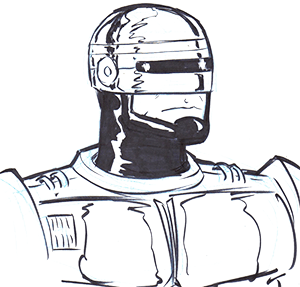
Paul Verhoeven (b. 1938) is a Dutch film director, screenwriter, and producer who has made movies in both the Netherlands and the United States. Explicitly violent and/or sexual content and social satire are trademarks of both his drama and science fiction films. He is best known for directing the American feature films RoboCop (1987), Total Recall (1990), Basic Instinct (1992), Showgirls (1995), Starship Troopers (1997), and Hollow Man (2000).
Posted in Art, Money |
Leave a Comment »
February 17, 2011
The Droste [dro-st] effect is a specific kind of recursive picture, one that in heraldry is termed ‘mise en abyme’ (French for ‘placing into infinity’). An image exhibiting the Droste effect depicts a smaller version of itself in a place where a similar picture would realistically be expected to appear. This smaller version then depicts an even smaller version of itself in the same place, and so on. Only in theory could this go on forever; practically, it continues only as long as the resolution of the picture allows, which is relatively short, since each iteration geometrically reduces the picture’s size.
The effect is named after the image on the tins and boxes of Droste cocoa powder, one of the main Dutch brands, which displayed a nurse carrying a serving tray with a cup of hot chocolate and a box with the same image. This image, introduced in 1904 and maintained for decades with slight variations, became a household notion.
Posted in Art, Language, Science |
Leave a Comment »
February 17, 2011
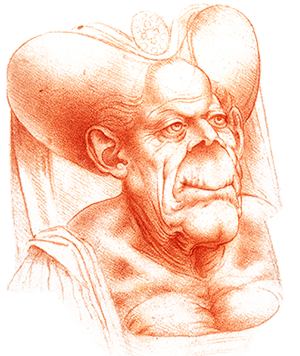
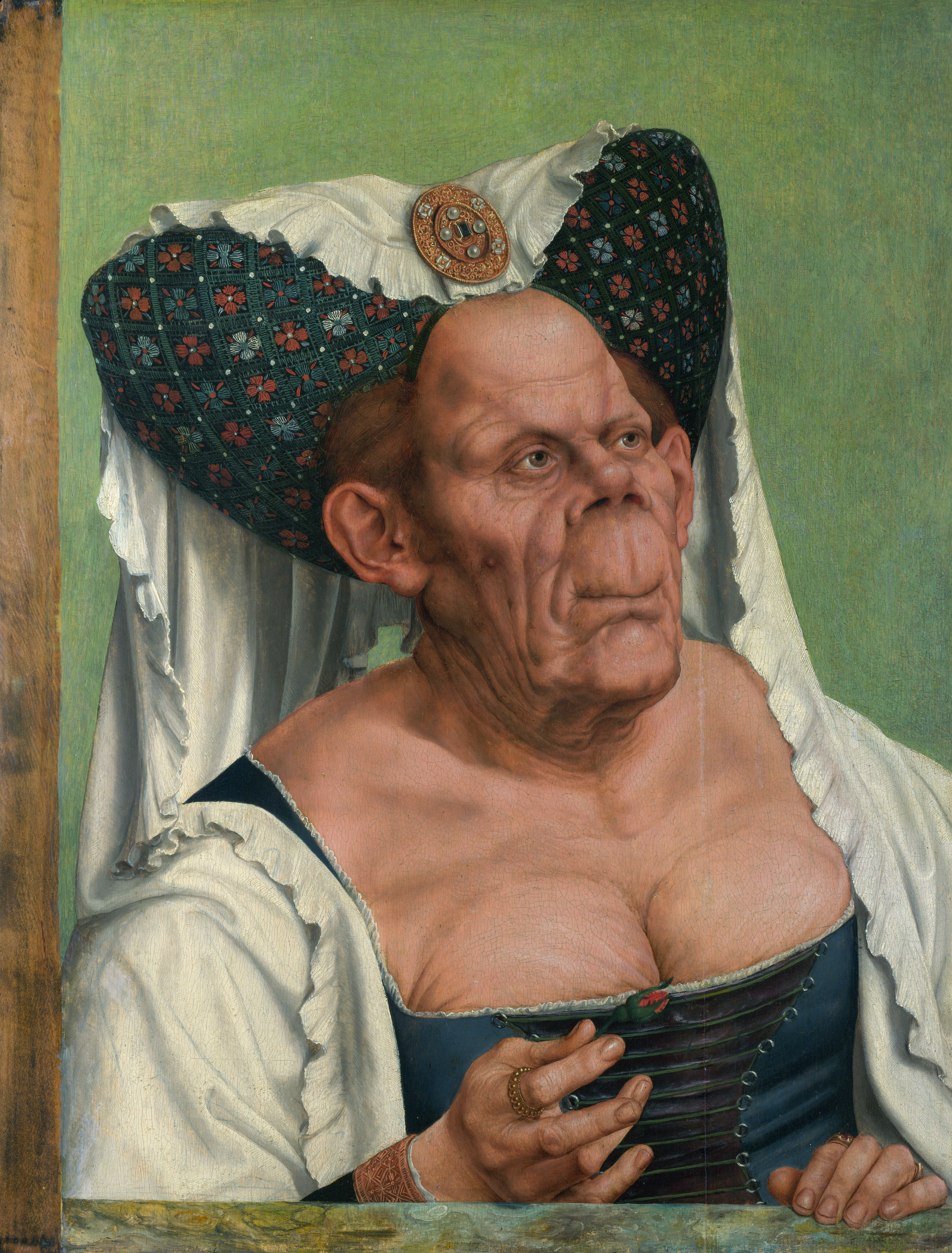
‘The Ugly Duchess‘ (also known as ‘A Grotesque Old Woman’) is a satirical portrait painted by the Flemish artist Quentin Matsys around 1513. It shows an old woman with wrinkled skin and shriveled breasts which are partially visible from her low-cut dress. She holds a red flower in her right hand, at the time a symbol of engagement, indicating that she is trying to attract a suitor. However, it is a bud that will likely never blossom. The work is likely drawn from two sources. One is Erasmus’s ‘In Praise of Folly,’ which satirises women who ‘still play the coquette,’ ‘cannot tear themselves away from their mirrors’ and ‘do not hesitate to exhibit their repulsive withered breasts.’
It also bears a resemblance to a caricature head drawing by Leonardo Da Vinci. It was originally half of a diptych, with a ‘Portrait of an Old Man.’ The portrait is held to be the inspiration for John Tenniel’s 1869 drawing of the Duchess in Alice’s Adventures in Wonderland. In 2008 it was claimed that the sitter, possibly Margaret, Countess of Tyrol, was suffering from a rare form of Paget’s disease, in which the victim’s bones enlarge and become deformed.
Posted in Art, Humor |
1 Comment »
February 17, 2011

The Alamo Drafthouse is an American cinema chain founded in 1997 in Austin, Texas, United States. It has screens in nine locations across Texas and one in Winchester, Virginia. The company began as a second-run movie theater, and distinguished itself by the food and drink service offered inside the theater, including cold beer. The seating is arranged with rows of cabaret style tables in front of each row of seats, with an aisle between each row to accommodate waiter service. Customers write their orders on slips of paper, which are picked up by black-clad waiters moving quietly between the rows.
Posted in Art, Food, Money |
Leave a Comment »
February 16, 2011

Wiley Wiggins (b. 1976) is an American film actor and visual effects artist. A native of Austin, Texas, he is the nephew of Lanny Wiggins, who was a member of Janis Joplin’s early band, The Waller Creek Boys. Wiggins starred in Richard Linklater’s films ‘Dazed and Confused’ (at the age of 16) and ‘Waking Life’ (at the age of 25), for which he also served as an animator for.
He was involved in early ’90s cyberculture, and wrote occasionally for such magazines as FringeWare Review, Mondo 2000, and Boing Boing. His current weblog, ‘It’s Not For Everyone,’ focuses on film, art, technology and free culture.
Posted in Art, Technology |
Leave a Comment »
February 16, 2011

The Octopus Project is an American indietronica band based in Austin, Texas, active since 1999. Its unique sound, blending pop and experimental elements, is a combination of digital and electronic sounds and noises (including drum machine, keyboard, synthesizers and other devices) and analog equipment (including guitars and live drums). Its music is mostly instrumental.
Posted in Art |
Leave a Comment »
February 16, 2011
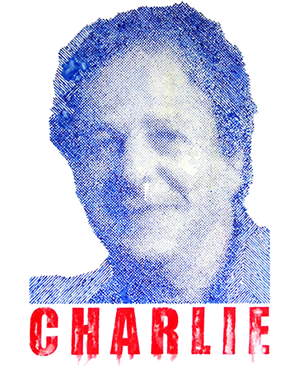
Charles Saatchi (b. 1943) is the co-founder with his brother Maurice of the global advertising agency Saatchi & Saatchi, and led that business – the world’s largest advertising agency in the 1980s – until they were forced out in 1995. Later that year the Saatchi brothers formed a new agency called M&C Saatchi. Charles is the second of four sons born to a wealthy Iraqi Jewish family in Baghdad. The name ‘Saatchi’ means ‘Watchmaker’ in Turkish. He attended Christ’s College, a secondary school in North London. During this time he developed an obsession with U.S. pop culture, including the music of Elvis Presley, Little Richard, and Chuck Berry. He also manifested an enthusiasm for collections, from cigarette cards and jukeboxes to ‘Superman’ comics and nudist magazines.
Charles is known worldwide as an art collector and owner of the Saatchi Gallery, and in particular for his sponsorship of the Young British Artists (YBAs), including Damien Hirst and Tracey Emin. He is a notorious recluse, even hiding from clients when they visited his agency’s offices, and has only ever granted two newspaper interviews. He does not attend his own exhibition openings; when asked why by the Sunday Telegraph, he replied: ‘I don’t go to other people’s openings, so I extend the same courtesy to my own.’
Posted in Art, Money, World |
Leave a Comment »
February 16, 2011


Stuckism is an international art movement that was founded in 1999 by Billy Childish and Charles Thomson to promote figurative painting in opposition to conceptual art. The charter group of thirteen British artists has since expanded, as of January 2011, to 209 groups in 48 countries. Although painting is the dominant artistic form of Stuckism, artists using other media such as photography, sculpture, film and collage have also joined, and share the Stuckist opposition to conceptualism.
The name ‘Stuckism’ was coined in January 1999 by Charles Thomson in response to a poem recited to him several times by Billy Childish, who records in it that his former girlfriend, Tracey Emin had said he was “stuck! stuck! stuck!” with his art, poetry and music. Later that month, Thomson approached Childish with a view to co-founding an art group called Stuckism.
Posted in Art, Language |
Leave a Comment »
February 16, 2011

A zombie walk is an organized public gathering of people who dress up in zombie costumes. Usually taking place in an urban centre, the participants make their way around the city streets and through shopping malls to a public space (or a series of taverns in the case of a zombie pub crawl) in a somewhat orderly fashion.
read more »
Posted in Art, Drugs, Humor |
Leave a Comment »
February 16, 2011
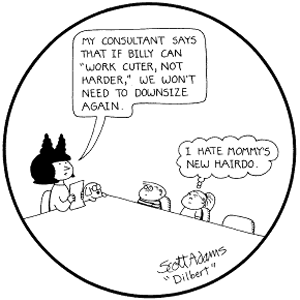
The Comic strip switcheroo was a series of jokes played out between comic strip writers and artists, without the foreknowledge of their editors, on April Fool’s Day 1997. The Switcheroo was masterminded by comic strip creators Rick Kirkman and Jerry Scott, creators of the Baby Blues daily newspaper comic strip.
Posted in Art, Humor |
Leave a Comment »
February 16, 2011

Anti-art is a loosely-used term applied to an array of concepts and attitudes that reject prior definitions of art and question art in general. The term is associated with the Dada movement and is generally accepted as attributable to Marcel Duchamp pre-World War I, when he began to use found objects as art. Anti-art has become generally accepted by fine art collectors, although some still reject Duchamp’s readymades as art, for instance the Stuckist group of artists who are ‘anti-anti-art.’
Posted in Art, Language, Politics |
Leave a Comment »
February 16, 2011

Recuperation [ri-koo-puh-rey-shuhn] is the process by which socially radical ideas are commodified and incorporated into mainstream society. It is the opposite of détournement, in which conventional ideas and images are commodified with radical intentions. Recuperation was first proposed by Marxist theorist Guy Debord and the Situationists. The term sometimes carries a negative connotation among radicals because recuperation often bears the consequence (whether intended or unintended) of fundamentally altering the meanings behind ideas and symbols due to their appropriation into mainstream culture, often to the dismay of the radical groups who originated them.
A dynamic similar to recuperation often occurs in the sphere of the punk rock subculture: many musical styles developed from punk rock (such as Grunge, Thrash metal, Metalcore, Post-punk, Indie rock, New Wave, Emo, and Pop punk) have garnered mainstream popularity; artists of these genres have signed to major labels, and have become household names in the mainstream culture. Kurt Cobain, in his journals, often expressed resentment at how his own band played into this situation. The formerly punk-rock group Chumbawumba, has attempted to subvert the recuperation concept by intentionally ‘selling out’ but then using their earned money to donate to the radical causes.
Posted in Art, Money, Politics |
Leave a Comment »