February 7, 2011

Andreas Gursky (b. 1955) is a German visual artist known for his enormous architecture and landscape color photographs, some ten feet or more wide, and most employing a high point of view. As of early 2007, Gursky holds the record for highest price paid at auction for a single photographic image. His print 99 Cent II, Diptych, sold for GBP 1.7 million (USD $3.3 million) at Sotheby’s, London. Before the 1990s, Gursky did not digitally manipulate his images.
In the years since, Gursky has been frank about his reliance on computers to edit and enhance his pictures, creating an art of spaces larger than the subjects photographed. Visually, Gursky is drawn to large, anonymous, man-made spaces—high-rise facades at night, office lobbies, stock exchanges, the interiors of big box retailers (See his print 99 Cent II Diptychon). His style is described by art critics as enigmatic and deadpan. There is little to no explanation or manipulation on the works. His photography is straightforward.
Posted in Art, Money, Technology |
Leave a Comment »
February 7, 2011

A guy-cry film is the masculine version of the chick flick genre, a film that addresses a male audience, but has strong emotional material. Sports films are important to the guy-cry genre, but sports action is not necessarily essential to qualify a film as a genuine guy-cry. Some notable sports films that could be defined as guy-cry would be Field of Dreams, Rudy, Brian’s Song, and The Wrestler.
While it may seem that ‘guy-cry’ is a neologism, it is a genre that has been around for many years and is now receiving critical attention from scholars and trade publications. Early popular guy-cry films date back to the early 1970s with films such as Five Easy Pieces and One Flew Over the Cuckoo’s Nest. Important themes to the guy-cry genre are concepts of brotherhood, sacrifice, loyalty, and family.
Posted in Art, Humor, Language |
Leave a Comment »
February 7, 2011

Full-spectrum light is light that covers the electromagnetic spectrum from infrared through near-ultraviolet, or all wavelengths that are useful to plant or animal life; in particular, sunlight is considered full spectrum, even though the solar spectral distribution reaching Earth changes with time of day, latitude, and atmospheric conditions. ‘Full-spectrum’ is not a technical term when applied to an electrical light bulb but rather a marketing term implying that the product emulates natural light.
Some products marketed as ‘full-spectrum’ may produce light throughout the entire spectrum, but not with an even spectral distribution, and may not even differ substantially from lights not marketed as ‘full-spectrum.’
read more »
Posted in Art, Health, Technology |
Leave a Comment »
February 3, 2011
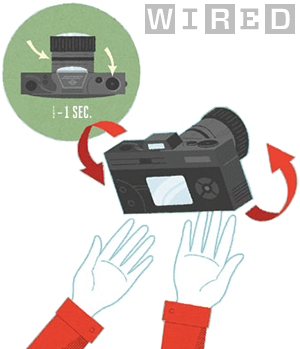
Kinetic photography is an experimental technique such as holding and shaking the wrist strap of the camera, dropping the camera, throwing or spinning the camera up in the air, or rigorously moving the camera while taking a picture. As the photographer has surrendered control over the camera to physical forces, this technique tends to produce abstract, random or blurred-motion photographs.
Perhaps the most risky field of kinetic photography is that of camera tossing, in which the photographer literally throws their equipment into the air in hopes of producing an artistic looking image. Many camera tosses take place at night, when the camera is able to capture light with a long exposure, resulting in streaks of hypnotizing light patterns. The pioneer of camera tossing, Ryan Gallagher, hosts a blog on the subject.
Posted in Art, Technology |
Leave a Comment »
February 3, 2011
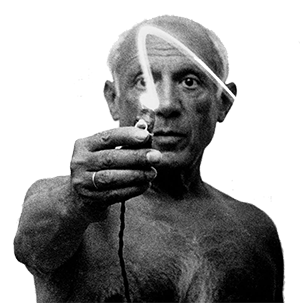
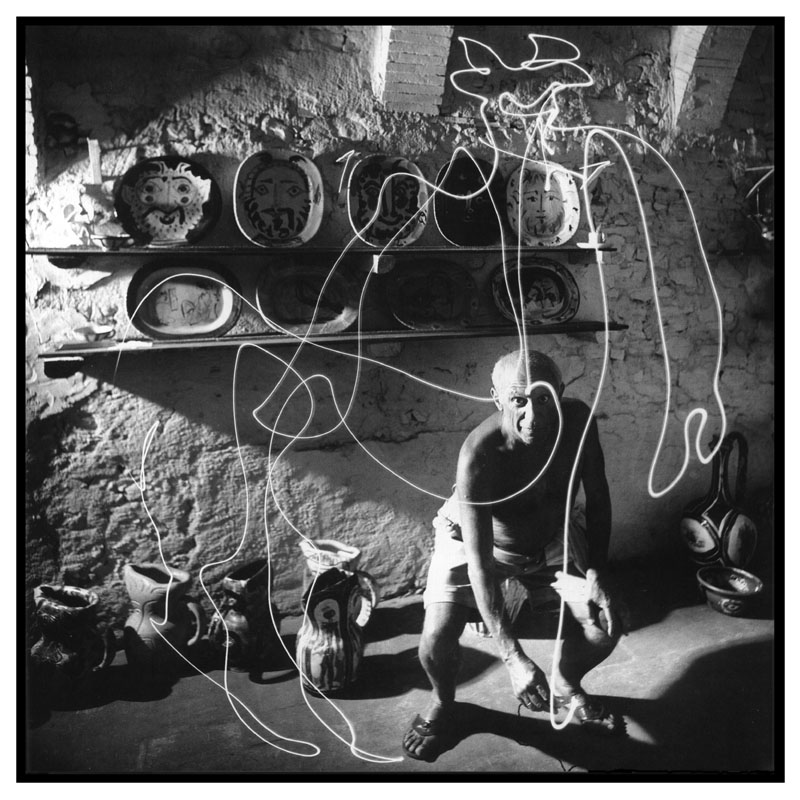
Light painting, also known as light graffiti, is a photographic technique in which exposures are made usually at night or in a darkened room by moving a hand-held light source or by moving the camera. In many cases the light source itself does not have to appear in the image. The first known photographer to use this technique was Man Ray in his series ‘Space Writing’ created in 1935.
In 1949 Pablo Picasso was visited by Gjon Mili, known photographer and lighting innovator, who introduced him to some of his photographs of ice skaters with lights attached to their skates. Immediately Picasso started making images in the air with a small flashlight in a dark room. This series of photos became known as Picasso’s ‘light drawings.’ Of these photos, the most celebrated and famous is known as ‘Picasso draws a centaur in the air.’
Posted in Art, Technology |
Leave a Comment »
February 3, 2011
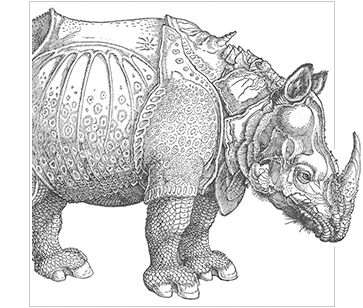
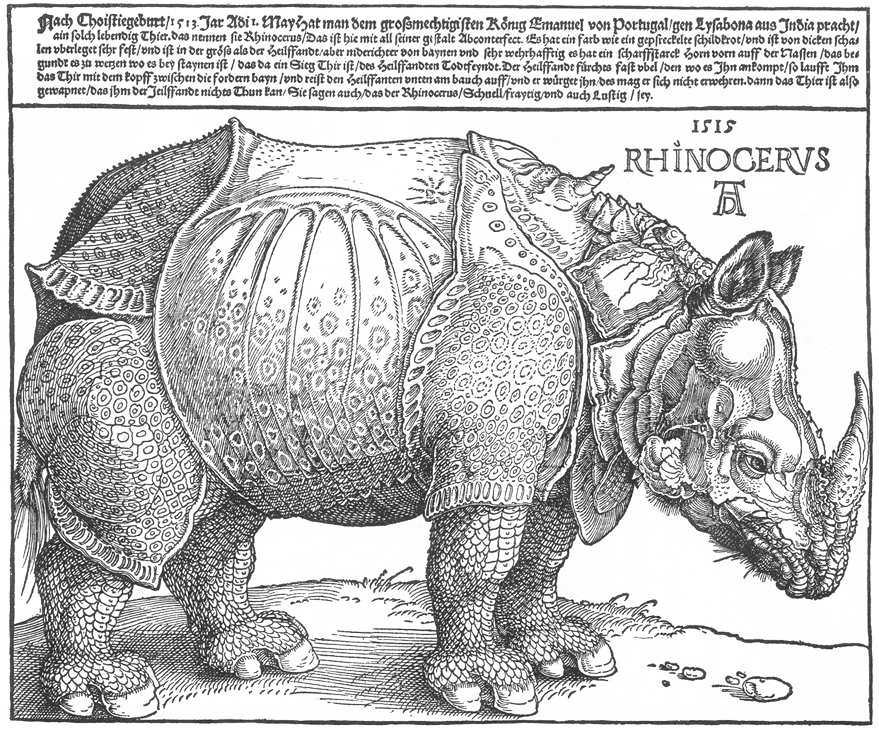
Dürer’s [door-ers] Rhinoceros is the name commonly given to a woodcut created by German painter and printmaker Albrecht Dürer in 1515. The image was based on a written description and brief sketch by an unknown artist of an Indian rhinoceros that had arrived in Lisbon earlier that year. Dürer never saw the actual rhinoceros, which was the first living example in Europe since Roman times. In late 1515, the King of Portugal, Manuel I, sent the animal as a gift for Pope Leo X, but it died in a shipwreck off the coast of Italy in early 1516. A live rhinoceros was not seen again in Europe until a second specimen arrived from India at the court of Sebastian of Portugal in 1577, being later inherited by Philip II of Spain around 1580.
Dürer’s woodcut is not an entirely accurate representation of a rhinoceros. He depicts an animal with hard plates that cover its body like sheets of armor, with a gorget at the throat, a solid-looking breastplate, and rivets along the seams; he also places a small twisted horn on its back, and gives it scaly legs and saw-like rear quarters. Despite these anatomical inaccuracies, it was a very popular woodcut in Europe and was copied many times in the following three centuries. It was regarded as a true representation of a rhinoceros into the late 18th century, when it was supplanted by more realistic drawings and paintings, particularly those of Clara the rhinoceros, who toured Europe in the 1740s and 1750s.
Posted in Art, Science |
Leave a Comment »
February 3, 2011

Vice is a free magazine and media conglomerate founded in Montreal and currently based in New York City. It is available in 19 countries. It supports itself primarily through advertising. Founded by Suroosh Alvi, Shane Smith, and Gavin McInnes, it was launched as the ‘Voice of Montreal’ in 1994 with government funding to provide work and a community service. When the editors wanted to break free of their commitments with the original publisher, Alix Laurent, they bought him out and changed the name to ‘Vice’ in 1996.
Vice’s content has shifted from dealing mostly with independent arts and pop cultural matters to covering more serious news topics, although both are often treated with the same spirit of blithe and caustic irreverence. Vice has championed the ‘Immersionist’ school of journalism, which it regards as something of a DIY antithesis to the big-office methods practiced by traditional news outlets. There have been issues dedicated to concerns facing Iraqi people, Native Americans, Russian people, people with mental disorders, and people with mental disabilities.
Posted in Art, Language, Money |
Leave a Comment »
February 2, 2011

Soap Opera Rapid Aging Syndrome (SORAS) is a term used to describe the practice of accelerating the age of a television character (usually a child or teenager) in conflict with the timeline of a series and/or the real-world progression of time. Characters unseen on screen for a time might reappear portrayed by an actor several years older than the original. Usually coinciding with a recast, rapid aging is typically done to open up the character to a wider range of storylines, and to attract younger viewers.
The process originated in (and is most commonly used in) daytime soap operas. SORAS generally refers to cases in which a character’s rapid aging happens off-screen without any explanation, rather than to storylines in science fiction and fantasy in which a character ages rapidly due to technology, magic, or non-human biology. Coined by Soap Opera Weekly founding editor-in-chief Mimi Torchin in the early days of the magazine, the term is now widely used in the soap opera media.
Posted in Art, Humor |
Leave a Comment »
February 1, 2011
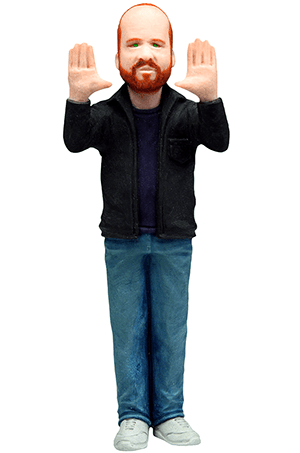
A script doctor is a highly-skilled screenwriter, hired by a film or television production, to rewrite or polish specific aspects of an existing screenplay, including structure, characterization, dialogue, pacing, theme, and other elements. Script doctors generally do their work uncredited, for a variety of commercial and artistic reasons. Script doctors are usually brought in during the development and pre-production phases of a film, to address specific issues with the script, as identified by the financiers, production team, and cast. They may also be employed during post production, to help address narrative problems that crop up during the editing process.
The use of script doctors was first revealed at the 1973 Academy Awards when Francis Ford Coppola thanked Robert Towne for his work on The Godfather. Since then, the use of script doctors has been downplayed within the industry, to avoid overshadowing the work of the original writers. Under the WGA screenwriting credit system, a screenwriter must contribute 50 percent to the story and/or characterization in order to qualify for credit. Uncredited screenwriters are not eligible to win the Academy Award for Best Screenplay or the Writers Guild of America Awards.
Posted in Art, Language, Money |
Leave a Comment »
February 1, 2011

EarthBound is a 1994 role-playing video game co-developed by Ape and HAL Laboratory and published by Nintendo for the Super NES video game console. The game has been lauded by gamers for its humorous depictions of American culture and parody of the RPG genre, and has since become a cult classic.
The game takes place on Earth in the year 199X. The game’s main antagonist is Giygas, an alien from a distant galaxy with the power to influence people using their own evil nature.
Posted in Art, Games, Humor |
Leave a Comment »
February 1, 2011
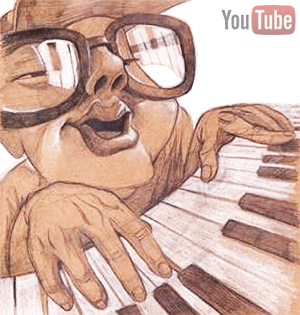
Ronald Jenkees is an American composer and musician best known for his YouTube keyboard performances. He has released two independent albums: the self-titled Ronald Jenkees (2007), and Disorganized Fun (2009).
Posted in Art, Technology |
Leave a Comment »
January 31, 2011

The Meisner Technique is an acting technique developed by the American theatre practitioner Sanford Meisner. Students develop an ability to improvise, to access an emotional life, and finally to bring the spontaneity of improvisation and the richness of personal response to text. The most fundamental exercise in Meisner training is Repetition: Two actors face each other and ‘repeat’ their observations about one another back and forth. An example of such an exchange might be: ‘You’re smiling.’ ‘I’m smiling.’ ‘You’re smiling!’
Meisner is based on the work of Russian thespian Constantin Stanislavski (1863 – 1938), as are a number of acting techniques, including Lee Strasberg’s. As in all Stanislavskian-derived approaches, for a actor traditional line memorization methods that include vocal inflections or gestures are avoided. It is taught that doing so merely increases the chance the actor will miss a ‘real moment’ in service of a rehearsed habit or line reading. Solid preparation supports the spontaneity, an idea articulated by Martha Graham when she wrote, ‘I work eight hours a day, every day, so that in the evenings I can improvise.’
Posted in Art |
Leave a Comment »



 The Daily Omnivore