January 21, 2011

The Book of Mormon is a musical written by South Park creators, Trey Parker and Matt Stone, and Avenue Q writer, Robert Lopez. The show tells the story of two young Mormon missionaries sent off to spread their faith in a dangerous part of Uganda. Scott Rudin and Anne Garafino are listed as the producers. The show debuted on Broadway at the Eugene O’Neill Theatre in 2011.
Posted in Art, Humor, Philosophy |
Leave a Comment »
January 20, 2011


McIntosh Laboratory is a manufacturer of high-end audio equipment based in Binghamton, New York. Founded in 1949 by Frank McIntosh, the company is noted for its extremely high build quality and excellent technical specifications. The ‘classic’ vacuum tube components of the 1960s include the MC275 power amplifier, the C22 preamplifier, and the MR67 tuner. Later McIntosh solid state power amps are known for their distinctive blue colored meters. In 1946, McIntosh, a design consultant for broadcast and TV stations, hired Gordon Gow to help him design a high power, low distortion amplifier needed for his clients. This amplifier would become the 50W-1. It included McIntosh’s first patented circuit, the Unity Coupled Circuit, still used by current products.
McIntosh amplifiers were used at the Woodstock Music Festival in 1969, and the Grateful Dead’s ‘Wall of Sound’ reputedly utilized forty-eight 300-watt per channel McIntosh model MC 2300 solid state amplifiers for a total of 28,800 watts of continuous power. The company was purchased by Japanese car audio maker Clarion in 1990. In a speech shortly after the purchase, Clarion president Yutaka Oyamada told McIntosh employees, ‘…we like McIntosh as it is, and we have no intention of changing what has made it so successful.’ In 2003, McIntosh was sold by Clarion to D&M Holdings, also of Japan.
Posted in Art, Technology |
Leave a Comment »
January 20, 2011

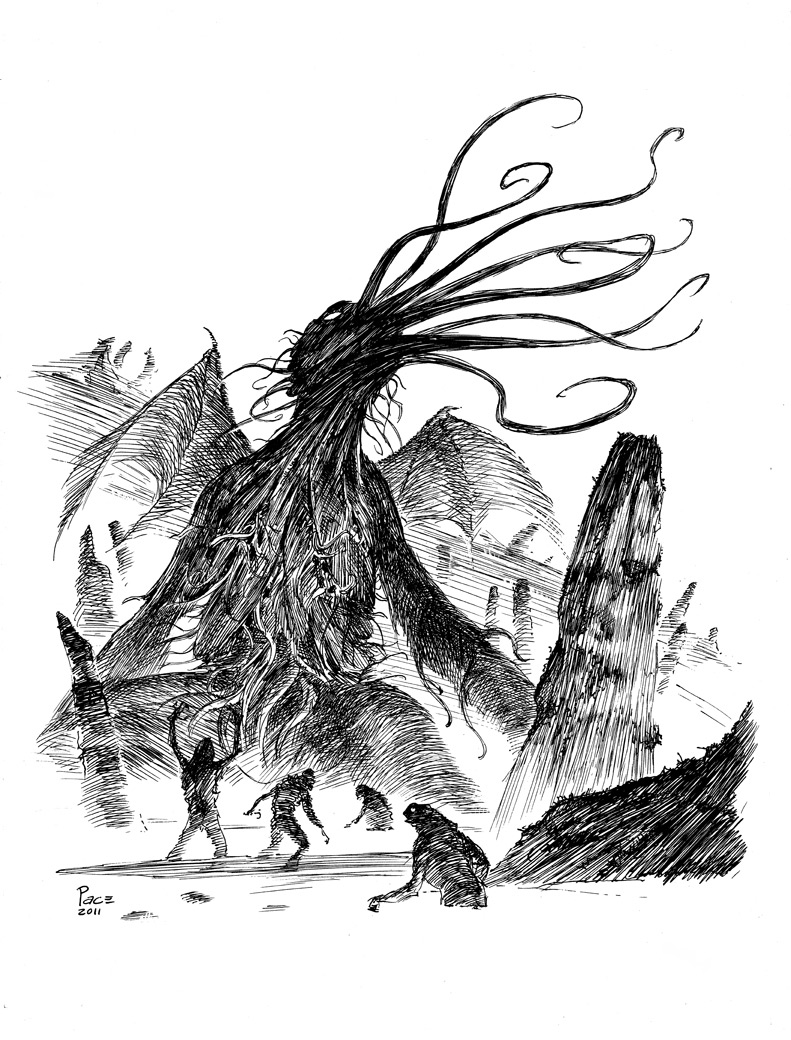
Cthulhu [kuh-thool-hoo] is a fictional cosmic entity created by horror author H. P. Lovecraft in 1926. Cthulhu is the high priest to the Great Old Ones and one of the central figures of the Lovecraft Mythos. It is often cited for the extreme descriptions given of its hideous appearance, its gargantuan size, and the abject terror that it evokes. Cthulhu is depicted as having a worldwide doomsday cult centered in Arabia, with followers in regions as far-flung as Greenland and Louisiana.
Posted in Art, Death |
Leave a Comment »
January 20, 2011

Mowgli syndrome is a term used by Wendy Doniger O’Flaherty in her 1995 book ‘Other Peoples’ Myths: The Cave of Echoes’ to describe mythological figures who succeed in bridging the animal and human worlds to become one with nature, a human animal, only to become trapped between the two worlds, not completely animal yet not entirely human.
It is also a rarely-used descriptive term for so-called feral children. The term originates from the character Mowgli, a fictional feral child from Rudyard Kipling’s ‘The Jungle Book.’
Posted in Art, Health, Language |
Leave a Comment »
January 20, 2011

K Foundation Burn a Million Quid was a performance art/ political exercise that took place in 1994, in which the K Foundation (an art duo consisting of Bill Drummond and Jimmy Cauty) burned cash in the amount of one million pounds sterling on the Scottish island of Jura. A single house brick that was manufactured from the fire’s ashes. This money represented the bulk of the K Foundation’s funds, earned by Drummond and Cauty as The KLF, one of the United Kingdom’s most successful pop groups of the early 1990s.
The incineration was recorded on a Hi-8 video camera by K Foundation collaborator Gimpo. In 1995, the film was toured around the UK, with Drummond and Cauty engaging each audience in debate about the burning and its meaning. Later that year, the duo pledged to dissolve the K Foundation and to refrain from public discussion of the burning for a period of 23 years. Despite this Drummond has spoken about the burning in 2000 and 2004. At first he was unrepentant but in 2004, he admitted to the BBC that he regretted burning the money.
Posted in Art, Money, Politics |
Leave a Comment »
January 20, 2011


A mashup is a song or composition created by blending two or more pre-recorded songs, usually by overlaying the vocal track of one song seamlessly over the instrumental track of another. To the extent that such works are ‘transformative’ of original content, they may find protection from copyright claims under the ‘fair use’ doctrine. Though the term ‘bastard pop’ first became popular in 2001, the practice of assembling new songs from purloined elements of other tracks stretches back to the beginnings of recorded music.
If one extends the definition beyond the realm of pop, precursors can be found in Musique concrète, as well as the classical practice of (re-)arranging traditional folk material and the jazz tradition of reinterpreting standards. In addition, many elements of bastard pop culture have antecedents in hip hop and the DIY ethic of punk.
Posted in Art, Money, Politics |
Leave a Comment »
January 20, 2011

Archie Meets the Punisher or The Punisher Meets Archie was a one-shot comic book intercompany crossover published under two separate covers by Marvel Comics and Archie Comics in 1994. It featured the unlikely meeting of Marvel’s murderous vigilante, the Punisher, and Archie Comics’ all-American teenager, Archie Andrews. The book was written by Batton Lash, with artwork by John Buscema (drawing the Punisher characters) and Stan Goldberg (drawing the Archie characters).
Posted in Art, Humor, Money |
Leave a Comment »
January 19, 2011


Lithography is a method for printing using a stone or metal plate with a completely smooth surface. It was invented in 1796 by Bavarian author Alois Senefelder as a low-cost method of publishing theatrical works. His method used an image drawn in wax or other oily substance applied to a stone plate as the medium to transfer ink to the paper. In modern times, the image is often made of polymer applied to a flexible aluminum plate. The flat surface of the plate or stone is slightly roughened, or etched, and divided into hydrophilic (water-loving) regions that accept a film of water and repel the greasy ink, and hydrophobic regions which repel water and accept ink. This process is different from gravure or intaglio printing where a plate is engraved, etched or stippled to make cavities to contain the printing ink, or woodblock printing and letterpress where ink is applied to the raised surfaces of letters or images.
In the early days of lithography, a smooth piece of limestone was used. After the oil-based image was put on the surface, a solution of gum arabic in water was applied, the gum sticking only to the non-oily surface. During printing, water adhered to the gum arabic surfaces and avoided the oily parts, while the oily ink used for printing did the opposite. Chromolithography (color lithography) was invented in 1837; by using more than one stone, different colors can be added to the same picture. Each color needs a separate stone. The great posters of such artists as Alphonse Mucha and Toulouse-Lautrec are made like this. Complicated graphics may need twenty or more stones.
Posted in Art, Technology |
Leave a Comment »
January 18, 2011


Gainclone or chipamp is a term commonly used to describe a type of audio amplifier made by do-it-yourselfers. The Gainclone is probably the most commonly built and well-known amplifier project amongst hobbyists. It is simple to build and involves only a few readily accessible, inexpensive parts.
In 1999, 47 Labs introduced the Gaincard amplifier, which had fewer parts, less capacitance and simpler construction than anything preceding it. The DIY community started building replicas or ‘clones’ of the Gaincard using integrated circuits from National Semiconductor and other manufacturers. Most designs are very effective and produce high quality sound, even though some audiophiles consider chip-based amplifiers to be inferior to their discrete counterparts.
Posted in Art, Money, Technology |
Leave a Comment »
January 18, 2011

Salvation Mountain is a colorful art installation covering much of a small hill north of Calipatria, California, near Slab City (an RV camp) and just several miles from the Salton Sea. It is made from adobe, straw, and thousands of gallons of paint. It was created by Leonard Knight to convey the message ‘God Is Love.’ Steps cut into the side of the hill lead to the summit, which is topped by a cross. Salvation Mountain also features many large straw bale and adobe walls supported by a matrix of logs enclosing several cave-like spaces. Knight lives full-time at the site in a small cabin mounted on the rear of a 1930s Chevrolet.
Like Salvation Mountain, Knight’s ‘Salvation Truck’ and a collection of other vehicles and machinery are entirely covered with paint and Biblical quotes. He estimates that more than 100,000 gallons of paint have gone into the creation of the mountain and that every California-based paint manufacturer has donated paint to the project. Once labeled an environmental hazard, the hill was threatened with removal by Imperial County. In recent years, the furor has died down. Although the project is unauthorized and on state land, Salvation Mountain was placed under protection in 2002 when Senator Barbara Boxer entered it into the Congressional Record as a national treasure.
Posted in Art, Philosophy |
Leave a Comment »
January 13, 2011


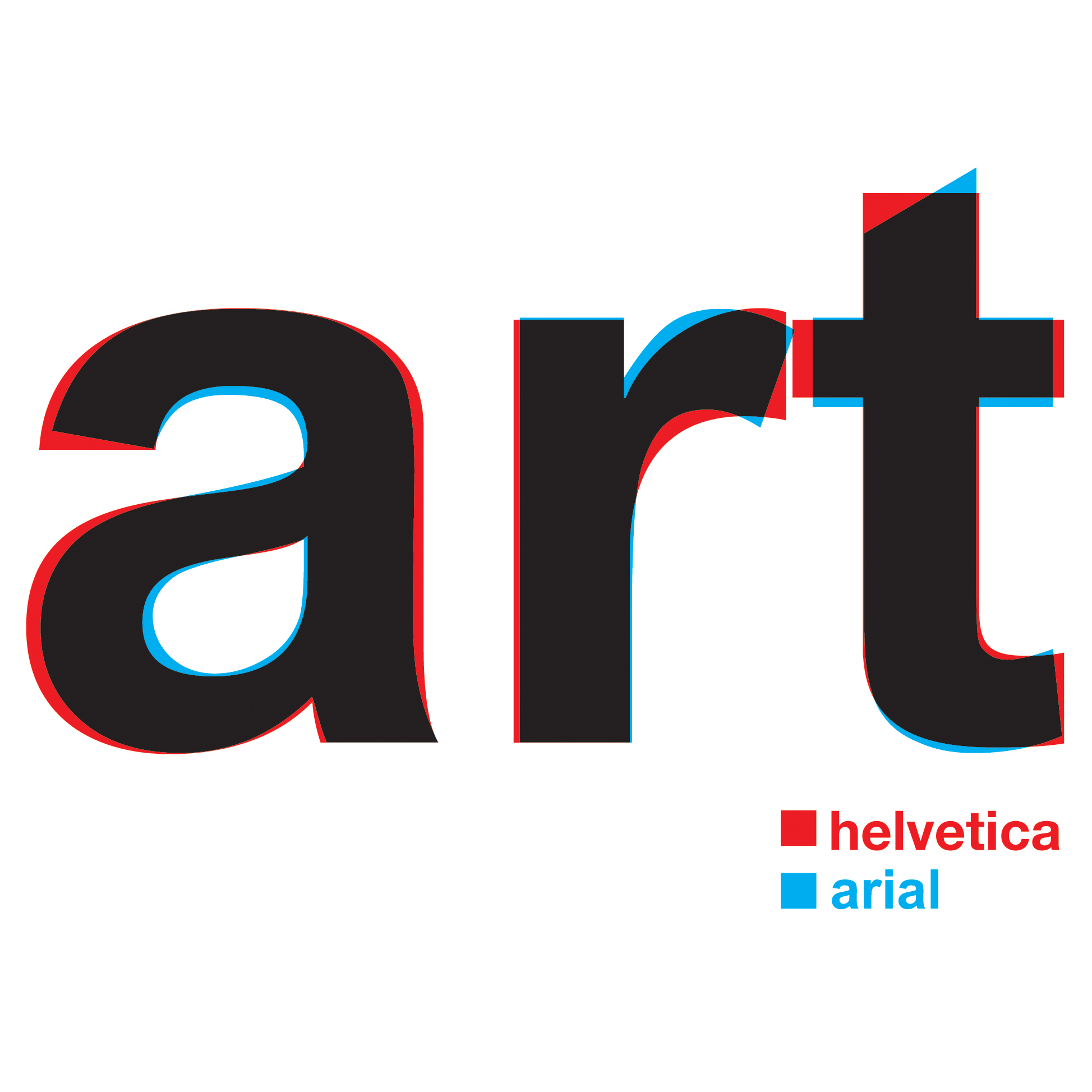
Helvetica is a widely used sans-serif typeface developed in 1957 by Swiss typeface designer Max Miedinger with Eduard Hoffmann to create a neutral typeface that had great clarity, no intrinsic meaning in its form, and could be used on a wide variety of signage. It’s original name was ‘Neue Haas Grotesk’; it was changed to ‘Helvetica’ (the Latin name for Switzerland) in 1960 in order to make it more marketable internationally. Generic versions of Helvetica have been made by various vendors; Monotype’s Arial, designed in 1982 has identical character widths and is indistinguishable by most non-specialists.
Helvetica is a popular choice for commercial wordmarks, including: 3M, American Airlines, American Apparel, BMW, Jeep, JCPenney, Lufthansa, Microsoft, Target, RE/MAX, Toyota, Panasonic, Motorola, Kawasaki, and Verizon Wireless. Apple Inc. has used Helvetica widely in its software. Helvetica is also widely used by the U.S. government; for example, federal income tax forms are set in Helvetica, and NASA uses the type on the Space Shuttle orbiter. New York City has been using Helvetica since 1989 for many of its subway signs. In 2007, director Gary Hustwit released a documentary, ‘Helvetica,’ to coincide with the fiftieth anniversary of the typeface.
Posted in Art, Language, Money |
Leave a Comment »
January 11, 2011

The Walker Library of Human Imagination is the private library of Priceline.com founder Jay S. Walker opened in 2002. The library occupies 3,600 square feet in his Connecticut home. It showcases a collection of rare books, artworks, maps and manuscripts as well as artifacts both modern and ancient. Rare books in the collection include: a complete Bible handwritten on sheepskin from 1240; the first illustrated history book (1493); the first illustrated medical book (1499); the first medical book to illustrate the human brain (1550); a copy of ‘Micrographia’ (1664), the first book of illustrations of images seen in the first microscopes; and a 1699 atlas containing the first maps to show the sun, not the earth, as the center of the known universe.
Historical artifacts include: an original 1957 Russian Sputnik backup; an instruction manual for a Saturn V rocket, along with a signed American flag carried to the surface of moon and back on the first lunar landing; and the napkin on which President Franklin D. Roosevelt jotted down his plan to win World War II, just four months after Pearl Harbor; one of two known Anastatic Facsimiles of the original 1776 Declaration of Independence (made directly from the original using a wet-copy process); a leaf from a Gutenberg Bible, the first book printed using movable type; and a Nazi Engima Machine decoder. Distributed around the Library are a series of etched-glass art panels by artist, Clyde Lynds, which illustrate major achievements in the history of human invention.
Posted in Art, Money, Technology |
Leave a Comment »





 The Daily Omnivore