January 11, 2011

Gaslighting is a form of psychological abuse in which false information is presented to the victim with the intent of making them doubt their own memory and perception. It may simply be the denial by an abuser that previous abusive incidents ever occurred, or it could be the staging of bizarre events by the abuser with the intention of disorienting the victim. Sociopaths frequently use gaslighting tactics; they consistently transgress social mores, break laws, and exploit others, but are also typically charming and convincing liars who consistently deny wrongdoing. Thus, some who have been victimized by sociopaths may doubt their perceptions.
Gaslighting had a colloquial origin in a 1938 play ‘Gas Light,’ but the term has also been used in clinical and research literature. The play and its 1940 and 1944 film adaptations, concern a husband who attempts to drive his wife mad by manipulating small elements of their environment, and insisting that she is mistaken or misremembering when she points out these changes. The title stems from the husband’s subtle dimming of the house’s gas lights, which she accurately notices and which the husband insists she’s imagining.
Posted in Art, Language |
Leave a Comment »
January 10, 2011
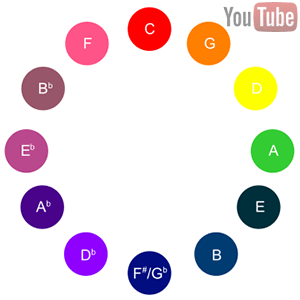
The clavier [kluh-veer] à [ah] lumières [ly-myer] keyboard with lights) was a musical instrument invented by Russian composer, Alexander Scriabin for use in his work Prometheus: Poem of Fire. However, only one version of this instrument was constructed, for the performance in New York in 1915. The instrument’s keyboard lights up as synesthetic system, specified in the score.
Scriabin was a friend of Nikolai Rimsky-Korsakov, who was a synesthete (someone with a neurologically-based condition in which stimulation of one sensory or cognitive pathway leads to automatic, involuntary experiences in a second sensory or cognitive pathway). Scriabin was also heavily influenced by Theosophy, which had its own different system of associating colors and pitches.
Posted in Art, Technology |
Leave a Comment »
January 10, 2011


A spiritual successor, sometimes called a spiritual sequel or a companion piece, is a successor to a work of fiction which does not directly build upon the storyline established by a previous work as do most traditional prequels or sequels, but nevertheless features many of the same elements, themes, and styles as its source material.
read more »
Posted in Art, Language, Money |
Leave a Comment »
January 10, 2011


Music visualization, a feature found in electronic music visualizers and media player software, generates animated imagery based on a piece of music. The imagery is usually generated and rendered in real time and synchronized with the music as it is played, but some visualizations are pre-rendered.
Visualization techniques range from simple ones (e.g., a simulation of an oscilloscope display) to elaborate ones, which often include a plurality of composited effects. The changes in the music’s loudness and frequency spectrum are among the properties used as input to the visualization.
Posted in Art, Technology |
Leave a Comment »
January 10, 2011


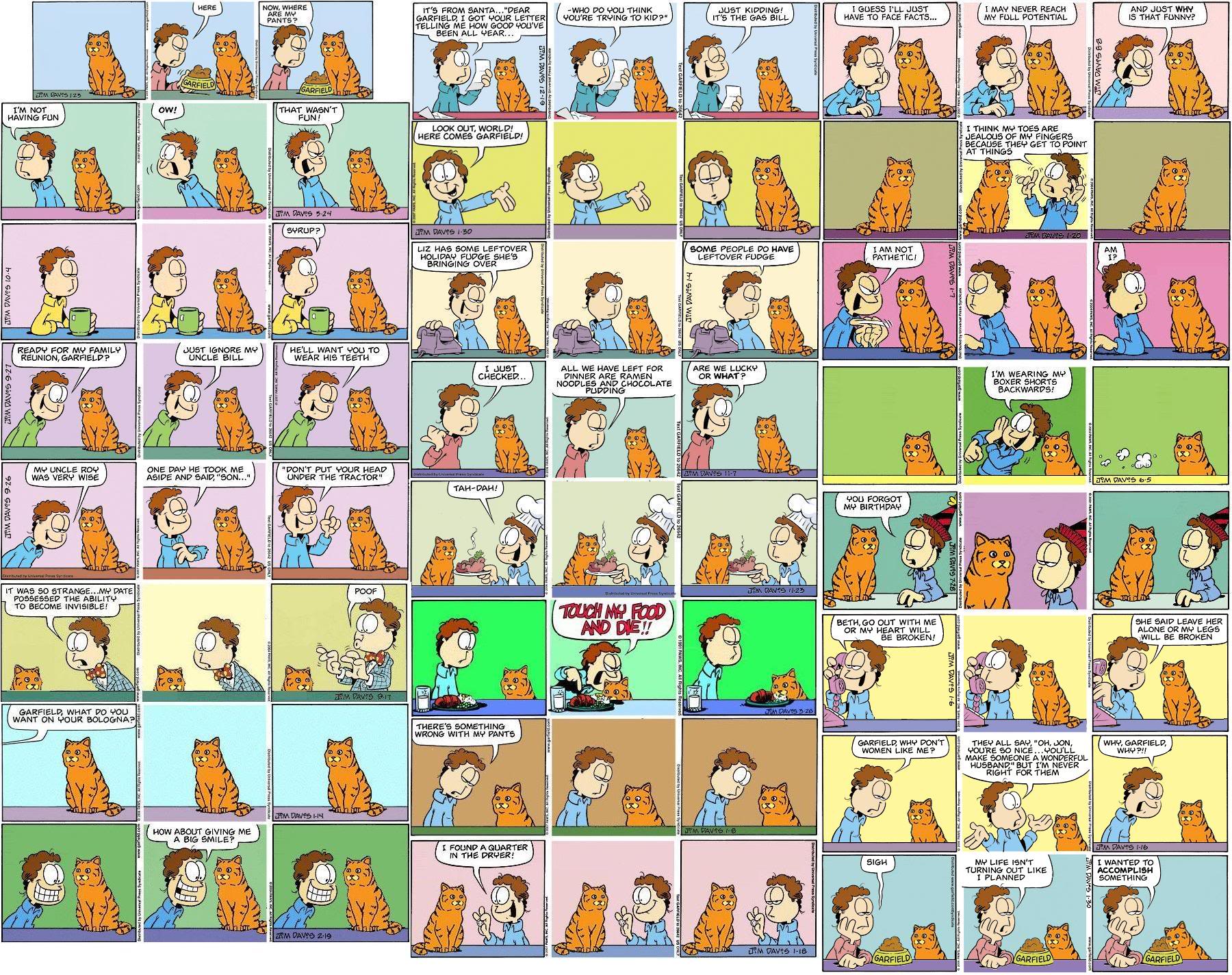
‘Silent Garfield‘ refers to the removal of Garfield’s thought balloons from his comic strips. A webcomic called Arbuckle does the above but also redraws the originals in a different art style. Garfield changes from being a comic about a sassy, corpulent feline, and becomes a compelling picture of a lonely, pathetic, delusional man who talks to his pets.
Another variation along the same lines, called ‘Realfield’ or ‘Realistic Garfield,’ is to redraw Garfield as a real cat as well as removing his thought balloons. Still another approach to editing the strips involves removing Garfield and other main characters from the originals completely, leaving Jon talking to himself, such as in ‘Garfield Minus Garfield’ by Dan Walsh.
Posted in Art, Humor |
Leave a Comment »
January 6, 2011

Googie architecture (also known as populuxe or Doo-Wop) is a form of modern architecture and a subdivision of futurist architecture, influenced by car culture and the Space and Atomic Ages. Originating in Southern California during the late 1940s and continuing approximately into the mid-1960s, the types of buildings that were most frequently designed in a Googie style were motels, coffee houses and bowling alleys.
The school later became widely-known as part of the Mid-Century modern style, and some of those more notable variations represent elements of the populuxe aesthetic, as in Eero Saarinen’s TWA Flight Center. Features of Googie include upswept roofs, curvaceous, geometric shapes, and bold use of glass, steel and neon. Googie was also characterized by Space Age designs that depict motion, such as boomerangs, flying saucers, atoms and parabolas, and free-form designs such as ‘soft’ parallelograms and the ubiquitous artist’s palette motif.
Posted in Art |
Leave a Comment »
January 6, 2011

Herbert Vogel (b. 1922) and Dorothy Vogel (b. 1935) are American art collectors. Herbert worked as a clerk for the United States Postal Service. Dorothy was a librarian employed by the Brooklyn Public Library. Together they built a large and impressive contemporary art collection on their modest income. Though their focus is conceptual art and minimalist art, the collection also includes noteworthy post-minimalist work.
They amassed a collection of over 4,782 works, which they kept in their New York City apartment. In 1992, they decided to transfer the entire collection to the National Gallery of Art. More recently, in late 2008, they launched The Dorothy and Herbert Vogel Collection: Fifty Works for Fifty States along with the National Gallery of Art, the National Endowment for the Arts, and the Institute of Museum and Library Services. The program will donate 2,500 works to 50 institutions across 50 states and will be accompanied by a book with the same name.
Posted in Art, Money |
Leave a Comment »
January 6, 2011

The tomacco is a hybrid of tomato and tobacco plants first described in a 1959 ‘Scientific American’ article. Both plants are members of the same family, Solanaceae or nightshade. The name ‘tomacco’ was given to the plant by Homer Simpson in a 1999 episode of ‘The Simpsons.’ Homer accidentally created it when he planted and fertilized his tomato and tobacco fields with plutonium. The result is a tomato that apparently has a dried, brown tobacco center, and, although being described as tasting terrible by many characters, is also immediately and powerfully addictive.
A Simpsons fan, Rob Baur of Lake Oswego, Oregon, was inspired by the episode. Remembering the article in a textbook, Baur cultivated real tomacco in 2003. The plant produced offspring that looked like a normal tomato, but Baur suspected that it contained a lethal amount of nicotine and thus would be inedible. The tomacco plant bore tomaccoes until it died after 18 months, spending one winter indoors. Baur was featured on audio commentary in the Simpsons Season 11 DVD box set discussing the plant and resulting fame.
Posted in Art, Humor, Science |
Leave a Comment »
January 5, 2011

Guerrillero Heroico (‘Heroic Guerrilla’) is an iconic photo of Marxist revolutionary Che Guevara taken by Alberto Korda. It was taken on March 5, 1960, in Havana, Cuba, at a memorial service for victims of the La Coubre explosion and by the end of the 1960s turned the charismatic and controversial leader into a cultural icon. Korda has said that at the moment he shot the picture, he was drawn to Guevara’s facial expression, which showed ‘absolute implacability’ as well as anger and pain. Guevara was 31 at the time the photo was taken.
Versions of it have been painted, printed, digitized, embroidered, tattooed, silk-screened, sculpted or sketched on nearly every surface imaginable, leading the Victoria and Albert Museum to say that the photo has been reproduced more than any other image in photography.
Posted in Art, Politics |
Leave a Comment »
January 5, 2011

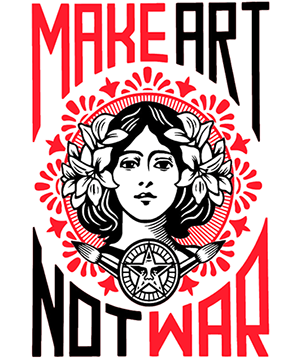
Shepard Fairey (b. 1970) is a contemporary artist, graphic designer, and illustrator who emerged from the American skateboarding scene. He first became known for his ‘André the Giant Has a Posse’ (…OBEY…) sticker campaign, in which he appropriated images from the comedic supermarket tabloid ‘Weekly World News.’ His work became more widely known in the 2008 U.S. presidential election, specifically his Barack Obama ‘HOPE’ poster.
Fairey’s first art museum exhibition, titled ‘Supply & Demand’ like his earlier book, was in Boston at the Institute of Contemporary Art in the summer of 2009. The exhibition featured over 250 works in a wide variety of media: screen prints, stencils, stickers, rubylith illustrations, collages, and works on wood, metal and canvas. As a complement to the ICA exhibition, Fairey created public art works around Boston. The artist explains his driving motivation: ‘The real message behind most of my work is ‘question everything.”
read more »
Posted in Art, Money, Politics |
Leave a Comment »
January 5, 2011

Andre the Giant Has a Posse is a street art campaign based on a design by Shepard Fairey created in 1989 in Providence, Rhode Island. Distributed by the skater community, the Andre stickers began showing up in many cities across the U.S. Over time the artwork has been reused in a number of ways and spread worldwide, following in the footsteps of World War II icon ‘Kilroy Was Here.’
Threat of a lawsuit from Titan Sports, Inc. in 1994 spurred Fairey to stop using the trademarked name ‘André the Giant,’ and to create a more styled image of the wrestler’s face, now most often with the equally iconic branding OBEY.
read more »
Posted in Art, Humor |
Leave a Comment »
January 5, 2011

They Live is a 1988 film directed by John Carpenter, who also wrote the screenplay under the pseudonym Frank Armitage. The film is based on Ray Nelson’s 1963 short story ‘Eight O’Clock in the Morning.’ Part science fiction horror and part dark comedy, the film echoed contemporary fears of a declining economy, within a culture of greed and conspicuous consumption common among Americans in the 1980s.
In They Live, the ruling class within the moneyed elite are in fact aliens managing human social affairs through the use of a signal on top of the TV broadcast that is concealing their appearance and subliminal messages in mass media. The story revolves around a nameless man referred to as Nada (Roddy Piper), a quiet drifter who finds an unusual pair of sunglasses that allow him to see the aliens and their subliminal messages.
Posted in Art, Humor |
Leave a Comment »




 The Daily Omnivore