January 6, 2011

Herbert Vogel (b. 1922) and Dorothy Vogel (b. 1935) are American art collectors. Herbert worked as a clerk for the United States Postal Service. Dorothy was a librarian employed by the Brooklyn Public Library. Together they built a large and impressive contemporary art collection on their modest income. Though their focus is conceptual art and minimalist art, the collection also includes noteworthy post-minimalist work.
They amassed a collection of over 4,782 works, which they kept in their New York City apartment. In 1992, they decided to transfer the entire collection to the National Gallery of Art. More recently, in late 2008, they launched The Dorothy and Herbert Vogel Collection: Fifty Works for Fifty States along with the National Gallery of Art, the National Endowment for the Arts, and the Institute of Museum and Library Services. The program will donate 2,500 works to 50 institutions across 50 states and will be accompanied by a book with the same name.
Posted in Art, Money |
Leave a Comment »
January 6, 2011

The tomacco is a hybrid of tomato and tobacco plants first described in a 1959 ‘Scientific American’ article. Both plants are members of the same family, Solanaceae or nightshade. The name ‘tomacco’ was given to the plant by Homer Simpson in a 1999 episode of ‘The Simpsons.’ Homer accidentally created it when he planted and fertilized his tomato and tobacco fields with plutonium. The result is a tomato that apparently has a dried, brown tobacco center, and, although being described as tasting terrible by many characters, is also immediately and powerfully addictive.
A Simpsons fan, Rob Baur of Lake Oswego, Oregon, was inspired by the episode. Remembering the article in a textbook, Baur cultivated real tomacco in 2003. The plant produced offspring that looked like a normal tomato, but Baur suspected that it contained a lethal amount of nicotine and thus would be inedible. The tomacco plant bore tomaccoes until it died after 18 months, spending one winter indoors. Baur was featured on audio commentary in the Simpsons Season 11 DVD box set discussing the plant and resulting fame.
Posted in Art, Humor, Science |
Leave a Comment »
January 5, 2011

Guerrillero Heroico (‘Heroic Guerrilla’) is an iconic photo of Marxist revolutionary Che Guevara taken by Alberto Korda. It was taken on March 5, 1960, in Havana, Cuba, at a memorial service for victims of the La Coubre explosion and by the end of the 1960s turned the charismatic and controversial leader into a cultural icon. Korda has said that at the moment he shot the picture, he was drawn to Guevara’s facial expression, which showed ‘absolute implacability’ as well as anger and pain. Guevara was 31 at the time the photo was taken.
Versions of it have been painted, printed, digitized, embroidered, tattooed, silk-screened, sculpted or sketched on nearly every surface imaginable, leading the Victoria and Albert Museum to say that the photo has been reproduced more than any other image in photography.
Posted in Art, Politics |
Leave a Comment »
January 5, 2011

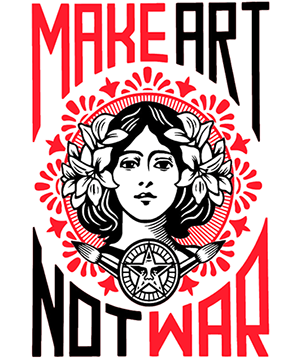
Shepard Fairey (b. 1970) is a contemporary artist, graphic designer, and illustrator who emerged from the American skateboarding scene. He first became known for his ‘André the Giant Has a Posse’ (…OBEY…) sticker campaign, in which he appropriated images from the comedic supermarket tabloid ‘Weekly World News.’ His work became more widely known in the 2008 U.S. presidential election, specifically his Barack Obama ‘HOPE’ poster.
Fairey’s first art museum exhibition, titled ‘Supply & Demand’ like his earlier book, was in Boston at the Institute of Contemporary Art in the summer of 2009. The exhibition featured over 250 works in a wide variety of media: screen prints, stencils, stickers, rubylith illustrations, collages, and works on wood, metal and canvas. As a complement to the ICA exhibition, Fairey created public art works around Boston. The artist explains his driving motivation: ‘The real message behind most of my work is ‘question everything.”
read more »
Posted in Art, Money, Politics |
Leave a Comment »
January 5, 2011

Andre the Giant Has a Posse is a street art campaign based on a design by Shepard Fairey created in 1989 in Providence, Rhode Island. Distributed by the skater community, the Andre stickers began showing up in many cities across the U.S. Over time the artwork has been reused in a number of ways and spread worldwide, following in the footsteps of World War II icon ‘Kilroy Was Here.’
Threat of a lawsuit from Titan Sports, Inc. in 1994 spurred Fairey to stop using the trademarked name ‘André the Giant,’ and to create a more styled image of the wrestler’s face, now most often with the equally iconic branding OBEY.
read more »
Posted in Art, Humor |
Leave a Comment »
January 5, 2011

They Live is a 1988 film directed by John Carpenter, who also wrote the screenplay under the pseudonym Frank Armitage. The film is based on Ray Nelson’s 1963 short story ‘Eight O’Clock in the Morning.’ Part science fiction horror and part dark comedy, the film echoed contemporary fears of a declining economy, within a culture of greed and conspicuous consumption common among Americans in the 1980s.
In They Live, the ruling class within the moneyed elite are in fact aliens managing human social affairs through the use of a signal on top of the TV broadcast that is concealing their appearance and subliminal messages in mass media. The story revolves around a nameless man referred to as Nada (Roddy Piper), a quiet drifter who finds an unusual pair of sunglasses that allow him to see the aliens and their subliminal messages.
Posted in Art, Humor |
Leave a Comment »
January 4, 2011

Ganguro (‘Black Face’) is an alternative fashion trend of blonde or orange hair and tanned skin among young Japanese women that appeared in the early 1990s and peaked in popularity around the year 2000. The Shibuya and Ikebukuro districts of Tokyo were the centers of the trend. Ganguro falls into the larger subculture of ‘gyaru’ (from English ‘gal’), a slang term used for various groups of young women, usually referring to overly childish or rebellious girls.
In ganguro fashion, a deep tan is combined with hair dyed in shades of orange to blonde, or a silver grey known as ‘high bleached.’ Black ink is used as eyeliner and white concealer is used as lipstick and eyeshadow. False eyelashes, plastic facial gems, and pearl powder are often added. Platform shoes and brightly-colored outfits complete the look. Also typical of ganguro fashion are tie-dyed sarongs, miniskirts, stickers on the face, and many bracelets, rings, and necklaces.
Posted in Art, World |
Leave a Comment »
January 4, 2011

Harajuku is the common name for the area around Harajuku Station in the Shibuya ward of Tokyo, Japan. It is a fashion capital of the world, renowned for its unique street fashion. Every Sunday, young people dressed in a variety of styles including gothic lolita, visual kei, and decora, as well as cosplayers spend the day in Harajuku socializing. The term ‘Harajuku Girls’ has been used by English-language media to describe teenagers dressed in any fashion style who are in the area of Harajuku.
Posted in Art, World |
Leave a Comment »
January 4, 2011

Abu l-Hasan (789–857), nicknamed Ziryab, was a Persian or Kurdish polymath: a poet, musician, courtesan, astronomer, botanist and geographer born in Baghdad and active in Córdoba, Spain. According to some sources, he was a former slave, possibly of East African descent. The name ‘Ziryab’ (Blackbird) was given to him for his dark complexion, eloquence, and melodious voice.
Ziryab introduced musical instruments to Iberia, notably the Persian lute that became the Spanish guitar, as well as passionate songs and dances of Persia and Mesopotamia that later, mixed with Gypsy influence, evolved into the famed Spanish flamenco. He is also credited with inventing and popularizing an early form of toothpaste.
Posted in Art, World |
Leave a Comment »
January 3, 2011


Method acting refers to a family of techniques by which actors try to create in themselves the thoughts and emotions of their characters in an effort to develop lifelike performances. It can be contrasted with more classical forms of acting, in which actors simulate the thoughts and emotions of their characters through external means, such as vocal intonation or facial expression. Though not all Method actors use the same approach, the ‘method’ in Method acting usually refers to the practice, advocated by Lee Strasberg, by which actors draw upon their own emotions and memories in their portrayals, aided by a set of exercises and practices including sense memory and affective memory.
Method actors are often characterized as immersing themselves in their characters to the extent that they continue to portray them even offstage or off-camera for the duration of a project. However, this is a popular misconception. While some actors have employed this approach, it is generally not taught as part of the Method. Method acting has been described as revolutionizing American theater. While classical acting instruction had focused on developing external talents the Method was the first systematized training that also developed internal abilities (sensory, psychological, emotional).
Posted in Art, Education |
Leave a Comment »
January 2, 2011

A panorama is any wide-angle view or representation of a physical space, whether in painting, drawing, photography, film/video, or a three-dimensional model. The word was originally coined by the Irish painter Robert Barker to describe his panoramic paintings of Edinburgh. Shown on a cylindrical surface and viewed from the inside, they were exhibited in London in 1792. The motion-picture term ‘panning’ is derived from panorama. Panoramic photography eventually came to displace painting as the most common method for creating wide views.
Not long after the introduction of the Daguerreotype in 1839, photographers began assembling multiple images of a view into a single wide image. In the late 19th century, panoramic cameras using curved film holders employed clockwork drives to scan a line image in an arc to create an image over almost 180 degrees. Digital photography of the late twentieth century greatly simplified this assembly process, which is now known as image stitching. Such stitched images may even be fashioned into forms of virtual reality movies, using technologies such as QuickTime VR, Flash, or Java.
Posted in Art, Technology |
Leave a Comment »
January 2, 2011
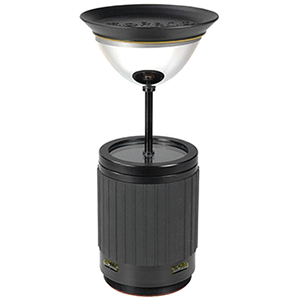
In photography, an omnidirectional camera is a camera with a 360-degree field of view in the horizontal plane, or with a visual field that covers (approximately) the entire sphere. Omnidirectional cameras are important in areas where large visual field coverage is needed, such as in panoramic photography and robotics.
Posted in Art, Technology |
Leave a Comment »





