January 2, 2011

Fantastic Planet is a 1973 animated science fiction film directed by René Laloux, production designed by Roland Topor, written by both of them and animated at Jiří Trnka Studio. The film was an international production between France and Czechoslovakia and was distributed in the United States by Roger Corman. The story is based on the novel ‘Oms en série,’ by the French writer Stefan Wul. The film is chiefly noted for Topor’s surreal imagery.
The film depicts a future in which human beings, known as ‘Oms’ (a play on the French word ‘hommes,’ meaning ‘men’), have been brought by the giant Draags to the Draag home world, where they are kept as pets (with collars). Most Oms are domesticated as pets, but others run wild, and are periodically exterminated. The Draags’ treatment of the Oms is ironically contrasted with their high level of technological and spiritual development. The Draag practice of meditation, whereby they commune psychically with each other and with different species, is shown in transformations of their shape and color.
Posted in Art, World |
Leave a Comment »
January 2, 2011
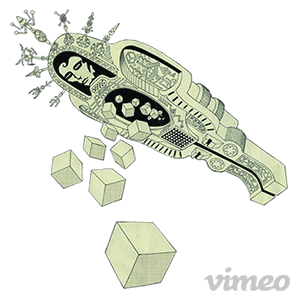
Birdy Nam Nam is a French DJ crew, originally formed to compete in the DMC World DJ Championship. Their self-titled debut album was released in 2006 on Uncivilized World Records and was created entirely on turntables.
In 2009 they released ‘Manual for Successful Rioting,’ an album that found the four programming and playing synths along with their turntables. The group’s name is taken from the 1968 Peter Sellers film ‘The Party,’ directed by Blake Edwards.
Posted in Art |
Leave a Comment »
January 1, 2011


The Japanese kusudama (literally ‘medicine ball’) is a paper model that is usually (although not always) created by sewing or gluing multiple identical pyramidal units (usually stylized flowers folded from square paper) together through their points to form a spherical shape. Occasionally, a tassel is attached to the bottom for decoration.
Kusudama originate from ancient Japanese culture, where they were used for incense and potpourri; possibly originally being actual bunches of flowers or herbs. They are now typically used as decorations, or as gifts. It is a precursor to modular origami, a paper folding technique which uses multiple sheets of paper to create a larger and more complex structure than possible using single-piece origami techniques.
Posted in Art, World |
Leave a Comment »
January 1, 2011

Blockhead (real name Tony Simon) is an American Hip hop producer based in Manhattan, New York. Aside from his solo efforts released on the Ninja Tune label, he is most associated with producing for Aesop Rock, a rapper for the Definitive Jux independent hip hop label. He is also a member of the hip hop/comedy group Party Fun Action Committee. His father, the late Sidney Simon, was a well known sculptor in New York City.
Posted in Art |
Leave a Comment »
December 24, 2010


In Jamaican popular culture, a sound system is a group of disc jockeys, engineers and MCs playing ska, rocksteady or reggae music. The sound system scene is generally regarded as an important part of Jamaican cultural history and as being responsible for the rise of several modern Jamaican musical genres.
The sound system concept first became popular in the 1950s, in the ghettos of Kingston. DJs would load up a truck with a generator, turntables, and huge speakers and set up street parties. In the beginning, the DJs played American rhythm and blues music, but as time progressed the sound migrated to a local flavor.
read more »
Posted in Art, World |
Leave a Comment »
December 24, 2010

Dubstep is a genre of electronic dance music, originating from Croydon, UK. Its overall sound has been described as ‘tightly coiled productions with overwhelming bass lines and reverberant drum patterns, clipped samples, and occasional vocals.’
The earliest dubstep releases, which date back to 1998, were darker, more experimental, instrumental dub remixes of 2-step garage tracks attempting to incorporate the funky elements of breakbeat, or the dark elements of drum and bass into 2-step.
read more »
Posted in Art, Technology |
1 Comment »
December 22, 2010

An ambigram [am-bi-gram] is a typographical design or artform that may be read as one or more words not only in its form as presented, but also from another viewpoint, direction, or orientation.
The words readable in the other viewpoint, direction or orientation may be the same or different from the original words. Different ambigram artists (sometimes called ambigramists) may create completely different ambigrams from the same word or words, differing in both style and form.
Posted in Art, Language |
Leave a Comment »
December 22, 2010

Chuck Close (b. 1940) is an American painter and photographer who achieved fame as a photorealist, through his massive-scale portraits.
Though a catastrophic spinal artery collapse in 1988 left him severely paralyzed, he has continued to paint and produce work that remains sought after by museums and collectors. Ironically, while being one of the most successful portrait artists of his time, Close is also afflicted with prosopagnosia (face blindness), a condition that prevents him from recognizing people’s faces.
read more »
Posted in Art |
2 Comments »
December 20, 2010

Love is a sculpture by American artist Robert Indiana. It consists of the letters LO (with the O canted sideways) over the letters VE. The image was originally designed as a Christmas card for the Museum of Modern Art in 1964, and first exhibited as a sculpture in New York City in 1970. This original sculpture is made of weathering steel and has been on exhibit at the Indianapolis Museum of Art since 1975.
The LOVE design has been reproduced in a variety of formats. Likewise, the sculpture has been recreated in multiple versions and a variety of colors, and is now on display around the world. While it was first made in English, versions of the sculpture exist in Hebrew, Chinese, Italian and Spanish. The LOVE emblem has been adopted by skateboarders and frequently appears in skateboard magazines and videos. After skateboarding was banned in Philadelphia’s LOVE Park, the emblem was used by organizations opposing the ban.
Posted in Art, Love |
Leave a Comment »
December 20, 2010

Victor Vasarely (1906 – 1997) was a Hungarian French artist whose work is generally seen aligned with Op-art. His work entitled Zebra, created by in the 1930s, is considered by some to be one of the earliest examples of Op-art.
He was born in a town outside of Budapest, but settled in Paris in 1930, where he went on to produce art and sculpture mainly focused around the area of optical illusion. Over the next three decades, Vasarely developed his style of geometric abstract art, working in various materials but using a minimal number of forms and colors.
Posted in Art |
Leave a Comment »
December 20, 2010

Metropolis is a 1927 German expressionist film in the science-fiction genre directed by Fritz Lang. Produced in Germany during a stable period of the Weimar Republic, ‘Metropolis’ is set in a futuristic urban dystopia and makes use of this context to explore the social crisis between workers and owners in capitalism. The most expensive silent film ever made, it cost approximately 5 million Reichsmark. The film was written by Lang and his wife Thea von Harbou in 1924, and published a novelization in 1926. Lang was influenced by the Soviet science fiction film ‘Aelita’ by Yakov Protazanov (1924), which was an adaptation of a novel by Alexei Tolstoy. The plot of ‘Aelita’ included a revolution taking place on the planet Mars. However, Metropolis advocates non-violent cooperation rather than the Marxist ideal of ‘class struggle.’
‘Metropolis’ was cut substantially after its German premiere, and much footage was lost over the passage of successive decades. There have been several efforts to restore it, as well as discoveries of previously lost footage. In 2008, a copy of the film 30 minutes longer than any other known surviving was located in Argentina. After a long period of restoration in Germany, the film was shown publicly for the first time simultaneously at Berlin and Frankfurt on February 12, 2010.
Posted in Art, Money, Technology |
Leave a Comment »
December 19, 2010
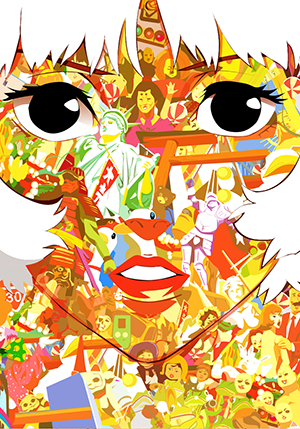
Paprika is a 2006 Japanese animated science fiction film, based on Yasutaka Tsutsui’s 1993 novel of the same name, about a research psychologist who uses a device that permits therapists to help patients by entering their dreams. The film was directed by the late Satoshi Kon, animated by Madhouse Studios, and produced and distributed by Sony Pictures Entertainment. The film’s music was composed by Susumu Hirasawa, who also composed the soundtrack for Kon’s award-winning film, Millennium Actress, and equally lauded television series, Paranoia Agent. The soundtrack is significant for being the first film to use a Vocaloid (a singing synthesizer) for various tracks.
The protagonist of the film is, Atsuko, a psychiatrist who uses advanced technology to study the human mind. She has developed a machine that will allow her to enter the dreams of her patients and study their psyches from the inside. Atsuko also does double duty as Paprika, a high-tech detective who uses this new innovation to find out the truth about what the people she’s trailing really think. However, Atsuko falls victim to a thief who steals the one-of-a-kind machine, and Paprika sets out to find it as a wave of psychological instability tears through the city.
Posted in Art, Technology |
Leave a Comment »