December 19, 2010

The New Yorker cover (March 29, 1976) ‘View of the World from 9th Avenue,’ has come to represent Manhattan’s telescoped interpretation of the country beyond the Hudson River. The cartoon showed the supposedly limited mental geography of Manhattanites. The image shows Manhattan’s 9th Avenue, 10th Avenue, and the Hudson River (appropriately labeled), while the top half depicts the rest of the world. The rest of the United States is drawn as a square, with a thin brown strip along the Hudson representing New Jersey, the names of five cities (Los Angeles, Washington D.C., Las Vegas, Kansas City, and Chicago) and three states (Texas, Utah, and Nebraska) are scattered among a few rocks for the U.S. beyond New Jersey.
The Pacific Ocean, perhaps twice as wide again as the Hudson, separates the U.S. from three flattened land masses labeled China, Japan, and Russia. The illustration, depicting New Yorkers’ self-image, inspired many similar works, including the poster for the 1984 film Moscow on the Hudson; that movie poster led to a lawsuit, Steinberg v. Columbia Pictures Industries, Inc., 663 F. Supp. 706 (S.D.N.Y. 1987), which held that Columbia Pictures violated the copyright that Steinberg held on his work. Another homage was created for the cover of The Economist newspaper’s March 21–27, 2009 issue entitled ‘How China sees the world.’
Posted in Art, Humor, Politics |
Leave a Comment »
December 19, 2010


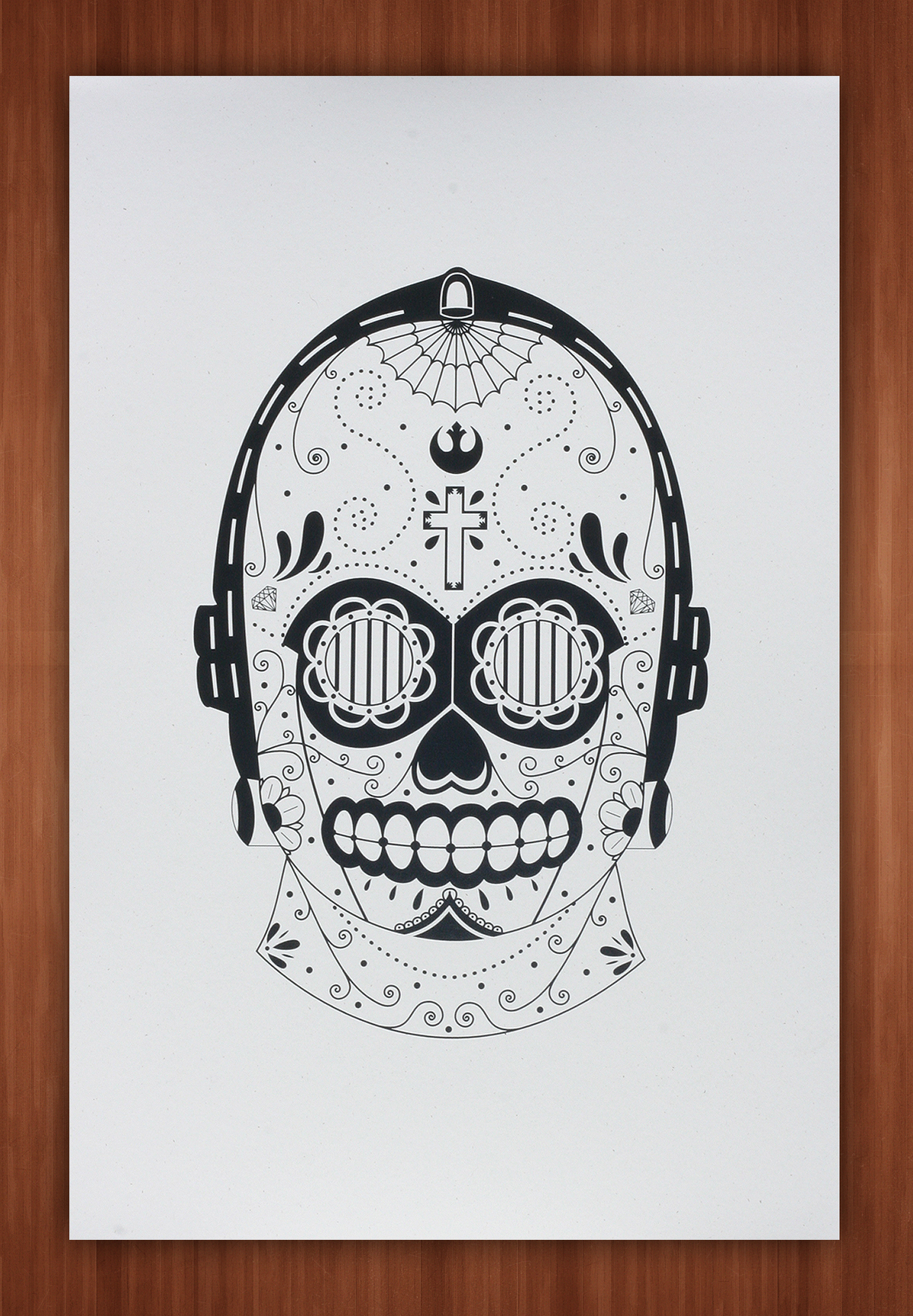
The word calavera, Spanish for ‘skull,’ can refer to a number of cultural phenomena associated with the Mexican celebration of the Day of the Dead and the Roman Catholic holiday All Souls Day. Calaveras de azúcar (‘sugar skulls’) are used to adorn altars and can be eaten. Calaveras are poems, written for the Day of the Dead but intended to humorously criticize the living. Calavera can refer to any artistic representations of skulls, such as the lithographs of José Guadalupe Posada.
Posted in Art, Death, Philosophy |
Leave a Comment »
December 19, 2010

Captain Harlock is a fictional character created by manga artist Leiji Matsumoto. Harlock is the archetypical romantic hero, a space pirate with an individualist philosophy of life. He is as noble as he is taciturn and rebellious; he stoically fights against totalitarian regimes, whether they be earthborn or alien.
The character was introduced in Adventures of a Honeybee (1953), but did not debut as a lead character until 1978’s Space Pirate Captain Harlock. Since then, he has appeared in numerous animated TV series and films, the latest of which re-imagines him as an Iron Cross fighter pilot and a gunslinger in the American Old West.
Posted in Art, World |
Leave a Comment »
December 19, 2010

‘Interstella 5555: The 5tory of the 5ecret 5tar 5ystem’ is a 2003 feature-length Japanese animated musical film set to French duo, Daft Punk’s second studio album, ‘Discovery.’ The film depicts the abduction and rescue of an interstellar pop band. The film was produced by Daft Punk and Toei Animation, under the supervision of famed managa and anime artist, Leiji Matsumoto. The film has no dialogue and minimal sound effects. Daft Punk’s concept for the project involved the merging of science fiction with entertainment industry culture and was further developed with their collaborator Cédric Hervet.
All three brought the album and the completed story to Tokyo in the hope of creating the film with their childhood hero, Leiji Matsumoto. Many elements common to Matsumoto’s stories, such as a romanticism of noble sacrifice and remembrance of fallen friends, appear in ‘Interstella 5555.’ Daft Punk revealed in an interview that ‘Captain Harlock’ was a great influence on them in their childhood. They also stated, ‘The music we have been making must have been influenced at some point by the shows we were watching when we were little kids.’
Posted in Art, World |
Leave a Comment »
December 17, 2010
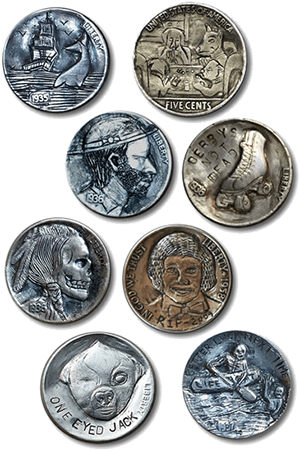
The hobo nickel is a sculptural art form involving the creative modification of small-denomination coins, essentially resulting in miniature bas reliefs. The nickel, because of its size, thickness, and relative softness, was a favored coin for this purpose. Due to its low cost and portability, this medium was particularly popular among hobos, hence the name. Common hobo nickels sell for $5 or $10, and rarer or more desirable coins sell for hundreds of dollars.
read more »
Posted in Art, Humor, Money |
Leave a Comment »
December 17, 2010

Love Tokens are custom engraved coins given as a gift. They were especially popular in the 1750s in the United States. They are made by machine-smoothing a coin (usually silver) on one or both sides, then engraving it with initials, monograms, names, scenes, etc., often with an ornate border. They can be mounted on pins or incorporated into bracelets and necklaces. The love token fad faded out in the early 20th century; love tokens engraved on buffalo nickels are quite rare and prized by collectors of ‘hobo nickels’ (altered coins).
Posted in Art, Love, Money |
Leave a Comment »
December 16, 2010

An amplified cactus is a cactus plant used as a musical instrument. It harnesses the acoustic properties of a cactus (preferably a Denmoza or Geohintonia), by applying contact microphones and amplifying their projection and tone. The effect is somewhat ethereal: Vivien Schweitzer of The New York Times reports ‘Jason Treuting played an amplified cactus, running his hand over the plant’s unfriendly spikes to produce an alluring sound like a babbling brook.’
The amplified cactus is a medium rarely written for, even in the contemporary music genre. John Cage, perhaps one of the most recognizable names in the contemporary music genre, composed Child of Tree (1975) and Branches (1976) for what he described as ‘amplified plant materials.’ Cage was a large proponent of chance music and felt that the organic nature of music without man-made instruments was very strong and influential. Another of the most famous pieces for amplified cactus is called Degrees of Separation ‘Grandchild of Tree’ by Paul Rudy which received mention at the Bourges International Competition for Electroacoustic Music in 2000.
Posted in Art, Technology |
Leave a Comment »
December 16, 2010

In mathematics, the Klein bottle is a geometrical object, named after the German mathematician Felix Klein. He described it in 1882, and named it Klein’sche Fläche (Klein surface). Like the Möbius strip, it only has one surface. Mathematicians call this a non-orientable surface. Klein bottles only exist in four-dimensional space, but a model of a Klein bottle can be made in 3D.
This model is different from the original because at some point the shape touches itself. In 3D, part of the shape is ‘inside’ the rest. Because the surface is non-orientable, there is no ‘inside’ or ‘outside.’ This means that if a liquid were filled ‘in the bottle,’ it would run down its surface. This may not be true for the 3D models of the bottle.
Posted in Art, Science, Technology |
Leave a Comment »
December 16, 2010

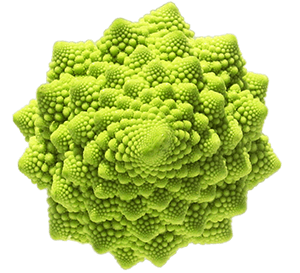
Many mathematicians derive aesthetic pleasure from their work, and from mathematics in general. They express this pleasure by describing mathematics as beautiful. Sometimes mathematicians describe mathematics as an art form or, at a minimum, as a creative activity. Hungarian mathematician Paul Erdős expressed his views on the ineffability of mathematics when he said, ‘Why are numbers beautiful? It’s like asking why is Beethoven’s Ninth Symphony beautiful. If you don’t see why, someone can’t tell you. I know numbers are beautiful. If they aren’t beautiful, nothing is.’
Comparisons are often made with music and poetry. British mathematician Bertrand Russell expressed his sense of mathematical beauty in these words: ‘Mathematics, rightly viewed, possesses not only truth, but supreme beauty — a beauty cold and austere, like that of sculpture, without appeal to any part of our weaker nature, without the gorgeous trappings of painting or music, yet sublimely pure, and capable of a stern perfection such as only the greatest art can show. The true spirit of delight, the exaltation, the sense of being more than Man, which is the touchstone of the highest excellence, is to be found in mathematics as surely as poetry.’
Posted in Art, Science |
Leave a Comment »
December 16, 2010

The Möbius strip [mo-bee-uhs] is a surface with only one side and only one edge. It can be made using a strip of paper by gluing the two ends together with a half-twist. The twisting is possible in two directions; so there are two different (mirror-image) Möbius strips.
The Möbius strip was discovered independently by the German mathematicians August Ferdinand Möbius and Johann Benedict Listing in 1858. The Mobius strip is known for its unusual properties. A bug crawling along the center line of the loop would go around twice before coming back to its starting point. Cutting along the center line of the loop creates one longer band, not two.
Posted in Art, Science |
Leave a Comment »
December 15, 2010
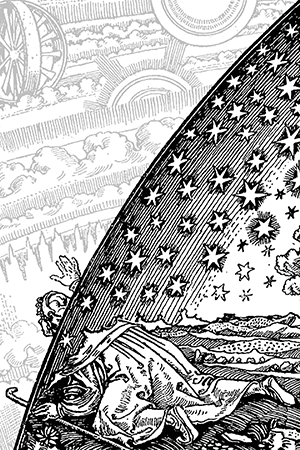
The Flammarion [fla-ma-ryawn] woodcut is an anonymous wood engraving (once believed to be a woodcut), so named because its first documented appearance is in Camille Flammarion’s 1888 book L’atmosphère: météorologie populaire (‘The Atmosphere: Popular Meteorology’).
The engraving depicts a man, dressed as a mediaeval pilgrim and carrying a pilgrim’s staff, who peers through the sky as if it were a curtain to look at the hidden workings of the universe. One of the elements of the cosmic machinery bears a strong resemblance to traditional pictorial representations of the ‘wheel in the middle of a wheel’ (Merkabah).
Posted in Art, Philosophy |
Leave a Comment »
December 15, 2010

Wood engraving is a technique in printmaking where the ‘matrix’ worked by the artist is a block of wood. It is a variety of woodcut and so a relief printing technique, where ink is applied to the face of the block and printed by using relatively low pressure. A normal engraving, like an etching, has a metal plate as a matrix and is printed by the intaglio method.
Wood engraving traditionally utilizes the end grain of wood as a medium for engraving, while in the older technique of woodcut the softer side grain is used. The technique of wood engraving developed at the end of the 18th century and the beginning of the 19th century, with the works of Thomas Bewick.
Posted in Art, Technology |
Leave a Comment »