December 15, 2010

Woodcut—formally known as xylography—is a relief printing artistic technique in printmaking in which an image is carved into the surface of a block of wood. the non-printing parts are removed, typically with gouges. The areas to show ‘white’ are cut away with a knife or chisel, leaving the characters or image to show in ‘black’ at the original surface level.
The block is cut along the grain of the wood (unlike wood engraving where the block is cut in the end-grain). Beechwood is commonly used in Europe. Cherry wood is favored in Japan. The surface is covered with ink by rolling over the surface with an ink-covered roller (brayer), leaving ink upon the flat surface but not in the non-printing areas. Multiple colors can be printed by keying the paper to a frame around the woodblocks (where a different block is used for each color).
Posted in Art, Technology |
Leave a Comment »
December 13, 2010
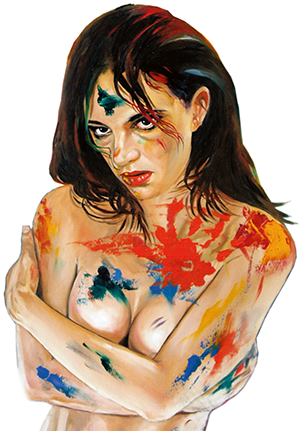
Stendhal [sten-dahl] syndrome (also known as hyperkulturemia and Florence syndrome) is a psychosomatic illness that causes rapid heartbeat, dizziness, fainting, confusion and even hallucinations when an individual is exposed to art, usually when the art is particularly beautiful or a large amount of art is in a single place. The term can also be used to describe a similar reaction to a surfeit of choice in other circumstances, e.g. when confronted with immense beauty in the natural world.
The condition is named after the famous 19th century French author Stendhal (Henri-Marie Beyle), who described his experience with the phenomenon during his 1817 visit to Florence, Italy. Although there are many descriptions of people becoming dizzy and fainting while taking in Florentine art, especially at the Uffizi, dating from the early 19th century on, the syndrome was only named in 1979, when it was described by Italian psychiatrist Graziella Magherini, who observed and described more than 100 similar cases among tourists and visitors in Florence.
Posted in Art, Health, Science |
Leave a Comment »
December 13, 2010
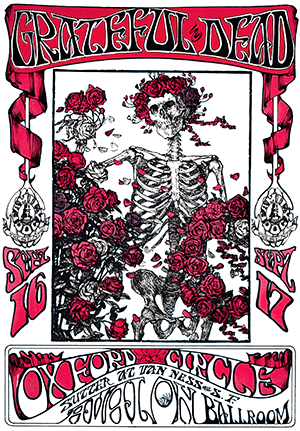

Stanley Mouse (b. 1940) is an American artist, best known for his 1960s psychedelic rock concert poster designs and Grateful Dead album cover art. He got his start in the Kustom Kulture scene working for Ed ‘Big Daddy’ Roth in 1958. The posters he produced were heavily influenced by Art Nouveau graphics, particularly the works of Alphonse Mucha and Edmund Joseph Sullivan.
Material associated with psychedelics, such as Zig-Zag rolling papers, were also referenced. Producing posters advertising for such musical groups as Big Brother and the Holding Company, Quicksilver Messenger Service, and Grateful Dead led to meeting the musicians and making contacts that were later to prove fruitful. Mouse and artist Alton Kelley are credited with creating the skeleton and roses image that became the Grateful Dead’s archetypal iconography, and Journey’s wings and beetles that appeared on their album covers from 1977 to 1980.
Posted in Art, Drugs |
Leave a Comment »
December 13, 2010

Chartjunk refers to all visual elements in charts and graphs that are not necessary to comprehend the information represented on the graph, or that distract the viewer from this information. Examples of unnecessary elements which might be called chartjunk include heavy or dark grid lines, unnecessary text or inappropriately complex typefaces, ornamented chart axes and display frames, pictures or icons within data graphs, ornamental shading and unnecessary dimensions.
Another kind of chartjunk skews the depiction and makes it difficult to understand the real data being displayed. Examples of this type include items depicted out of scale to one another, noisy backgrounds making comparison between elements difficult in a chart or graph, and 3-D simulations in line and bar charts. The term was coined by American statistician Edward Tufte in his 1983.
Posted in Art, Technology |
Leave a Comment »
December 10, 2010
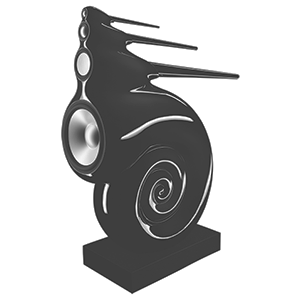
The Nautilus is a Bowers & Wilkins concept loudspeaker first released in 1993. It uses tapering tubes filled with absorbent wadding to reduce resonances to an insignificant minimum. Nautilus Tapering Tubes are fitted to nearly all Bowers & Wilkins speakers, even when they’re not visible to the eye. Tapering the tube enables you to make it shorter for the same level of absorption; it acts like a horn in reverse – reducing the sound level instead of increasing it.
The limit of this type of loading is reached when the wavelength gets small enough to be comparable with the diameter of the tube. To maintain the effectiveness of tube loading, you must restrict the bandwidth of each driver. This is one reason why the Nautilus loudspeaker is divided into a 4-way system. A more complex type of loading is required to cover a wider bandwidth and the sphere/tube enclosure was developed for the Nautilus 800 Series.
Posted in Art, Technology |
Leave a Comment »
December 10, 2010
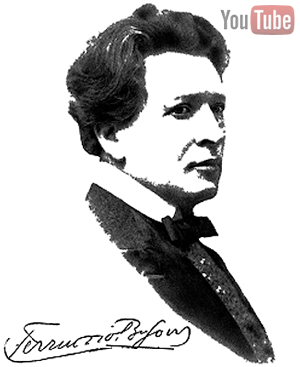
Ferruccio [fer-root-chaw] Busoni [byoo-soh-nee] (1866 – 1924) was an Italian composer. His philosophy that ‘Music was born free; and to win freedom is its destiny,’ greatly influenced his students Percy Grainger and Edgard Varèse, both of whom played significant roles in the 20th century opening of music to all sound. In 1907 he published Sketch of a New Esthetic of Music, which discussed the use of electrical and other new sound sources in future music.
He deplored that his own keyboard instrument had conditioned our ears to accept only an infinitesimal part of the infinite gradations of sounds in nature. He wrote of the future of microtonal scales in music, made possible by Cahill’s Dynamophone: ‘Only a long and careful series of experiments, and a continued training of the ear, can render this unfamiliar material approachable and plastic for the coming generation, and for Art.’
Posted in Art, Technology |
Leave a Comment »
December 10, 2010
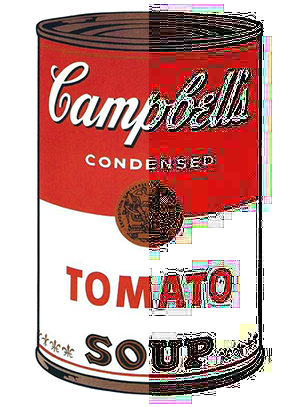

A compression artifact is a noticeable distortion of media – an image, audio, or video – due to the application of an overly aggressive or inappropriate lossy data compression algorithm. These lossy data compression schemes discard some data to simplify the media sufficiently to store it in the desired space. If there is not enough data in the compressed version to reproduce the original with acceptable fidelity, artifacts will result. Alternatively, the compression algorithm may incorrectly determine certain distortions to be of little subjective importance, but they may in fact be objectionable to the viewer.
Compression artifacts occur in many common media such as DVDs, common computer file formats such as JPEG, MP3, or MPEG files, and Sony’s ATRAC compression algorithm. Uncompressed media (such as on Laserdiscs, Audio CDs, and WAV files) or losslessly compressed media (FLAC, PNG, etc.) do not suffer from compression artifacts. The minimization of artifacts is a key goal in implementation of lossy compression schemes. However, artifacts are occasionally intentionally produced for artistic purposes, a style known as glitch art.
Posted in Art, Technology |
Leave a Comment »
December 10, 2010


‘Kafkaesque‘ [kahf-kuh-esk] is an eponym used to describe concepts, situations, and ideas which are reminiscent of the literary work of the Austro-Hungarian writer Franz Kafka, particularly his novels ‘The Trial’ and ‘The Castle,’ and the novella ‘The Metamorphosis.’ The term has also been described as ‘marked by a senseless, disorienting, often menacing complexity: Kafkaesque bureaucracies’ and ‘marked by surreal distortion; and often a sense of impending danger: Kafkaesque fantasies of the impassive interrogation, the false trial, the confiscated passport, etc.’
It can also describe an intentional distortion of reality by powerful but anonymous bureaucrats: ‘Lack of evidence is treated as a pesky inconvenience, to be circumvented by such Kafkaesque means as depositing unproven allegations into sealed files…’ Another definition would be an existentialist state of ever-elusive freedom, existing under unmitigable control. The adjective refers to anything suggestive of Kafka, especially his nightmarish style of narration, in which characters lack a clear course of action, the ability to see beyond immediate events, and the possibility of escape. The term’s meaning has transcended the literary realm to apply to real-life occurrences and situations that are incomprehensibly complex, bizarre, or illogical.
Posted in Art, Language |
Leave a Comment »
December 10, 2010

Transmetropolitan is a cyberpunk comic book series written by Warren Ellis with art by Darick Robertson and published by DC Comics. It chronicles the battles of Spider Jerusalem, infamous renegade gonzo journalist of the future, an homage to gonzo journalism founder Hunter S. Thompson. Jerusalem dedicates himself to fighting the corruption and abuse of power of two successive United States presidents; he strives to keep his world from turning more dystopian than it already is while dealing with the struggles of fame and power.
Posted in Art, Humor |
Leave a Comment »
December 9, 2010

Cyriak Harris is a British freelance animator better known by his first name Cyriak, or by his pseudonym Mutated Monty. He is known for his surreal short web animations. A regular contributor to the British website B3ta since 2004, Cyriak displays a surreal and often disturbing animation style with a distinct British theme. He uses a combination of Adobe Photoshop and After Effects for his animation and visuals along with FL Studio (formerly known as Fruity Lookps) for original music pieces alongside his videos.
Posted in Art, Humor |
Leave a Comment »
December 9, 2010
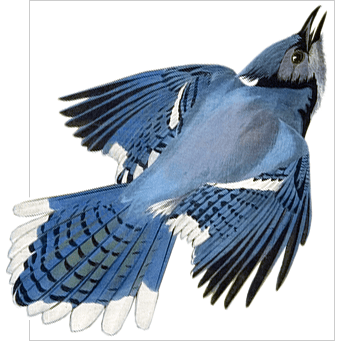

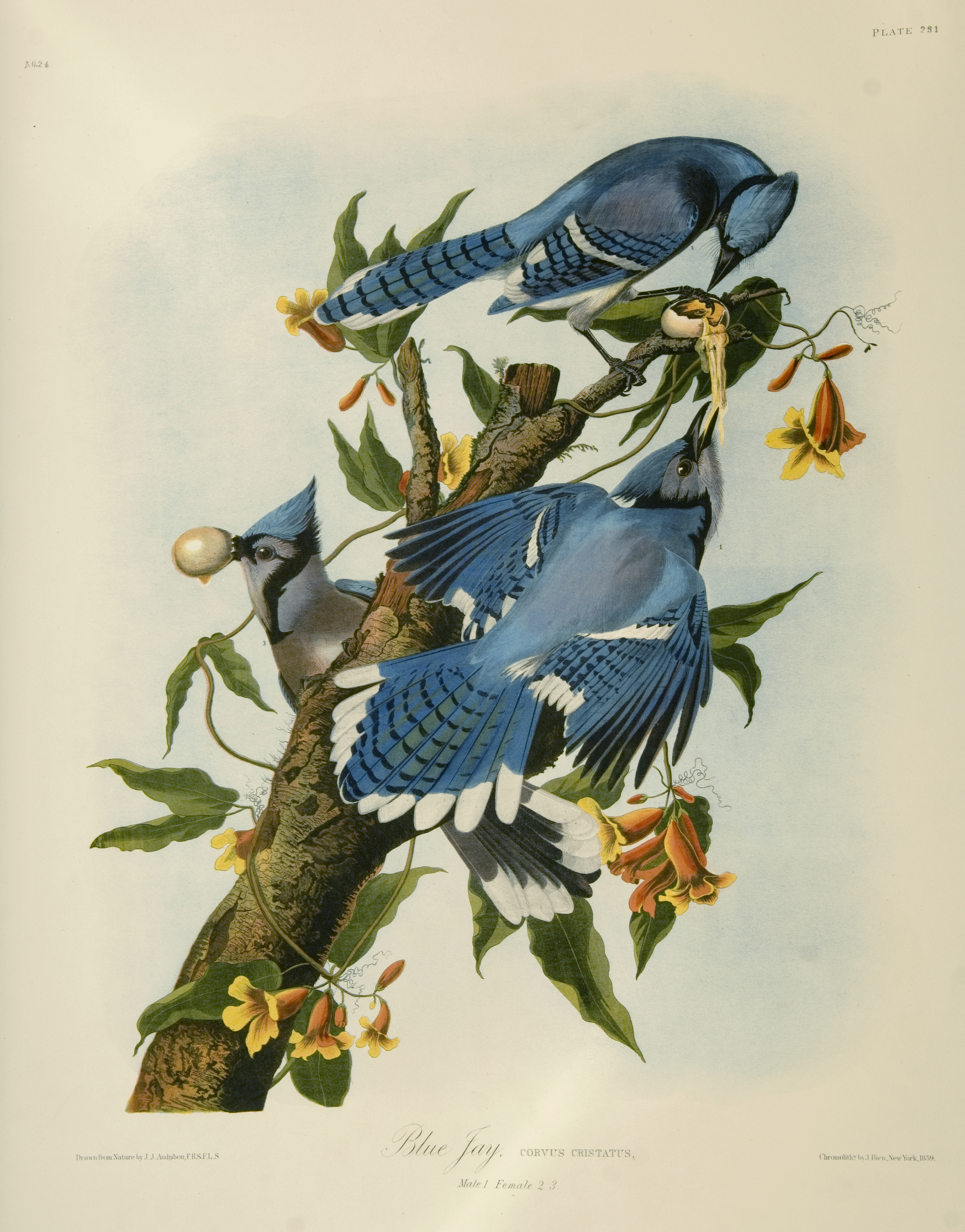
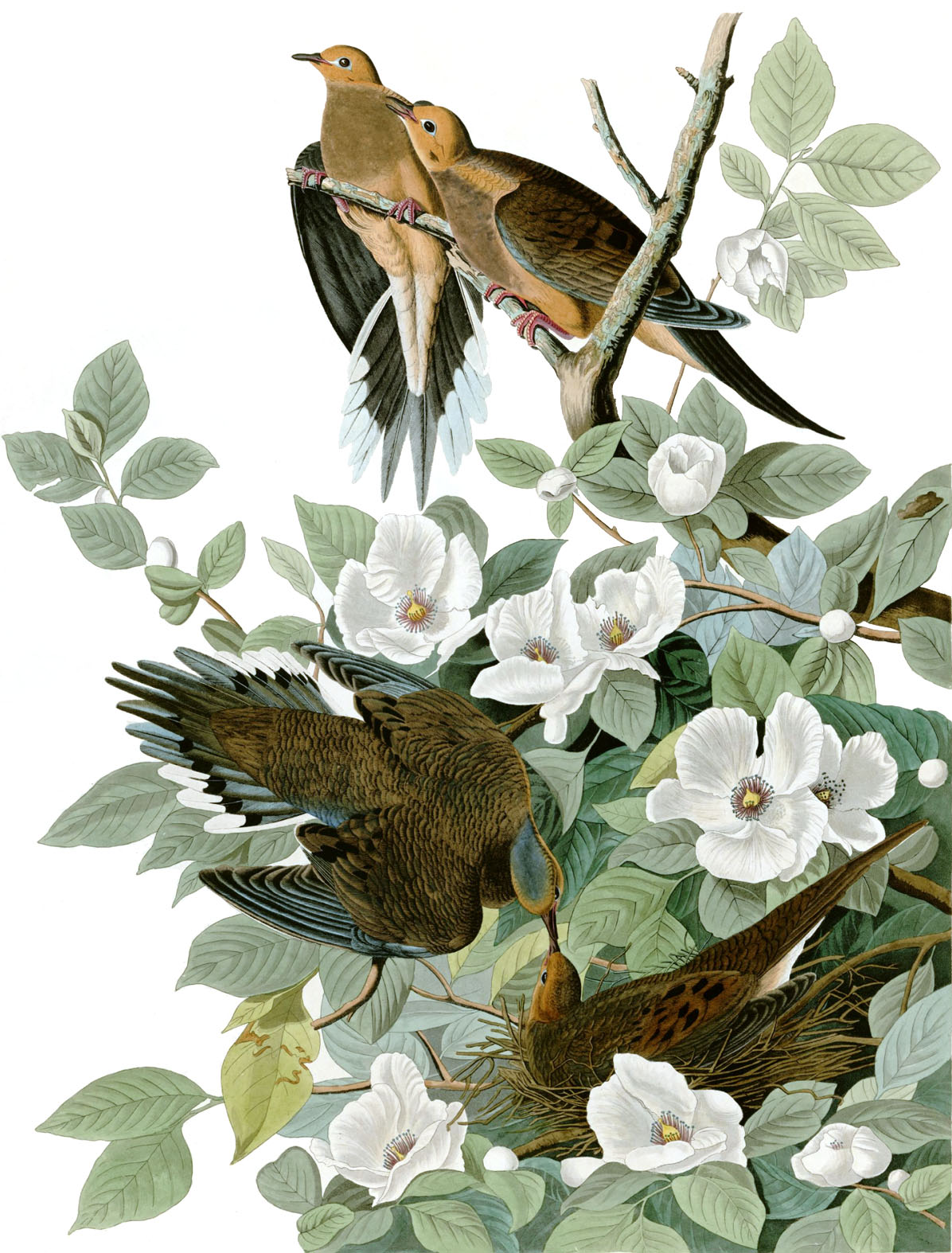
‘The Birds of America‘ is the title of a book by naturalist and painter John James Audubon, containing paintings and scientific description of a wide variety of birds of the United States. It was first published as a series of sections between 1827 and 1838 in Edinburgh and London. The work consists of hand-colored, life-size prints made from engraved plates measuring around 39 by 26 inches. In December of 2010 a copy sold at auction for £7.3 million. The original edition is often regarded as the greatest picture book ever produced. 161 subscribers paid $1,000 each for what ended up to be four volumes.
There are only 11 copies held in private collections out of 119 thought to still exist and it is estimated that out of the top ten most expensive books, five of them would be copies of ‘Birds of America.’ In 2007 the book was the subject of an exhibition by the Teylers Museum (the oldest museum in the Netherlands), which owns a copy it ordered from the original subscription, along with the table sold to house and display it. The book’s subsections fit into special drawers around a fly-leaf table; the table formed the centerpiece for gatherings of the Teyler’s gentleman’s society of science. A low-resolution version of ‘Birds of America’ can be viewed on the Audubon website.
Posted in Art, Money, Science |
Leave a Comment »
December 8, 2010

Bouffon is a modern french theater term that was re-coined in the early 1960s by French acting instructor Jacques Lecoq to describe a specific style of performance work that has a main focus in the art of mockery. Similar to, but distinct from clowning, the bouffon draws from burlesque, commedia dell’arte, farce, gallows humor, parody, satire, and slapstick.
According to Lecoq, ‘the difference between the clown and the bouffon is that while the clown is alone, the bouffon is part of a gang; while we make fun of the clown, the bouffon makes fun of us. At the heart of the bouffon is mockery pushed to the point of parody. Bouffons amuse themselves by reproducing the life of man in their own way, through games and pranks.’
Posted in Art, Humor, Language |
Leave a Comment »