November 16, 2010

Catullus 16 is a poem by Gaius Valerius Catullus (ca. 84 BC – ca. 54 BC). The poem, written in a hendecasyllabic (11-syllable) meter, was considered so explicit that a full English translation was not openly published until the late twentieth century:
read more »
Posted in Art, Language, Sex |
Leave a Comment »
November 16, 2010
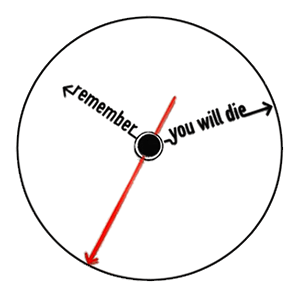
Memento mori is a Latin phrase translated as ‘Remember your mortality’ or “remember you will die’ – (literally: ‘[in the future] remember to die’). It names a genre of artistic creations that vary widely from one another, but which all share the same purpose: to remind people of their own mortality. The phrase has a tradition in art that dates back to antiquity. In ancient Rome, the words are believed to have been used on the occasions when a Roman general was parading through the streets during a victory triumph. Standing behind the victorious general was his slave, who was tasked to remind the general that, though his highness was at his peak today, tomorrow he could fall.
The thought came into its own with Christianity, whose strong emphasis on Divine Judgment, Heaven, Hell, and the salvation of the soul brought death to the forefront of consciousness. Most memento mori works are products of Christian art, although there are equivalents in Buddhist art.
Posted in Art, Death, Philosophy |
Leave a Comment »
November 16, 2010

Jeff Koons’s ‘Rabbit‘ began as an inflatable, store-bought, plastic toy. Its transformation started when Koons bought it, blew it up, and had it cast in highly polished stainless steel. It has crinkled ears like an inflatable toy, a spherical head, and bulbous appendages, yet its face is blank. While it appears to be a shiny, lightweight, Mylar balloon, it is actually quite heavy and hard and stands 41 inches tall.
Rabbit’s surface also calls to mind the use of shiny metals in both historical and social contexts. According to Koons, ‘Polished objects have often been displayed by the church and by wealthy people to set a stage of both material security and enlightenment of spiritual nature; the stainless steel is a fake reflection of that stage.’
Posted in Art |
Leave a Comment »
November 16, 2010

Kilgore Trout is a fictional character created by author Kurt Vonnegut. He was originally created as a fictionalized version of author Theodore Sturgeon (Vonnegut’s colleague in the genre of science fiction), although Trout’s consistent presence in Vonnegut’s works has also led critics to view him as the author’s own alter ego.
Trout, who has supposedly written over 117 novels and over 2000 short stories, is usually described as an unappreciated science fiction writer whose works are used only as filler material in pornographic magazines. However, he does have at least three fans: Eliot Rosewater and Billy Pilgrim—both Vonnegut characters—have a near-complete collection of Trout’s work or have read most of his work.
read more »
Posted in Art, Humor |
Leave a Comment »
November 15, 2010

City Hall station, also known as City Hall Loop, was the original southern terminal of the first line of the New York City Subway, built by the Interborough Rapid Transit Company (IRT), named the ‘Manhattan Main Line,’ and now part of the IRT Lexington Avenue Line. Opened on October 27, 1904, this station underneath the public area in front of City Hall was designed to be the showpiece of the new subway. The station was designed by Spanish architect, Rafael Guastavino.
This station is unusually elegant in architectural style, and is unique among the original IRT stations, employing Romanesque Revival architecture. The platform and mezzanine feature Guastavino tile, skylights, colored glass tilework and brass chandeliers. Passenger service was discontinued on December 31, 1945, making it a ghost station, although the station is still used as a turning loop for 6 and <6> trains.
Posted in Art, Technology |
Leave a Comment »
November 15, 2010

The Voynich manuscript is a handwritten book thought to have been written between 1404 and 1438, composed of 240 vellum (mammal skin) pages, most with illustrations. Despite centuries of research, the author, script, and language remain unknown. Some think the manuscript is an elaborate hoax, others believe it was meant to serve as a pharmacopoeia or to address topics in medieval or early modern medicine.
Generally presumed to be some kind of ciphertext (an encrypted document), the Voynich manuscript has been studied by many professional and amateur cryptographers, including American and British codebreakers from both World War I and World War II. Yet it has defied all decipherment attempts, becoming a historical cryptology cause célèbre. The book is named after the Polish-Lithuanian-American book dealer Wilfrid M. Voynich, who acquired it in 1912. Currently the Voynich manuscript is owned by the Beinecke Rare Book and Manuscript Library of Yale University.
Posted in Art, Language |
Leave a Comment »
November 15, 2010
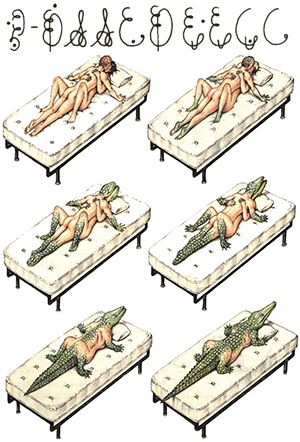

The Codex Seraphinianus is a book written and illustrated by the Italian artist, architect and industrial designer Luigi Serafini during thirty months, from 1976 to 1978. The book is a visual encyclopedia of an unknown world, written in one of its languages, a thus-far undeciphered alphabetic writing. The Codex is divided into eleven chapters, partitioned into two sections. The first section appears to describe the natural world, dealing with flora, fauna, and physics. The second deals with the humanities, the various aspects of human life: clothing, history, cuisine, architecture and so on. The illustrations are often surreal parodies of things in our world: bleeding fruit; a plant that grows into roughly the shape of a chair and is subsequently made into one; a lovemaking couple that metamorphoses into an alligator; etc.
The language of the codex has defied complete analysis by linguists for decades. The number system used for numbering the pages, however, has been discovered to be a variation of base 21. In a talk at the Oxford University Society of Bibliophiles held in 2009, Serafini stated that the script of the Codex is asemic, that his own experience in writing it was closely similar to automatic writing, and that what he wanted his alphabet to convey to the ‘reader’ is the sensation that children feel in front of books they cannot yet understand, although they see that their writing does make sense for grown-ups.
Posted in Art, Humor, Language |
2 Comments »
November 11, 2010

The Eames [eemz] Lounge Chair, officially titled Eames Lounge (670) and Ottoman (671), were released in 1956 after years of development by designers Charles and Ray Eames for the Herman Miller furniture company. It was the first chair the Eames designed for a high-end market. They are made of molded plywood and leather, and examples of these furnishings are part of the permanent collection of New York’s Museum of Modern Art. They are prized for comfort, aesthetics, and for the pioneering use of new materials and manufacturing methods.
There is a decent used market for these chairs. Some collectors are willing to pay high prices for earlier chairs made with Brazilian Rosewood veneer, which is no longer available due to a worldwide embargo since 1992. Prices for original rosewood chairs have recently reached as much as $7,000 in auction. A new Eames Lounge Chair and ottoman starts at $3,200 for a Herman Miller model. In 2006, to commemorate the 50th anniversary of the chair, Herman Miller released models using a sustainable Palisander Rosewood veneer.
Posted in Art, Money, Technology |
Leave a Comment »
November 9, 2010

Jay Pinkerton (born June 15, 1977) is a nationally published humorist and a former editor of both CRACKED.com and Cracked magazine. Prior to joining Cracked, Pinkerton served as the managing editor of NationalLampoon.com. Since joining Cracked, Pinkerton has helped make CRACKED.com a leading comedy site, including by bringing in new contributors.
Jay Pinkerton initially registered his website, Jaypinkerton.com, to be a portfolio of his comedy and artwork. Afterwards, Pinkerton joined the forums of the Internet humor website ‘Pointless Waste of Time’ (PWOT), and took the attention of the site’s owner, David Wong, with whom Pinkerton worked with on a series of comedy articles. It was around this time that he first published his redone Spider-Man comics, spawning an Internet phenomenon. In addition to Cracked, Pinkerton’s work has also appeared on McSweeney’s Internet Tendency, Modern Humorist, CollegeHumor.com and numerous other sites. He has also been hired by Valve Software to write some of the sequel to Portal, Portal 2.
Posted in Art, Humor |
Leave a Comment »
November 4, 2010

The Roland TR-808 Rhythm Composer was one of the first programmable drum machines. Introduced by the Roland Corporation in early 1980, it was originally manufactured for use as a tool for studio musicians to create demos. Like earlier Roland drum machines, it does not sound very much like a real drum kit.
One of the machine’s earliest mainstream hits in the United States was on Marvin Gaye’s ‘Sexual Healing.’ A TR-808 was also David Byrne’s sole accompaniment (apart from his acoustic guitar) at the beginning of ‘Stop Making Sense.’
read more »
Posted in Art, Technology |
Leave a Comment »
November 4, 2010

Reason is a music software program developed by Swedish software developers Propellerhead Software. It emulates a rack of hardware synthesizers, samplers, signal processors, sequencers and mixers, all of which can be freely interconnected in an arbitrary manner. Reason can be used either as a complete virtual music studio, or as a collection of virtual instruments to be played live or used with other sequencing software. As of August 2010 Reason was at version 5.0, version 1.0 was released in November 2000.
Posted in Art, Technology |
Leave a Comment »
November 4, 2010
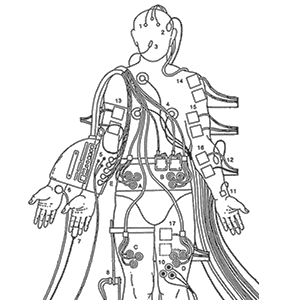
Stelarc (Stelios Arkadiou) is a Greek-Australian performance artist whose works focuses heavily on extending the capabilities of the human body. As such, most of his pieces are centred around his concept that the human body is obsolete. He is currently a visiting Professor in the School of Arts at Brunel University, West London.
In 2007, Stelarc had a cell-cultivated ear surgically attached to his left arm. In 2005, MIT Press published ‘Stelarc: The Monograph’ which is the first extensive study of his prolific work.
Posted in Art, Science, Technology |
Leave a Comment »




 The Daily Omnivore