September 14, 2010

For the Love of God is a sculpture by English artist Damien Hirst produced in 2007. It consists of a platinum cast of a human skull encrusted with 8,601 flawless diamonds, which weigh over 1,106.18 carats in total, including a pear-shaped pink diamond located in the forehead. Costing £14 million to produce, the work went on display at the White Cube gallery in London in an exhibition called ‘Beyond Belief’ with an asking price of £50 million. The work’s title was supposedly inspired by Hirst’s mother, who once asked, ‘For the love of God, what are you going to do next?’
Hirst said that the work was sold on August, 30 2007, for £50 million, to an anonymous consortium. Christina Ruiz, editor of The Art Newspaper, claims that Hirst had failed to find a buyer and had been trying to offload the skull for £38 million. Immediately after these allegations were made, Hirst claimed he had sold it for the full asking price, in cash, leaving no paper trail. The consortium that bought the piece included Hirst himself. Art critic David Lee commented, ‘Everyone in the art world knows Hirst hasn’t sold the skull. It’s clearly just an elaborate ruse to drum up publicity and rewrite the book value of all his other work.’
Posted in Art, Money |
Leave a Comment »
September 14, 2010


Italo disco is a broad term, encompassing much of the dance music output in Europe during the 1980s. It is one of the world’s first forms of completely electronic dance music and evolved during the late 1970s and early 1980s in Italy, Germany, the Netherlands and other parts of Europe. Italo disco music has a distinct, futuristic and spacey sound, which was created using synthesizers, drum machines and vocoders. The term ‘Italo disco’ was marketed only in Europe in the early 1980s by the German record label ZYX Music. Prior to 1983, the music was simply considered dance or disco music from Europe.
Posted in Art, World |
Leave a Comment »
September 13, 2010
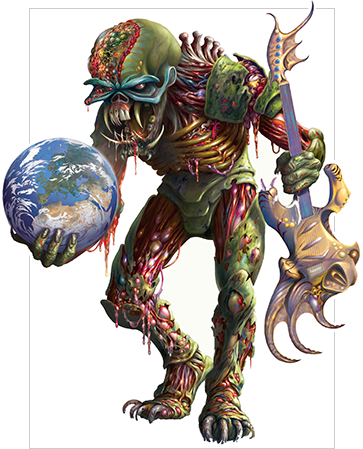

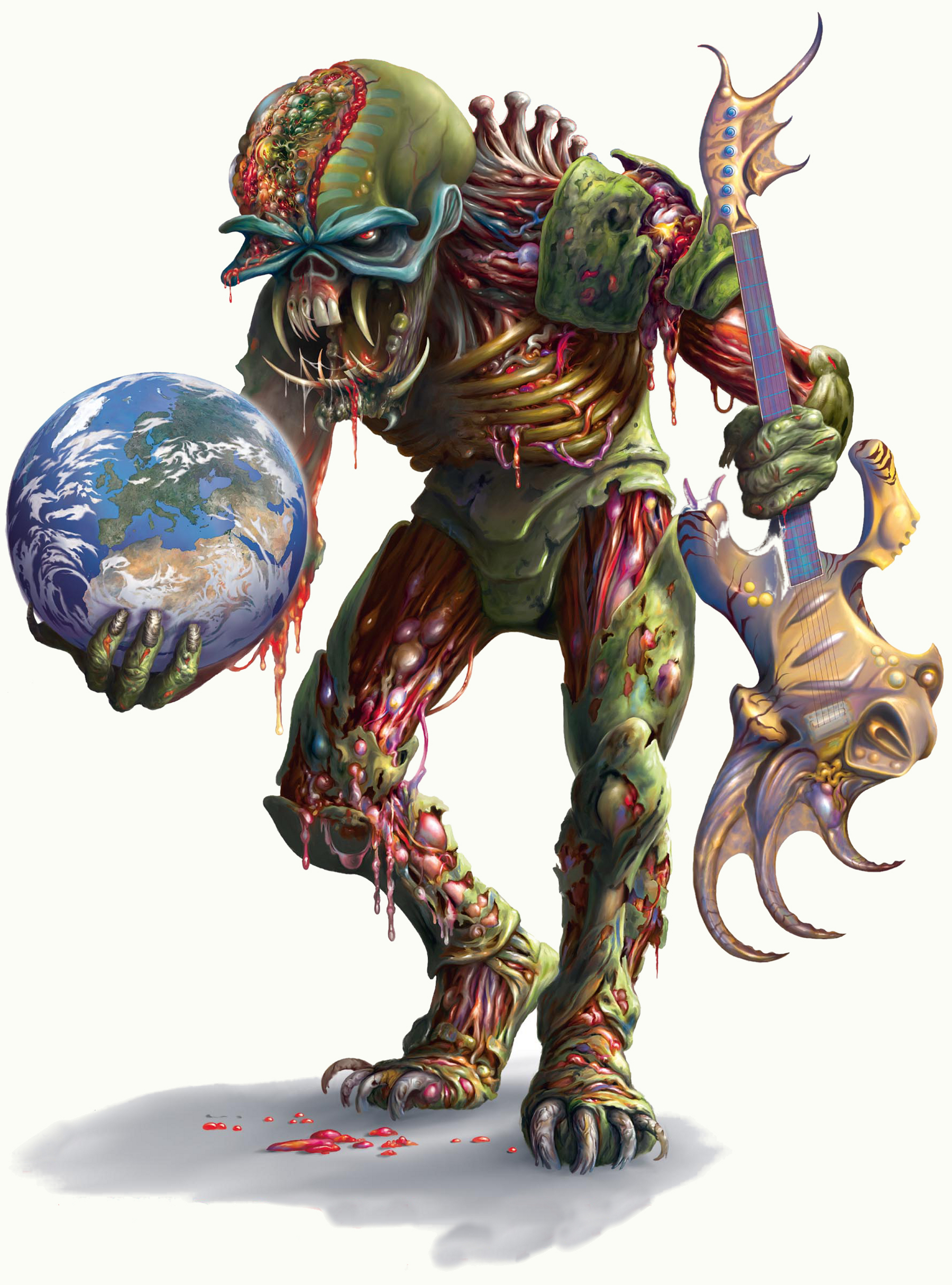
Eddie the Head is the mascot for the British heavy metal band Iron Maiden. He is a perennial fixture in the album cover art, as well as ever present in their live shows.The character was created by artist Derek Riggs. Riggs claimed that the design was based on a Japanese head he saw on a television documentary, hanging on the side of a burned out tank at the Matanikau River during the Battle for Henderson Field, October 24, 1942. The original Eddie was just a theatrical mask. It was connected to a pump that would eject various kinds of liquids, from food dye to paint, and would drool over Doug Sampson who was the drummer at the time.
The name originates from an old joke: Eddie the head was born with no body, no arms, and no legs. All he had was a head. But despite this major birth defect, his parents still loved him very much. So on his sixteenth birthday, his parents found a doctor that could surgically give Eddie a body. When the parents got home, they couldn’t wait to tell him that he could finally have a body and be like other normal people. When Eddie got there, they were really excited and said, ‘Have we got a surprise for you. It’s the best present ever!’ And Eddie said, ‘Oh no, not another f*****’ hat!’
Posted in Art, Humor |
Leave a Comment »
September 12, 2010

Bebop [bee-bop] or bop is a style of jazz characterized by fast tempo, instrumental virtuosity and improvisation based on the combination of harmonic structure and melody. It was developed in the early and mid-1940s. It first surfaced in musicians’ argot some time during the first two years of American involvement in WWII. This style of jazz ultimately became synonymous with modern jazz, as either category reached a certain final maturity in the 1960s.
read more »
Posted in Art, Language |
Leave a Comment »
September 12, 2010


Domo Kun is the official mascot of NHK television station, appearing in several 30 second stop-motion interstitial sketches shown as station identification during shows. NHK is Japan’s national public broadcasting organization. The name ‘Domo’ was acquired during the second episode of his show in which a TV announcer said, ‘dōmo, konnichiwa,’ which is a greeting meaning something along the lines of, ‘Well, hello there!” but which can also be interpreted as ‘Hello, Domo!’ The suffix ‘kun’ is a Japanese honorific often used with young males.
Posted in Art, Humor, World |
Leave a Comment »
September 11, 2010

DJ-Kicks is a series of DJ mix albums, mixed by various artists for the independent record label !K7 Records. The series started out in 1995 as a compilation of electronic DJ club-style mixes in the techno or house genres, with the then-novel twist of being targeted to a home listening audience. Soon afterwards, both the choice of compilers and the genres included were expanded: In addition to DJs, more and more producers (like Terranova), remixers (like Kruder & Dorfmeister), bands (like the Stereo MCs) and musicians (like Nicolette) compiled DJ-Kicks albums. The actual music began to vary wildly as well, ranging from Trüby Trio’s downbeat jazz sound to Kemistry & Storm’s aggressive drum and bass. Still, all contributions remain broadly within the electronic music genre.
The first DJ-Kicks release was C.J. Bolland’s in 1995, and the series is still regularly expanded. As of October 2006, there are 28 releases in the series, with a release rate of roughly two to three new ones each year. Some of the DJ-Kicks mixes are very popular and counted among the regular albums of the compiler, most notably the one by Kruder & Dorfmeister. The DJ-Kicks series has been called ‘the most important DJ-mix series ever’ by Mixmag.
Posted in Art |
Leave a Comment »
September 3, 2010

Contact juggling is a form of object manipulation that focuses on the movement of objects such as balls in contact with the body. Although often used with ‘toss’ juggling, it typically involves the rolling of one or more balls on the hands and arms to create visual illusions without releasing the props into the air. It is divided into three main techniques: body rolling (manipulating one or more props around the hands, arms, and body), palm spinning (manipulating two or more balls in the open hand so that at least one ball is in motion), and isolation (manipulating a ball so that it appears to be suspended in place).
Some of the manipulations have been performed for centuries, but contact juggling in its modern form originated with a routine called ‘Light’ developed by Michael Moschen in the 1980s. He received high regard from the international circus community for his range of innovative new techniques, and was awarded the MacArthur genius grant in 1990.
Posted in Art, Games |
Leave a Comment »
August 25, 2010

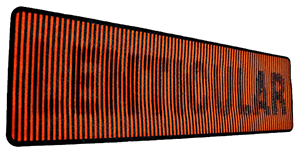
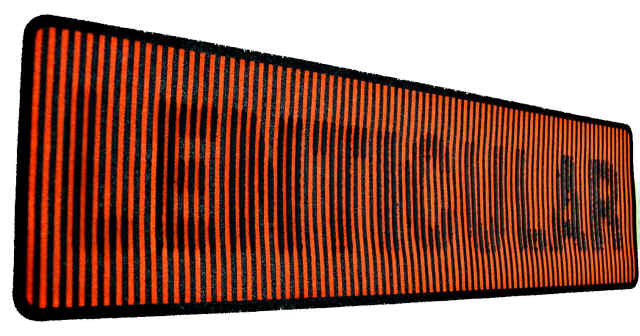
Lenticular [len-tik-yuh-ler] printing is a technology in which a lenticular lens (an array of magnifying lenses, designed so that when viewed from slightly different angles, different images are magnified) is used to produce images with an illusion of depth, or the ability to change or move as the image is viewed from different angles. This technology was created in the 1940s but has evolved in recent years to show more motion and increased depth.
Posted in Art, Technology |
Leave a Comment »
August 25, 2010

Ming the Merciless is a fictional character who first appeared in the Flash Gordon comic strip in 1934. He has since been the main villain of the strip and its related movie serials, TV shows and film adaptation. The capital of his empire is named ‘Mingo City’ in his honour. In addition to his army, Ming has access to a wide variety of science fiction gadgets, ranging from rocket ships to death rays to robots.
Posted in Art |
Leave a Comment »
August 24, 2010

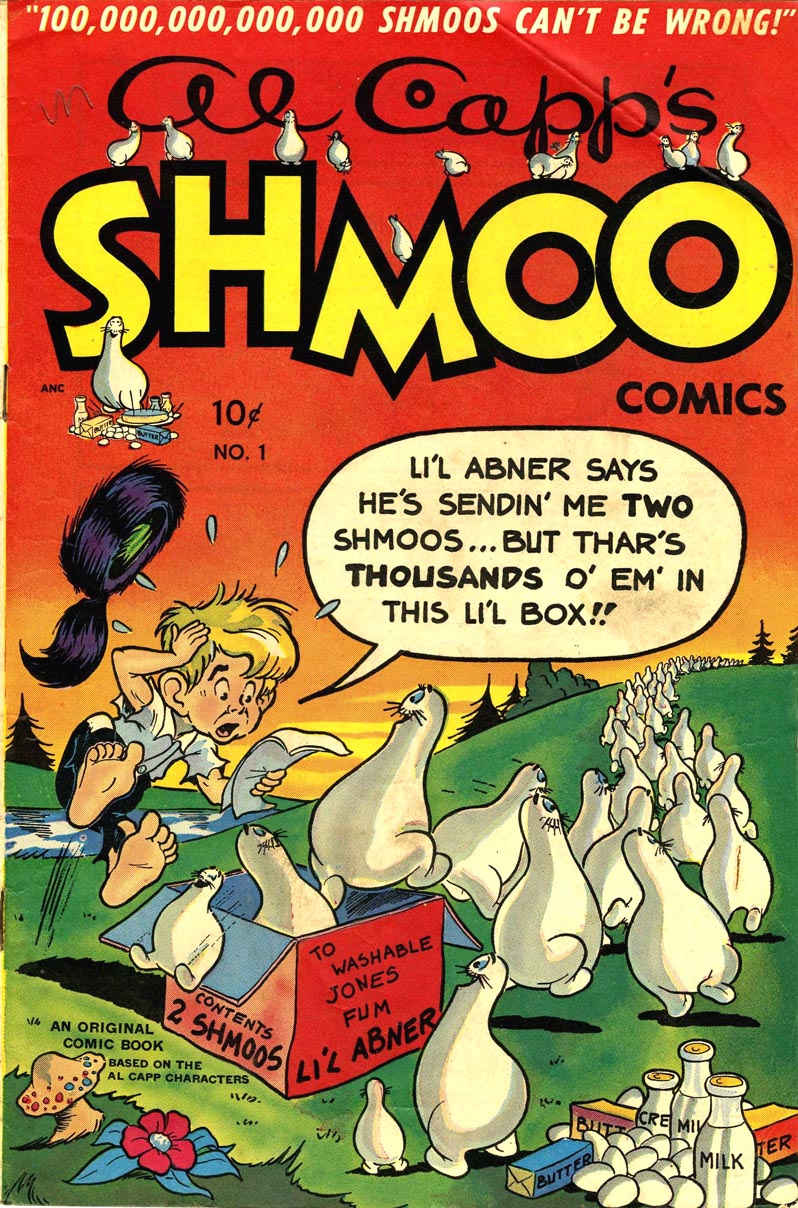
A shmoo is a fictional cartoon creature created by Al Capp. They first appeared in his comic strip ‘Li’l Abner’ on August 31, 1948, and quickly became a postwar national craze in the USA. Shmoon reproduce asexually, require no sustenance other than air, make good pets, are delicious to eat, and are eager to be eaten. Their pelts make perfect boot leather or house timber, depending on how thick you slice it. They have no bones, their eyes make the best suspender buttons, and their whiskers make perfect toothpicks. In short, they are the ideal herd animal.
In the comic strip the frolicking of shmoon is so entertaining that people no longer feel the need to watch television or go to the movies. It’s been used in discussions of socioeconomics, for instance, a widget is any material good which is produced through labor from a finite resource. In contrast, a shmoo is a material good that reproduces itself and is captured or bred as an economic activity.
Posted in Art, Humor, Money |
Leave a Comment »
August 16, 2010
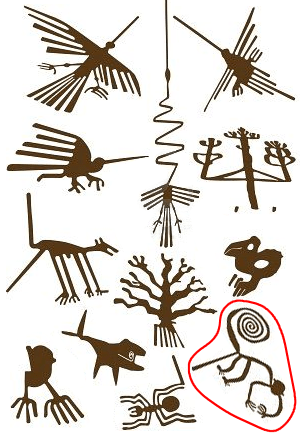
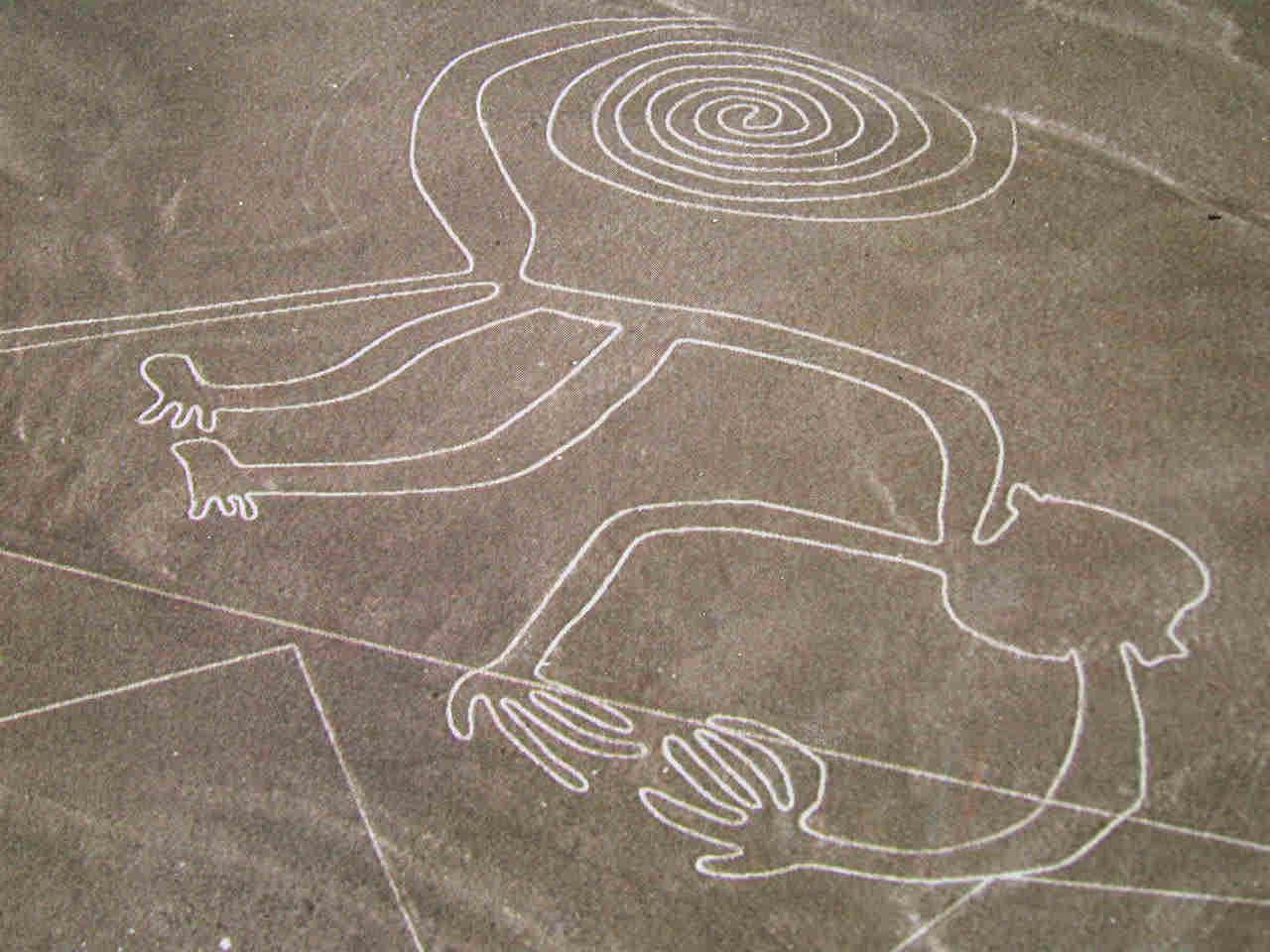
The Nazca Lines are a series of ancient geoglyphs located in the Nazca Desert of Peru. They have been designated a UNESCO World Heritage Site. Scholars believe the Nazca Lines were created by the Nazca culture between 400 and 650 AD. The hundreds of individual figures range in complexity from simple lines to stylized hummingbirds, spiders, monkeys, fish, sharks or orcas, llamas, and lizards.
The lines are shallow designs made in the ground by removing the ubiquitous reddish pebbles and uncovering the whitish ground beneath. Hundreds are simple lines or geometric shapes; more than seventy are designs of animal, bird, fish or human figures. The largest figures are over 660 ft across. Scholars differ in interpreting the purpose of the designs, but they generally ascribe religious significance to them, as they were major works that required vision, planning and coordination of people to achieve.
Posted in Art, World |
Leave a Comment »
August 16, 2010
Bele Chere is an annual music and arts street festival held in downtown Asheville, North Carolina. The festival has been held annually on the last weekend in July since the late 1970s. It is the largest free festival in the Southeastern United States, attracting over 350,000 people. Displayed art covers a variety of media types including painting, photography, pottery and jewelry. A variety of music genres are represented at the festival, including Country, Blues, Folk, Mountain, Rock and Jazz .
Posted in Art |
Leave a Comment »





 The Daily Omnivore