May 17, 2015

Grim Fandango is a dark comedy neo-noir adventure game released by LucasArts in 1998 for Windows, with game designer Tim Schafer as project leader. It is the first adventure game by LucasArts to use 3D computer graphics overlaid on pre-rendered, static backgrounds. As with other LucasArts adventure games, the player must converse with other characters and examine, collect, and use objects correctly to solve puzzles in order to progress.
Grim Fandango ’s world combines elements of the Aztec belief of afterlife with style aspects of film noir, including ‘The Maltese Falcon,’ ‘On the Waterfront, ‘and ‘Casablanca,’ to create the Land of the Dead, through which recently departed souls, represented in the game as calaca-like figures, must travel before they reach their final destination, the Ninth Underworld. The story follows travel agent Manuel ‘Manny’ Calavera as he attempts to save Mercedes ‘Meche’ Colomar, a newly arrived but virtuous soul, during her long journey.
read more »
Posted in Art, Games, Humor |
Leave a Comment »
May 1, 2015

Leaves of Grass is a collection of poetry by Walt Whitman praising sensuality, the material world, nature, and the experience of the senses. The book was published at Whitman’s own expense in 1855, a period where poetry focused on the soul and organized religion, and was a failure at first. Whitman spent most of his professional life writing and rewriting the book, revising it multiple times until his death. This resulted in vastly different editions over four decades—the first a small book of twelve poems and the last a compilation of over 400.
The collection is notable for its discussion of delight in carnal pleasures during a time when such candid displays were considered immoral. Where much previous poetry, especially English, relied on symbolism, allegory, and meditation on the religious and spiritual, ‘Leaves of Grass’ (particularly the first edition) exalted the physical form and ephemera. Influenced by Ralph Waldo Emerson and the Transcendentalist movement, itself an offshoot of Romanticism, Whitman’s poetry praises nature and the individual’s role in it. However, much like Emerson, Whitman does not diminish the role of the mind or the spirit; rather, he elevates the human form and mind, deeming both worthy of poetic praise.
read more »
Posted in Art, Language, Philosophy |
Leave a Comment »
April 29, 2015

The United Federation of Planets, usually referred to as ‘the Federation,’ is an interstellar federal republic composed of planetary sovereignties depicted in the ‘Star Trek’ science fiction franchise. Formed in 2161, the planetary governments voluntarily exist semi-autonomously under a single central government based on the Utopian principles of universal liberty, rights, and equality, and to share their knowledge and resources in peaceful cooperation and space exploration.
The Federation is described a post-capitalist, libertarian, constitutional republic, which was composed of more than 150 member planets and thousands of colonies spread across some 6,000,000 cubic light years of the Milky Way Galaxy by 2373. The social structure within the Federation is classless and operates within a moneyless ‘New World Economy.’ It is described as stressing, at least nominally, the values of universal liberty, equality, justice, peace, and cooperation. The Federation also maintains its own quasi-militaristic and scientific exploratory agency, known as ‘Starfleet’ which handles many other governmental processes, sometimes with no other agency’s influence, such as border defense and diplomatic relations.
read more »
Posted in Art, Money, Politics |
Leave a Comment »
April 17, 2015

Terry Gross (b. 1951) is the host and co-executive producer of ‘Fresh Air,’ an interview format radio show produced by ‘WHYY-FM,’ the flagship National Public Radio (NPR) station in Philadelphia. The show is broadcast nationally by NPR. Gross has won praise over the years for her low-key and friendly yet often probing interview style and for the diversity of her guests. She has a reputation for researching her guests’ work largely the night before an interview, often asking them unexpected questions about their early careers.
Gross grew up in a Jewish family in Sheepshead Bay, Brooklyn. She earned a bachelor’s degree in English and a master’s degree in communications from SUNY, Buffalo. She began a teaching career, but said that she was ‘totally unequipped’ for the job, and was fired after only six weeks. Gross began her radio career in 1973 at ‘WBFO,’ a public radio station in Buffalo, where she had been volunteering. In 1975, she moved to WHYY-FM in Philadelphia to host and produce ‘Fresh Air,’ which was a local interview program at the time. In 1985, the show went national, being distributed weekly by NPR. It became a daily program two years later.
read more »
Posted in Art, Language, Politics |
1 Comment »
April 2, 2015

Stone Soup is an old folk story in which hungry strangers trick the local people of a town to share their food: a good confidence trick that benefits the group from combining their individual resources. The story is usually told as a lesson in cooperation, especially amid scarcity. In varying traditions, the stone has been replaced with other common inedible objects, and therefore the fable is also known as button soup, wood soup, nail soup, and axe soup. In the story, some hungry travellers come to a village carrying nothing more than an empty cooking pot. Upon their arrival, the villagers are unwilling to share any of their food stores with them.
The travellers go to a stream and fill the pot with water, drop a large stone in it, and place it over a fire. One of the villagers becomes curious and asks what they are doing. The travellers answer that they are making ‘stone soup,’ which tastes wonderful, but could use a little bit of garnish to improve the flavor. The villager does not mind parting with a few carrots to help them out, so that gets added to the soup. Another villager walks by, inquiring about the pot, and the travellers again mention their stone soup which has not reached its full potential yet. The villager hands them a little bit of seasoning to help them out. More and more villagers walk by, each adding another ingredient. Finally, a delicious and nourishing pot of soup is enjoyed by all.
read more »
Posted in Art, Food, Humor |
Leave a Comment »
March 26, 2015
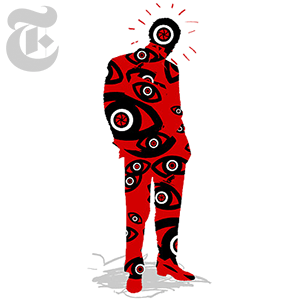
The Truman Show delusion, informally known as Truman Syndrome, is a type of persecutory/grandiose delusion in which patients believe their lives are staged plays or reality television shows. The term was coined in 2008 by brothers Joel and Ian Gold, a psychiatrist and a neurophilosopher, respectively, after the 1998 film ‘The Truman Show,’ about a man who discovers he is living in a constructed reality televised globally around the clock. Since he was in the womb, all the people in Burbank’s life have been paid actors.
The concept predates this particular film. It was based on a 1989 episode of the ‘Twilight Zone,’ ‘Special Service,’ which begins with the protagonist discovering a camera in his bathroom mirror. This man soon learns that his life is being broadcast 24/7 on TV. Author Philip K. Dick has also written short stories and, most notably, a novel, ‘Time Out of Joint’ (1959), in which the protagonist lives in a created world in which his ‘family’ and ‘friends’ are paid to maintain the delusions.
read more »
Posted in Art, Health, Technology |
Leave a Comment »
March 11, 2015

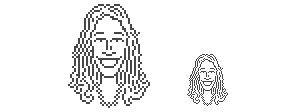
Susan Kare (b. 1954) is an artist and graphic designer who created many of the interface elements for the Apple Macintosh in the 1980s. She left Apple with Steve Jobs in 1985 to be the Creative Director at his new company NeXT.
Kare was born in Ithaca, New York, and is the sister of noted aerospace engineer Jordin Kare. She graduated from Harriton High School in 1971, received her B.A., summa cum laude, in Art from Mount Holyoke College in 1975 and her Ph.D. from New York University in 1978. She next moved to San Francisco and worked for the Museum of Modern Art. Today, the MOMA store in New York City carries stationery and notebooks featuring her designs.
read more »
Posted in Art, Technology |
Leave a Comment »
March 6, 2015

Alebrijes [ah-lay-bree-hay] are brightly colored Oaxacan folk art sculptures of fantastical creatures. The first alebrijes, along with use of the term, originated with Mexican artisan Pedro Linares (1906 – 1992). Linares specialized in making piñatas, carnival masks, and ‘Judas’ figures from papier-mâché. In the 1930s, he fell ill and dreamt of a strange place resembling a forest. There, he saw clouds that transformed into strange, brightly colored animals. He saw a donkey with butterfly wings, a rooster with bull horns, a lion with an eagle head, and all of them were shouting the nonsensical word, ‘Alebrijes.’ Upon recovery, he began recreating the creatures he saw in cardboard and paper mache and called them Alebrijes.
His work caught the attention of a gallery owner in Cuernavaca, in the south of Mexico and later, of artists Diego Rivera and Frida Kahlo. In the 1980s, British Filmmaker, Judith Bronowski, arranged an itinerant Mexican art craft demonstration workshop in the US featuring Linares, Manuel Jiménez, and a textile artisan Maria Sabina. Linares demonstrated his designs on family visits and which were adapted to the carving of a local wood called copal. The paper mache-to-wood carving adaptation was pioneered by Jiménez. This version of the craft has since spread to a number of other towns, most notably San Martín Tilcajete and La Unión Tejalapan, and become a major source of income for the area, especially for Tilcajete. The success of the craft, however, has led to the depletion of the native copal trees.
Posted in Art, World |
Leave a Comment »
March 3, 2015

The Up Against the Wall Motherfuckers (often referred to as simply ‘The Motherfuckers,’ or UAW/MF) was an anarchist affinity group based in New York City. This ‘street gang with analysis’ was famous for its Lower East Side direct action and is said to have inspired members of the Weather Underground (a radical leftist group), as well as counterculture leader Abbie Hoffman’s Yippies.
The Motherfuckers grew out of a Dada-influenced art group called Black Mask with some additional people involved with the anti-Vietnam War ‘Angry Arts’ week, held in January 1967. Formed in 1966 by painter Ben Morea and the poet Dan Georgakas, Black Mask produced a broadside of the same name and declared that revolutionary art should be ‘an integral part of life, as in primitive society, and not an appendage to wealth.’ In May 1968, Black Mask changed its name and went underground. Their new name, ‘Up Against the Wall Motherfuckers,’ came from a poem by Amiri Baraka. Abbie Hoffman characterized them as ‘the middle-class nightmare… an anti-media media phenomenon simply because their name could not be printed.’
read more »
Posted in Art, Politics, War |
Leave a Comment »
March 1, 2015

L’arrivée d’un train en gare de La Ciotat (‘The Arrival of a Train at La Ciotat Station,’ known in the UK as ‘Train Pulling into a Station’) is an 1895 French short black-and-white silent documentary film directed and produced by filmmaking pioneers Auguste and Louis Lumière. Contrary to myth, it was not shown at the Lumières’ first public film screening on December 28th, 1895 in Paris (the first public showing took place in January 1896). The train moving directly towards the camera was said to have terrified spectators at the first screening, a claim that has been called an urban legend.
This 50-second silent film shows the entry of a train pulled by a steam locomotive into a train station in the French coastal town of La Ciotat. Like most of the early Lumière films it consists of a single, unedited view illustrating an aspect of everyday life. There is no apparent intentional camera movement, and the film consists of one continuous real-time shot. This 50-second movie was filmed by means of the Cinématographe, an all-in-one camera, which also serves as a printer and film projector. As with all early Lumière movies, this film was made in a 35 mm format with an aspect ratio of 1.33:1.
read more »
Posted in Art, Technology |
1 Comment »
February 23, 2015
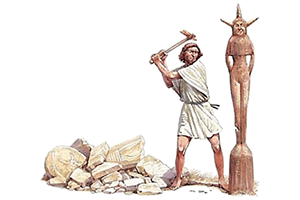

Aniconism [an-ahy-kuh-niz-uhm] is the practice of or belief in the avoiding or shunning of images of divine beings, prophets or other respected religious figures, or in different manifestations, any human beings or living creatures. The term ‘aniconic’ may be used to describe the absence of graphic representations in a particular belief system, regardless of whether an injunction against them exists.
An avoidance and repugnance of holy representations is called ‘iconophobia,’ its antonymic reaction being that of an ‘iconodule’ (one who is in favor of religious images or icons and their veneration). Aniconism can lead to iconoclasm, the destruction of sacred images as heretical. Aniconism can also lead to censorship, which takes place after a representation was already produced, but before, or shortly after, it is made public.
read more »
Posted in Art, Philosophy, Politics |
Leave a Comment »
February 21, 2015

Wim Delvoye (b. 1965 ) is a Belgian neo-conceptual artist known for his inventive and often shocking projects. Much of his work is focused on the body, and he is perhaps best known for his digestive machine, Cloaca, which he unveiled at the Museum voor Hedendaagse Kunst, Antwerp, after eight years of consultation with experts in fields ranging from plumbing to gastroenterology. In a comment on the Belgians’ love of fine dining, Cloaca is a large installation that turns food into feces, allowing Delvoye to explore the digestive process. The food begins at a long, transparent mouth, travels through a number of enzyme filled, machine-like assembly stations, and ends in hard matter which is separated from liquid through a cylinder. Delvoye collects and sells the realistically smelling output, suspended in small jars of resin at his Ghent studio.
When asked about his inspiration, Delvoye stated that everything in modern life is pointless. The most useless object he could create was a machine that serves no purpose at all, besides the reduction of food to waste. Previously, Delvoye claimed that he would never sell a Cloaca machine to a museum as he could never trust that the curator would maintain the installation properly. However after two years of discussion with David Walsh, Delvoye agreed to construct a custom Cloaca built specifically for the Museum of Old and New Art in Hobart, Tasmania. The new installation is suspended from the museum ceiling in a room custom-built for it.
Posted in Art, Health, Humor |
Leave a Comment »





 The Daily Omnivore