November 3, 2015

QI (‘Quite Interesting’) is a British television quiz show hosted by comedian Stephen Fry. There are four contestants in each show, of whom one is always stand-up comic Alan Davies. Most of the questions are extremely obscure, making it unlikely that the correct answer will be given. To compensate, points are awarded not only for right answers, but also for interesting ones, regardless of whether they are right or even relate to the original question.
QI has stated it follows a philosophy: everything in the world, even that which appears to be the most boring, is ‘quite interesting’ if looked at in the right way.
read more »
Posted in Art, Games, Humor |
1 Comment »
October 22, 2015

Vinyl revival refers to the renewed interest and increased sales of vinyl records since 2006. The analoge format made of polyvinyl chloride had been the main vehicle for the commercial distribution of pop music from the 1950s until the 1980s and 1990s when they were replaced by the Compact Disc. Since the early 2000s CDs have been partially replaced by digital downloads; conversely, vinyl sales have started growing. In some territories, vinyl is now more popular than it has been since the late 1980s, though vinyl records still make up only a marginal percentage (<3%) of overall music sales.
Founded in 2007, ‘Record Store Day’ is an internationally celebrated day observed the third Saturday of April each year. Its purpose, as conceived by independent record store employee Chris Brown, is to celebrate the art of music. The day brings together fans, artists, and thousands of independent record stores across the world.
Posted in Art, Money |
Leave a Comment »
October 21, 2015

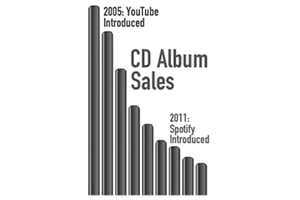
Tower Records was an American retail music chain that liquidated in 2006. The brand currently exists as an international franchise and an online music store. Tower.com was purchased by a separate entity and was not affected by the retail store closings.
Tower was founded in 1960 by Russell Solomon in Sacramento, California. The store was named after his father’s drugstore, which shared a building and name with the Tower Theater, where Solomon first started selling records. The first Tower Records store was opened in 1960 on Watt Avenue in Sacramento. By 1976, Solomon had opened Tower Books, Posters, and Plants at 1600 Broadway, next door to Tower Records. It was also one of the first retailers to move online in 1995 as Tower.com.
read more »
Posted in Art, Money, World |
Leave a Comment »
October 12, 2015

Hamilton is a 2015 musical written and performed by Lin-Manuel Miranda, inspired by the biography ‘Alexander Hamilton,’ by Ron Chernow. ‘The New Yorker’ said the show was ‘Rooted in hip-hop, but also encompassing R&B, jazz, pop, Tin Pan Alley, and the choral strains of contemporary Broadway, the show is an achievement of historical and cultural reimagining.’
The play begins with Aaron Burr and others giving a summary of Alexander Hamilton’s early life and poses the question: How can a penniless immigrant from the Caribbean, abandoned by his father at age ten, who watched his mother die when he was 12 and his town destroyed by a hurricane at age 17, use the power of his writing and idealism to become a man who shaped a nation?
Posted in Art, Politics |
Leave a Comment »
October 9, 2015


An alternative newspaper is a type of newspaper that eschews comprehensive coverage of general news in favor of stylized reporting, opinionated reviews and columns, investigations into edgy topics, and magazine-style feature stories highlighting local people and culture.
Its news coverage is more locally focused and their target audiences younger than those of daily newspapers. Typically, alternative newspapers are published in tabloid format and printed on newsprint. Most metropolitan areas of the United States and Canada are home to at least one alternative paper.
read more »
Posted in Art, Language, World |
1 Comment »
October 8, 2015

Massimo [ma-see-moh] Vignelli [veen-yell-ee] (1931 – 2014) was an Italian graphic and industrial designer who worked in a number of areas including product packaging, housewares, furniture, public signage, and showrooms. He was the co-founder of Vignelli Associates, with his wife, Lella. His ethos was, ‘If you can design one thing, you can design everything,’ and this was reflected in the broad range of his work. Vignelli worked firmly within the Modernist tradition, and focused on simplicity through the use of basic geometric forms in all his work.
His educational background was in architecture, which he studied at the Politecnico di Milano and later at the Università di Architettura, Venice. From 1957 to 1960, he visited America on a fellowship, and returned to New York in 1966 to start the New York branch of a new company, Unimark International, which quickly became, in scope and personnel, one of the largest design firms in the world.
read more »
Posted in Art, Money, World |
1 Comment »
September 30, 2015

Edisonade is a modern term, coined in 1993 by John Clute in his and Peter Nicholls’ ‘The Encyclopedia of Science Fiction,’ for fictional stories about a brilliant young inventor and his inventions. This subgenre started in the Victorian and Edwardian eras and had its apex of popularity during the late 19th and early 20th centuries, and was common in ‘scientific romance,’ an archaic term for the genre of fiction now known as ‘science fiction.’
The term ‘Edisonade’ originated in the 1850s to describe both fiction and elements of scientific writing, but has since come to refer to the science fiction of the late nineteenth and early twentieth century, primarily that of Jules Verne, H. G. Wells, and Arthur Conan Doyle. In recent years, the term has come to be applied to science fiction written in a deliberately anachronistic style, as a homage to or pastiche of the original scientific romances.
read more »
Posted in Art, Language, Technology |
Leave a Comment »
September 28, 2015


Tinker Hatfield (b. 1952) is the designer of many of Nike’s most popular and innovative athletic shoe designs, including the Air Jordan 3 through Air Jordan 15, the twentieth anniversary Air Jordan, the Air Jordan XXIII, XXV, XXIX, and other athletic sneakers including the world’s first ‘cross training’ shoes, the Nike Air Trainer. Hatfield oversees Nike’s ‘Innovation Kitchen.’ He is Nike’s Vice President for Design and Special Projects.
He attended the University of Oregon, where he ran track for coach and Nike co-founder Bill Bowerman, and at one time had the pole-vault record at the school. Academically, he studied architecture and graduated with a degree from the University of Oregon School of Architecture. Hatfield joined Nike in 1981, and in 1985 started working on shoe design, believing that his architectural skills could be applied to footwear.
read more »
Posted in Art, Games, Money |
Leave a Comment »
September 20, 2015

A ghost light is an electric light that is left lit on the stage of an unoccupied theater. It typically consists of an exposed bulb mounted in a wire cage on a portable light stand near center stage. Ghost lights are also sometimes known as ‘equity lights’ or ‘equity lamps,’ possibly indicating their use was originally mandated by the Actors’ Equity Association. A ghost light enables one to navigate the theater to find the lighting control console and to avoid accidents such as falling into the orchestra pit or damaging set pieces. Aside from its obvious practical purpose, there are a number of superstitions associated with the origin and purpose of ghost lights.
A popular legend holds that every theater has a ghost. Some theaters have traditions to appease ghosts that reach far back into their history. For example, the Palace Theatre, London keeps two seats in their balcony permanently bolted open to provide seating for the theater ghosts. Similar superstitions hold that ghost lights provide opportunities for ghosts to perform onstage, thus appeasing them and preventing them from cursing the theater or sabotaging the set or production. The use of ghost lights might also be a throwback to the 1800s when theaters were lit with gas lamps. Leaving a flame burning would prevent the buildup of pressure in the gas lines which could cause an explosion.
Posted in Art, Philosophy, Technology |
Leave a Comment »
September 18, 2015

Colonel Tom Parker (1909 – 1997), born Andreas Cornelis van Kuijk, was a Dutch-born American entertainment impresario known best as the manager of Elvis Presley. Parker’s management of Presley defined the role of masterminding talent management, which involved every facet of his life and was seen as central to the success of Presley’s career.
‘The Colonel’ displayed a ruthless devotion to his own financial gain rather than his client’s interests and took more than the traditional 10 to 15 percent of his earnings (reaching up to 50 percent by the end of Presley’s life). Presley said of Parker: ‘I don’t think I’d have ever been very big if it wasn’t for him. He’s a very smart man.’ For many years Parker falsely claimed to have been US-born, but it eventually emerged that he was born in Breda in the Netherlands.
read more »
Posted in Art, Money, Politics |
Leave a Comment »
September 7, 2015
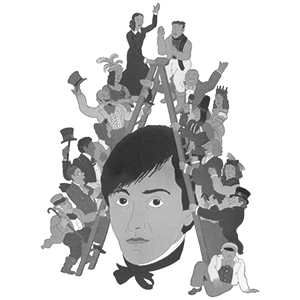
Nicholas Nickleby is a novel by Charles Dickens. Originally published as a monthly serial from 1838 to 1839, it was Dickens’ third novel. The book centers on the life and adventures of Nicholas Nickleby, a young man who must support his mother and sister after his father dies. Dickens began writing ‘Nickleby’ while still working on ‘Oliver Twist’ and while the mood is considerably lighter, his depiction of the Yorkshire school run by Wackford Squeers is as moving and influential as those of the workhouse and criminal underclass in ‘Twist.’
Like most of Dickens’ early works, the novel has a contemporary setting. Much of the action takes place in London, with several chapters taking place in Dickens’ birthplace of Portsmouth, as well as settings in Yorkshire and Devon. The tone of the work is that of ironic social satire, with Dickens taking aim at what he perceives to be the class injustices of Victorian England. Many memorable characters are introduced, including Nicholas’ malevolent Uncle Ralph, and the villainous Wackford Squeers, who operates an abusive all-boys boarding school at which Nicholas temporarily serves as a tutor.
read more »
Posted in Art, Language |
Leave a Comment »
September 6, 2015
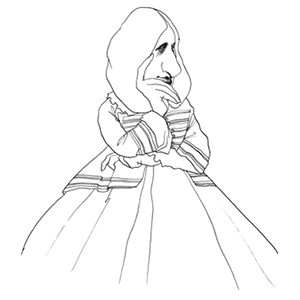
‘Silas Marner: The Weaver of Raveloe’ is the third novel by George Eliot, pen name of English novelist Mary Ann Evans. Published in 1861, it is an outwardly simple tale of a linen weaver, it is notable for its strong realism and its sophisticated treatment of a variety of issues ranging from religion to industrialization to community. Eliot’s novels often presented the cases of social outsiders and small-town persecution.
The novel is set in the early years of the 19th century. Silas Marner, a weaver, is a member of a small Calvinist congregation in Lantern Yard, a slum street in an unnamed city in Northern England. He is falsely accused of stealing the congregation’s funds while watching over the very ill deacon.
read more »
Posted in Art, Language |
1 Comment »



