March 3, 2015

The Up Against the Wall Motherfuckers (often referred to as simply ‘The Motherfuckers,’ or UAW/MF) was an anarchist affinity group based in New York City. This ‘street gang with analysis’ was famous for its Lower East Side direct action and is said to have inspired members of the Weather Underground (a radical leftist group), as well as counterculture leader Abbie Hoffman’s Yippies.
The Motherfuckers grew out of a Dada-influenced art group called Black Mask with some additional people involved with the anti-Vietnam War ‘Angry Arts’ week, held in January 1967. Formed in 1966 by painter Ben Morea and the poet Dan Georgakas, Black Mask produced a broadside of the same name and declared that revolutionary art should be ‘an integral part of life, as in primitive society, and not an appendage to wealth.’ In May 1968, Black Mask changed its name and went underground. Their new name, ‘Up Against the Wall Motherfuckers,’ came from a poem by Amiri Baraka. Abbie Hoffman characterized them as ‘the middle-class nightmare… an anti-media media phenomenon simply because their name could not be printed.’
read more »
Posted in Art, Politics, War |
Leave a Comment »
March 1, 2015

L’arrivée d’un train en gare de La Ciotat (‘The Arrival of a Train at La Ciotat Station,’ known in the UK as ‘Train Pulling into a Station’) is an 1895 French short black-and-white silent documentary film directed and produced by filmmaking pioneers Auguste and Louis Lumière. Contrary to myth, it was not shown at the Lumières’ first public film screening on December 28th, 1895 in Paris (the first public showing took place in January 1896). The train moving directly towards the camera was said to have terrified spectators at the first screening, a claim that has been called an urban legend.
This 50-second silent film shows the entry of a train pulled by a steam locomotive into a train station in the French coastal town of La Ciotat. Like most of the early Lumière films it consists of a single, unedited view illustrating an aspect of everyday life. There is no apparent intentional camera movement, and the film consists of one continuous real-time shot. This 50-second movie was filmed by means of the Cinématographe, an all-in-one camera, which also serves as a printer and film projector. As with all early Lumière movies, this film was made in a 35 mm format with an aspect ratio of 1.33:1.
read more »
Posted in Art, Technology |
1 Comment »
February 23, 2015
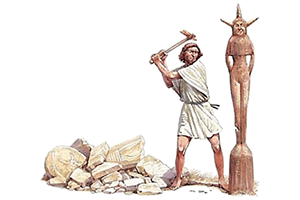

Aniconism [an-ahy-kuh-niz-uhm] is the practice of or belief in the avoiding or shunning of images of divine beings, prophets or other respected religious figures, or in different manifestations, any human beings or living creatures. The term ‘aniconic’ may be used to describe the absence of graphic representations in a particular belief system, regardless of whether an injunction against them exists.
An avoidance and repugnance of holy representations is called ‘iconophobia,’ its antonymic reaction being that of an ‘iconodule’ (one who is in favor of religious images or icons and their veneration). Aniconism can lead to iconoclasm, the destruction of sacred images as heretical. Aniconism can also lead to censorship, which takes place after a representation was already produced, but before, or shortly after, it is made public.
read more »
Posted in Art, Philosophy, Politics |
Leave a Comment »
February 21, 2015

Wim Delvoye (b. 1965 ) is a Belgian neo-conceptual artist known for his inventive and often shocking projects. Much of his work is focused on the body, and he is perhaps best known for his digestive machine, Cloaca, which he unveiled at the Museum voor Hedendaagse Kunst, Antwerp, after eight years of consultation with experts in fields ranging from plumbing to gastroenterology. In a comment on the Belgians’ love of fine dining, Cloaca is a large installation that turns food into feces, allowing Delvoye to explore the digestive process. The food begins at a long, transparent mouth, travels through a number of enzyme filled, machine-like assembly stations, and ends in hard matter which is separated from liquid through a cylinder. Delvoye collects and sells the realistically smelling output, suspended in small jars of resin at his Ghent studio.
When asked about his inspiration, Delvoye stated that everything in modern life is pointless. The most useless object he could create was a machine that serves no purpose at all, besides the reduction of food to waste. Previously, Delvoye claimed that he would never sell a Cloaca machine to a museum as he could never trust that the curator would maintain the installation properly. However after two years of discussion with David Walsh, Delvoye agreed to construct a custom Cloaca built specifically for the Museum of Old and New Art in Hobart, Tasmania. The new installation is suspended from the museum ceiling in a room custom-built for it.
Posted in Art, Health, Humor |
Leave a Comment »
February 18, 2015

‘All Is Full of Love‘ is a 1997 song by Icelandic musician Björk and is from her fourth studio album, ‘Homogenic.’ The lyrics are inspired by the presence of love in the advent of spring and Norse mythology’s Ragnarök (the universe ending clash of the gods). The more popular version of the track, the original mix solely produced by Björk, was used in the music video but did not appear in the album. The album version is a remix by Glaswegian producer Howie B and has a minimalist approach and places emphasis on the singer’s vocals. The video version of “All Is Full of Love” is a midtempo trip hop ballad with soul influences. In opposition to the sonically minimalist mix included in the album.
The music video was directed by British video artist Chris Cunningham and depicts the assembling of a robot with Björk’s features and her passionately kissing another robot against an ethereal and sterile backdrop. The song’s video garnered acclaim from critics and is commonly regarded as one of the best music videos of all time and a milestone in computer animation. The subject of much analysis and scrutiny, it was on permanent display at the Museum of Modern Art in New York City and has been included in various art exhibitions.
Posted in Art, Love |
Leave a Comment »
February 13, 2015
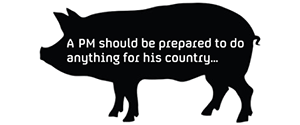
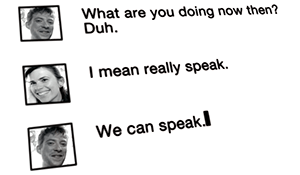
Black Mirror is a British television anthology series created by English broadcaster Charlie Brooker that features speculative fiction with dark and sometimes satirical themes that examine modern society, particularly with regard to the unanticipated consequences of new technologies. Regarding the program’s content and structure, Brooker noted, ‘each episode has a different cast, a different setting, even a different reality. But they’re all about the way we live now – and the way we might be living in 10 minutes’ time if we’re clumsy.’
He explained the series’ title to ‘The Guardian,’ noting: ‘If technology is a drug – and it does feel like a drug – then what, precisely, are the side-effects? This area – between delight and discomfort – is where ‘Black Mirror,’ my new drama series, is set. The ‘black mirror’ of the title is the one you’ll find on every wall, on every desk, in the palm of every hand: the cold, shiny screen of a TV, a monitor, a smartphone.’ The first series has been acclaimed as being innovative and shocking with twists-in-the-tale reminiscent of ‘The Twilight Zone.’ ‘The Daily Telegraph’ described the first episode as ‘a shocking but ballsy, blackly comic study of the modern media. A reporter from ‘The Beijing News’ thought the show was ‘an apocalypse of modern world,’ ‘desperate but profound.’
Posted in Art, Technology, World |
Leave a Comment »
December 26, 2014
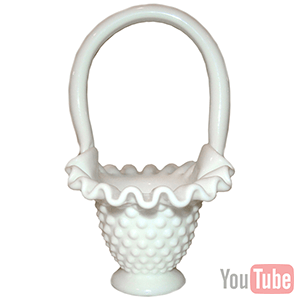
The Fenton Art Glass Company was founded in 1905 by brothers Frank L. Fenton and John W. Fenton in an old glass factory in Martins Ferry, Ohio. Originally, they painted glass blanks from other glass makers, but started making their own glass when they moved across the Ohio river to Williamstown, West Virginia, and built a factory in 1906. The first year for glass production was 1907. Frank Fenton was the designer and decorator. From 1905 to 1920, the designs made there were heavily influenced by two other glass companies: Tiffany and Steuben. But the many different colors were the work of Jacob Rosenthal, a famous glass chemist who is known for developing chocolate and golden agate glass. Towards the end of 1907, the Fenton brothers were the first to introduce carnival glass (metallic or iridescent glass), which later became a popular collector’s item.
During the Great Depression and World War II, Fenton produced practical items (such as mixing bowls and tableware) due to shortages. At the same time, they continued creating new colors. Towards the end of the Great Depression they also produced perfume bottles for the Wrisley Company in 1938. The bottles were made in French opalescent glass with the hobnail pattern (similar to the studs on the sole of a hiking boot). In 1939, Fenton started selling Hobnail items in milk glass (opaque or translucent glass, often in white). Hobnail milk glass would become the top-selling line and allowed the Fenton company to expand.
read more »
Posted in Art |
Leave a Comment »
November 20, 2014
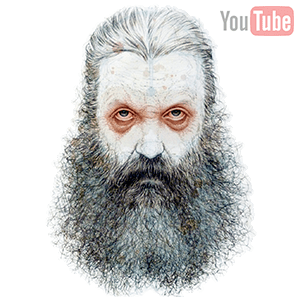
Alan Moore (b. 1953) is an English writer primarily known for his work in comic books including ‘Watchmen,’ ‘V for Vendetta,’ and ‘From Hell.’ Frequently described as the best graphic novel writer in history (though he prefers the term ‘comic’ to ‘graphic novel’), he has been called ‘one of the most important British writers of the last fifty years.’ He has occasionally used such pseudonyms as Curt Vile, Jill de Ray, and Translucia Baboon.
Moore is an occultist, ceremonial magician, and anarchist, and features such themes in his fiction, as well as performing avant-garde spoken word occult ‘workings’ with ‘The Moon and Serpent Grand Egyptian Theatre of Marvels,’ some of which have been released on CD. Despite his own personal objections, his books have provided the basis for a number of Hollywood films. He has stated that much of his work is designed to be ‘unfilmable’ to expose difference in the two mediums.
read more »
Posted in Art, Language |
1 Comment »
November 17, 2014

Irony is when something happens that is opposite from what is expected. In literature, it is sometimes used for comedic effect, but it is also used in tragedies. There are many types of irony, such as ‘dramatic irony’ (when the audience knows something is going to happen on stage that the characters on stage do not), ‘Socratic irony’ (when a teacher feigns ignorance to his students), ‘cosmic irony’ (when something that everyone thinks will happen actually happens very differently — as opposed to ‘situational irony’ that only affects a small group or individual), ‘verbal irony’ (an absence of expression and intention or the use of sarcasm), and ‘ironic fate’ (misfortune as the result of fate or chance).
The word ‘irony’ comes from Ancient Greek (‘eironeia’: ‘dissimulation, feigned ignorance’), in specific terms it is a rhetorical device, literary technique, or event characterized by an incongruity, or contrast, between what the expectations of a situation are and what is really the case, with a third element, that defines that what is really the case is ironic because of the situation that led to it. Verbal, dramatic, and situational irony are often used to underscore the assertion of a truth. The ironic form of simile, used in sarcasm, and some forms of litotes (understatement used to emphasize a point by denying the opposite) can highlight one’s meaning by the deliberate use of language which states the opposite of the truth, denies the contrary of the truth, or drastically and obviously understates a factual connection.
read more »
Posted in Art, Humor, Language |
1 Comment »
November 13, 2014

Christopher Nolan (b. 1970) is a British-American film director, screenwriter, and producer. He created several of the most successful films of the early 21st century, and his eight films have grossed over $3.5 billion worldwide. Having made his directorial debut with ‘Following’ (1998), he gained considerable attention for his second feature, ‘Memento’ (2000). The acclaim of these independent films afforded Nolan the opportunity to make the big-budget thriller ‘Insomnia’ (2002), and the more offbeat production ‘The Prestige’ (2006); which were well-received critically and commercially. He found popular success with ‘The Dark Knight’ trilogy (2005–2012), ‘Inception’ (2010), and ‘Interstellar’ (2014). He runs the London-based production company Syncopy Inc. with his wife Emma Thomas.
His films are rooted in philosophical and sociological concepts, exploring human morality, the construction of time, and the malleable nature of memory and personal identity. Experimentation with metafictive elements, temporal shifts, elliptical cutting, solipsistic perspectives, nonlinear storytelling and the analogous relationship between the visual language and narrative elements, permeate his entire body of work.
read more »
Posted in Art |
1 Comment »
November 12, 2014
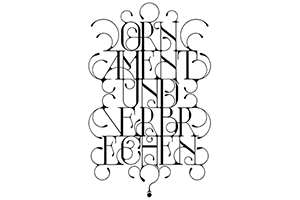

Form follows function, a principle associated with modernist architecture and industrial design in the 20th century, holds that the shape of a building or object should be primarily based upon its intended purpose, not aesthetics or tradition. The authorship of the phrase is often, though wrongly, ascribed to the American sculptor Horatio Greenough, whose thinking to a large extent predates the later functionalist approach to architecture. Greenough’s writings were for a long time largely forgotten, and were rediscovered only in the 1930s; in 1947 a selection of his essays was published under the title ‘Form and Function: Remarks on Art by Horatio Greenough.’
American architect, Louis Sullivan, Greenough’s much younger compatriot, who admired rationalist thinkers like Greenough, Thoreau, Emerson, Whitman, and Melville, coined the phrase in his article ‘The Tall Office Building Artistically Considered’ in 1896 (some fifty years after Greenough’s death), though Sullivan later attributed the core idea to Marcus Vitruvius Pollio the Roman architect, engineer and author who first asserted in his book ‘De architectura’ that a structure must exhibit the three qualities of ‘firmitas, utilitas, venustas’ – that is, it must be solid, useful, beautiful. Here Sullivan actually said ‘form ever follows function,’ but the simpler (and less emphatic) phrase is the one usually remembered.
read more »
Posted in Art, Language, Technology |
1 Comment »
November 10, 2014
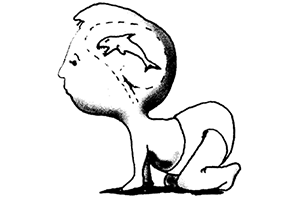

‘Prometheus Rising‘ is a book by Robert Anton Wilson first published in 1983. It is a guide book of ‘how to get from here to there,’ an amalgam of psychonaut Timothy Leary’s 8-circuit model of consciousness, spiritualist Georges Gurdjieff’s self-observation exercises, Polish semiotician Alfred Korzybski’s general semantics, occultist Aleister Crowley’s magical theorems, Sociobiology (the study of the evolutionary bases of behavior), Yoga, relativity, and quantum mechanics among other approaches to understanding the world around us. Wilson describes it as an ‘owner’s manual for the human brain.’
The book, which examines many aspects of social mind control and mental imprinting, provides mind exercises at the end of every chapter, with the goal of giving the reader more control over how one’s mind works. Wilson also discusses the effect of certain psychoactive substances and how these affect the brain, tantric breathing techniques, and other methods and holistic approaches to expanding consciousness. The book’s take on transactional analysis became the main seed thought for ‘The Sekhmet Hypothesis’ (suggesting a link between the emergence of youth culture archetypes in relation to the 11 year solar cycle), specifically the idea of applying the life scripts to pop cultural trends.
Posted in Art, Language, Philosophy |
Leave a Comment »