April 11, 2014

Monoliths [mon-uh-liths] are fictional advanced machines built by an unseen extraterrestrial species that appear in Arthur C. Clarke’s ‘Space Odyssey’ series of novels and films. During the series, three monoliths are discovered by humans and it is revealed that thousands if not more were created throughout the solar system, although none are seen. The subsequent response of the characters to their discovery drives the plot of the series. It also influences the fictional history of the series, particularly by encouraging humankind to progress with technological development and space travel.
The first monolith appears in the beginning of the story, set in prehistoric times. It is discovered by a group of hominids (apes), and somehow triggers a considerable shift in evolution, starting with the ability to use tools and weaponry.
read more »
Posted in Art |
Leave a Comment »
April 8, 2014

Max Richter [rik-ter] (b. 1966) is a British composer. He studied composition and piano at the University of Edinburgh, the Royal Academy of Music, and with Italian composer Luciano Berio in Florence. After finishing his studies, Richter co-founded the contemporary classical ensemble Piano Circus. He stayed with the group for ten years, commissioning and performing works by Arvo Pärt, Brian Eno, Philip Glass, Julia Wolfe, and Steve Reich. The ensemble was signed to Decca/Argo, producing five albums.
In 1996, Richter collaborated with Future Sound of London on their album ‘Dead Cities,’ beginning as a pianist, but ultimately working on several tracks, as well as co-writing one track (titled ‘Max’). He subsequently worked with the band over a period of two years, also contributing to the albums ‘The Isness’ and ‘The Peppermint Tree and Seeds of Superconsciousness.’ In 2000, he worked with Mercury Prize winner Roni Size on the Reprazent album ‘In the Møde.’ Richter produced English singer-songwriter Vashti Bunyan’s 2005 album ‘Lookaftering’ and Sneaker Pimps lead singer Kelli Ali’s 2008 album ‘Rocking Horse.’
read more »
Posted in Art |
Leave a Comment »
April 3, 2014
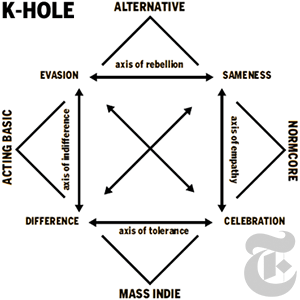
Normcore is an emerging cultural trend focusing on ‘coolness that opts into sameness.’ It is in response to hipster subculture. Jeremy Lewis, the founder of fashion website ‘Garmento’ calls normcore ‘one facet of a growing anti-fashion sentiment.’
K-hole, a creative trend forecasting collective based in New York City is cited as coining the phrase. Normcore is an anti-trendy trend.
Posted in Art, Humor |
Leave a Comment »
March 30, 2014

The Rock-afire Explosion is an animatronic robot band that played in Showbiz Pizza Place from 1980 to 1990, and in various Showbiz Pizza locations between 1990 and 1992 as Showbiz rebranded and the band was steadily replaced by Chuck E. Cheese characters. The characters in The Rock-afire Explosion were various animals ranging from a dog to a gorilla. They would perform medleys of classic rock, pop, and country music, as well as original compositions.
The show was a pioneer in commercial animatronics in the 1980s, featuring life-sized characters capable of facial expression; some were even programmed in such a way that they could actually play simple melodies on musical instruments. The show was created and manufactured by noted inventor Aaron Fechter, through his company Creative Engineering, Inc. in Orlando, Florida; in addition to overseeing the production of the animatronics, Fechter also provided the voices for several characters.
read more »
Posted in Art, Humor |
Leave a Comment »
March 18, 2014

The Mule is a fictional character from Isaac Asimov’s ‘Foundation’ series (first appearing in 1955 under the title ‘The 1,000-Year Plan,’ it is the story of scientist Hari Seldon’s effort to preserve knowledge as the civilizations around him begin to regress). One of the greatest conquerors the galaxy has ever seen, the Mule is a mentalic, a psychic mutant, who has the ability to reach into the minds of others and ‘adjust’ their emotions, individually or en masse, using this capability to conscript followers for his cause.
Mentalics are not capable of direct mind-control, but can subtly influence other’s subconscious; individuals under the Mule’s influence behave otherwise normally – logic, memories, and personality intact. This gives the Mule the capacity to disrupt Seldon’s plan by invalidating the assumption that no single individual could have a measurable effect on galactic socio-historical trends on their own. Seldon’s discipline, called psychohistory, relied on the predictability of the actions of very large numbers of people.
read more »
Posted in Art |
Leave a Comment »
March 11, 2014

Florentijn Hofman (b. 1977) is a Dutch artist known for playful urban installations such as the ‘Rubber Duck’ (a giant floating sculpture). They were built in various sizes, including one created in 2007 that is the largest rubber duck in the world at 105 feet long. Hofman’s tour was named ‘Spreading joy around the world.’ He aimed to recall everyone’s childhood memories by exhibiting the duck in 14 cities. The ducks are constructed with more than 200 pieces of PVC. There is an opening at the back of the body so that staff can perform maintenance. In addition, there is an electric fan in its body so that it can be inflated at any time, in either good or bad weather.
Since 2007, the ducks have been on display in Amsterdam, Belgium, Osaka, Sydney, Sao Paulo, Hong Kong, and Pittsburg. In 2009, while it was on display in Belgium, vandals stabbed the duck 42 times. The duck on display in Hong Kong was damaged and deflated in Taiwan after an earthquake, before bursting a few weeks later. In 2013, Sina Weibo, China’s most popular microblog, blocked the terms ‘Big Yellow Duck.’ The censorship occurred because a photoshopped version of ‘Tank Man’ (the Tiananmen Square protester), which swapped all tanks with this sculpture, had been circulating.
Posted in Art, Humor, World |
Leave a Comment »
March 6, 2014
Beyond the Black Rainbow is a 2010 Canadian science fiction film written and directed by Panos Cosmatos in his feature film debut. The films begins in the 1960s, as Dr. Arboria founds the Arboria Institute, a New Age research facility dedicated to finding a reconciliation between science and spirituality, allowing human beings to move into a new age of perpetual happiness.
In the 1980s, Arboria’s work has been taken over by his protégé, Dr. Barry Nyle. Outwardly a charming, handsome scientist, Nyle is in fact a psychopath who has been keeping Elena, a teenage girl, captive in an elaborate prison/hospital beneath the Institute. Elena demonstrates psychic capabilities, which Nyle can suppress, using a glowing, prism-like device.
read more »
Posted in Art, Drugs, Philosophy |
Leave a Comment »
March 1, 2014
Comics studies is an academic field that focuses on comics and graphic novels. Formerly dismissed as less relevant pop culture texts, scholars in fields such as Semiotics and Composition Studies are now re-considering comics and graphic novels as complex texts deserving of serious scholarly study.
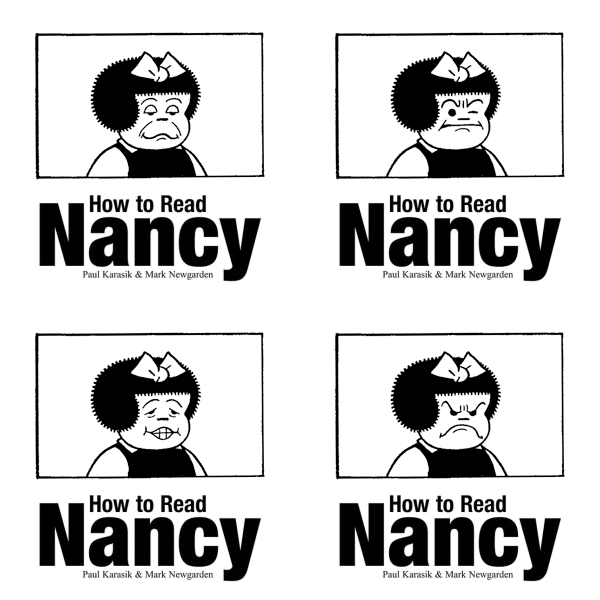
‘How to Read Nancy’ is a 1988 essay by underground cartoonists Mark Newgarden and Paul Karasik. The piece examines the comic strip ‘Nancy,’ focusing on creator Ernie Bushmiller’s use of the comics language in to deliver a gag. Finding correspondences to the minimalist architecture of Mies Van Der Rohe, the essay calls ‘Nancy’ ‘a complex amalgam of formal rules laid out by [its] designer.’
read more »
Posted in Art, Education, Language |
Leave a Comment »
February 28, 2014
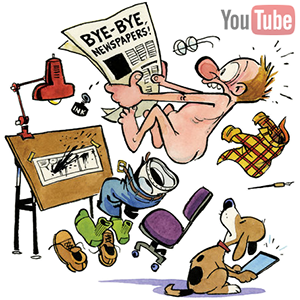
A comic strip is a sequence of drawings arranged in interrelated panels to display brief humor or form a narrative, often serialized, with text in balloons and captions. Throughout the 20th century and into the 21st, these were published in newspapers, with horizontal strips printed in black-and-white in daily newspapers, while Sunday newspapers offered longer sequences in special color comics sections.
Strips are written and drawn by a comics artist or cartoonist. As the name implies, comic strips can be humorous (for example, ‘gag-a-day’ strips such as ‘Blondie’ or ‘Marmaduke’). Starting in the late 1920s, comic strips expanded from their mirthful origins to feature adventure stories, as seen in ‘Popeye,’ ‘Captain Easy,’ ‘Buck Rogers,’ ‘Tarzan,’ and ‘The Adventures of Tintin.’ Soap-opera continuity strips such as ‘Judge Parker’ and ‘Mary Worth’ gained popularity in the 1940s. All are called, generically, comic strips, though cartoonist Will Eisner has suggested that ‘sequential art’ would be a better name.
read more »
Posted in Art |
Leave a Comment »
February 27, 2014
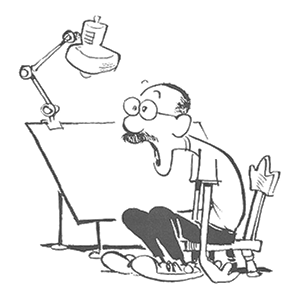
Bill Watterson (b. 1958) is an American artist and the author of the comic strip ‘Calvin and Hobbes,’ which was syndicated from 1985 to 1995. Watterson stopped drawing the strip at the end of 1995 with a short statement to newspaper editors and his readers that he felt he had achieved all he could in the medium.
Watterson is known for his views on licensing (he refused to merchandise his creations on the grounds that displaying their images on commercially sold mugs, stickers and T-shirts would devalue the characters and their personalities) and his move back into private life after ‘Calvin and Hobbes.’
read more »
Posted in Art, Humor, Language |
1 Comment »
February 26, 2014

The Discreet Charm of the Bourgeoisie (‘Le Charme discret de la bourgeoisie’) is a 1972 surrealist film directed by Luis Buñuel and written by Jean-Claude Carrière in collaboration with the director. The narrative concerns a group of upper-middle-class people attempting — despite continual interruptions — to dine together.
The film consists of several thematically linked scenes: five gatherings of a group of bourgeois friends, and the four dreams of different characters. The beginning of the film focuses on the gatherings, while the latter part focuses on the dreams, but both types of scenes are intertwined. There are also scenes involving other characters, such as two involving a Latin American female terrorist from the fictitious Republic of Miranda. The film’s world is not logical: the bizarre events are accepted by the characters, even if they are impossible or contradictory.
read more »
Posted in Art, Money, World |
Leave a Comment »
February 22, 2014

Itasha [ee-tah-sha] (literally ‘painful car’) is a Japanese term for a fashion of individuals decorating the bodies of their cars with fictional characters of anime, manga, or video games (especially ‘bishojo game’ and ‘eroge’ – dating and porn games). These characters are predominantly ‘cute’ females. The decorations usually involve paint schemes and stickers. Automobiles are called ‘itasha,’ while similar motorcycles and bicycles are called ‘itansha’ and ‘itachari,’ respectively.
In the 1980s, when Japan was at the zenith of its economic might, Tokyo’s streets were a parade of luxury import cars. Among them, the ‘itasha’—originally Japanese slang meaning an imported Italian car—was the most desired. Since then, ‘itasha’ (as the decorated vehicle) was derived from combining the Japanese words for ‘itai’ (‘painful’) and ‘sha’ (‘vehicle’). ‘Painful’ can be interpreted as ‘painfully embarrassing’ or ‘painful for the wallet’ due to the high costs involved.
Posted in Art, Technology, World |
Leave a Comment »


 The Daily Omnivore