August 27, 2014
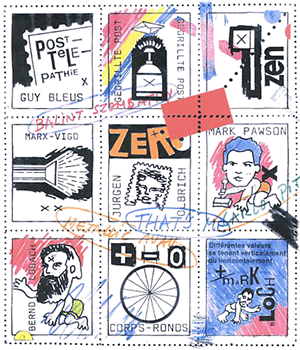
The term artistamp (a portmanteau of the words ‘artist’ and ‘stamp’) or artist’s stamp refers to a postage stamp-like art form used to depict or commemorate any subject its creator chooses. Artistamps are a form of ‘Cinderella stamp’ (unofficial stamps, not valid for postage), but they differ from forgeries or bogus Illegal stamps in that typically the creator has no intent to defraud postal authorities or stamp collectors.
Artistamp creators often include their work on legitimate mail, alongside valid postage stamps, in order to decorate the envelope with their art. In many countries this practice is legal, provided the artistamp isn’t passed-off as or likely to be mistaken for a genuine postage stamp. When so combined (and sometimes, less strictly speaking, even when not so) the artistamp may be considered part of the ‘mail art’ genre (a populist artistic movement centered around sending small scale works through the postal service, initially developed out of the Fluxus movement in the 1950s and 60s).
read more »
Posted in Art, Politics |
Leave a Comment »
August 26, 2014

The Congress is a 2013 French-Israeli live-action/animation science fiction drama film written and directed by Ari Folman. The film premiered at the Cannes Film Festival. Independent film distributor Drafthouse Films announced, along with Films We Like In Toronto, their co-acquisition of the North American rights to the film and a US theatrical and VOD/digital release planned for 2014.
Robin Wright plays an aging actress with a reputation for being fickle and unreliable, so much so that nobody is willing to offer her roles anymore. She agrees to sell the film rights to her digital image to Miramount Studios (a portmanteau of Miramax and Paramount) in exchange for a hefty sum and the promise to never act again. After her body is digitally scanned, the studio will be able to make films starring her using only computer-generated characters.
read more »
Posted in Art, Technology |
Leave a Comment »
August 20, 2014
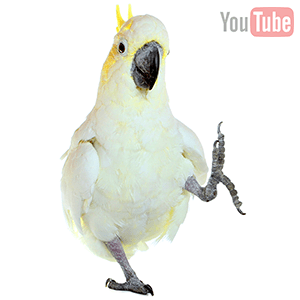
Snowball (hatched c. 1996) is a male Eleonora Cockatoo, noted as being the first non-human animal conclusively demonstrated to be capable of beat induction— perceiving music and synchronizing body movements to the beat (i.e., dancing).
Snowball’s abilities first became apparent after being acquired from a bird show at the age of six by his previous owner. He was observed bobbing his head in time to the Backstreet Boys song, ‘Everybody (Backstreet’s Back).’ The owner and his children encouraged this behavior and observed him developing rhythmic foot-lifting gestures, perhaps in imitation of his human companions’ arm-lifting gestures.
read more »
Posted in Art, Humor, Science |
Leave a Comment »
August 20, 2014

Entrainment [en-treyn-muhnt] in the biomusicological [bahy-oh-myoo-zi-kol-loj-i-kuhl] sense refers to the synchronization of organisms to an external rhythm, usually produced by other organisms with whom they interact socially. Examples include firefly flashing, mosquito wing clapping, as well as human music and dance such as foot tapping.
Beat induction is the process in which a regular isochronous pulse is activated while one listens to music (i.e. the beat to which one would tap one’s foot). It was thought that the cognitive mechanism that allows us to infer a beat from a sound pattern, and to synchronize or dance to it, was uniquely human. No other primate can dance or collaboratively clap to the beat of the music. Humans know when to start, when to stop, when to speed up or to slow down, in synchronizing with their fellow dancers or musicians. Although apes do not appear to display beat induction, some parrots do. The most famous example, Snowball was shown to display genuine dance, including changing his movements to a change in tempo in a 2009 study.
read more »
Posted in Art, Health, Science |
Leave a Comment »
August 20, 2014

Zoomusicology [zoh-uh-myoo-zi-kol-uh-jee] is a field of musicology and zoology or more specifically, zoosemiotics (animal communication). It is the study of the music of non-human animals, or rather the musical aspects of sound or communication produced and received by animals, and is related to ethnomusicology (the study of human music). Italian musicologist and semiotician Dario Martinelli describes the subject of as the ‘aesthetic use of sound communication among animals.’
Musicologist Marcello Sorce Keller attributes musical qualities to animal sounds, specifically whales’ and birds’ songs, by stating that regional variations can be found that resemble cultural traits in human music. He advocates for a combined study of zoomusicology and ethnomusicology with the remark that he ‘would like to suggest that musical scholarship excluding non-human animals cannot ultimately describe ‘how musical is man.”
read more »
Posted in Art, Science |
Leave a Comment »
August 20, 2014

Soundscape ecology is the study of sound within a landscape and its effect on organisms. The discipline of conservation biology has traditionally been concerned with the preservation of biodiversity and the habitats that organisms are dependent upon. However, soundscape ecology encourages biologists to consider natural soundscapes as resources worthy of conservation efforts. Unaltered soundscapes have value for wildlife as demonstrated by the numerous negative effects of anthropogenic (human created) noise on various species.
Organisms that use acoustic cues generated by their prey may be particularly impacted by human-altered soundscapes. In this situation, the (unintentional) senders of the acoustic signals will have no incentive to compensate for masking imposed by anthropogenic sound. In addition, natural soundscapes can have benefits for human wellbeing and may help generate a distinct sense of place, connecting people to the environment and providing unique aesthetic experiences. Because of the various values inherent in natural soundscapes, they may be considered ecosystem services that are provisioned by intact, functioning ecosystems.
Posted in Art, Science, World |
Leave a Comment »
July 23, 2014

The picaresque [pik-uh-resk] novel (Spanish:’picaresca,’ from ‘pícaro,’ for ‘rogue’ or ‘rascal’) is a popular subgenre of prose fiction which might sometimes be satirical and depicts, in realistic and often humorous detail, the adventures of a roguish hero of low social class who lives by his wits in a corrupt society. This style of novel originated in 16th-century Spain and flourished throughout Europe in the 17th and 18th centuries. The word ‘picaro’ does not appear in ‘Lazarillo de Tormes’ (1554), the novella credited with founding the genre. The expression ‘picaresque novel’ was coined in 1810. The genre continues to influence modern literature.
Picaresque novels are usually written in first person as an autobiographical account. A Lazarillo or picaro character is an alienated outsider, whose ability to expose and ridicule individuals compromised with society gives him a revolutionary stance. Lazarillo states that the motivation for his writing is to communicate his experiences of overcoming deception, hypocrisy, and falsehood (desengaño).
read more »
Posted in Art, Humor |
1 Comment »
July 22, 2014

The Vulcan salute is a hand gesture consisting of a raised hand, palm forward with the fingers parted between the middle and ring finger, and the thumb extended. The salute was devised and popularized by Leonard Nimoy, who portrayed the half-Vulcan character Mr. Spock on the original ‘Star Trek’ television series in the late 1960s.
The gesture famously has a reputation for being difficult for some people to make without practice or the covert pre-positioning of the fingers, and actors on the original show reportedly had to position their fingers off-screen with the other hand before raising their hand into frame. This reputation may stem from variations in individuals’ manual dexterity. This reputation is parodied somewhat in the motion picture ‘Star Trek: First Contact’ when Zefram Cochrane, upon meeting a Vulcan for the first time in human history, is unable to return the Vulcan salute gesture and instead shakes the Vulcan’s hand.
read more »
Posted in Art, Humor |
Leave a Comment »
July 17, 2014
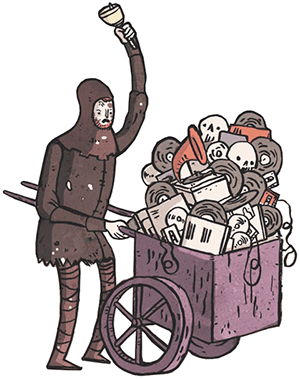
The Album Era was a period in English-language popular music from the mid 1960s to the mid 2000s in which the album was the dominant form of recorded music expression and consumption. It was primarily driven by three successive music recording formats, the 331⁄3 rpm phonograph record (1931), the audiocassette (1964), and the compact disc (1982).
In 1999, peer-to-peer file sharing application Napster was released, popularizing digital copies of music. The ease of downloading individual songs facilitated by it and later networks is often credited with ushering in the end of the Album Era in popular music.
read more »
Posted in Art, Money, Technology |
2 Comments »
July 13, 2014

Anthony Charles Grant Thompson (b 1959), better known as Anthony Ausgang, is an LA based artist and writer born in Pointe-à-Pierre, Trinidad and Tobago. He is a principal painter associated with Lowbrow art, a populist movement with cultural roots in underground comix, punk music, and hot-rod culture. Ausgang was one of ‘the first major wave of lowbrow artists’ to show in Los Angeles in the early 1980s. The protagonists of his paintings are cats — ‘psychedelic, wide eyed, with a kind of evil look in their eyes.’
By 1993, his artistic production consisted of customized cars, original acrylic paintings, and commercial merchandise, including clothing, puzzles, toys, lighters, and posters. Laguna Art Museum commissioned Ausgang to design a hole for a miniature golf course exhibit at South Coast Plaza in 1996. In 2010, he did the cover art for the MGMT release ‘Congratulations,’ ‘an eye grabbing illustration that could easily been found on a Grateful dead release circa 1974.’
Posted in Art |
Leave a Comment »
July 3, 2014

Concert etiquette refers to a set of social norms observed by those attending musical performances. These norms vary depending upon the type of music performance and can be stringent or informal. Etiquette is especially valued at concerts featuring music from the classical tradition.
The cardinal principle at work is to let others listen to the music undisturbed. Instruments and voices are typically unamplified, the music is rich in detail, wide in dynamic range, and poetic in intent. Audiences want to hear everything.
read more »
Posted in Art |
1 Comment »
June 2, 2014

The genre of Menippean [meh-nip-pee-uhn] satire is a form of satire (ridicule of foolishness and moral failings), usually in prose, which has a length and structure similar to a novel and is characterized by attacking mental attitudes instead of specific individuals. Other features found in Menippean satire are different forms of parody and mythological burlesque (humorous caricatures of the gods), a critique of the myths inherited from traditional culture, a rhapsodic nature, a fragmented narrative, the combination of many different targets, and the rapid moving between styles and points of view.
The term is used by classical grammarians and by philologists mostly to refer to satires in prose. Typical mental attitudes attacked and ridiculed by Menippean satires are ‘pedants, bigots, cranks, parvenus, virtuosi, enthusiasts, rapacious and incompetent professional men of all kinds,’ which are treated as diseases of the intellect. The term Menippean satire distinguishes it from the earlier satire pioneered by Aristophanes, which was based on personal attacks.
read more »
Posted in Art, Humor, Language |
1 Comment »



