August 20, 2021
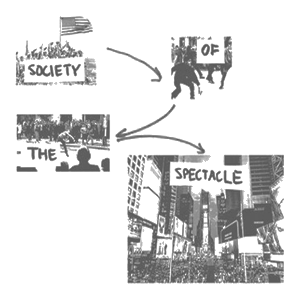
The avant-garde (French: ‘advance guard’ or ‘vanguard’) are people or works that are experimental, radical, or unorthodox with respect to art, culture, or society. It is frequently characterized by aesthetic innovation and initial unacceptability.
The avant-garde pushes the boundaries of what is accepted as the norm or the status quo, primarily in the cultural realm. The avant-garde is considered by some to be a hallmark of modernism, as distinct from postmodernism. Many artists have aligned themselves with the avant-garde movement, and still continue to do so, tracing their history from Dada through the Situationists and to postmodern artists such as the Language poets of the 1980s.
read more »
Posted in Art, Language, Politics |
Leave a Comment »
August 2, 2021
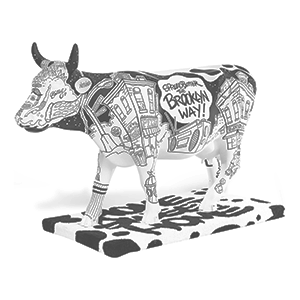
CowParade is an international public art exhibit where fiberglass sculptures of cows are decorated by local artists and distributed in public places. After the exhibition in a city, which may last many months, the statues are auctioned off and the proceeds donated to charity.
They often feature artwork and designs specific to local culture, as well as city life and other relevant themes. There are a few variations of shape, but the three most common shapes of cow were created by Pascal Knapp, a Swiss-born sculptor who was commissioned to create the cows specifically for the CowParade. He owns the copyrights to the standing, lying, and grazing cow shapes used.
read more »
Posted in Art, World |
Leave a Comment »
August 1, 2021
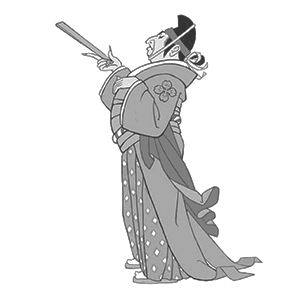
Grand Poobah is a satirical term derived from the name of the haughty character Pooh-Bah in Gilbert and Sullivan’s ‘The Mikado’ (1885). In this comic opera, Pooh-Bah holds numerous exalted offices, including ‘First Lord of the Treasury, Lord Chief Justice, Commander-in-Chief, Lord High Admiral … Archbishop … Lord Mayor’ and ‘Lord High Everything Else.’
The name has come to be used as a mocking title for someone self-important or locally high-ranking and who either exhibits an inflated self-regard or who has limited authority while taking impressive titles. American writer William Safire wrote that ‘everyone assumes [the name] Pooh-Bah merely comes from [W. S. Gilbert] combining the two negative exclamations Pooh! plus Bah!, typical put-downs from a typical bureaucrat.’
read more »
Posted in Art, Humor, Language |
Leave a Comment »
July 25, 2021
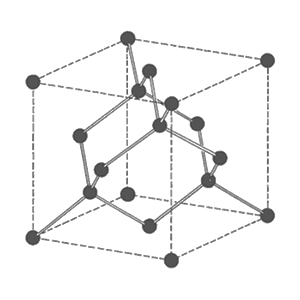
‘The Diamond Age: Or, A Young Lady’s Illustrated Primer’ is a 1995 science fiction novel by American writer Neal Stephenson. It is to some extent a Bildungsroman or coming-of-age story, focused on a young girl named Nell, set in a future world in which nanotechnology affects all aspects of life. The novel deals with themes of education, social class, ethnicity, and the nature of artificial intelligence.
The book contains descriptions of various exotic technologies, such as the chevaline (a mechanical horse that can fold up and is light enough to be carried one-handed), and forecasts the use of technologies that are in development today, such as smart paper that can show personalized news headlines. Major cities have immune systems made up of aerostatic defensive micromachines, and public matter compilers provide basic food, blankets, and water for free to anyone who requests them.
read more »
Posted in Art, Language, Technology |
Leave a Comment »
July 6, 2021

The Factory was Andy Warhol’s New York City studio, which had three locations between 1962 and 1984. The original Factory was on the fifth floor at 231 East 47th Street, in Midtown Manhattan. The rent was one hundred dollars per year. Warhol left in 1967 when the building was scheduled to be torn down to make way for an apartment building. He then relocated his studio to the sixth floor of the Decker Building at 33 Union Square West near the corner of East 16th Street, where he was shot in 1968 by Valerie Solanas.
The Factory was revamped and remained there until 1973. It moved to 860 Broadway at the north end of Union Square. Although this space was much larger, not much filmmaking took place there. In 1984, Warhol moved his remaining ventures, no longer including filming, to 22 East 33rd Street, a conventional office building. Many Warhol films, including those made at the Factory, were first (or later) shown at the New Andy Warhol Garrick Theatre or 55th Street Playhouse.
read more »
Posted in Art, Money |
Leave a Comment »
June 28, 2021
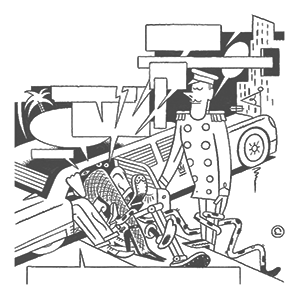
Ever Meulen [myoo-lin] (born Eddy Vermeulen in 1946) is a Belgian illustrator, cartoonist, caricaturist and comic strip artist. His pseudonym is based on his name E. Vermeulen.
Vermeulen studied graphic arts at the Sint-Lucas School of Architecture in Ghent and Brussels. He debuted in 1970, working for the magazine ‘Humo,’ where he drew both comics (‘Balthazar de Groene Steenvreter’ (‘Balthasar the Green Stone Eater’) and ‘Piet Peuk’ (‘Pete Stub’)), as well as cover illustrations, caricatures and illustrations to articles. When ‘Humo’ published books or CDs, Meulen often provided the cover illustration.
read more »
Posted in Art |
Leave a Comment »
June 19, 2021
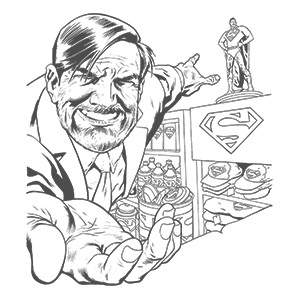
Funky Flashman is a fictional character, an entrepreneur in the DC Universe. Created by Jack Kirby, the character first appeared in the pages of ‘Mister Miracle’ during the early 1970s. He has no superhuman powers, but is very charismatic, charming, and a cunning businessman.
The character is popularly considered a satiric caricature of Stan Lee, Kirby’s former artistic collaborator at Marvel Comics with whom he had a falling-out, but this claim has no substantial evidence to back it up. Flashman’s attempts to rip off ‘Mister Miracle’ potentially reflect Kirby’s view that Lee exploited his work at Marvel in the 1960s.
read more »
Posted in Art, Humor, Money |
Leave a Comment »
May 26, 2021
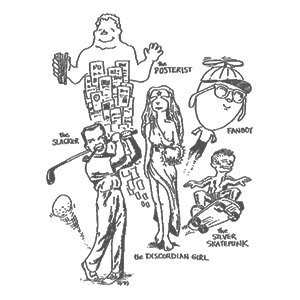
A zine [zeen] (short for magazine or fanzine) is a small-circulation self-published work of original or appropriated texts and images, usually reproduced via a copy machine. A fanzine (blend of fan and magazine) is a non-professional and non-official publication produced by enthusiasts of a particular cultural phenomenon (such as a literary or musical genre) for the pleasure of others who share their interest.
The term ‘zine’ was coined in an 1940 science fiction fanzine by Russ Chauvenet and popularized within science fiction fandom, entering the Oxford English Dictionary in 1949. Zines have served as a medium for various subcultures, and frequently draw inspiration from a DIY ethos that disregards traditional publishing conventions.
read more »
Posted in Art, Language |
Leave a Comment »
May 16, 2021
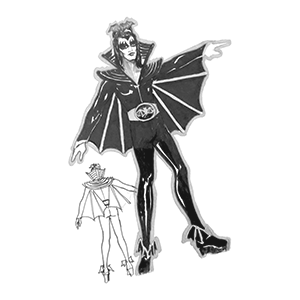
Larry LeGaspi (1950 – 2001) was an American fashion designer best known for creating signature designs worn by Labelle, Kiss, Grace Jones, George Clinton and Funkadelic, Divine, and other notables in the 1970s and 1980s.
Legaspi was born in Lakewood Township, New Jersey, and attended the Fashion Institute of Technology in New York City. He subsequently opened his own studio and boutique, Moonstone, where he sold his Art Deco-inspired futuristic styles in a space decorated with a moon and stars motif.
read more »
Posted in Art |
1 Comment »
April 11, 2021

A sideman is a professional musician hired to perform live with a featured act. John Lennon, Paul McCartney, George Harrison, and Pete Best acted as sidemen to Tony Sheridan before becoming famous as The Beatles.
Sidemen and sidewomen are often well-versed in multiple styles of music, and can be hired at any level of the music industry, from playing in a cover band to backing up established artists on major tours.
read more »
Posted in Art, Money |
Leave a Comment »
March 23, 2021

Gated reverb or gated ambience is an audio processing technique that combines strong reverb (echo) and a noise gate (attenuating signals that register below a threshold). The effect is often associated with the sound of 1980s popular music.
It was developed in 1979 by engineer Hugh Padgham and producer Steve Lillywhite while working with the artists XTC, Peter Gabriel, and Phil Collins at Townhouse Studios in London, and is most famously demonstrated in Collins’s 1981 single ‘In the Air Tonight.’
read more »
Posted in Art, Technology |
Leave a Comment »
March 19, 2021
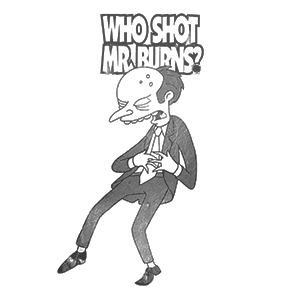
A cliffhanger or cliffhanger ending is a plot device in fiction which features a main character in a precarious or difficult dilemma or confronted with a shocking revelation at the end of an episode of serialized fiction. A cliffhanger is hoped to incentivize the audience to return to see how the characters resolve the dilemma.
Cliffhangers were used as literary devices in several works of the medieval era, with ‘One Thousand and One Nights,’ the collection of Arabic folktales, ending on a cliffhanger each night.
read more »
Posted in Art, Language |
Leave a Comment »


 The Daily Omnivore