February 26, 2013
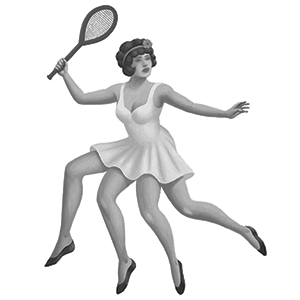
Alex Gross (b. 1968) is a visual artist currently working in Los Angeles; he specializes in oil paintings on canvas whose themes include globalization, commerce, great beauty, dark mayhem, and the remorseless passage of time. Alex graduated in 1990 from Art Center College of Design, in Pasadena, California. Since then, he has become established as an artist in the Pop Surrealism movement (e.g. lowbrow).
In 2000, he received a fellowship from the Japan Foundation; he spent two months traveling throughout Japan, researching and collecting a wide variety of Japanese Fine and Commercial art, as research for his own artwork. Part of his collection was compiled and published by Taschen under the title ‘Japanese Beauties’ in 2004.
read more »
Posted in Art |
Leave a Comment »
February 26, 2013
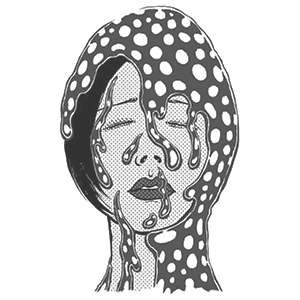
Yuko Shimizu is a Japanese illustrator based in New York City. Among comic fans, she is best known for her ongoing monthly covers for ‘The Unwritten’ and her cover art for P. Craig Russell’s comic book adaptations of Neil Gaiman’s ‘The Sandman: The Dream Hunters,’ published by Vertigo (DC Comics). Her self-titled monograph was published by Gestalten in the fall of 2011, and her children’s book, ‘Barbed Wire Baseball,’ written by Marissa Moss, is scheduled to be published by Abrams Books in the spring of 2013. She has been a faculty member at the School of Visual Arts since 2003.
She graduated from Waseda University’s School of Commerce in 1988 as valedictorian and soon began her first job in the corporate PR department of one of Tokyo’s largest sogo shoshas (trading company). Eleven years later, she resigned and moved to New York City to pursue her childhood dream of becoming an artist. She set out to earn a second bachelor’s degree, this time in illustration at the School of Visual Arts. However, after finishing her sophomore year, she was accepted into the MFA Illustration as Visual Essay program. She graduated in May 2003.
Posted in Art |
Leave a Comment »
February 25, 2013

The Kit-Cat Klock is an art deco novelty style wall clock in the shape of a grinning black cat with cartoon eyes that roll horizontally in sync with a pendulum tail that wags beneath. The clock is traditionally colored black, but models in other colors/styles are available. It first appeared during the 1930s. The clock is an iconic symbol of kitchens in pop culture. Having changed very little in the intervening years, the first clock was made in 1932 by the California Clock Company in Portland, Oregon.
The first generation of clocks, manufactured in the 1930s, 1940s and 1950s, have two paws, while newer models have four paws and a bow tie. The words ‘Kit-Cat’ were added to the clock face in the 1980s. The original clocks were plug-in, but most models sold since the late 1980s use batteries. The manufacturer estimates that the clock has sold on average at the rate of one every three minutes for the last 50 years.
Posted in Art, Humor |
Leave a Comment »
February 25, 2013

Felix the Cat is a cartoon character created in the silent film era. His black body, white eyes, and giant grin, coupled with the surrealism of the situations in which his cartoons place him, combine to make Felix one of the most recognized cartoon characters in film history. Felix was the first character from animation to attain a level of popularity sufficient to draw movie audiences. Felix’s origins remain disputed. Australian cartoonist/film entrepreneur Pat Sullivan, owner of the Felix character, claimed during his lifetime to be its creator.
However, American animator Otto Messmer, Sullivan’s lead animator, has also been credited as such. What is certain is that Felix emerged from Sullivan’s studio in NYC, and cartoons featuring the character enjoyed success and popularity in 1920s popular culture. Aside from the animated shorts, Felix starred in a comic strip (drawn by Messmer) beginning in 1923, and his image soon adorned merchandise such as ceramics, toys and postcards. Several manufacturers made stuffed Felix toys. Jazz bands such as Paul Whiteman’s played songs about him (1923’s ‘Felix Kept On Walking’ and others).
read more »
Posted in Art, Humor, Money |
Leave a Comment »
February 18, 2013

‘Harlem Shake‘ is a song recorded by American DJ and producer Baauer. It was released as a free digital download by Mad Decent imprint label Jeffree’s in 2012. The song incorporates samples of growling-lion sounds and Plastic Little’s 2001 song ‘Miller Time,’ specifically its line ‘then do the Harlem shake.’
In 2013, a user-submitted video set to ‘Harlem Shake’ became a viral hit on YouTube. The song features an undulating synth, harsh snares, and a mechanical bassline. It is categorized by Resident Advisor’s Andrew Ryce as a hip hop and bass song, while David Wagner of ‘The Atlantic’ describes its music as trap, a sub-genre with stylistic origins in EDM and Southern hip hop.
read more »
Posted in Art, Games, Humor |
Leave a Comment »
February 15, 2013

A hi-top fade is a style of haircut where hair on the sides is cut off or kept very short and hair on the top of the head is very long (in contrast, a low fade is when hair on the top is kept shorter). The hi-top has been a trend symbolizing the Golden Era of hip hop and urban contemporary music during the late 1980s and the early 1990s. The hi-top fade was common among young African Americans between 1986 to 1993 and to a lesser extent in the mid-1990s (1994-1996).
The style fell completely out of fashion by 1997, though it has slowly made a return in the public eye in the late 2000s. In the hip hop community throughout the mid-1980s, young African-Americans leaned towards Jheri curls or simple haircuts without tapers or fades of any sort.
read more »
Posted in Art, Humor |
Leave a Comment »
February 15, 2013

The Zeitgeist [tsahyt-gahyst] (spirit of the age or spirit of the time) is the intellectual fashion or dominant school of thought that typifies and influences the culture of a particular period in time. For example, the Zeitgeist of modernism typified and influenced architecture, art, and fashion during much of the 20th century. The German word ‘Zeitgeist’ is often attributed to the philosopher Georg Hegel, but he never actually used the word. In his works such as ‘Lectures on the Philosophy of History,’ he uses the phrase ‘der Geist seiner Zeit’ (‘the spirit of his time’)—for example, ‘no man can surpass his own time, for the spirit of his time is also his own spirit.’
Other philosophers who were associated with such ideas include Herder and Spencer and Voltaire. The concept counters the ‘Great Man theory’ popularized by Thomas Carlyle which sees history as the result of the actions of heroes and geniuses.
read more »
Posted in Art, Philosophy, Politics |
Leave a Comment »
February 13, 2013

Chet Helms (1942 – 2005), often called the father of San Francisco’s 1967 ‘Summer of Love,’ was a music promoter and a cultural figure in San Francisco during its hippie period in the late Sixties. Helms was the founder and manager of Big Brother and the Holding Company and recruited Janis Joplin as its lead singer.
He was a producer and organizer, helping to stage free concerts and other cultural events at Golden Gate Park, the backdrop of San Francisco’s Summer of Love in 1967, as well as at other venues, including the Avalon Ballroom. He was the first producer of psychedelic light-show concerts at the Fillmore and the Avalon Ballroom and was instrumental in helping to develop bands that had the distinctive San Francisco Sound.
read more »
Posted in Art, Money |
Leave a Comment »
February 10, 2013

Naked Lunch is the 1991 film adaptation written and directed by David Cronenberg, of William S. Burroughs’ novel of the same name. Rather than attempting a straight adaptation, Cronenberg took a few elements from the book and combined them with elements of Burroughs’ life, creating a hybrid film about the writing of the book rather than the book itself. Peter Weller starred as William Lee, the pseudonym Burroughs used when he wrote ‘Junkie.’
Lee is an exterminator who finds that his wife Joan is stealing his insecticide (pyrethrum) to use as a drug. When Lee is arrested by the police, he begins hallucinating because of ‘bug powder’ exposure. He believes he is a secret agent whose controller (a giant bug) assigns him the mission of killing Joan, who is an agent of an organization called Interzone Incorporated. Lee dismisses the bug and its instructions and kills it. He returns home to find Joan sleeping with Hank, one of his writer friends. Shortly afterwards, he accidentally kills her while attempting to shoot a drinking glass off her head in imitation of William Tell.
read more »
Posted in Art, Drugs, Language |
Leave a Comment »
February 7, 2013
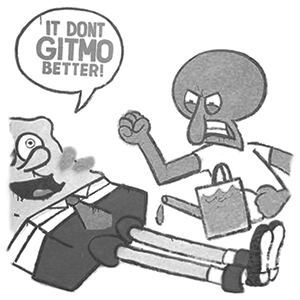
In the summer of 2008 conceptual artist Steve Powers presented a work that came to be known as the Coney Island waterboarding thrill ride. As originally conceived Powers saw the public watching volunteers undergoing actual waterboarding.
‘The Washington Post’ reported that Powers brought in Mike Ritz, a former US official experienced in administering waterboarding, for a one time demonstration of waterboarding on volunteers. This demonstration was not open to the general public, but rather for an invited audience. Powers himself was one of the volunteers.
read more »
Posted in Art, Games, Politics |
Leave a Comment »
February 7, 2013
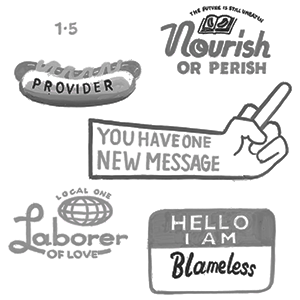
Steve Powers (b. 1968) is a New York City artist who at one time wrote graffiti in Philadelphia and New York under the name ESPO (‘Exterior Surface Painting Outreach’). Powers is from Philadelphia’s Overbrook neighborhood; he graduated from Robert E. Lamberton High School in 1987 and took classes at The Art Institute of Philadelphia and the University of the Arts. In 1994, he moved to New York with fellow writer and designer Ari Forman, in order to expand the reach of his magazine, ‘On the Go.’
ESPO’s work often blurred the lines of legality. For example, pieces like ‘Greetings from ESPOLand’ utilized the style of the Asbury Park Billboards and appeared to be a legitimate billboard. In 1997 ESPO began his most ambitious non-commissioned art. He painted on storefront grates in Fort Greene, Bedford-Stuyvesant, TriBeCa, and the South Bronx, covering the entire grate with white or silver paint and then using black to make each grate into a letter in his name.
read more »
Posted in Art, Politics |
Leave a Comment »
February 7, 2013
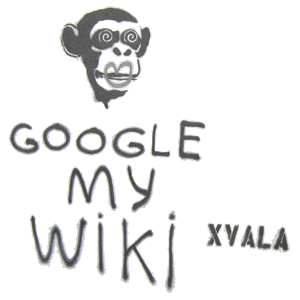
XVALA is an art project created by Jeff Hamilton (b. 1970). XVALA typically focuses on pieces that address celebrity and popular culture and he refers to this as ‘Tabloid Art.’ XVALA collaborated with sculptor Daniel Edwards on ‘The Brangelina,’ a house located in Oklahoma. In 2010, Jeff Hamilton walked away from his art and the name XVALA. Hamilton passed the name on to unnamed, upcoming artist.
‘Fear Google’ is the first street art sticker designed for the Post-PC era and was launched in 2010, the same year as Apple’s iPad and other Post-PC devices. The stickers fear message shows society’s growing inability to disconnect from the internet. First distributed by friends of the artist and some Apple Store employees the first stickers appeared on the California city streets.
read more »
Posted in Art, Money, Politics |
Leave a Comment »


 The Daily Omnivore