September 1, 2012

Side by Side is an American documentary film released in 2012 directed by Chris Kenneally and produced by Justin Szlasa and Keanu Reeves who also stars in the film. The film explores the art, science and impact of digital cinema through interviews with leading directors, cinematographers, film students, producers, technologists, editors, and exhibitors.
The movie examines all aspects of feature filmmaking: capture, editing, visual effects, color correction, distribution, and archiving. Reeves explores the development of cinema and the impact of digital filmmaking via in-depth interviews with Hollywood masters, such as James Cameron, David Fincher, David Lynch, Christopher Nolan, Martin Scorsese, George Lucas, Steven Soderbergh, Danny Boyle, and others.
Posted in Art, Technology |
Leave a Comment »
August 31, 2012
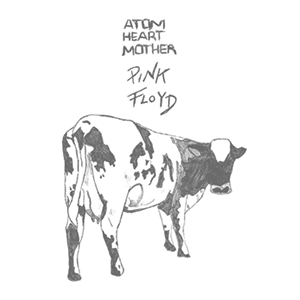
Ron Geesin (b. 1943) is a British musician and composer, noted for his quirky creations and novel applications of sound. He is probably best known as the orchestrator and organizer of Pink Floyd’s ‘Atom Heart Mother’ in 1970, after the band found themselves hopelessly deadlocked over how to complete it.
Geesin first collaborated with the band’s Roger Waters (the two shared a love of golf) on 1970’s unconventional film soundtrack ‘Music from ‘The Body,” sampling sounds made by the human body. Ron Geesin played piano with The Original Downtown Syncopators, a Dixieland band emulating the Original Dixieland Band during the 1960s. The band was based in Sussex, UK.
read more »
Posted in Art, Technology |
Leave a Comment »
August 31, 2012

The Body is a 1970 scientific documentary film directed and produced by Roy Battersby. In the film, external and internal cameras are used to showcase different parts of the human body. The film’s narrators, Frank Finlay and Vanessa Redgrave, provide insightful commentary that combines the knowledge of world renowned human biologists and anatomical experts.
Unlike similar films of this subject matter ‘The Body’ strives for an entertaining presentation of the human anatomy, and avoids monotone narration. The film’s soundtrack, ‘Music from the Body,’ was composed by Ron Geesin and Roger Waters, and includes songs that were literally made using the human body as a medium.
Posted in Art, Education, Science |
Leave a Comment »
August 27, 2012

Trash the dress, also known as ‘fearless bridal’ or ‘rock the frock,’ is a style of wedding photography that contrasts elegant clothing with an environment in which it is out of place. Usually brides decide to have pictures taken on a beach, but other locations include city streets, rooftops, garbage dumps, fields, and abandoned buildings.
Some sources claim that the trend was originally started in 2001 by Las Vegas wedding photographer John Michael Cooper. However, the idea of destroying a wedding dress has been used in Hollywood symbolically since at least 1998 when Meg Cummings of the show ‘Sunset Beach’ ran into the ocean in her wedding dress after her wedding was badly interrupted. It may be done as an additional shoot after the wedding, almost as a declaration that the wedding is done and the dress will not be used again. It is seen as an alternative to storing the dress away.
Posted in Art, Humor |
Leave a Comment »
August 26, 2012

Electro house is a subgenre of house music influenced by 1980s music. The term has been used to describe the music of many of the world’s top DJs, such as David Guetta, deadmau5, Skrillex, and Tiësto. Electro house, sometimes resembling tech house (a hybrid of techno with house), typically retains elements of house music and can incorporate electro-influenced synths and samples.
It often has a ‘dirty’ bass sound created from saw waves with compression and distortion. The exact origins of the genre are uncertain; it has sometimes been seen as a fusion of electro and house; or a term using ‘electro’ as an adjective (meaning ‘futuristic’ or ‘hard’). French house, by artists such as Justice and especially Daft Punk, has also been considered a strong influence.
read more »
Posted in Art, Language, Technology |
Leave a Comment »
August 24, 2012

Voina (literally ‘War’) is a Russian street-art group known for their provocative and politically charged works of performance art. The group has had more than sixty members, including former and current students of the Rodchenko Moscow School of Photography, Moscow State University, and Tartu University. However, the group does not cooperate with state or private institutions, and is not supported by any Russian curators or gallerists.
The activities of Voina have ranged from street protests, symbolic pranks in public places, and performance-art happenings, to vandalism and destruction of public property. More than a dozen criminal cases have been brought against the group. According to its members, Voina has no formal leadership, and all members are considered equal. Conceptions are worked out by Oleg Vorotnikov (a.k.a. ‘Vor,’ ‘Thief ‘– the chief ideologist), Natalia Sokol (a.k.a. ‘Kozlyonok,’ ‘Goatling’ – the chief coordinator), Leonid Nikolayev (a.k.a. ‘Crazy Lenya’) and Alexei Plutser-Sarno (the chief media artist, the author of the group’s media art and texts).
read more »
Posted in Art, Politics, World |
Leave a Comment »
August 23, 2012

The Point! is a fable and the sixth album by American songwriter and musician Harry Nilsson about a boy named Oblio, the only round-headed person in the Pointed Village, where by law everyone and everything had to have a point. According to Nilsson:
‘I was on acid and I looked at the trees and I realized that they all came to points, and the little branches came to points, and the houses came to point. I thought, ‘Oh! Everything has a point, and if it doesn’t, then there’s a point to it.” There have been, so far, at least three different renditions of The Point!, each featuring songs written by Nilsson to accompany the story, including an animated film, an album, and a stage musical.
Posted in Art, Drugs |
Leave a Comment »
August 23, 2012

The Moth is a non-profit group based in New York City dedicated to the art and craft of storytelling. It was founded in 1997 by poet and novelist George Dawes Green, who wanted to recreate the feeling of sultry summer evenings in his native Georgia, when moths were attracted to the light on the porch where he and his friends would gather to spin spellbinding tales. George and his original group of storytellers called themselves ‘The Moths,’ and George took the name with him to New York. The organization now runs a number of different storytelling events in New York City, Los Angeles, Chicago, Detroit, and other American cities, often featuring prominent literary and cultural personalities. Previous notable storytellers have included Margaret Cho, Ethan Hawke, Malcolm Gladwell, Darryl ‘DMC’ McDaniels, George Plimpton, Al Sharpton, Moby, Lili Taylor, and Sam Shepard.
The organization also holds ‘StorySLAM’ events, storytelling competitions open to everyone. The Moth also runs a community program that offers storytelling workshops free of charge to high school students and underprivileged New Yorkers. The Moth offers a weekly podcast, which provides free audio of stories from all types of Moth events. In 2009, the organization also launched a national public radio show, ‘The Moth Radio Hour.’ Andy Borowitz became the Moth’s primary host in 1999. The organization’s annual fundraising event is called the Moth Ball, where the annual Moth award is presented. The 2008 Moth Award was presented to Salman Rushdie.
Posted in Art, Games, Language |
Leave a Comment »
August 13, 2012

Cassette culture refers to the practices surrounding amateur production and distribution of recorded music that emerged in the late 1970s via home-made audio cassettes. It is characterized by the adoption of home-recording by independent artists, and involvement in ad-hoc self-distribution and promotion networks – primarily conducted through mail (though there were a few retail outlets, such as Rough Trade and Falling A in the UK) and fanzines.
The culture was in part an offshoot of the mail art movement of the 1970s and 1980s, and participants engaged in tape trading in addition to traditional sales. The culture is related to the DIY ethic of punk, and encouraged musical eclecticism and diversity.
read more »
Posted in Art, Money, Technology |
Leave a Comment »
August 13, 2012

Kinderwhore was an image used by a handful of mostly female punk rock bands in the US during the early to mid 1990s. The kinderwhore look consisted of torn, ripped tight or low-cut babydoll dresses or nighties, heavy makeup, and leather boots or Mary–Jane shoes of various colors.
The exact origin of the kinderwhore image is up for debate, though it is widely accepted that Kat Bjelland of Babes in Toyland was the first to define it and Courtney Love of Hole was the first to popularize it. Christina Amphlett of Divinyls can clearly be seen sporting the image on the cover of her band’s 1983 album, ‘Desperate.’ Love declared in an interview in the Los Angeles zine ‘Ben Is Dead’ that she took the style from Amphlett.
Posted in Art, Language, Sex |
1 Comment »
August 13, 2012
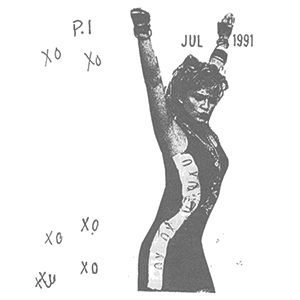
Riot grrrl is an underground feminist punk rock movement that originally started in Washington, D.C. and the Pacific Northwest in the early to mid-1990s. It is often associated with third-wave feminism which is sometimes seen as its starting point. Riot grrrl bands often address issues such as rape, domestic abuse, sexuality, racism, patriarchy, and female empowerment.
Bands associated with the movement include Bikini Kill, Jack Off Jill (and later Scarling), Bratmobile, Fifth Column, Sleater-Kinney, L7, and also queercore like Team Dresch. In addition to a music scene and genre, riot grrrl is a subculture: zines, the DIY ethic, art, political action, and activism are part of the movement.
read more »
Posted in Art, Politics, Sex |
Leave a Comment »
August 13, 2012
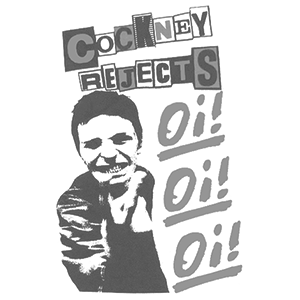
Oi! is a working class subgenre of punk rock that originated in the UK in the late 1970s. The music and its associated subculture had the goal of bringing together punks, skinheads and other working-class youths (sometimes called ‘herberts’).
The Oi! movement was partly a response to the perception that many participants in the early punk rock scene were, in the words of The Business guitarist Steve Kent, ‘trendy university people using long words, trying to be artistic…and losing touch.’ André Schlesinger, singer of The Press, said, ‘Oi shares many similarities with folk music, besides its often simple musical structure; quaint in some respects and crude in others, not to mention brutally honest, it usually tells a story based in truth.’
read more »
Posted in Art, Politics, World |
Leave a Comment »




