August 10, 2012

Thomas Pynchon [pin-chuhn] (b. 1937) is an American novelist. A MacArthur Fellow, he is noted for his dense and complex novels. Both his fiction and non-fiction writings encompass a vast array of subject matter, styles, and themes, including (but not limited to) the fields of history, science, and mathematics. For his most praised novel, ‘Gravity’s Rainbow,’ Pynchon won the 1974 U.S. National Book Award for Fiction (which he declined).
After publishing several short stories in the late 1950s and early 1960s, he began composing the novels for which he is best known: ‘V.’ (1963), ‘The Crying of Lot 49’ (1966), ‘Gravity’s Rainbow’ (1973), and ‘Mason & Dixon’ (1997). Pynchon is also known for being very private; very few photographs of him have ever been published, and rumors about his location and identity have circulated since the 1960s.
read more »
Posted in Art, Humor, Language |
Leave a Comment »
August 9, 2012

‘The Ultimate Computer‘ is a season two episode of ‘Star Trek,’ first broadcast in 1968, written by D.C. Fontana, based on a story by Laurence N. Wolf and directed by John Meredyth Lucas. In the episode, a skeleton Enterprise crew are assigned to test a revolutionary computer system, the M-5, that is given total control of the ship. Designed by the brilliant Dr. Richard Daystrom (who’d also invented the currently used computer systems), the M-5 handles all ship functions without human assistance. While Captain Kirk and Chief Medical Officer Dr. McCoy are unhappy about the test, Science Officer Spock is impressed with M-5.
At first M-5 works well, performing ship functions more quickly and efficiently than a living crew. Later, M-5 exhibits quirks such as turning off power and life support to unoccupied parts of the ship. It draws increased power for unknown reasons. Daystrom maintains M-5 is working properly. In a drill, M-5 defends the Enterprise against mock attacks from starships Excalibur and Lexington. The Enterprise is declared the victor, prompting Commodore Wesley to call Kirk ‘Captain Dunsel.’ Spock explains the term is used by midshipmen at Starfleet Academy to describe a part serving no useful purpose. Kirk is visibly shaken by this.
read more »
Posted in Art, Technology |
Leave a Comment »
August 9, 2012

‘The City on the Edge of Forever‘ is the penultimate episode of the first season of the television series ‘Star Trek,’ first broadcast in 1967. The teleplay is credited to Harlan Ellison, but was also largely rewritten by several authors before filming. The filming was directed by Joseph Pevney. Joan Collins guest starred as Edith Keeler. This episode involves the crew of the starship USS Enterprise discovering a portal through space and time, which leads to Dr. McCoy’s accidentally altering history.
The USS Enterprise investigates temporal disturbances centered on a nearby planet. Once on the planet, Spock finds that the source of the time distortions is an ancient ring of glowing, stone-like material. When a question is directed at the ring, it speaks identifying itself as the ‘Guardian of Forever,’ explains that it is a doorway to any time and place, and displays periods of Earth’s history in its portal opening. McCoy, driven mad by an accidental self overdose leaps through the portal. Suddenly the landing party loses contact with the Enterprise. The Guardian informs the landing party that history has just been altered and that, as a result, the Enterprise now no longer exists.
read more »
Posted in Art, War |
Leave a Comment »
August 6, 2012
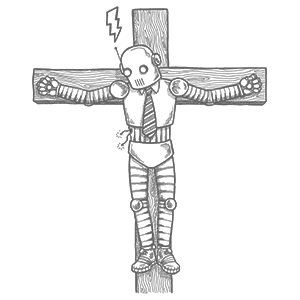
Robochrist Industries is a robotic performance art troupe most notably recognized for its performances in and around Los Angeles during the years 1997 – 2005. The performances feature large radio-controlled robots moving among and eventually destroying props and set-pieces intended to convey specific theatrical narratives. The troupe is a direct offshoot of Survival Research Laboratories (SRL), a pioneer in machine performance art.
Ristow worked on several SRL performances, contributing not only props but also, particularly in the years 1996 and 1997, robots that he had constructed. During this period Ristow also participated in several collaborative performances with another San Francisco based performance group, The Seemen, including the often cited ‘Hellco’ performance at the 1996 Burning Man festival.
read more »
Posted in Art, Technology |
1 Comment »
August 6, 2012

Survival Research Laboratories (SRL) is a machine performance art group credited for pioneering the genre of large-scale machine performance. After about 30 years in San Francisco, SRL spent most of 2008 moving 40 miles north to Petaluma. Since its inception in 1978 SRL has operated as an organization of creative technicians and technical creatives dedicated to redirecting the techniques, tools, and tenets of industry, science, and the military away from their typical manifestations in practicality, product or warfare.
Since 1979, SRL has staged over 45 mechanized presentations in the United States and Europe. Each performance consists of a unique set of ritualized interactions between machines, robots, and special-effects devices, employed in developing themes of socio-political satire. Humans are present only as audience or operators.
read more »
Posted in Art, Humor, Technology |
Leave a Comment »
August 3, 2012
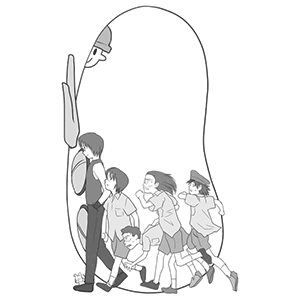
Dennō Coil (literally ‘Electric Brain Coil’) is a Japanese anime television series depicting a near future where semi-immersive augmented reality (AR) technology has just begun to enter the mainstream. The series takes place in the fictional city of Daikoku, a hotbed of AR development with an emerging city-wide virtual infrastructure.
It follows a group of children as they use AR glasses to unravel the mysteries of the half real, half Internet city, using a variety of illegal software tools, techniques, and virtual pets to manipulate the digital landscape. The show was in development for over a decade, and was the directorial debut of Japanese animator Mitsuo Iso. It premiered on NHK Educational TV in 2007.
read more »
Posted in Art, Technology, World |
Leave a Comment »
July 30, 2012
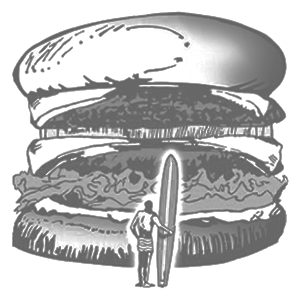
Big Kahuna Burger is a fictional chain of Hawaiian-themed fast food restaurants that appears in the movies of Quentin Tarantino including ‘Death Proof,’ ‘Four Rooms,’ ‘From Dusk Till Dawn,’ ‘Pulp Fiction,’ and ‘Reservoir Dogs.’
The packaging was created by Tarantino’s old friend Jerry Martinez. The Big Kahuna Burger is also seen in ‘The Adventures of Sharkboy and Lavagirl in 3-D,’ directed by Robert Rodriguez.
Posted in Art, Food |
Leave a Comment »
July 30, 2012
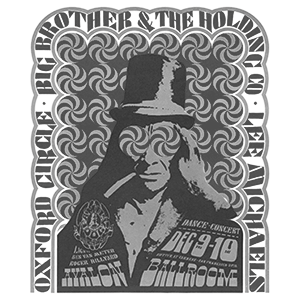
Victor Moscoso (b. 1936) is an artist best known for producing psychedelic rock posters/advertisements and underground comix in San Francisco during the 1960s and 1970s. Born in Spain, Moscoso was the first of the rock poster artists of the 1960s era with formal academic training and experience. After studying art at Cooper Union in New York City and at Yale University, he moved to San Francisco in 1959. There, he attended the San Francisco Art Institute, where he eventually became an instructor. Moscoso’s use of vibrating colors was influenced by painter Josef Albers, one of his teachers at Yale. He was the first of the rock poster artists to use photographic collage in many of his posters.
Professional lightning struck in the form of the psychedelic rock and roll poster for San Francisco’s dance halls and clubs. Moscoso’s posters for the Family Dog dance-concerts at the Avalon Ballroom and his Neon Rose posters for the Matrix resulted in international attention during the 1967 Summer of Love. Within a year, lightning struck again in the form of the underground comix. As one of the ‘Zap Comix’ artists, Moscoso’s work once again received international attention. Moscoso’s comix and poster work has continued up to the present and includes album covers for musicians such as Jerry Garcia, Bob Weir, Herbie Hancock, Jed Davis, and David Grisman.
Posted in Art |
Leave a Comment »
July 30, 2012

The Avalon Ballroom is a music venue, in the Polk Gulch neighborhood of San Francisco. The space operated from 1966 to 1968 and reopened in 2003. Large events include ‘Pagan Fest USA,’ that is held in May. The building that housed the Avalon Ballroom was built in 1911 and was originally called the Colin Traver Academy of Dance. The Avalon was founded by Robert E. Cohen, impresario Chet Helms and his music production company, Family Dog Productions, which had offices on Van Ness. Extraordinary posters advertising each event were produced by psychedelic artists, including Rick Griffin, Stanley Mouse, Alton Kelly, and Victor Moscoso.
Many local bands, such as Quicksilver Messenger Service and The Steve Miller Band, served as backup bands, as did the early Moby Grape and headliners such as the The Doors, 13th Floor Elevators, The Butterfield Blues Band, and Big Brother and the Holding Company, which Helms organized around singer and performer Janis Joplin in spring 1966. The Grateful Dead recorded two live albums, entitled ‘Vintage Dead’ and ‘Historic Dead,’ here in the autumn of 1966. In 1967, it hosted the ‘Mantra-Rock Dance’ musical event, organized by the local Hare Krishna temple, which featured Hare Krishna founder Bhaktivedanta Swami, along with Allen Ginsberg, The Grateful Dead, Moby Grape, and Big Brother and the Holding Company, with Janis Joplin.
Posted in Art |
Leave a Comment »
July 30, 2012

Bruce Conner (1933 – 2008) was an American artist renowned for his work in assemblage (artistic compositions made by putting together found objects) and film, among other disciplines. He attended Wichita University (now Wichita State), and received his B.F.A in Art at Nebraska University in 1956.
He then attended the University of Colorado on scholarship; also there was Jean Sandstedt, whom he had met at Nebraska and who would become his wife. In 1957 the two married and immediately flew to San Francisco. There, Conner quickly assimilated into the city’s famous Beat community and founded the Rat Bastard Protective Association, an underground, arts organization. His first solo shows in San Francisco, in 1958 and 1959, featured paintings, drawings, prints, collages, assemblages, and sculpture.
read more »
Posted in Art, Philosophy, Politics |
Leave a Comment »
July 27, 2012
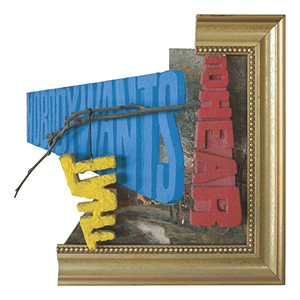
Wayne White is an American artist, art director, cartoonist, and illustrator. He started his art career working as a cartoonist and illustrator for a number of publications including ‘The East Village Eye,’ ‘Raw,’ ‘The New York Times,’ and ‘The Village Voice.’ In 1986 he worked on ‘Pee Wee’s Playhouse’ where his work for his set and puppet designs won three Emmy awards; he also supplied a number of voices on the show.
Other television credits include production and set design for ‘Shining Time Station,’ ‘Riders in the Sky,’ ‘The Weird Al Show,’ and ‘Beakman’s World.’ He art directed two seminal music videos, Peter Gabriel’s ‘Big Time’ in 1986, and in 1996 he designed all the Georges Méliès inspired sets for the award-winning video for the Smashing Pumpkins, ‘Tonight, Tonight.’
read more »
Posted in Art, Humor |
1 Comment »
July 26, 2012

It Couldn’t Happen Here is a 1988 musical film starring the British pop duo Pet Shop Boys and based around their music. It was originally conceived as an hour-long video based around their album ‘Actually,’ but it turned into a surreal full-scale feature film directed by Jack Bond and co-starring Barbara Windsor, Joss Ackland, Neil Dickson and Gareth Hunt. The original idea of making a film emerged from the band’s immense reluctance to go on tour.
The band hoped that a film would satisfy the fans’ demand to see them in live action. Neil Tennant subsequently commented that making the film made him realize one thing, that he couldn’t act. When the film premiered in London’s West End, a crowd of fans were standing outside the cinema, waiting for the duo to arrive. However, as both Neil and Chris approached the crowd, they went completely unnoticed thanks to their anonymous appearance, and managed to walk past them.
read more »
Posted in Art |
Leave a Comment »



