July 2, 2012
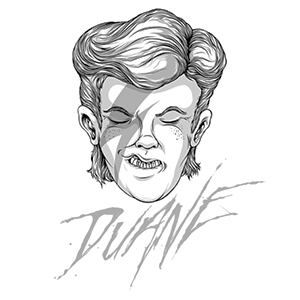
Everything is Terrible! is a Chicago-based video blogging website launched in 2007 that features clips of VHS tapes from the late 20th century. The project was founded in 2000 by a group of friends while at Ohio University. They search at thrift stores, garage sales, and ‘bargain bins’ for the worst and most outrageous VHS tapes in which to share with each other. The website has also been attempting to amass the largest collection of tapes that feature the film ‘Jerry Maguire’; according to member Ghoul Skool: ‘We always have noticed since the beginning that there seems to be nothing but just ‘Jerry Maguire’ tapes filling our nation’s thrift stores. I don’t know why.’
The people behind ‘Everything is Terrible’ also perform live shows wearing cloaks and gold VHS tapes around their necks to showcase their new VHS discoveries. In 2009, the website released a video titled ‘Everything is Terrible! The Movie,’ which featured the same type of VHS clips that would be featured on their website. The ‘A.V. Club’ called the video ‘a portal into a world halfway between showbiz and real life—a look at how the people who make entertainment for a living think the rest of us saps actually live,’ adding that it’s ‘simultaneously enlightening, hilarious, and deeply sad.
Posted in Art, Humor, Technology |
Leave a Comment »
June 29, 2012
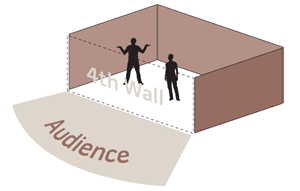
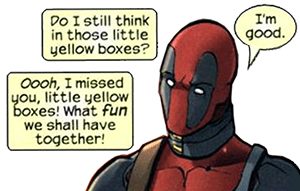
Metareference is a situation in a work of fiction whereby characters display an awareness that they are in such a work. Sometimes it may even just be a form of editing or film-making technique that comments on the show/film/book itself. It is also sometimes known as ‘Breaking the Fourth Wall,’ in reference to the theatrical tradition of playing as if there were no audience, as if a wall existed between them and the actors.
Metareference in fiction is jarring to the reader, but can be comical, as in Jasper Fforde’s novel ‘Lost in a Good Book.’ The character Thursday Next remarks to her husband that she feels uncomfortable having sex in front of so many people, when he is confused because they are alone in their bedroom, she explains, ‘all the people reading us.’ In Fforde’s ‘The Fourth Bear’ two characters lament over a bad joke made by the author, saying, ‘I can’t believe he gets away with that.’ Some novels with first person narration contain instances of metareference when the narrator addresses the reader directly (e.g. Charlotte Brontë’s ‘Jane Eyre’).
read more »
Posted in Art, Language |
Leave a Comment »
June 29, 2012

Mise [meez] en [awn] abyme [ah-beem] is a term originally from the French and means ‘placed into abyss.’ The commonplace usage of this phrase is describing the visual experience of standing between two mirrors, seeing an infinite reproduction of one’s image, but it has several other meanings in the realm of the creative arts and literary theory. In Western art history, ‘mise en abyme’ is a formal technique in which an image contains a smaller copy of itself, the sequence appearing to recur infinitely.
In the terminology of heraldry, the ‘abyme’ is the center of a coat of arms. The term ‘mise en abyme’ then meant literally ‘put in the center.’ It described a coat of arms that appears as a smaller shield in the center of a larger one (the Droste effect). For example, the two-headed eagle on modern coat of arms of Russia has a scepter with coat of arms of Russia on top of it, with the same scepter.
read more »
Posted in Art, Language, Philosophy |
Leave a Comment »
June 29, 2012

Mirrored sunglasses are sunglasses with a reflective optical coating (called a mirror coating or flash coating) on the outside of the lenses to make them appear like small mirrors. The lenses typically give the wearer’s vision a brown or grey tint. The mirror coating decreases the amount of light passing through the tinted lens by a further 10–60%, making it especially useful for conditions of sand, water, snow, and higher altitudes.
Mirrored sunglasses are one-way mirrors. The color of the mirror coating is independent of the tint of the lenses. It is determined by the thickness and structure of the layer. Their popularity with police officers in the United States has earned them the nickname ‘cop shades.’ Characters in the cyberpunk genre frequently wear mirrorshades, and they are considered a hallmark of the subculture. Many characters in the movie series ‘The Matrix’ exclusively wear mirrored sunglasses, Morpheus in particular.
Posted in Art, Technology |
Leave a Comment »
June 26, 2012
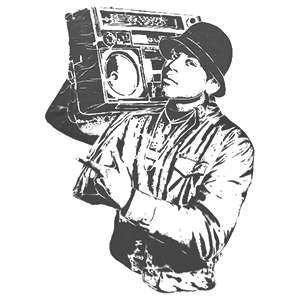
Boombox is a colloquial expression for a portable music player with two or more loudspeakers. It is a device capable of receiving radio stations and playing recorded music (usually cassettes or CDs), usually at relatively high volume. Many models are also capable of recording (onto cassette) from radio and (sometimes) other sources. Designed for portability, most boomboxes can be powered by batteries, as well as by line current.
The first Boombox was developed by the inventor of the C-Cassette, Philips of the Netherlands. Their first ‘Radiorecorder’ was released in 1969. The Philips innovation was the first time that radio broadcasts could be recorded onto C-Cassette tapes without cables or microphones. Early sound quality of tape recordings was poor but as the C-Cassette technology evolved, with stereo recording, Chromium tapes and noise reduction, soon HiFi quality devices become possible. Several European electronics brands such as Grundig also introduced similar devices.
read more »
Posted in Art, Money, Technology |
Leave a Comment »
June 21, 2012

Elizabeth Murray (1940 – 2007) was an American painter. In 1967, Murray moved to New York, and first exhibited in 1971 in the Whitney Museum of American Art Annual Exhibition. One of her first mature works included ‘Children Meeting,’ 1978 (now in the permanent collection of the Whitney Museum, New York), an oil on canvas painting evoking human characteristics, personalities, or pure feeling through an interaction of non-figurative shapes, color, and lines. She is particularly noted for her shaped canvas paintings.
In 1999, Murray was awarded a MacArthur Fellowship. This grant led directly to opening of the Bowery Poetry Club, a Lower East Side performance arts venue run by her husband, Bob Holman. In 2007, Murray died of lung cancer. In her obituary, the ‘New York Times’ wrote that she ‘reshaped Modernist abstraction into a high-spirited, cartoon-based, language of form whose subjects included domestic life, relationships and the nature of painting itself…’
Posted in Art |
Leave a Comment »
June 21, 2012
Sébastien Tellier (b. 1974) is a French singer, songwriter and multi-instrumentalist. He is currently signed to Record Makers, a French independent record label. He sings in English, French, and Italian. Tellier’s first album, ‘L’incroyable Vérité’ (‘The Incredible Truth’), was released in 2001.
Tellier’s sophomore album ‘Politics’ was released in 2005. A particularly popular song from Politics was ‘La Ritournelle,’ a string-led tune, which featured Nigerian drummer, Tony Allen of Fela Kuti fame. ‘La Ritournelle’ was remixed by various artists, notably in Britain by Metronomy. Tellier has also recorded an acoustic album of his more popular songs, ‘Sessions’ in 2006. His third studio album ‘Sexuality’ was produced by Guy-Manuel de Homem-Christo of Daft Punk.
Posted in Art, World |
Leave a Comment »
June 21, 2012
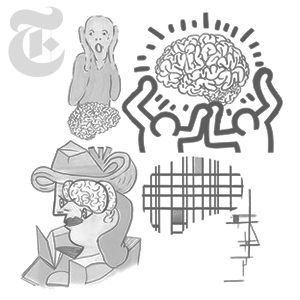
Neuroesthetics is a relatively recent sub-discipline of aesthetics (a branch of philosophy dealing with the nature of beauty), which received its formal definition in 2002 as the scientific study of the neural bases for the contemplation and creation of a work of art. With the aim of discovering general rules about aesthetics, one approach is the observation of subjects viewing art and the exploration of the mechanics of vision. It is proposed that pleasing sensations are derived from the repeated activation of neurons due to primitive visual stimuli such as horizontal and vertical lines.
The link between specific brain areas and artistic activity is of great importance to the field of neuroesthetics. This can be applied both to the ability to create and interpret art. A common approach to uncover the neural mechanisms is through the study of individuals, specifically artists, with neural disorders such as savant syndrome or some form of traumatic injury. It is argued that the sense of beauty and aesthetic judgment presupposes a change in the activation of the brain’s reward system.
read more »
Posted in Art, Science |
Leave a Comment »
June 21, 2012
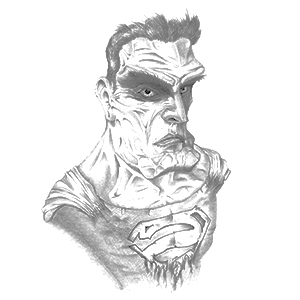
Simulacrum [sim-yuh-ley-kruhm] (Latin: ‘likeness, similarity’) was first recorded in the English language in the late 16th century, to describe a representation, such as a statue or a painting, especially of a god. By the late 19th century, it had gathered a secondary association of inferiority: an image without the substance or qualities of the original.
Philosopher Fredric Jameson offers photorealism as an example of artistic simulacrum, where a painting is sometimes created by copying a photograph that is itself a copy of the real. Other art forms that play with simulacra include Trompe l’oeil, Pop Art, Italian neorealism, and the French New Wave.
read more »
Posted in Art, Philosophy, Technology |
1 Comment »
June 18, 2012
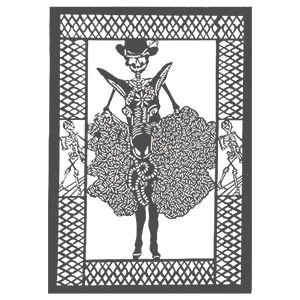
Papel picado (‘perforated paper’) is a decorative craft made out of paper cut into elaborate designs. Although it is a Mexican folk art, papel picado is used as a holiday decoration in many countries. The designs are commonly cut from tissue paper using a guide and small chisels, creating as many as forty banners at a time. Common themes includes birds, floral designs, and skeletons.
They are commonly displayed for both secular and religious occasions, such as Easter, Christmas, the Day of the Dead, as well as during weddings, quinceañeras, baptisms, and christenings. In Mexico, papel picado is especially incorporated into altars during the Day of the Dead.
read more »
Posted in Art, World |
Leave a Comment »
June 14, 2012

Hercules and Love Affair is a musical project from New York based DJ Andy Butler. Members include Butler, Kim Ann Foxman, Mark Pistel, Aerea Negrot, and Shaun Wright. It is signed to DFA Records. The single ‘Blind’ featuring guest Antony Hegarty (lead vocalist in Antony & The Johnsons) was released in 2008, as was their self-titles debut album (produced by Butler and Tim Goldsworthy).
The band’s central figure, Andrew Butler, began his musical career at 15, DJing in a Denver leather bar run by a hostess called Chocolate Thunder Pussy. He then moved to New York, in order to attend Sarah Lawrence College. According to Butler: ‘I’ve been writing songs since childhood. I made music for dance performances in college (where he studied under Martin Goldray), like a remake of Gino Soccio’s ‘Runaway’ done in the style of Kraftwerk.’ In early interviews, Butler stated his intent to release music with a rotating cast of performers and musicians.
Posted in Art |
Leave a Comment »
June 14, 2012
The Copycat Building is a Baltimore landmark containing artists’ live/work/paint spaces. The building was originally occupied in 1905 by the Crown Cork & Seal Company (originators of the modern bottle cap).
It is home to many young artists, musicians, filmmakers, and professionals looking for a large space to live, create, study, and live in the city. The cost of rent is 50 cents per square foot. The building is used for the set of the talk show, ‘It’s a Remarckable Time Who Cares.’
read more »
Posted in Art, Money |
Leave a Comment »