April 6, 2012

Artists and repertoire (A&R) is the division of a record label that is responsible for talent scouting and overseeing the artistic development of recording artists. It also acts as a liaison between artists and the record label; every activity involving artists to the point of album release is generally considered under the purview of, and responsibility of, A&R. The A&R division is responsible for discovering new recording artists and bringing them to the record company.
They are expected to understand the current tastes of the market and to be able to find artists that will be commercially successful. For this reason, A&R people are often young and many are musicians, music journalists or record producers. An A&R executive is authorized to offer a record contract, often in the form of a ‘deal memo’: a short informal document that establishes a business relationship between the recording artist and the record company. The actual contract negotiations will typically be carried out by rival entertainment lawyers hired by the musician’s manager and the record company.
read more »
Posted in Art, Money |
Leave a Comment »
April 6, 2012
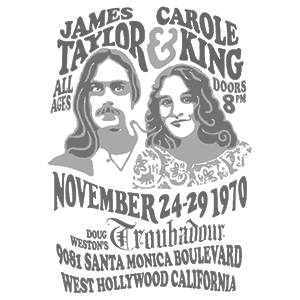
The Troubadour is a nightclub located in West Hollywood, founded in 1957 by Doug Weston. It was a major center for folk music in the 1960s, and subsequently for singer-songwriters and rock.
The Troubadour played an important role in the careers of Elton John, Linda Ronstadt, Hoyt Axton, the Eagles, The Byrds, Joni Mitchell, James Taylor, Carole King, Bonnie Raitt, J.D. Souther, Jackson Browne, Van Morrison, Buffalo Springfield and other prominent and successful performers, who played performances there establishing their future fame.
read more »
Posted in Art, Humor, Money |
Leave a Comment »
April 6, 2012

‘Minnie the Moocher‘ is a jazz song first recorded in 1931 by Cab Calloway and His Orchestra, famous for its nonsensical ad libbed (‘scat’) lyrics. In performances, Calloway would have the audience participate by repeating each scat phrase in a form of call and response. Eventually Calloway’s phrases would become so long and complex that the audience would laugh at their own failed attempts to repeat them. The song is based both musically and lyrically on Frankie ‘Half-Pint’ Jaxon’s 1927 ‘Willie the Weeper’ (Bette Davis sings this version in ‘The Cabin in the Cotton’).
The lyrics are heavily laden with drug references. The character ‘Smokey’ is described as ‘cokey’ meaning a user of cocaine; the phrase ‘kicking the gong around’ was a slang reference to smoking opium. It was followed two years later by Lonnie Johnson’s ‘Winnie the Wailer.’
read more »
Posted in Art, Drugs |
Leave a Comment »
April 4, 2012


Gun fu, a portmanteau of ‘gun’ and ‘kung fu,’ is the style of sophisticated close-quarters gunplay seen in Hong Kong action cinema and in Western films influenced by it. It often resembles a martial arts battle played out with firearms instead of traditional weapons. It may also be described by other terms such as ‘bullet ballet,’ ‘gun kata,’ or ‘gymnastic gunplay.’
The focus of gun fu is both style and the usage of firearms in ways that they were not designed to be used. Shooting a gun from each hand, shots from behind the back, as well as the use of guns as melee weapons are all common. Other moves can involve shotguns, Uzis, rocket launchers, and just about anything else that can be worked into a cinematic shot. It is often mixed with hand-to-hand combat maneuvers. Gun fu has become a staple factor in modern action films due to its visually appealing nature (regardless of its actual practicality in a real-life combat situation). This is a contrast to American action movies of the 1980s which focused more on heavy weaponry and outright brute-force in firearm-based combat.
read more »
Posted in Art, Death |
Leave a Comment »
April 4, 2012

Girls with guns is a sub-genre of action films and animation, often Asian films and anime, that portray a strong female protagonist who makes use of firearms to defend against or attack a group of antagonists. The genre may typically involves gunplay, stunts and martial arts action. The genre started in the late 1950s and early 1960s in Asia. Suzuki Seijun’s 1958 film ‘Underworld Beauty’ is an early example from Japan.
In the 1966, Hong Kong actress Cheng Pei-pei starred in the Shaw Brothers Studio film ‘Come Drink with Me,’ an early Chinese film of the genre. Rival Hong Kong studio, Golden Harvest Studios, had their own female fighter, Angela Mao Ying, who also helped popularize the trend in Asia.
read more »
Posted in Art, Death, Sex |
1 Comment »
April 4, 2012

Gil Evans (1912 – 1988) was a jazz pianist, arranger, composer and bandleader, active in the United States. He played an important role in the development of cool jazz, modal jazz, free jazz and jazz fusion, and collaborated extensively with Miles Davis.
Between 1941 and 1948, he worked as an arranger for the Claude Thornhill Orchestra. Evans’ modest basement apartment behind a New York City Chinese laundry soon became a meeting place for musicians looking to develop new musical styles outside of the dominant bebop of the day. Those present included the leading bebop performer Charlie Parker himself, as well as Gerry Mulligan and John Carisi.
read more »
Posted in Art |
1 Comment »
April 4, 2012
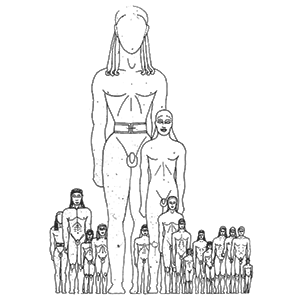
The Getty kouros [koor-os] is an over-life-sized statue in the form of a late archaic Greek kouros (representations of male youths). The dolomitic marble sculpture was bought by the J. Paul Getty Museum, Malibu, California, in 1985 for $7 million. Despite initial favorable scientific analysis of the patina and aging of the marble, a question of its authenticity has persisted from the start.
Subsequent demonstration of an artificial means of creating the de-dolomitization observed on the stone has prompted a number of art historians to revise their opinions of the work. If genuine, it is one of only twelve complete kouroi still extant. If fake, it exhibits a high degree of technical and artistic sophistication by an as-yet unidentified forger. Its status remains undetermined: today the museum’s label reads ‘Greek, about 530 B.C., or modern forgery.’
read more »
Posted in Art, Money, Science |
1 Comment »
April 3, 2012


Simian Mobile Disco are an electronic music duo and production team from London, formed in 2005 by James Ford and Jas Shaw. Musically, they are known for their analog production. In addition to his work with Simian Mobile Disco, Ford is a producer and has worked with artists such as Florence and the Machine, Peaches, Arctic Monkeys, and Klaxons. Simian Mobile Disco originally formed as a DJ duo, on the side of their early four-piece band Simian. They released a number of early tastemaker singles, such as ‘The Mighty Atom / Boatrace / Upside Down’ on I’m a Cliché and ‘The Count’ on Kitsuné, but gained more fame for their remixes of artists such as Muse, Klaxons, The Go! Team, Air, and others.
In 2006, Kitsuné released the duo’s underground hit ‘Hustler,’ which features guest vocals from New York singer Char Johnson. The band’s debut album, ‘Attack Decay Sustain Release’ was released in 2007 on Wichita Recordings. The lead single, ‘It’s the Beat,’ features Ninja from UK indie band The Go! Team on vocals. Their sophomore studio album, ‘Temporary Pleasure’ was released in 2009, and featured many guests including Gruff Rhys of Super Furry Animals, Alexis Taylor of Hot Chip, Beth Ditto of Gossip, and Chris Keating of Yeasayer.
Posted in Art, Technology |
Leave a Comment »
April 2, 2012

UV tattoos are tattoos made with a special ink that is visible under an ultraviolet light (blacklight). Depending upon the ink, they can be nearly invisible in non-UV environments, thus they are a popular consideration for people seeking a subtler tattoo. They are particularly popular in the raver subculture. Although the tattoos are sometimes considered invisible in normal light, scarring from the tattoo machine in the application process may remain, and therefore still show.
A UV tattoo becomes visible under blacklight, when it glows in colors ranging from white to purple, depending on the ink chosen. Colored ink is also available, where the ink is visible in normal light (as with a regular tattoo) but the ink will glow vividly under UV light. However, some UV inks are not as bright under normal light as normal tattoo ink and are considered not as vibrant.
Posted in Art, Health, Technology |
Leave a Comment »
April 2, 2012

The Orange Catholic Bible (abbreviated to O. C. Bible or OCB) is a fictional book from the ‘Dune’ universe created by Frank Herbert. Created in the wake of the crusade against thinking machines known as the Butlerian Jihad, the Orange Catholic Bible is the key religious text in the Dune universe and is described thus in the glossary of the 1965 novel:
‘ORANGE CATHOLIC BIBLE: the ‘Accumulated Book,’ the religious text produced by the Commission of Ecumenical Translators. It contains elements of most ancient religions, including the Maometh Saari, Mahayana Christianity, Zensunni Catholicism, and Buddislamic traditions. Its supreme commandment is considered to be: ‘Thou shalt not disfigure the soul,’ followed by ‘Thou shalt not make a machine in the likeness of a human mind.’
read more »
Posted in Art, Language, Philosophy |
Leave a Comment »
March 29, 2012

An unreliable narrator is a narrator, whether in literature, film, or theater, whose credibility has been seriously compromised. The term was coined in 1961 by Wayne C. Booth in ‘The Rhetoric of Fiction.’ This narrative mode is one that can be developed by an author for a number of reasons, usually to deceive the reader or audience.
Unreliable narrators are usually first-person narrators, but third-person narrators can also be unreliable. The nature of the narrator is sometimes immediately clear. For instance, a story may open with the narrator making a plainly false or delusional claim or admitting to being severely mentally ill, or the story itself may have a frame in which the narrator appears as a character, with clues to his unreliability.
read more »
Posted in Art, Language |
Leave a Comment »
March 29, 2012
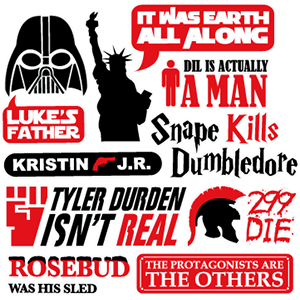
Spoiler is any element of any summary or description of any piece of fiction that reveals any plot element which will give away the outcome of a dramatic episode within the work of fiction, or the conclusion of the entire work. It can also be used to refer to any piece of information regarding any part of a given media. Because enjoyment of fiction sometimes depends upon the dramatic tension and suspense which arises within it, the external revelation of such plot elements can ‘spoil’ the enjoyment that some consumers of the narrative would otherwise have experienced.
The term spoiler was introduced in the early days of the internet, and is often associated with specialist internet sites and in newsgroup postings. Early rules of netiquette insisted that spoilers could and should be normally avoided, but if the posting of “‘spoiling’ information was unavoidable, it be preceded by a warning (‘SPOILER!’), or the spoiler itself has to be masked so that it can not be visible to any but those keen for details and not fazed at the thought of such potentially plot-revealing information.
read more »
Posted in Art, Language |
1 Comment »



