September 25, 2011
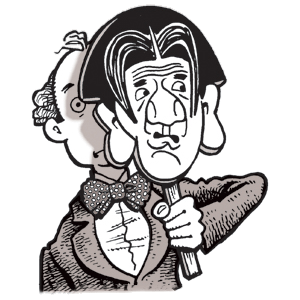
Fake Shemp is the term for someone who appears in a film under heavy make-up, filmed from the back, or perhaps only showing an arm or a foot.
In 1955, Shemp Howard of the ‘Three Stooges’ died suddenly of a heart attack. At the time, the Stooges still had four shorts left to deliver, according to the terms of their annual contract with Columbia Pictures.
read more »
Posted in Art, Language, Money |
1 Comment »
September 25, 2011

The Voyager Golden Records are phonograph records which were included aboard both Voyager spacecraft, which were launched in 1977. They contain sounds and images selected to portray the diversity of life and culture on Earth, and are intended for any intelligent extraterrestrial life form, or for future humans, who may find them. As the probes are extremely small compared to the vastness of interstellar space, the probability of a space faring civilization encountering them is very small, especially since the probes will eventually stop emitting any kind of electromagnetic radiation. If they are ever found by an alien species, it will most likely be far in the future as the nearest star on Voyager 1’s trajectory will only be reached in 40,000 years. Voyager 1 passed the orbit of Pluto in 1990, and left the solar system in 2004. In 2009, it was over 16.5 billion km from the Sun and traveling at a speed of 38,000 mph.
As Carl Sagan noted, ‘The spacecraft will be encountered and the record played only if there are advanced space-faring civilizations in interstellar space. But the launching of this ‘bottle’ into the cosmic ‘ocean’ says something very hopeful about life on this planet.’ Thus the record is best seen as a time capsule or a symbolic statement rather than a serious attempt to communicate with extraterrestrial life. The inscription, by President Jimmy Carter, reads: ‘This is a present from a small, distant world, a token of our sounds, our science, our images, our music, our thoughts and our feelings. We are attempting to survive our time so we may live into yours.’
read more »
Posted in Art, Language, Technology |
Leave a Comment »
September 25, 2011

‘Echoes‘ is a song by Pink Floyd including lengthy instrumental passages, sound effects, and musical improvisation. Written in 1970 by all four members of the group (credited as Roger Waters, Richard Wright, Nick Mason, David Gilmour on the original release), ‘Echoes’ provides the extended finale to Pink Floyd’s album ‘Meddle.’ The track has a running time of 23:31 and takes up the entire second side of the vinyl recording.
The composition uses many progressive and unconventional musical effects. The ping sound heard at the beginning of the song was created as the result of an experiment at the very beginning of the Meddle sessions. It was produced through amplifying a grand piano and sending the signal through a Leslie rotating speaker. At six minutes in, a funk progression in the tonic minor begins. Gilmour used the slide for certain sound effects on the studio recording.
read more »
Posted in Art |
Leave a Comment »
September 21, 2011

The Leslie speaker is a specially constructed amplifier/loudspeaker used to create special audio effects using the Doppler effect. Named after its inventor, Donald Leslie, it is particularly associated with the Hammond organ, an electric organ invented by Laurens Hammond in 1934 and manufactured by the Hammond Organ Company. While the Hammond organ was originally sold to churches as a lower-cost alternative to the wind-driven pipe organ, in the 1960s and 1970s it became a standard keyboard instrument for jazz, blues, rock music, church and gospel music. The Hammond/Leslie combination has become an element in many genres of music. Both brands are currently owned by Suzuki Musical Instrument Corporation.
Unlike a high fidelity loudspeaker, the Leslie is specifically designed, via reproduction of the Doppler effect, to alter or modify sound. Although there have been many variations over the years, the classic Leslie speaker consists of two driver units – a treble unit with horns, and a bass unit, and a crossover that divided the frequencies between the horn and the woofer. The key feature is that both the horns (in reality one working horn with a dummy to counter-balance it) and a sound baffle or scoop for the bass are electrically rotated to create ‘Doppler effect based’ vibrato, tremolo and chorus effects. The rotating elements can be stopped, switched between slow (chorale) and fast (tremolo), or transitioned between the two settings.
read more »
Posted in Art, Money, Technology |
Leave a Comment »
September 16, 2011

In photography, bokeh [boh-kay] is the blur, or the aesthetic quality of the blur, in out-of-focus areas of an image, or ‘the way the lens renders out-of-focus points of light.’ Differences in lens aberrations and aperture shape cause some lens designs to blur the image in a way that is pleasing to the eye, while others produce blurring that is unpleasant or distracting—’good’ and ‘bad’ bokeh, respectively. Bokeh occurs for parts of the scene that lie outside the depth of field. Photographers sometimes deliberately use a shallow focus technique to create images with prominent out-of-focus regions.
Bokeh is often most visible around small background highlights, such as specular reflections and light sources, which is why it is often associated with such areas. However, bokeh is not limited to highlights; blur occurs in all out-of-focus regions of the image.
read more »
Posted in Art, Language, Technology |
2 Comments »
September 13, 2011
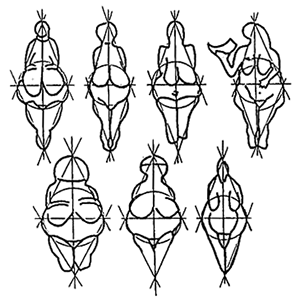
Venus figurines is an umbrella term for a number of prehistoric statuettes of women portrayed with similar physical attributes from the Upper Palaeolithic (between 40,000 and 10,000 years ago), mostly found in Europe, but with finds as far east as Siberia, extending their distribution to much of Eurasia.
These figurines were carved from soft stone (such as steatite, calcite or limestone), bone or ivory, or formed of clay and fired. The latter are among the oldest ceramics known. In total, over a hundred such figurines are known; virtually all of modest size, between 4 cm and 25 cm in height. They are some of the earliest works of prehistoric art.
read more »
Posted in Art, Sex, World |
Leave a Comment »
September 13, 2011
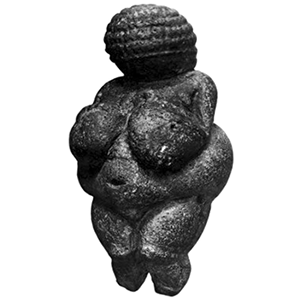
The Venus of Willendorf, also known as the ‘Woman of Willendorf,’ is an 11 cm (4.3 in) high statuette of a female figure estimated to have been made between 24,000 and 22,000 BCE. It was discovered in 1908 by archaeologist Josef Szombathy at a paleolithic site near Willendorf, a village in Lower Austria. It is carved from an oolitic limestone that is not local to the area, and tinted with red ochre. Several similar statuettes and other forms of art have been discovered, and they are collectively referred to as ‘Venus figurines,’ although they pre-date the mythological figure of Venus by millennia. The Willendorf figure was named following a model already over fifty years old, and shares many characteristics with other figures.
After a wide variety of proposed dates, following a revised analysis of the stratigraphy of its site in 1990, the figure has been estimated to have been carved 24,000–22,000 BCE. Very little is known about its origin, method of creation, or cultural significance. The Venus of Willendorf was recovered in a site that also contained a few amulets of Moldavite. The purpose of the carving is the subject of much speculation. It never had feet and does not stand on its own. The apparent large size of the breasts and abdomen, and the detail put into the vulva, have led scholars to interpret the figure as a fertility symbol. The figure has no visible face, her head being covered with circular horizontal bands of what might be rows of plaited hair, or a type of headdress. She was thought to be very healthy given her weight and size.
Posted in Art, Sex |
Leave a Comment »
September 11, 2011

Jeju Loveland is an outdoor sculpture park which opened in 2004 on Jeju Island in South Korea. The park is focused on a theme of sex, running sex education films, and featuring 140 sculptures representing humans in various sexual positions. It also has other elements such as large phallus statues, stone labia, and hands-on exhibits such as a ‘masturbation-cycle.’ The park’s website describes the location as ‘a place where love oriented art and eroticism meet.’ In 2002, graduates of Seoul’s Hongik University began creating sculptures for the park. Encompassing an area the size of two soccer fields, all of the sculptures can be viewed in approximately one hour, and there is an additional monthly rotating exhibit featuring works by different Korean artists. Visitors are required to be at least 18 years old, and a separate play area is available for minors while adults visit.
After the Korean War, the island became a popular honeymoon destination for Korean couples, due to the island’s warm climate. Many of the couples had wed because of arranged marriages, and the island also became known for being a center of sex education. According to an article in Germany’s ‘Der Spiegel’ magazine, in the late 1980s journalist and travel writer Simon Winchester reported that some hotel employees on the island performed as ‘professional icebreakers.’ In the evenings, the hotel would offer an entertainment program featuring erotic elements, to help newlyweds relax.
Posted in Art, Sex, World |
Leave a Comment »
September 8, 2011

PFFR (or Pre-natal Fighting Frightening Remembrances Forever Ltd.) is a Brooklyn based production company/art collective/electro-rock band consisting of Alyson Levy, Vernon Chatman, Jim Tozzi, and John Lee. The group has been active since 2000. The group’s portfolio of work includes albums, live performances, various art exhibits such as ‘An Attack On All Americans Or The Tyranny Of Weed’ shown at the LFL Galley in New York, and the script for the film ‘Final Flesh.’
PFFR are also active in television comedy. They wrote, directed, produced and starred in the MTV2 variety program ‘Wonder Showzen’ (2005–2006) and the Adult Swim CGI series ‘Xavier: Renegade Angel.’ For both these shows, Chatman and Lee are the directors and main voice talent, whilst Tozzi and Levy are the animation/character designer and art director, respectively. Levy provides additional voices for both shows whilst Tozzi does only for ‘Xavier.’ PFFR are also responsible for producing, directing and co-writing Jon Glaser’s Adult Swim show ‘Delocated.’
read more »
Posted in Art, Humor |
Leave a Comment »
September 8, 2011
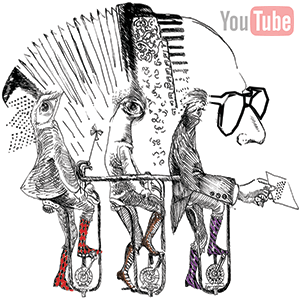
Motion Trio is a Polish accordion trio founded in 1996 by Janusz Wojtarowicz. The group has worked with such artists as Bobby McFerrin and Michał Urbaniak.
Its members consist of accordionists Janusz Wojtarowicz, Paweł Baranek, and Marcin Gałażyn.
Posted in Art, World |
Leave a Comment »
September 8, 2011
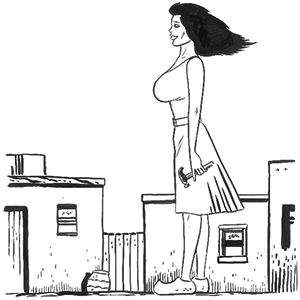
Luba is a comic book character created by Los Bros Hernandez, featured mainly in the ‘Love and Rockets’ series by these authors. She first appeared in ‘BEM,’ found in the ‘Love and Rockets’ collection ‘Music for Mechanics.’ Created by Gilbert Hernandez, Luba was the protagonist for his main contribution to Hernandez Brothers groundbreaking indie comic ‘Love and Rockets.’ Based largely in a small Central American village named Palomar, the Luba stories follow the progress of Luba and her ever increasing family through the years. Gilbert developed a rich cast of residents, who over the years developed an intricate series of relations with each other.
From the outset Luba is portrayed as a beautiful, fiery-tempered woman with enormous breasts and an eye for younger men, often depicted in random panels inexplicably carrying a hammer. This, in conjunction with Jaime Hernandez’ ‘Maggie and Hopey’ tales, differentiated ‘Love And Rockets’ from other comics in that the principal characters were all strong women who, whilst being independent, were also fallible. Through some twenty odd years Gilbert has taken the character of Luba through her infancy as the illegitimate child of a woman married into organized crime, through to life as a middle-aged migrant to America. The bulk of the tales dealt with what happened after Luba and her family moved from Palomar to California to escape the mafia and be near her half sisters Fritz and Petra. These stories comprise the books that make up the Luba Trilogy: ‘Luba in America,’ ‘The Book Of Ofelia’ and ‘The Three Daughters.’
Posted in Art, Language |
1 Comment »
September 8, 2011

Love and Rockets (often abbreviated L&R) is a black and white comic book series by Gilbert Hernandez and Jaime Hernandez, sometimes cited jointly as Los Bros Hernandez. Their brother Mario Hernandez is an occasional contributor. It was one of the first comics in the alternative comics revolution of the 1980s.
The Hernandez brothers self-published the first issue of ‘Love and Rockets’ in 1981, but since 1982 it has been published by Fantagraphics Books. The magazine temporarily ceased publication in 1996 after the release of issue #50, while Gilbert and Jaime went on to do separate series involving many of the same characters. However, in 2001 Los Bros revived the series as ‘Love and Rockets Volume 2’.
read more »
Posted in Art, Humor, Language |
Leave a Comment »





 The Daily Omnivore