August 22, 2011

Cinemagraphs are still photographs in which a minor and repeated movement action occurs. They are produced by taking a series of photographs or a video recording, and, using image editing software, compositing the photographs or the video frames into an animated GIF file in such a manner that motion in part of the subject between exposures (for example, a person’s dangling leg) is perceived as a repeating or continued motion.
The term was coined by U.S. photographers Kevin Burg and Jamie Beck, who used the technique to animate their fashion and news photographs beginning in early 2011.
Posted in Art, Technology |
Leave a Comment »
August 18, 2011

Michael Nyman (b. 1944) is an English composer of minimalist music, pianist, and musicologist, known for the many film scores he wrote during his lengthy collaboration with the filmmaker Peter Greenaway, and his soundtrack album to Jane Campion’s ‘The Piano.’ He has composed operas, concertos, string quartets, and many other chamber works, many for his Michael Nyman Band, with and without whom he tours as a performing pianist. Nyman has stated his preference for writing opera to other sorts of music.
In 1969, he provided the libretto for Harrison Birtwistle’s opera, ‘Down by the Greenwood Side’ and directed the short film ‘Love Love Love’ (based on, and identical length to, The Beatles’ ‘All You Need Is Love’) before settling into music criticism, where he is generally acknowledged to have been the first to apply the term ‘minimalism’ to music (in a 1968 article in The Spectator magazine about the English composer Cornelius Cardew).
read more »
Posted in Art |
Leave a Comment »
August 18, 2011

Alan Smithee was an official pseudonym used by film directors who wish to disown a project, coined in 1968. Until its use was formally discontinued in 2000, it was the sole pseudonym used by members of the Directors Guild of America (DGA) when a director dissatisfied with the final product proved to the satisfaction of a guild panel that he or she had not been able to exercise creative control over a film. The director was also required by guild rules not to discuss the circumstances leading to the move or even to acknowledge being the actual director.
Prior to 1968, DGA rules did not permit directors to be credited under a pseudonym. This was intended to prevent producers from forcing them upon directors, which would inhibit the development of their résumés. The guild also required that the director be credited, in support of the DGA philosophy that the director was the primary creative force behind a film.
read more »
Posted in Art, Humor, Money |
Leave a Comment »
August 17, 2011


Juggalo or Juggalette (the latter being feminine) is a name given to fans of Insane Clown Posse or any other Psychopathic Records hip hop group. Juggalos have developed their own idioms, slang, and characteristics. The term originated during a 1994 live performance by Insane Clown Posse. During the song ‘The Juggla,’ Joseph Bruce addressed the audience as Juggalos, and the positive response resulted in him and Joseph Utsler using the word thereafter to refer to themselves and their friends, family, and fans, including other Psychopathic Records artists.
Juggalos have compared themselves to a family. Common characteristics include drinking the inexpensive soft drink Faygo, wearing face paint and an interest in professional wrestling. They view the lyrics of Psychopathic Records artists (which are often violent in nature) as a catharsis for aggression.
read more »
Posted in Art, Language |
Leave a Comment »
August 16, 2011

Toasting, chatting, or deejaying is the act of talking or chanting, usually in a monotone melody, over a rhythm or beat by a deejay. The lyrics can be either improvised or pre-written. Toasting has been used in various African traditions, such as griots (storytellers) chanting over a drum beat, as well as in Jamaican music forms, such as dancehall, reggae, ska, dub, and lovers rock. The combination of singing and toasting is known as singjaying.
In the late 1950s deejay toasting was developed by Count Machuki. He conceived the idea from listening to disc jockeys on American radio stations. He would do American jive over the music while selecting and playing R&B music. Deejays like Count Machuki working for producers would play the latest hits on traveling sound systems at parties and add their toasts or vocals to the music. These toasts consisted of comedy, boastful commentaries, chants, half-sung rhymes, rhythmic chants, squeals, screams, and rhymed storytelling.
read more »
Posted in Art, Language, World |
1 Comment »
August 16, 2011

Riddim is the Jamaican Patois pronunciation of the English word ‘rhythm,’ but in dancehall/reggae parlance it refers to the instrumental accompaniment to a song. Thus, a dancehall song consists of the riddim plus the ‘voicing’ (vocal part) sung by the deejay (not to be confused with disc jockeys who select and play music, and are called selectors in Jamaica). The resulting song structure may be taken for granted by dancehall fans, but is in many ways unique. A given riddim, if popular, may be used in dozens—or even hundreds—of songs, not only in recordings, but also in live performances. Some ‘classic’ riddims, such as ‘Nanny Goat’ and ‘Real Rock’ are essentially the accompaniment tracks to the original 1960s reggae songs with those names.
Since the 1980s, however, riddims started to be originally composed by producers/beatmakers, who give the riddims original names and, typically, contract artists to ‘voice’ over them. Thus, for example, ‘Diwali’ is the name not of a song, but of a riddim created by Lenky Marsden, subsequently used as the basis for several songs, such as Sean Paul’s ‘Get Busy’ and Bounty Killer’s ‘Sufferer.’ Riddims are the primary musical building blocks of Jamaican popular songs. At any given time, ten to fifteen riddims are widely used in dancehall recordings, but only two or three of these are the now ‘ting’ (the latest riddims that everyone must record over if they want to get them played in the dance or on radio). In dancehall performing, those whose timing is right on top of the rhythm are said to be ‘ridding di riddim.’
read more »
Posted in Art, Language, World |
Leave a Comment »
August 16, 2011

Raymond Loewy [loh-ee] (1893 – 1986) was an industrial designer. Born in France, he spent most of his professional career in the United States. Among his work were the Shell and former BP logos, the Greyhound bus, the Coca-Cola bottle, the Pennsylvania Railroad GG1 and S-1 locomotives, the Lucky Strike package, Coldspot refrigerators, the Studebaker Avanti and Champion, and the Air Force One livery. His career spanned seven decades.
Loewy was born in Paris in 1893, the son of a Jewish Viennese journalist and French woman. He served in the French army during World War I, attaining the rank of captain. He boarded a ship to America in 1919 with only his French officer’s uniform and $50 in his pocket. He lived in New York and found work as a window designer for department stores, including Macy’s, Wanamaker’s and Saks in addition to working as a fashion illustrator for Vogue and Harper’s Bazaar.
read more »
Posted in Art, Money, Technology |
Leave a Comment »
August 16, 2011
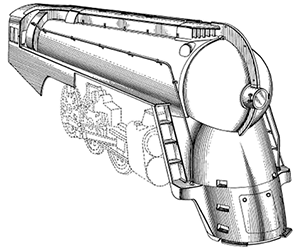

Henry Dreyfuss (1904 – 1972) was an American industrial designer. Dreyfuss was a native of Brooklyn, New York. As one of the celebrity industrial designers of the 1930s and 1940s, Dreyfuss dramatically improved the look, feel, and usability of dozens of consumer products.
As opposed to Raymond Loewy and other contemporaries, Dreyfuss was not a stylist: he applied common sense and a scientific approach to design problems. His work both popularized the field for public consumption, and made significant contributions to the underlying fields of ergonomics, anthropometrics, and human factors.
Posted in Art, Money, Technology |
Leave a Comment »
August 15, 2011
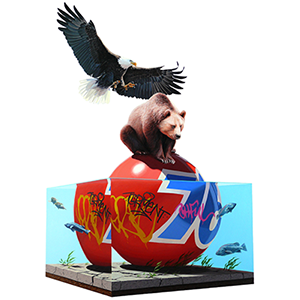
Josh Keyes (b. 1969) is an American contemporary artist who works with painting, drawing, and installation art. He currently works out of Portland, Oregon. His work has been described as ‘a satirical look at the impact urban sprawl has on the environment and surmises, with the aid of scientific slices and core samples, what could happen if we continue to infiltrate and encroach on our rural surroundings.’
Josh’s work brings to mind the detail and complexity of natural history dioramas, and the color and diagrammatic complexity one might find in cross section illustrations from a vintage science textbook. His work has developed over the past years into a complex personal vocabulary of imagery that creates a mysterious and sometimes unsettling juxtaposition between the natural world and the man made landscape.
read more »
Posted in Art, Politics, Technology |
Leave a Comment »
August 15, 2011
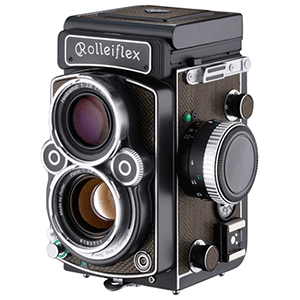
A twin-lens reflex camera (TLR) is a type of camera with two objective lenses of the same focal length. One of the lenses is the photographic objective or ‘taking lens,’ while the other is used for the viewfinder system, which is usually viewed from above at waist level. In addition to the objective, the viewfinder consists of a 45-degree mirror (the reason for the word reflex in the name), a matte focusing screen at the top of the camera, and a pop-up hood surrounding it. The two objectives are connected, so that the focus shown on the focusing screen will be exactly the same as on the film.
However, many inexpensive TLRs are fixed-focus models. Most TLRs use leaf shutters with shutter speeds up to 1/500th sec with a B setting. For practical purposes, all TLRs are film cameras, most often using 120 film, although there are many examples which used other formats. No general-purpose digital TLRs exist, since their heyday ended long prior to the digital era. The main exception is the collector-oriented Rollei Mini-Digi, introduced as a rather expensive ‘toy’ in 2004.
read more »
Posted in Art, Money, Technology |
Leave a Comment »
August 15, 2011


Chillwave, sometimes also referred to as Glo-Fi, is a genre of music where artists are often characterized by their heavy use of effects processing, synthesizers, looping, sampling, and heavily filtered vocals with simple melodic lines.
The genre combines the larger 2000s trends towards 80s retro music and (in indie music) use of ambient sound, with modern pop. The term is said to have been originated on the Hipster Runoff blog.
read more »
Posted in Art, Language, Technology |
Leave a Comment »
August 11, 2011

Ferdinand Cheval (1836 – 1924) was a French postman who spent thirty-three years of his life building Le Palais Idéal (‘The Ideal Palace’) in Hauterives. The structure is regarded as an extraordinary example of naïve art architecture. Cheval began the building in April 1879. He claimed that he had tripped on a stone and was inspired by its shape. He returned to the same spot the next day and started collecting stones. For the next thirty-three years, Cheval picked up stones during his daily mail round and carried them home to build with. He spent the first twenty years building the outer walls. At first, he carried the stones in his pockets, then switched to a basket. Eventually, he used a wheelbarrow. He often worked at night, by the light of an oil lamp.
The Palais is a mix of different styles with inspirations from Christianity to Hinduism. Cheval bound the stones together with lime, mortar and cement. He also wanted to be buried in his palace. However, since that is illegal in France, he proceeded to spend eight more years building a mausoleum for himself in the Hauterives cemetery. He died one year after he had finished building it, and is buried there. Just prior to his death, Cheval began to receive some recognition from luminaries like André Breton and Pablo Picasso. His work is commemorated in an essay by Anaïs Nin. In 1932, the German artist Max Ernst created a collage titled ‘The Postman Cheval.’ The work belongs to the Peggy Guggenheim Collection and is on display there.
Posted in Art, Humor, World |
Leave a Comment »




 The Daily Omnivore