July 29, 2011


Berry Gordy, Jr. (b. 1929) is an American record producer, and the founder of the Motown record label, which played an important role in the racial integration of popular music. Motown achieved a crossover success. In the 1960s, Motown and its soul-based subsidiaries were the most successful proponents of what came to be known as The Motown Sound, a style of soul music with a distinct pop influence.
The Motown Sound typically used tambourines to accent the back beat, prominent and often melodic electric bass-guitar lines, distinctive melodic and chord structures, and a call-and-response singing style that originated in gospel music. Pop production techniques such as the use of orchestral string sections, charted horn sections, and carefully arranged background vocals were also used. Complex arrangements and elaborate, melismatic vocal riffs were avoided. Motown producers believed steadfastly in the ‘KISS principle’ (keep it simple, stupid).
read more »
Posted in Art, Money |
Leave a Comment »
July 27, 2011

Captain America is a superhero that appears in Marvel Comics. The character first appeared in 1941, from Marvel Comics’ predecessor, Timely Comics, and was created by Joe Simon and Jack Kirby. For nearly all of the character’s publication history, Captain America was the alter ego of Steve Rogers, a sickly young man who was enhanced to the peak of human perfection by an experimental serum in order to aid the United States war effort. Captain America wears a costume that bears an American flag motif, and is armed with an indestructible shield that can be thrown as a weapon.
An intentionally patriotic creation who was often depicted fighting the Axis powers of World War II, Captain America was Timely Comics’ most popular character during the wartime period. After the war ended, the character’s popularity waned and he disappeared by the 1950s. He was reintroduced during the Silver Age of comics when he was revived from suspended animation by the superhero team the Avengers in 1964.
read more »
Posted in Art, Politics, War |
Leave a Comment »
July 26, 2011


Dub is a genre of music which grew out of 1960’s reggae. Music in this genre consists predominantly of instrumental remixes of existing recordings which have been manipulated and reshaped, usually by removing the vocals, and emphasizing the drum and bass elements (this stripped down track is sometimes referred to as a ‘riddim’). Other techniques include dynamically adding extensive echo, reverb, panoramic delay, and occasional dubbing of vocal or instrumental snippets from the original version or other works. Dub also sometimes features electronically generated sound effects, or the use of distinctive instruments such as the melodica by artists such as Augustus Pablo.
Dub was pioneered by Osbourne ‘King Tubby’ Ruddock, Lee ‘Scratch’ Perry, Errol Thompson and others in the late 1960s. Similar experiments with recordings at the mixing desk outside of the dancehall environment were also done by producers Clive Chin and Herman Chin Loy. These producers, especially Ruddock and Perry, looked upon the mixing desk as an instrument, manipulating tracks to come up with something new and different. Dub has influenced many genres of music, including punk, hip hop, disco, house, and trip hop, and has become a basis for jungle/drum’n’bass and dubstep music.
read more »
Posted in Art, Language, World |
Leave a Comment »
July 26, 2011

A dubplate is an acetate disc — usually 12, 10, or 7 inches in diameter — used in mastering studios for quality control and test recordings before proceeding with the final master, and subsequent pressing of the record to be mass-produced on vinyl. The ‘dub’ in dubplate is an allusion to the plate’s use in ‘dubbing’ or ‘doubling’ the original version of a track. In music, dubbing is copying of audio recordings from one medium to another.
The name dubplate also refers to an exclusive, ‘one-off’ disc recording pioneered by reggae sound systems but also used by drum and bass and other dance music artists, DJs and sound systems. These dubplates will often be unreleased recordings (which may or may not end up being made available to the general public). They are often used as a market research tool to assess the probable sales of a song once it’s released, as they are far cheaper to produce than a pressed vinyl record. However, because they have a limited life-span they can only be used about fifty times.
Posted in Art, Language, Technology |
Leave a Comment »
July 26, 2011

Biophilia is the musical project and forthcoming eighth full-length studio album from Icelandic singer Björk. The album is ‘partly recorded’ on an iPad and will be released in the form of a series of apps. Biophilia will be the world’s ‘first app album’ in collaboration with Apple. Björk has described the project as a multimedia collection ‘encompassing music, apps, internet, installations, and live shows.’ Scott Snibbe, an interactive artist was commissioned by Björk in the summer of 2010 to produce the app, as well as the images for the live shows (which will combine his visuals with National Geographic imagery, mixed live from iPads on the stage).
For the song, ‘Virus,’ the app will feature a close-up study of cells being attacked by a virus to represent what Snibbe calls: ‘A kind of a love story between a virus and a cell. And of course the virus loves the cell so much that it destroys it.’ The interactive game challenges the user to halt the attack of the virus, although the result is that the song will stop if the player succeeds. In order to hear the rest of the song, the players will have to let the virus take its course. Using some artistic license, the cells will also mouth along to the chorus. Björk is determined to fuse different elements together, be it juxtaposing a female choir from Greenland with the bleeps and glitches of electronic music pioneers Matmos during the Vespertine tour, or meshing soaring strings and jagged beats on ‘Homogenic,’ that ‘helps explain the power and success of Björk’s collaborations.’
Posted in Art, Games, Technology |
Leave a Comment »
July 25, 2011

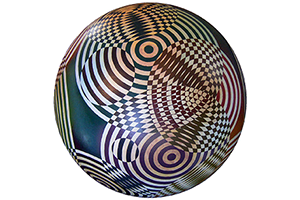
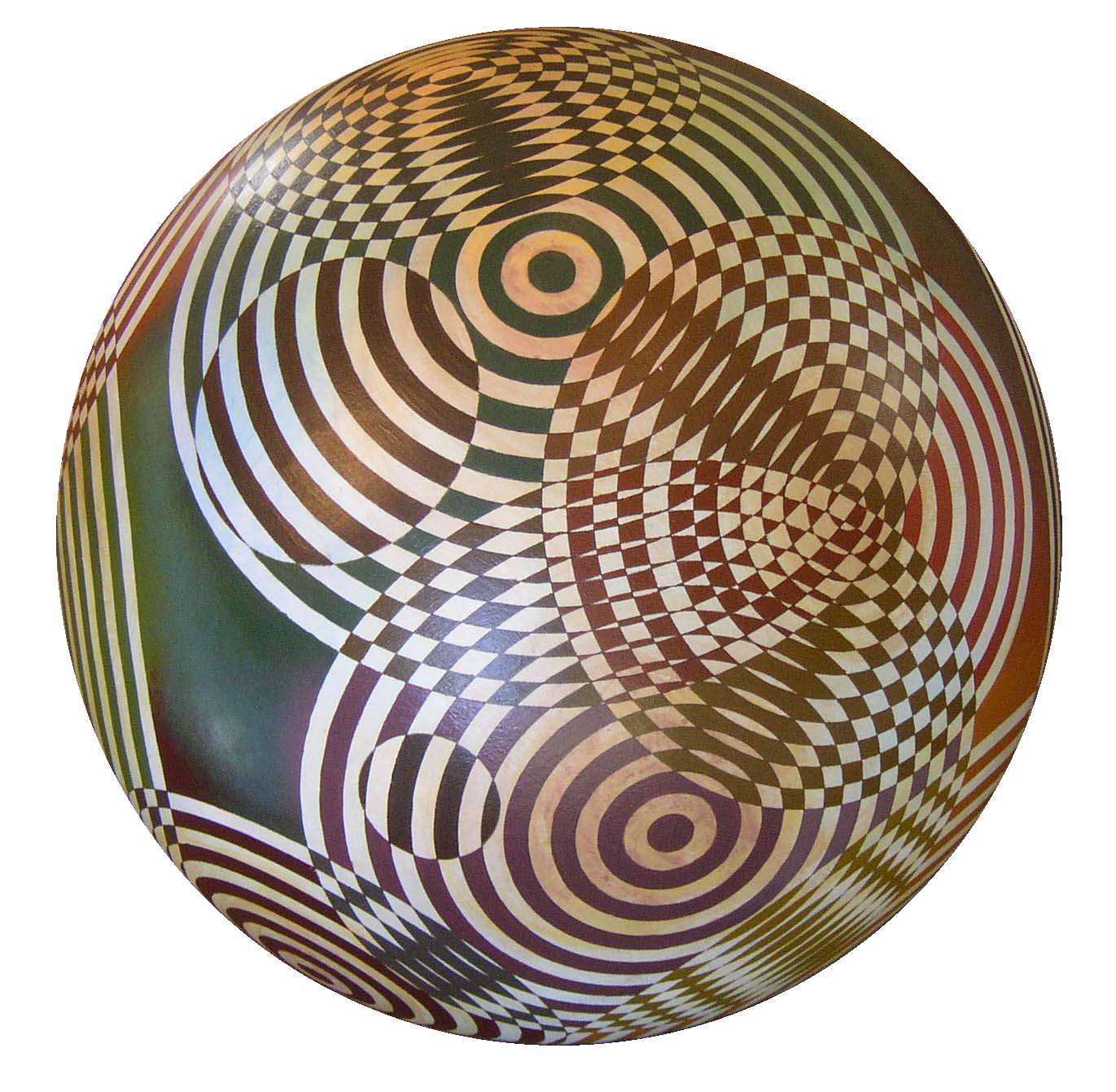
Dick Termes is an innovative American artist who uses a six point perspective system that he devised to create unique paintings on large spheres called Termespheres. They are paintings on spherical canvases that capture an entire environment (Up, Down, Left, Right, Front & Back). Termespheres are typically hung by small chains and rotated with electric ceiling motors to reveal a complete world as the spheres slowly rotate. Optical illusions tend to appear as the spheres rotate.
Although the image is painted on the outside of the convex sphere, the vantage point continuously changes. The rotation also may appear to reverse direction, giving the sensation that the viewer is inside the painting viewing the concave surface of the inside of the rotating sphere. Although the six point perspective appears very non-linear and distorted when viewed on a two-dimensional plane, when the design is superimposed on the sphere, the perspective appears corrected. Termes acknowledges strong influences from M.C. Escher and Buckminster Fuller in developing his technique.
Posted in Art |
Leave a Comment »
July 25, 2011

Wave Twisters (2001) is an animated film, also known as the first turntablism-based musical. It is based on DJ Q-Bert’s album of the same name. The film is entirely scripted to match the DJ Q-Bert recording. As such, it can seem a little disjointed at times. It was produced digitally using Adobe After Effects and a relatively small team of animators. Buckethead makes a short appearance in the film as well, near the beginning.
A crew of heroes is determined to save the lost arts of Hip Hop. Break Dancing, Graffiti, MCing, and DJing from total extinction. The lost arts are being oppressed throughout inner-space by lord Ook and his evil minions the Chinheads. The dental commander Dr. Julio Azul DDS, assumed to be secretary Honey Drips, Dental Hygienist/Robot Rubbish, and Grandpa have a series of adventures, synced to the music. Armed with the ancient relic known as the Wave Twister (a small turntable/wristwatch, the only weapon powerful enough to defeat their enemies), they travel to the far ends of inner-space for a final confrontation with the sinister army of oppressors. The film ends with the team teaching the liberated the lost fundamentals of hip hop.
Posted in Art, Humor, Technology |
Leave a Comment »
July 25, 2011

Idiocracy is a 2006 American film, a satirical science fiction comedy, directed by Mike Judge. The film tells the story of two ordinary people who are taken into a top-secret military hibernation experiment which goes awry, and awaken 500 years in the future. They discover that the world has degenerated into a dystopia where advertising, commercialism, and cultural anti-intellectualism run rampant and dysgenic pressure has resulted in a uniformly stupid human society devoid of intellectual curiosity, social responsibility and coherent notions of justice and human rights. Rather, this future society emphasizes popularity, sexual attraction, and hedonism.
During the prologue, a narrator explains that in our modern society, natural selection does not favor the intelligent (who are very selective and careful in how they have children) and that less-intelligent people procreate freely and easily out-breed the intelligent. This, combined with a general celebration of the cultural ‘lowest common denominator’ and general anti-intellectual cultural mores result in a world that has degenerated into a barely functioning society held together by a rapidly crumbling, mostly automated technological infrastructure that was created by intelligent individuals many years (perhaps centuries) earlier that few, if any, of the members of 26th Century society know how to operate or fix.
Posted in Art, Humor, Politics |
Leave a Comment »
July 25, 2011


Luigi Colani (b. 1928) is a German industrial designer. The prime characteristic of his designs are the rounded, organic forms, which he terms ‘biodynamic’ and claims are ergonomically superior to traditional designs. His ‘kitchen satellite’ from 1969 is the most prominent example of this school of thought. Many of his designs for small appliances are being mass-produced and marketed, but his larger designs have not been built, ‘a whole host of futuristic concepts that will have us living in pods and driving cars so flat that leg amputation is the only option.’
Colani responding to his critics said, ‘The earth is round, all the heavenly bodies are round; they all move on round or elliptical orbits. This same image of circular globe-shaped mini worlds orbiting around each other follows us right down to the microcosmos. We are even aroused by round forms in species propagation related eroticism. Why should I join the straying mass who want to make everything angular? I am going to pursue Galileo Galilei’s philosophy: my world is also round.’
Posted in Art, Money, Technology |
Leave a Comment »
July 24, 2011
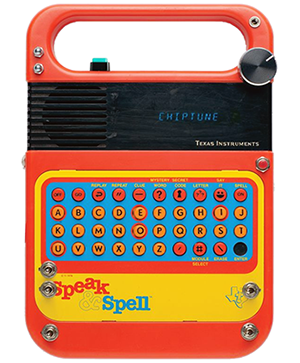
Circuit bending is the creative customization of the circuits within electronic devices such as low voltage, battery-powered guitar effects, children’s toys, and small digital synthesizers to create new musical or visual instruments and sound generators.
Emphasizing spontaneity and randomness, the techniques of circuit bending have been commonly associated with noise music, though many more conventional contemporary musicians and musical groups have been known to experiment with ‘bent’ instruments. Circuit bending usually involves dismantling the machine and adding components such as switches and potentiometers (control knobs) that alter the circuit.
read more »
Posted in Art, Games, Technology |
Leave a Comment »
July 23, 2011

Kid Carpet, real name Ed Patrick, is a musician from Bristol, England. His music has been described as ‘kiddy disco punk’ and ‘shit-hop,’ as it is recorded in his home studio using instruments such as samplers, Casio keyboards, and various children’s toys including plastic Fisher-Price guitars and Tamagotchi innards.
Posted in Art, Humor, Technology |
Leave a Comment »
July 23, 2011

Retrotronics is the making of electric circuits or appliances using older electric components, such as vacuum tubes, Nixie displays, relays, uniselectors, analog meters, etc. These are usually chosen for their aesthetic qualities, rather than their utility. Retrotronics is a popular strand within the steampunk movement. At the Oxford exhibition of Steampunk art, many of the works had a strong retrotronic influence, from light fittings of period components to computer keyboards and webcams of burnished copper and brass. Outside steampunk, similar influences are found amongst the retro-futurist scene.
A recent musical trend has sought to recapture early 1980s 8-bit game and synthesizer sounds, often referred to as Chiptune. Artists such as Kid Carpet perform entire sets on children’s toys or pocket synths of the period. Other artists, such as Nullsleep, perform using only period video game hardware. DJs offer dance music events built from samples of period games or gadgets.
read more »
Posted in Art, Money, Technology |
Leave a Comment »





 The Daily Omnivore