June 30, 2011

Tutting is a contemporary abstract interpretive street dance style modeled after Egyptian hieroglyphics. It is performed with attention to the musics’ rhythm by altering the position of the body and limbs in a synchronized, robotic manner. The size of poses, or tuts, varies from large body tuts to intricate finger tuts. The transitions between poses can be elaborate and expressive. Moreover, certain sub-styles have emerged such as boxing (creating and manipulating box-like or rectangular shapes predominantly with ones arms) and a liquid-influenced style that some tutters use to make the joints appear as hinges that can then be manipulated by another body part.
Both techniques are special applications of the mime concept ‘fixed point.’ Much as a mime conveys a wall by always keeping one hand on the wall, or shows a rope by always keeping one hand on the rope, a tutter shows a shape by always maintaining at least one side of the shape. To do this, a tutter will use his body parts to assemble a shape segment by segment and disassemble it in the same piecemeal fashion. The electronic dance community has played a large role in the increasing robustness of tutting due to the more abstract nature of its own predominant style, liquiding. Tutting is highly regarded in both the electronic and popping communities for its technical depth and distinctiveness.
Posted in Art, Games, Language |
Leave a Comment »
June 30, 2011

Yellow Magic Orchestra (YMO) is a Japanese electronic music band consisting of principal members Haruomi Hosono (bass and keyboards), Yukihiro Takahashi (drums and lead vocals) and Ryuichi Sakamoto (keyboards and vocals). The group began under the name ‘Yellow Magic Band’ in 1977, and then renamed itself as ‘Yellow Magic Orchestra’ in 1978.
The band’s former ‘fourth member’ was music programmer Hideki Matsutake. They are regarded as influential innovators of popular electronic music. They helped pioneer synthpop and ambient house, ushered in electronica, anticipated the beats and sounds of electro music, laid the foundations for J-pop, and influenced the house, techno, and hip-hop movements.
read more »
Posted in Art, Technology, World |
Leave a Comment »
June 30, 2011


A chiptune, also known as chip music, is synthesized electronic music often produced with the sound chips of old computers and video game consoles, as well as with other methods such as emulation. In the early 1980s, home computers became cheaper and more accessible; this led to a proliferation of personal computers and gaming consoles that were abandoned as users moved on to the next generation of software, and the hardware to run it. Small groups of artists and musicians continue to use these forgotten computers to produce audio and visual work.
The game technologies that are typically used in chip music production are those produced from the 1980s up until the early to mid 1990s. These systems, including the NEC PC-8801, Commodore 64, Nintendo Entertainment System, and Nintendo Game Boy, were aimed at the domestic consumer market. These systems were unique in that they marked a period in the technological development of game audio in which dedicated hardware sub-systems or sound chips were used to create sound.
read more »
Posted in Art, Games, Technology |
Leave a Comment »
June 30, 2011

Mati Klarwein (1932 – 2002) was a painter best known for his works used on the covers of music albums. Klarwein was born in Hamburg, Germany. His family was of Jewish origin and fled to the British Mandate of Palestine when he was two years old, after the rise of Nazi Germany.
In 1948 when the territory became Israel, his family traveled to Paris. There Mati studied with French painter, Fernand Léger. Later, he traveled south to Saint-Tropez and met Austrian artist, Ernst Fuchs, who would have a profound influence on him. Leaving France in the 1950s, Klarwein traveled widely and lived in many different countries, including Tibet, India, Bali, North Africa, Turkey, Europe and the Americas. He settled in New York City in the early 1960s.
read more »
Posted in Art, Drugs |
Leave a Comment »
June 30, 2011
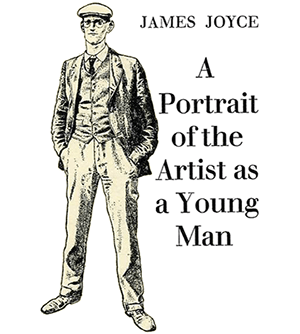

The Bildungsroman [bil-doongz-roh-mahn] (German: ‘education novel’) is a genre of novel which focuses on the psychological and moral growth of the protagonist from youth to adulthood, and in which character change is thus extremely important. The term was coined by philologist (scholar of language in written historical sources) Karl Morgenstern in 1819, and later famously reprised by German historian Wilhelm Dilthey in 1905. The birth of the genre is normally dated to the publication of Goethe’s ‘The Apprenticeship of Wilhelm Meister’ in 1795 in Germany. A Bildungsroman tells about the growing up or coming of age of a sensitive person who is looking for answers and experience. The genre evolved from folklore tales of a dunce or youngest son going out in the world to seek his fortune.
Typically, in the beginning of the story there is an emotional loss which makes the protagonist leave on his journey. In a Bildungsroman, the goal is maturity, and the protagonist achieves it gradually and with difficulty. The genre often features a main conflict between the character and society. Typically, the values of society are gradually accepted by the protagonist who is in turn welcomed back into the fold. There are many variations and subgenres: An Entwicklungsroman (‘development novel’) is a story of general growth rather than self-cultivation. An Erziehungsroman (‘education novel’) focuses on training and formal schooling, while a Künstlerroman (‘artist novel’) is about the development of an artist and shows a growth of the self.
Posted in Art, Language, World |
Leave a Comment »
June 30, 2011

‘Demian: The Story of Emil Sinclair’s Youth’ is a 1919 novel by Herman Hesse. It is a bildungsroman, a novel showing a character’s maturation from youth to adulthood. The book was first published under the pseudonym ‘Emil Sinclair,’ the name of the narrator of the story, but Hesse was later revealed to be the author.
Emil Sinclair is a young boy raised in a bourgeois home, amid what is described as a ‘Scheinwelt,’ a play on words that means ‘world of light’ as well as ‘world of illusion.’ Emil’s entire existence can be summarized as a struggle between two worlds: the show world of illusion (related to the Hindu concept of maya) and the real world, the world of spiritual truth. In the course of the novel, accompanied and prompted by his mysterious classmate ‘Max Demian,’ he detaches from and revolts against the superficial ideals of the world of appearances and eventually awakens into a realization of self.
read more »
Posted in Art, Language, Philosophy |
Leave a Comment »
June 30, 2011
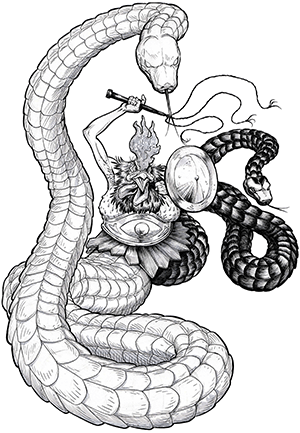
‘Abraxas‘ [uh-brak-suhs] is the second studio album by the latin band Santana. Consolidating their live success at the Woodstock Festival in 1969, and the interest generated by their first album the band took some time to issue a follow-up. Released in 1970, the album’s mix of rock, blues, jazz, salsa and other influences made it a classic that defined Santana’s early sound, and showed a musical maturation from their first album. The album’s cover features the 1961 painting ‘Annunciation,’ by Mati Klarwein.
Abraxas is the name of a deity in Gnostic cosmology. The title of the album comes from a line from Herman Hesse’s book ‘Demian.’ Abraxas is used as a symbol throughout the text, idealizing the harmonious union of all that is good and evil in the world. Demian argues that the Christian God is an insufficient god; it rules over all that is wholesome, but there is another half of the world. The symbol of Abraxas appears as a bird breaking free from an egg or a globe.
Posted in Art, Language, Philosophy |
1 Comment »
June 29, 2011
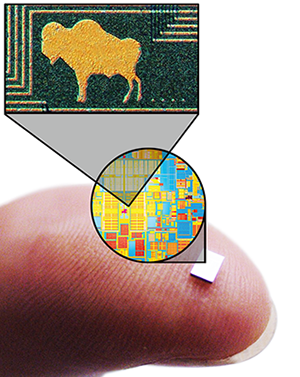
Chip art, also known as silicon art, chip graffiti or silicon doodling, refers to microscopic artwork built into integrated circuits, also called chips or ICs. Since ICs are printed by photolithography, not constructed a component at a time, there is no additional cost to include features in otherwise unused space on the chip.
Designers have used this freedom to put all sorts of artwork on the chips themselves, from designers’ simple initials to rather complex drawings. Given the small size of chips, these figures cannot be seen without a microscope. Chip graffiti is sometimes called the hardware version of software easter eggs (an intentional hidden message or feature).
read more »
Posted in Art, Humor, Technology |
Leave a Comment »
June 29, 2011
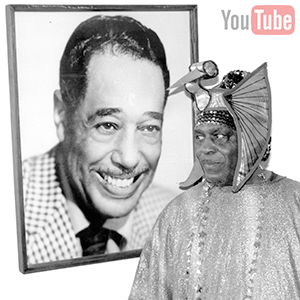
Sun Ra (1914 – 1993), born Herman Poole Blount, was a prolific jazz artist and philosopher known for his ‘cosmic’ music and philosophies. His eclectic music and unorthodox lifestyle made him controversial. Claiming that he was of the ‘Angel Race’ and not from Earth, but from Saturn, Sun Ra developed a complex persona using ‘cosmic’ philosophies and lyrical poetry that made him a pioneer of afrofuturism. He preached awareness and peace above all.
He abandoned his birth name and took on the name and persona of Sun Ra (Ra being the Egyptian God of the Sun), and used several other names throughout his career, including Le Sonra and Sonny Lee. Sun Ra denied any connection with his birth name, saying ‘That’s an imaginary person, never existed … Any name that I use other than Ra is a pseudonym.’
read more »
Posted in Art, Humor, Philosophy |
Leave a Comment »
June 29, 2011
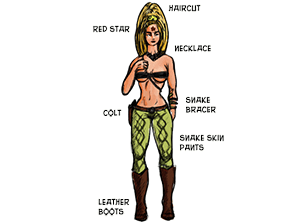

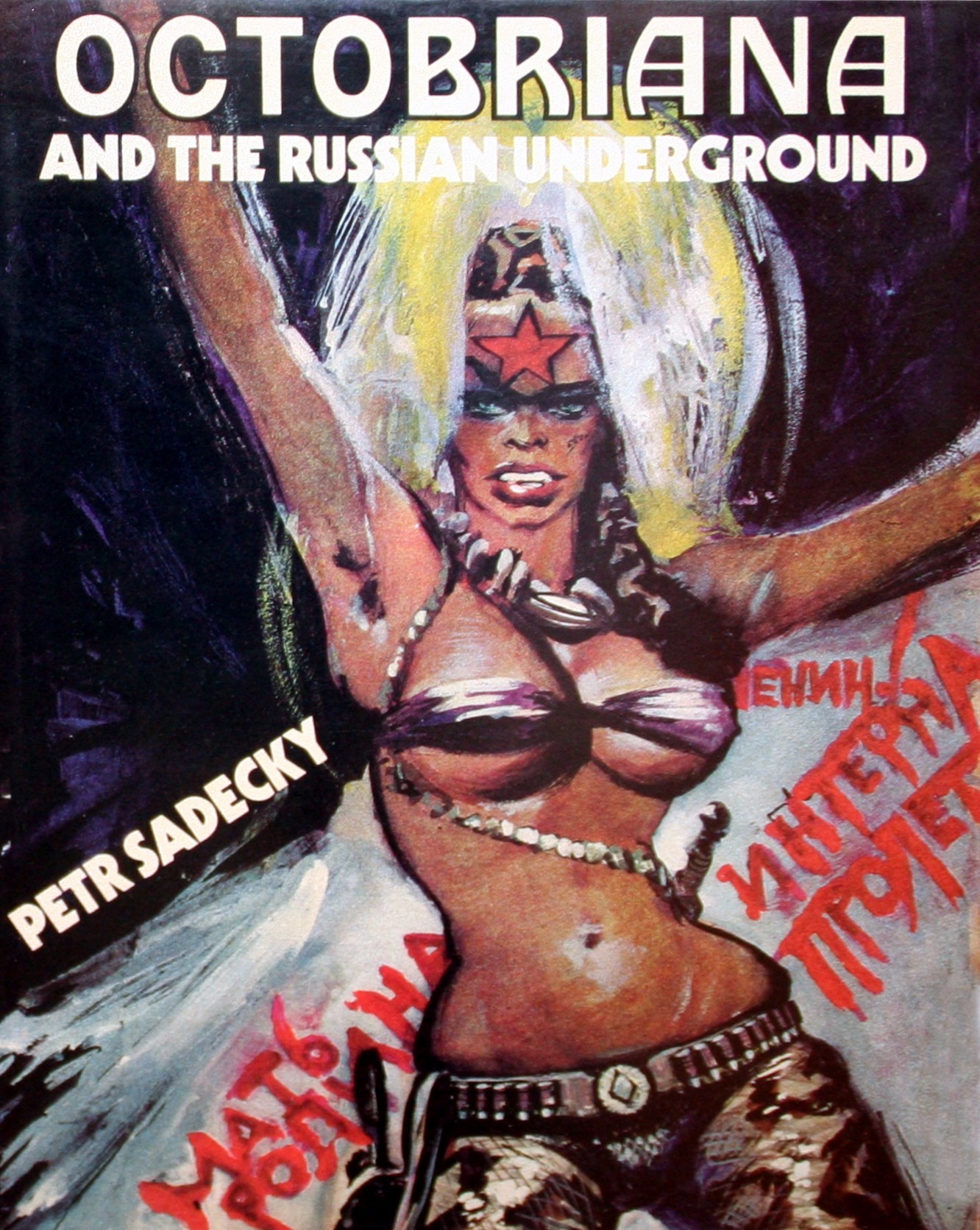
Octobriana is a comic superheroine originating from literary hoax by Czech artist Petr Sadecký. Sadecký wrote ‘Octobriana and the Russian Underground,’ a book that told the story of Octobriana, purported to be the creation of a group of Russian dissident artists calling themselves Progressive Political Pornography (PPP) in the 1960s. Octobriana was actually Sadecký’s own creation. While still in Prague, he enlisted the help of two Czech artists, Bohumil Konečný and Zdeněk Burian, in creating a comic centering around the character of ‘Amazona.’ Sadecký told the two that he had a buyer interested in the comic, and they worked together on writing and illustrating it.
However, Sadecký betrayed his friends by stealing the artwork and escaping to the West, where, in his efforts to market the Amazona comic, he changed the dialog, drew a red star on the character’s forehead, changed her name to Octobriana, and gave her a fake political backstory. Burian and Konečný sued Sadecký in a West German court, winning the case but never recovering all their stolen artwork. Since Octobriana is still widely thought to be the product of dissident cells within the U.S.S.R., she is not copyrighted, and has appeared in a variety of artistic incarnations.
Posted in Art, Money, World |
Leave a Comment »
June 29, 2011

Musopen is an online music library of copyright-free (public domain) music. Musopen’s mission is to record or obtain recordings that have no copyrights so that its visitors may listen, re-use, or in any way enjoy music, and ‘to set music free.’ In 2008, Musopen released newly-commissioned recordings of the 32 Beethoven piano sonatas into the public domain.
In 2010, the site organized a fundraiser via Kickstarter to commission recordings of a larger repertoire. Musopen is a nonprofit charity, operating out of Palo Alto, California, created by Aaron Dunn in 2005.
Posted in Art, Money, Politics |
Leave a Comment »
June 28, 2011

‘Paul is dead‘ is an urban legend suggesting that Paul McCartney of the English rock band The Beatles died in 1966 and was secretly replaced by a look-alike. In September 1969, American college students published articles claiming that clues to McCartney’s death could be found among the lyrics and artwork of The Beatles’ recordings.
Clue hunting proved infectious and within a few weeks had become an international phenomenon. Rumors declined after a contemporary interview with McCartney was published in Life magazine in November 1969. Popular culture continues to make occasional reference to the legend.
read more »
Posted in Art, Death, Humor |
Leave a Comment »




 The Daily Omnivore