June 29, 2011

Musopen is an online music library of copyright-free (public domain) music. Musopen’s mission is to record or obtain recordings that have no copyrights so that its visitors may listen, re-use, or in any way enjoy music, and ‘to set music free.’ In 2008, Musopen released newly-commissioned recordings of the 32 Beethoven piano sonatas into the public domain.
In 2010, the site organized a fundraiser via Kickstarter to commission recordings of a larger repertoire. Musopen is a nonprofit charity, operating out of Palo Alto, California, created by Aaron Dunn in 2005.
Posted in Art, Money, Politics |
Leave a Comment »
June 28, 2011

‘Paul is dead‘ is an urban legend suggesting that Paul McCartney of the English rock band The Beatles died in 1966 and was secretly replaced by a look-alike. In September 1969, American college students published articles claiming that clues to McCartney’s death could be found among the lyrics and artwork of The Beatles’ recordings.
Clue hunting proved infectious and within a few weeks had become an international phenomenon. Rumors declined after a contemporary interview with McCartney was published in Life magazine in November 1969. Popular culture continues to make occasional reference to the legend.
read more »
Posted in Art, Death, Humor |
Leave a Comment »
June 28, 2011

Voiced by Dave Willis, Carl Brutananadilewski is the only main character on ‘Aqua Teen Hunger Force’ who is a human. Carl wears blue sweatpants, a white tank top, flip flops, and a golden chain. Carl has a mustache and is overweight, balding, and has hair all over his body, even on the bottom of his feet.
Carl Brutananadilewski lives next door to Frylock, Meatwad, and Master Shake in a suburban neighborhood in New Jersey. Carl is quick tempered and sarcastic. He has a strong passion for sports, classic rock, and pornography which helps him with his favorite activity, masturbation. He generally dislikes Master Shake, Frylock, and Meatwad, and considers them freaks. Carl sometimes tolerates and welcomes them (rarely with a favorable outcome) possibly because of loneliness. He has a pool which they often use uninvited. His car and house are often destroyed, and he is often tortured and killed, usually as a result of something the Aqua Teens have done but occasionally by his own or others’ doing. Carl has a car he named ‘2Wycked,’ a Ford Probe which is based on Matt Maiellaro’s real life car, the creator of ATHF.
read more »
Posted in Art, Humor |
Leave a Comment »
June 28, 2011

Stitch ‘n Bitch is a phrase that has been used to refer to social knitting groups. ‘Stitch ‘n Bitch’ is a name used by knitting groups that meet on a weekly or monthly basis at locations throughout the world. This use of the term originates as early as the Second World War.
Today’s Stitch ‘n Bitch clubs are generally casual groups of knitters who meet in public spaces such as bars or cafes for socializing and sharing knitting advice. These groups are free or small fee required memberships and open to the public, and are listed in a directory of worldwide knitting groups.
Posted in Art, Games, Humor |
Leave a Comment »
June 27, 2011

Zombie Nation is a German techno and electro project of the Munich based DJ and producer Florian Senfter (also known as John Starlight). The first Zombie Nation five track EP was released in the spring of 1999 on DJ Hell’s label, International DeeJay Gigolo Records.
A remix of the song ‘Kernkraft 400’ on this debut release landed in high chart-positions all over the world, including number 2 in the U.K. ‘Kernkraft 400’ was a 1:1 melody copy from the Commodore C64 computer game ‘Lazy Jones.’
read more »
Posted in Art, Money, Technology |
Leave a Comment »
June 24, 2011
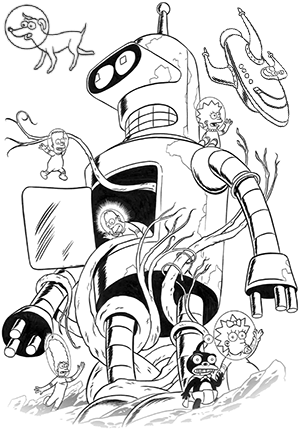
A fictional crossover is the placement of two or more otherwise discrete fictional characters, settings, or universes into the context of a single story. They can arise from legal agreements between the relevant copyright holders, or because of unauthorized efforts by fans, or even amid common corporate ownership.
Crossovers generally occur between properties owned by a single holder, but they can more rarely involve properties from different holders, provided that the inherent legal obstacles can be overcome. They may also involve using characters that have passed into the public domain with those that currently enjoy copyright protection.
read more »
Posted in Art, Language |
Leave a Comment »
June 24, 2011
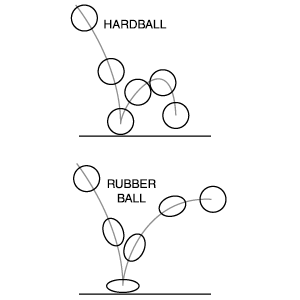
Squash and stretch is a common animation technique applied to characters or objects in motion. The technique makes their actions more fluid, and it is generally exaggerated for a cartoonish effect. When utilized with more subtlety, it works just as well for realistic movements. Squash and stretch was used to great effect in early 1920s American cartoons such as ‘Felix the Cat’ and ‘Betty Boop.’ It can also be used in comics or still cartoon art.
When done in accordance with the principles of animation, squash and stretch keeps the volume of the character constant. When squash and stretch is applied, it creates the illusion that a drawing has dimension and volume. Squash and stretch does not always have to be cartoonlike – when we crouch down in anticipation for a large leap, we squash. When we spring into the air, we stretch. A half-filled flour sack is an example of a more cartoonlike squash and stretch – when dropped the sack squashes a lot; when picked up it stretches a lot – but throughout the entire action, the volume never changes.
Posted in Art, Humor |
Leave a Comment »
June 24, 2011
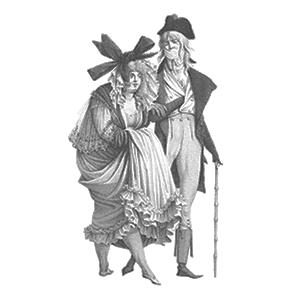
The Incroyables (Incredibles) and their female counterparts, the Merveilleuses (Marvelous), were a name for the fashionable subcultures living in France in the Directoire era (late 18th century). The exhibition of products of national industry, organized in 1798, testified to their infatuation with luxury.
The names are sometimes spelled and were pronounced ‘incoyables’ and ‘meveilleuses’ without the letter R, in reaction against the Revolution, which begins with an R, in which so many had suffered and lost relatives, the letter R was banished. Divorce became legal under the Directoire and morals tended to be looser than in the past. Many Incroyables were ‘nouveaux riches,’ gaining their wealth from selling arms and lending money (usury). When the Directoire period ended, society took a more sober and modest turn.
read more »
Posted in Art, Money, World |
Leave a Comment »
June 24, 2011


This Is Your Life is an American television documentary series broadcast on NBC, originally hosted by its producer, Ralph Edwards from 1952 to 1961. In the show, the host surprises a guest, and proceeds to take them through their life in front of an audience including friends and family. The format originated as a radio show on NBC Radio airing from 1948 to 1952.
The idea for ‘This Is Your Life’ arose while Edwards was working on ‘Truth or Consequences.’ He had been asked by the U.S. Army to ‘do something’ for paraplegic soldiers at a California Army rehabilitation hospital. Edwards chose a ‘particularly despondent young soldier and hit on the idea of presenting his life on the air, in order to integrate the wreckage of the present with his happier past and the promise of a hopeful future.’
read more »
Posted in Art, Money |
1 Comment »
June 23, 2011

The dolly zoom effect is an unsettling in-camera special effect that appears to undermine normal visual perception in film. In its classic form, the camera is pulled away from a subject while the lens zooms in, or vice-versa.
Thus, during the zoom, there is a continuous perspective distortion, the most directly noticeable feature being that the background appears to change size relative to the subject.
read more »
Posted in Art, Language, Technology |
Leave a Comment »
June 23, 2011
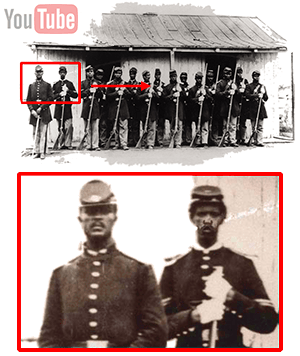
The Ken Burns effect is a popular name for a type of panning and zooming effect used in video production from still imagery. The name derives from extensive use of the technique by American documentarian Ken Burns. The technique predates his use of it, but his name has become associated with the effect in much the same way as Alfred Hitchcock is associated with the Hitchcock zoom.
The name ‘The Ken Burns Effect’ was used by Apple in 2003 for a feature in its iMovie 3 software. The feature enables a widely used technique of embedding still photographs in motion pictures, displayed with slow zooming and panning effects, and fading transitions between frames.
read more »
Posted in Art, Technology |
Leave a Comment »
June 23, 2011

Pickover stalks are certain kinds of details to be found empirically in the Mandelbrot set, in the study of fractal geometry. They are so named after the researcher Clifford Pickover, whose ‘epsilon cross’ method was instrumental in their discovery. An ‘epsilon cross’ is a cross-shaped orbit trap, which is a method of coloring fractal images based upon how close an iterative function, used to create the fractal, approaches a geometric shape, called a ‘trap.’ Pickover hit on the novel concept of looking to see how closely the orbits of interior points come to the x and y axes. In these pictures, the closer that the point approaches, the higher up the color scale, with red denoting the closest approach. The logarithm of the distance is taken to accentuate the details.
Biomorphs are biological-looking Pickover Stalks. At the end of the 1980s, Pickover developed biological feedback organisms similar to Julia sets and the fractal Mandelbrot set. He described an algorithm which could be used for the creation of diverse and complicated forms resembling invertebrate organisms. The shapes are complicated and difficult to predict before actually experimenting with the mappings. He hoped these techniques would encourage others to explore further and discover new forms, by accident, that are on the edge of science and art. Pickover’s biomorphs show a self-similarity at different scales and illustrate a significant feature of feedback in dynamical systems. Real systems, such as human beings and mountain ranges, also show self-similarity at different scales.
Posted in Art, Technology |
Leave a Comment »




 The Daily Omnivore