June 13, 2011
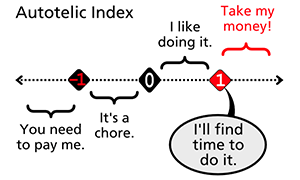

‘Art for art’s sake‘ is the usual English rendering of a French slogan, from the early 19th century, ‘l’art pour l’art,’ and expresses a philosophy that the intrinsic value of art, and the only ‘true’ art, is divorced from any didactic (educational), moral or utilitarian function.
Such works are sometimes described as ‘autotelic,’ from the Greek ‘autoteles,’ ‘complete in itself,’ a concept that has been expanded to embrace ‘inner-directed’ or ‘self-motivated’ human beings. A Latin version of this phrase, ‘Ars gratia artis,’ is used as a slogan by Metro-Goldwyn-Mayer and appears in its logo.
read more »
Posted in Art, Language, Philosophy |
1 Comment »
June 13, 2011

Didacticism [dahy-dak-tuh-siz-uhm] is an artistic philosophy that emphasizes instructional and informative qualities in literature and other types of art. The primary intention of didactic art is not to entertain, but to teach. Didactic plays, for instance, teach the audience through the use of a moral or a theme. An example of didactic writing is Alexander Pope’s ‘An Essay on Criticism’ (1711), which offers a range of advice about critics and criticism. An example of didactism in music is the chant ‘Ut queant laxis,’ which was used by Guido of Arezzo to teach solfege syllables.
The term ‘didactic’ is also used as a criticism for work that appears to be overly burdened with instructive, factual, or otherwise educational information, to the detriment of the enjoyment of the reader. Edgar Allan Poe called didacticism the worst of ‘heresies’ in his essay ‘The Poetic Principle.’
Posted in Art, Games, Language |
Leave a Comment »
June 12, 2011
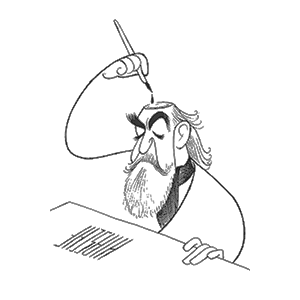
Al Hirschfeld (1903 – 2003) was an American caricaturist best known for his simple black and white portraits of celebrities and Broadway stars. Hirschfeld’s art style is unique, and he is considered to be one of the most important figures in contemporary caricature, having influenced countless cartoonists.
His caricatures are almost always drawings of pure line with simple black ink on white paper with little to no shading or crosshatching. His drawings always manage to capture a likeness using the minimum number of lines. Though his caricatures often exaggerate and distort the faces of his subjects, he is often described as being a fundamentally ‘nicer’ caricaturist than many of his contemporaries, and being drawn by Hirschfeld was considered an honor more than an insult. Nonetheless he did face some complaints from his editors over the years.
read more »
Posted in Art, Humor |
Leave a Comment »
June 10, 2011


Gary Panter (b. 1950) is an illustrator, designer, and part-time musician. Panter’s work is representative of the post-underground, new wave comics movement that began with the end of one periodical, ‘Arcade: The Comics Revue’ and the initiation of another, RAW, one of the second generation in American underground comix. Panter attended Texas A&M University where he studied under commercial illustrator, Jack Unruh.
He has published his work in various magazines and newspapers, including ‘Raw,’ ‘Time,’ and ‘Rolling Stone.’ He has exhibited widely, and won three Emmy awards for his set designs for ‘Pee-Wee’s Playhouse.’ Prior to Panter’s work, kid shows had a more lulling aesthetic: everything was round, ‘cute,’ simplified, and pastel. His set design was the antithesis of pablum-art: it was dense as a jungle and jam-packed with surprises, often loud and abrasive ones.
read more »
Posted in Art, Humor |
Leave a Comment »
June 10, 2011


A DVJ is a DJ who performs live using an audio-visual music player instead of an audio-only setup. This is not to be confused with a VJ, which usually refers to a host of a music video channel, or a visual-only performer separate from the DJ in a live environment. The term comes from the industry-standard Pioneer DVD-turntable, called the DVJ. Liquid Basildon a British nightclub is host to a number of DVJs such as Sander Kleinenberg, Christian S and Kel Sweeney.
Visuals in one form or another have always been a part of live DJ performances, but until the advent of this form of performance, the visual aspect was largely limited to computerized strobes and spotlights, laser projectors, and/or pyrotechnics. With the advent of DVD technology (especially once it became cheap enough for the average individual to create his or her own discs), a push was made for a device that would give a performer the same flexibility in accessing the music and video on the disc as the turntable-style CD players commonly available for DJs.
read more »
Posted in Art, Technology |
Leave a Comment »
June 10, 2011


VJing is a broad designation for realtime visual performance. Characteristics of VJing are the creation or manipulation of imagery in realtime through technological mediation and for an audience, in synchronization to music. VJing often takes place at events such as concerts, nightclubs, music festivals and sometimes in combination with other performative arts. The term VJing became popular in its association with MTV’s Video Jockey but its origins date back to the New York club scene of the 70s. In both situations VJing is the manipulation or selection of visuals, the same way DJing is a selection and manipulation of audio.
One of the key elements in the practice of VJing is the realtime mix of content from a ‘library of media,’ on storage media such as VHS tapes or DVD disks, video and still image files on computer hard drives, live camera input, or from a computer generated visuals. In addition to the selection of media, VJing mostly implies realtime processing of the visual material. The term is also used to describe the performative use of generative software, although the usage is contested since no video is being mixed.
read more »
Posted in Art, Technology |
1 Comment »
June 10, 2011
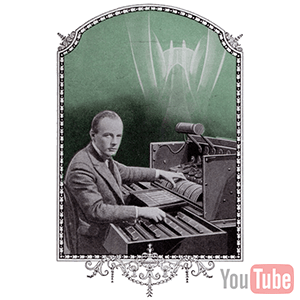
The term color organ refers to a tradition of mechanical (18th century), then electromechanical, devices built to represent sound or to accompany music in a visual medium—by any number of means. In the early 20th century, a silent color organ tradition (Lumia) developed. In the 60s and 70s, the term ‘color organ’ became popularly associated with electronic devices that responded to their music inputs with light shows. The term ‘light organ’ is increasingly being used for these devices; allowing ‘color organ’ to reassume its original meaning.
The dream of creating a visual music comparable to auditory music found its fulfillment in animated abstract films by artists such as Oskar Fischinger, Len Lye and Norman McLaren; but long before them, many people built instruments, usually called ‘color organs,’ that would display modulated colored light in some kind of fluid fashion comparable to music. In 1590, Gregorio Comanini described an invention by the Mannerist painter Arcimboldo of a system for creating color-music based on apparent luminosity (light-dark contrast) instead of hue.
read more »
Posted in Art, Technology |
Leave a Comment »
June 10, 2011
The term ‘Live Cinema‘ formerly described the live musical accompaniment of silent movies, but has grown to include the simultaneous creation of sound and image in real time by sonic and visual artists who collaborate to elaborate concepts on equal terms.
The traditional parameters of narrative cinema are expanded by a much broader conception of cinematographic space, the focus of which is no longer the photographic construction of reality as seen by the camera’s eye, or linear forms of narration. The term ‘Cinema’ is now to be understood as embracing all forms of configuring moving images, beginning with the animation of painted or synthetic images.
Posted in Art |
Leave a Comment »
June 8, 2011

Ralph McQuarrie (1929 – 2012) is a conceptual designer and illustrator who designed ‘Star Wars’ (all of the original trilogy), the original ‘Battlestar Galactica,’ ‘E.T. the Extra-Terrestrial,’ and ‘Cocoon.’
Initially he worked as a technical illustrator for Boeing, as well designing film posters and animating CBS News’s coverage of the Apollo space program at the three-man company Reel Three. Impressed with his work, director George Lucas met with him to discuss his plans for a space-fantasy film. Several years later, in 1975, Lucas commissioned McQuarrie to illustrate several scenes from the script of the film, ‘Star Wars.’
read more »
Posted in Art |
Leave a Comment »
June 8, 2011

The Carousel of Progress is an attraction located at the Disney Magic Kingdom Park in Orlando. Created by both Walt Disney and WED Enterprises as the prime feature of the General Electric Pavilion for the 1964 New York World’s Fair, the attraction was moved to Tomorrowland at Disneyland Park in Anaheim, California, remaining there from 1967 until 1973. It was replaced in Disneyland by America Sings in 1974, and reopened in its present home in 1975.
Steeped in both nostalgia and futurism, the attraction’s premise is an exploration of the joys of living through the advent of electricity and other technological advances during the 20th century via a ‘typical’ American family. To keep it up with the times, the attraction has been updated five times (in 1967, 1975, 1981, 1985, and 1994) and has had two different theme songs, both written by the Sherman Brothers (Disney’s Academy Award-winning songwriting team).
read more »
Posted in Art, Technology |
Leave a Comment »
June 8, 2011

Captain EO is a 3-D film starring Michael Jackson and directed by Francis Ford Coppola (who based the name on Eos, the Greek goddess of dawn) that was shown at Disney theme parks from 1986 through the 1990s. The attraction returned in 2010, as a tribute after Jackson’s death. It is regarded as one of the first ‘4-D’ films (4-D being the name given to a 3-D film which incorporates in-theater effects, such as lasers, smoke, etc., frame synced to the film narrative). This innovation was suggested by producer-writer Rusty Lemorande who is, therefore, sometimes referred to as ‘The Father of 4-D.’ These effects resulted in the seventeen-minute film costing an estimated $30 million to produce. At the time, it was the most expensive film ever made on a per-minute basis, averaging out at $1.76 million per minute.
The film’s executive producer was George Lucas, and it was choreographed by Jeffrey Hornaday (who also choreographed ‘Flashdance’ and ‘A Chorus Line’) and Michael Jackson. The score was written by James Horner, and featured two songs (‘We Are Here to Change the World’ and ‘Another Part of Me’), both written and performed by Michael Jackson. The Supreme Leader was played by Anjelica Huston. The movie tells the story of Captain EO (Michael Jackson) and the ragtag crew of his spaceship on a mission to deliver a gift to ‘The Supreme Leader,’ who lives on a world of rotting, twisted metal and steaming vents. Captain EO’s alien crew consists of his small flying sidekick Fuzzball, the double-headed navigator and pilot Idey and Ody, robotic security officer Major Domo, a small robot Minor Domo (who fits like a module into Major Domo), and the clumsy elephant-like shipmate Hooter who always manages to upset the crew’s missions.
Posted in Art, Humor, Technology |
Leave a Comment »
June 8, 2011


A little green blobby planet thing, nicknamed the ‘Cosmic Cutie,’ with no eyes, a tongue and two thin arms, was used on the U.S. editions of the Hitch Hiker’s Guide To The Galaxy series of books because of worries that American consumers might not realize that a series of books with different names was a ‘trilogy.’
The author of the books, Douglas Adams was one of many people who disliked the character, and demanded it not appear on new editions of any of his books.
Posted in Art, Humor |
Leave a Comment »


 The Daily Omnivore