June 10, 2011
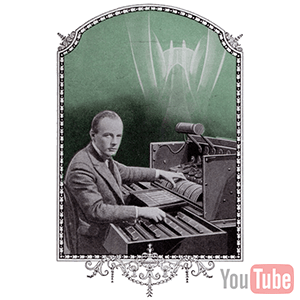
The term color organ refers to a tradition of mechanical (18th century), then electromechanical, devices built to represent sound or to accompany music in a visual medium—by any number of means. In the early 20th century, a silent color organ tradition (Lumia) developed. In the 60s and 70s, the term ‘color organ’ became popularly associated with electronic devices that responded to their music inputs with light shows. The term ‘light organ’ is increasingly being used for these devices; allowing ‘color organ’ to reassume its original meaning.
The dream of creating a visual music comparable to auditory music found its fulfillment in animated abstract films by artists such as Oskar Fischinger, Len Lye and Norman McLaren; but long before them, many people built instruments, usually called ‘color organs,’ that would display modulated colored light in some kind of fluid fashion comparable to music. In 1590, Gregorio Comanini described an invention by the Mannerist painter Arcimboldo of a system for creating color-music based on apparent luminosity (light-dark contrast) instead of hue.
read more »
Posted in Art, Technology |
Leave a Comment »
June 10, 2011
The term ‘Live Cinema‘ formerly described the live musical accompaniment of silent movies, but has grown to include the simultaneous creation of sound and image in real time by sonic and visual artists who collaborate to elaborate concepts on equal terms.
The traditional parameters of narrative cinema are expanded by a much broader conception of cinematographic space, the focus of which is no longer the photographic construction of reality as seen by the camera’s eye, or linear forms of narration. The term ‘Cinema’ is now to be understood as embracing all forms of configuring moving images, beginning with the animation of painted or synthetic images.
Posted in Art |
Leave a Comment »
June 8, 2011

Ralph McQuarrie (1929 – 2012) is a conceptual designer and illustrator who designed ‘Star Wars’ (all of the original trilogy), the original ‘Battlestar Galactica,’ ‘E.T. the Extra-Terrestrial,’ and ‘Cocoon.’
Initially he worked as a technical illustrator for Boeing, as well designing film posters and animating CBS News’s coverage of the Apollo space program at the three-man company Reel Three. Impressed with his work, director George Lucas met with him to discuss his plans for a space-fantasy film. Several years later, in 1975, Lucas commissioned McQuarrie to illustrate several scenes from the script of the film, ‘Star Wars.’
read more »
Posted in Art |
Leave a Comment »
June 8, 2011

The Carousel of Progress is an attraction located at the Disney Magic Kingdom Park in Orlando. Created by both Walt Disney and WED Enterprises as the prime feature of the General Electric Pavilion for the 1964 New York World’s Fair, the attraction was moved to Tomorrowland at Disneyland Park in Anaheim, California, remaining there from 1967 until 1973. It was replaced in Disneyland by America Sings in 1974, and reopened in its present home in 1975.
Steeped in both nostalgia and futurism, the attraction’s premise is an exploration of the joys of living through the advent of electricity and other technological advances during the 20th century via a ‘typical’ American family. To keep it up with the times, the attraction has been updated five times (in 1967, 1975, 1981, 1985, and 1994) and has had two different theme songs, both written by the Sherman Brothers (Disney’s Academy Award-winning songwriting team).
read more »
Posted in Art, Technology |
Leave a Comment »
June 8, 2011

Captain EO is a 3-D film starring Michael Jackson and directed by Francis Ford Coppola (who based the name on Eos, the Greek goddess of dawn) that was shown at Disney theme parks from 1986 through the 1990s. The attraction returned in 2010, as a tribute after Jackson’s death. It is regarded as one of the first ‘4-D’ films (4-D being the name given to a 3-D film which incorporates in-theater effects, such as lasers, smoke, etc., frame synced to the film narrative). This innovation was suggested by producer-writer Rusty Lemorande who is, therefore, sometimes referred to as ‘The Father of 4-D.’ These effects resulted in the seventeen-minute film costing an estimated $30 million to produce. At the time, it was the most expensive film ever made on a per-minute basis, averaging out at $1.76 million per minute.
The film’s executive producer was George Lucas, and it was choreographed by Jeffrey Hornaday (who also choreographed ‘Flashdance’ and ‘A Chorus Line’) and Michael Jackson. The score was written by James Horner, and featured two songs (‘We Are Here to Change the World’ and ‘Another Part of Me’), both written and performed by Michael Jackson. The Supreme Leader was played by Anjelica Huston. The movie tells the story of Captain EO (Michael Jackson) and the ragtag crew of his spaceship on a mission to deliver a gift to ‘The Supreme Leader,’ who lives on a world of rotting, twisted metal and steaming vents. Captain EO’s alien crew consists of his small flying sidekick Fuzzball, the double-headed navigator and pilot Idey and Ody, robotic security officer Major Domo, a small robot Minor Domo (who fits like a module into Major Domo), and the clumsy elephant-like shipmate Hooter who always manages to upset the crew’s missions.
Posted in Art, Humor, Technology |
Leave a Comment »
June 8, 2011


A little green blobby planet thing, nicknamed the ‘Cosmic Cutie,’ with no eyes, a tongue and two thin arms, was used on the U.S. editions of the Hitch Hiker’s Guide To The Galaxy series of books because of worries that American consumers might not realize that a series of books with different names was a ‘trilogy.’
The author of the books, Douglas Adams was one of many people who disliked the character, and demanded it not appear on new editions of any of his books.
Posted in Art, Humor |
Leave a Comment »
June 8, 2011
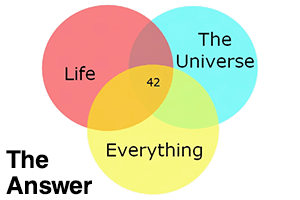

In the first novel and radio series of ‘The Hitchhiker’s Guide to the Galaxy’ a group of hyper-intelligent pan-dimensional beings demand to learn the Ultimate Answer to the Ultimate Question of Life, The Universe, and Everything from the supercomputer, Deep Thought, specially built for this purpose. It takes Deep Thought 7½ million years to compute and check the answer, which turns out to be 42. The Ultimate Question itself is unknown.
When asked to produce The Ultimate Question, the computer says that it cannot; however, it can help to design an even more powerful computer, the Earth, that can. The programmers then embark on a further ten-million-year program to discover The Ultimate Question. This new computer will incorporate living beings in the ‘computational matrix,’ with the pan-dimensional creators assuming the form of mice.
read more »
Posted in Art, Humor |
Leave a Comment »
June 8, 2011

Towel Day is celebrated every May 25th as a tribute by fans of the late author Douglas Adams.
On this day, fans carry a towel with them to demonstrate their love for the books and the author, as referred to in Adams’s ‘The Hitchhiker’s Guide to the Galaxy.’ The commemoration was first held in 2001, two weeks after Adams’s death in May of that year.
read more »
Posted in Art, Humor |
Leave a Comment »
June 8, 2011
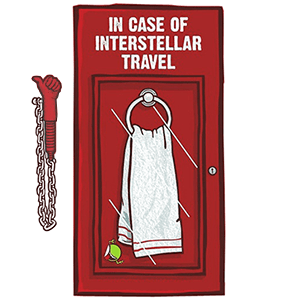
In ‘The Hitchhiker’s Guide to the Galaxy’ series, DON’T PANIC (always upper-case) is a phrase written on the cover of titular ‘The Hitchhiker’s Guide to the Galaxy.’ The novel explains that this was partly because the device ‘looked insanely complicated’ to operate, and partly to keep intergalactic travelers from panicking.
It is said that despite its many glaring (and occasionally fatal) inaccuracies, the Hitchhiker’s Guide to the Galaxy itself has outsold the Encyclopedia Galactica because it is slightly cheaper, and because it has the words ‘DON’T PANIC’ in large, friendly letters on the cover.
Posted in Art, Humor, Language |
Leave a Comment »
June 7, 2011

Tecnocumbia [tek-noh-koom-bee-uh] is a style of Cumbia (Latin American folk music) were there is a fusion between electronic sounds generated by electronic musical instruments and traditional instruments. The term ‘tecnocumbia’ was coined in Mexico to describe this type of music, but the style of music was developed throughout South America with different names given to it. In Mexico, it developed as a variant of the Mexican cumbia that started in the early 80s. The style added electronic instruments along with samplers to the Mexican cumbia music. One of the first musical groups with electrical 80’s sounds was Super Show de los Vazkez from Veracruz, formed in 1981. In the early 90s Selena the ‘Tex-mex queen’ had hits in U.S. and Mexico in the tecnocumbia style.
In South America, where the Colombian Cumbia most easily expanded in popularity, different ‘modern’ styles of the original Colombian rhythm were started mainly in the countries of Peru, Ecuador and Bolivia. The Peruvian cumbia, developed in the early 60s, used electric guitars and synthesizers along with the other classical instruments of the Colombian cumbia in order to create a kind of tropical sound. Variations within the Peruvian cumbia added more tropical rhythms along with a more Andean flavor, which eventually resulted in the creation of the Andean cumbia (Commonly called ‘Chicha music’ in Peru).
Posted in Art, Technology, World |
Leave a Comment »
June 7, 2011


Cumbia [koom-bee-uh] is a Latin American music style that originated in Colombia’s Caribbean coastal region. Traditional cumbia and its associated dance is considered to be representative of Colombia, along with Vallenato, Bambuco and Pasillo. Cumbia originated in the Caribbean coast of eastern Colombia, but there are also folkloric variants in Panama.
During the mid-20th century, Colombian band leaders such as Pacho Galan and Lucho Bermudez orchestrated this Caribbean folklore and brought it to different parts of Latin America, where it gained particular popularity in Mexico, Argentina, and the Andean region. Cumbia began as a courtship dance practiced among the African slave population that was later mixed with European instruments and musical characteristics. Cumbia is very popular in the Andean region and the Southern Cone and was until the early 1980’s more popular in these regions than the salsa.
Posted in Art, Sex, World |
Leave a Comment »
June 7, 2011
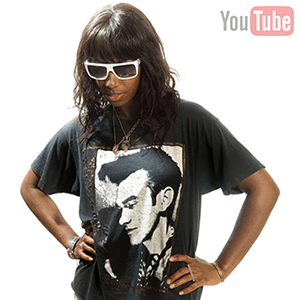
Santi White (b. 1976), better known by her stage name Santigold, is an American songwriter, producer, and singer. Her debut album Santogold was released in 2008. The artist got her pseudonym in the 1990s from a friend’s nickname for her. Santigold was the singer of the Philadelphia-based punk rock band Stiffed, whose 2003 album, ‘Sex Sells,’ and 2005 album, ‘Burned Again,’ were produced by Bad Brains bassist Darryl Jenifer. In February 2009, Santogold changed her stage name to Santigold, as a result of infomercial jeweller Santo Gold threatening legal action.
White’s style has been compared often to that of M.I.A. White said of the M.I.A. comparison that they are both ‘women who have similar influences and have worked with some of the same people,’ but that her music is different, adding ‘I can’t think of anybody who would be a better fit of somebody who I’m like… I think what’s accurate about that comparison is that she’s an artist who has loads of different influences… and is putting things together in a way that’s unexpected and genreless.’ Santigold and her friend Amanda Blank have been described as being part of ‘a new crop of young, multicultural, female acts in the wake of M.I.A.’ White also stated her liking for New Wave, stating that ‘My Superman’ is an interpolation of a Siouxsie and the Banshees’ song, ‘Red Light.’
Posted in Art |
Leave a Comment »