June 15, 2011


David Eagleman (b. 1971) is a neuroscientist at Baylor College of Medicine, where he directs the Laboratory for Perception and Action and the Initiative on Neuroscience and Law. He is best known for his work on time perception, synesthesia, and neurolaw. He is also an internationally bestselling fiction writer.
An early experience of falling from a roof raised his interest in understanding the neural basis of time perception. Eagleman’s scientific work combines psychophysical, behavioral, and computational approaches to address the relationship between the timing of perception and the timing of neural signals.
read more »
Posted in Art, Politics, Science |
Leave a Comment »
June 15, 2011

Synesthesia [sin-uhs-thee-zhuh] is a condition where the brain mixes up the senses (e.g. sounds can have ‘colors,’ images can have ‘odors,’ etc.). People who have synesthesia are called synesthetes. Synesthesia is usually inherited (called congenital synesthesia), but exactly how people inherit it is unknown.
Synesthesia is sometimes reported by people using psychedelic drugs, after a stroke, or during an epileptic seizure. It is also reported to be a result of blindness or deafness. Synesthesia that comes from events unrelated to genes is called adventitious synesthesia. This synesthesia results from some drugs or a stroke but not blindness or deafness. It involves sound being linked to vision or touch being linked to hearing.
read more »
Posted in Art, Health, Science |
Leave a Comment »
June 14, 2011
Ben Wilson is a London-based artist who creates tiny works of art by painting onto chewing gum stuck to the pavement. Wilson started experimenting with occasional chewing-gum paintings in 1998, and in 2004 began working on them full time.
He has created more than 10,000 of these works on pavements all over the UK and parts of Europe. Wilson heats the gum with a small blow torch and then adds lacquer to harden it. He then uses special acrylic paints to create his designs. The paintings can take up to ten hours to produce. In 2005, he was arrested in Trafalgar Square, and in 2009 he was arrested by the City of London Police on suspicion of criminal damage, although the case was dropped a few months later.
Posted in Art, Humor, World |
1 Comment »
June 14, 2011
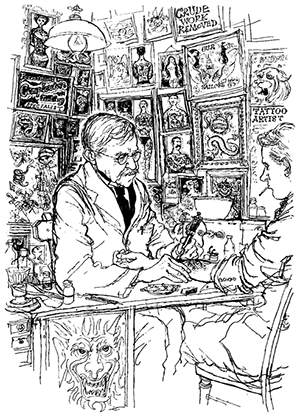
George Burchett (1872 – 1953), known as ‘Professor Burchett’ and the ‘King of Tattooists,’ is a renown English tattoo artist. Having been expelled from school at 12 for tattooing his classmates, he joined the Royal Navy at 13, developing his skills while travelling overseas as a deckhand on the HMS Vincent. After absconding from the Navy, he returned to England, where he was trained in tattoo artistry in London by the legendary English tattooist Tom Riley (who invented the modern tattoo machine).
With a studio on Mile End Road, London, Burchett became the first star tattooist and a favourite among the wealthy upper class and European royalty. Among his customers were King Alfonso XIII of Spain, King Frederick IX of Denmark and the ‘Sailor King’ George V of the United Kingdom. He also tattooed sideshow performer, Horace Ridler (‘The Great Omi’). He constantly designed new tattoos from his worldwide travel, incorporating African, Japanese and Southeast Asian motifs into his work. In the 1930s, he developed cosmetic tattooing with such techniques as permanently darkening eyebrows.
Posted in Art |
Leave a Comment »
June 14, 2011
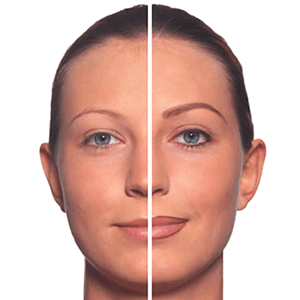
Permanent makeup is a cosmetic technique which employs tattoos (permanent pigmentation of the dermis) as a means of producing designs that resemble makeup, such as eyelining and other permanent enhancing colors to the skin of the face, lips, and eyelids.
It is also used to produce artificial eyebrows, particularly in people who have lost them as a consequence of old age, disease, such as alopecia, chemotherapy, or a genetic disturbance, and to disguise scars and white spots in the skin such as in vitiligo. It is also used to restore or enhance the breast’s areola, such as after breast surgery.
read more »
Posted in Art, Health |
Leave a Comment »
June 14, 2011
Bompas & Parr is a company specializing in food art using gelatin desserts. Named after the defunct food company of the same name, the company uses food molds to make edible decorations shaped like buildings and other architectural structures. The work of Bompas & Parr have been noted for their detail and have competed in culinary artwork competitions, an example being the Architectural Jelly Design Competition organized for the London Festival of Architecture.
The company claims their projects explore how the taste of food is altered through synaesthesia (a condition where the brain mixes up the senses), performance and setting. Currently the focus of their projects is gelatin based because they feel it is a perfect medium for an examination of food and architecture due to its plastic form and the historic role it has played in exploring notions of taste.
Posted in Art, Food, Humor |
Leave a Comment »
June 13, 2011
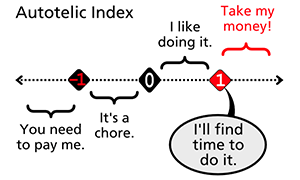

‘Art for art’s sake‘ is the usual English rendering of a French slogan, from the early 19th century, ‘l’art pour l’art,’ and expresses a philosophy that the intrinsic value of art, and the only ‘true’ art, is divorced from any didactic (educational), moral or utilitarian function.
Such works are sometimes described as ‘autotelic,’ from the Greek ‘autoteles,’ ‘complete in itself,’ a concept that has been expanded to embrace ‘inner-directed’ or ‘self-motivated’ human beings. A Latin version of this phrase, ‘Ars gratia artis,’ is used as a slogan by Metro-Goldwyn-Mayer and appears in its logo.
read more »
Posted in Art, Language, Philosophy |
1 Comment »
June 13, 2011

Didacticism [dahy-dak-tuh-siz-uhm] is an artistic philosophy that emphasizes instructional and informative qualities in literature and other types of art. The primary intention of didactic art is not to entertain, but to teach. Didactic plays, for instance, teach the audience through the use of a moral or a theme. An example of didactic writing is Alexander Pope’s ‘An Essay on Criticism’ (1711), which offers a range of advice about critics and criticism. An example of didactism in music is the chant ‘Ut queant laxis,’ which was used by Guido of Arezzo to teach solfege syllables.
The term ‘didactic’ is also used as a criticism for work that appears to be overly burdened with instructive, factual, or otherwise educational information, to the detriment of the enjoyment of the reader. Edgar Allan Poe called didacticism the worst of ‘heresies’ in his essay ‘The Poetic Principle.’
Posted in Art, Games, Language |
Leave a Comment »
June 12, 2011
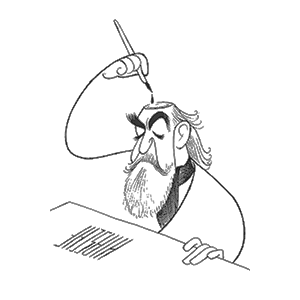
Al Hirschfeld (1903 – 2003) was an American caricaturist best known for his simple black and white portraits of celebrities and Broadway stars. Hirschfeld’s art style is unique, and he is considered to be one of the most important figures in contemporary caricature, having influenced countless cartoonists.
His caricatures are almost always drawings of pure line with simple black ink on white paper with little to no shading or crosshatching. His drawings always manage to capture a likeness using the minimum number of lines. Though his caricatures often exaggerate and distort the faces of his subjects, he is often described as being a fundamentally ‘nicer’ caricaturist than many of his contemporaries, and being drawn by Hirschfeld was considered an honor more than an insult. Nonetheless he did face some complaints from his editors over the years.
read more »
Posted in Art, Humor |
Leave a Comment »
June 10, 2011

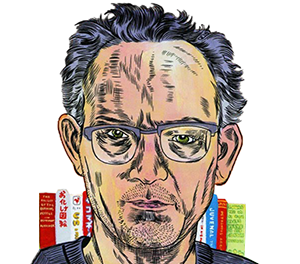
Gary Panter (b. 1950) is an illustrator, designer, and part-time musician. Panter’s work is representative of the post-underground, new wave comics movement that began with the end of one periodical, ‘Arcade: The Comics Revue’ and the initiation of another, RAW, one of the second generation in American underground comix. Panter attended Texas A&M University where he studied under commercial illustrator, Jack Unruh.
He has published his work in various magazines and newspapers, including ‘Raw,’ ‘Time,’ and ‘Rolling Stone.’ He has exhibited widely, and won three Emmy awards for his set designs for ‘Pee-Wee’s Playhouse.’ Prior to Panter’s work, kid shows had a more lulling aesthetic: everything was round, ‘cute,’ simplified, and pastel. His set design was the antithesis of pablum-art: it was dense as a jungle and jam-packed with surprises, often loud and abrasive ones.
read more »
Posted in Art, Humor |
Leave a Comment »
June 10, 2011


A DVJ is a DJ who performs live using an audio-visual music player instead of an audio-only setup. This is not to be confused with a VJ, which usually refers to a host of a music video channel, or a visual-only performer separate from the DJ in a live environment. The term comes from the industry-standard Pioneer DVD-turntable, called the DVJ. Liquid Basildon a British nightclub is host to a number of DVJs such as Sander Kleinenberg, Christian S and Kel Sweeney.
Visuals in one form or another have always been a part of live DJ performances, but until the advent of this form of performance, the visual aspect was largely limited to computerized strobes and spotlights, laser projectors, and/or pyrotechnics. With the advent of DVD technology (especially once it became cheap enough for the average individual to create his or her own discs), a push was made for a device that would give a performer the same flexibility in accessing the music and video on the disc as the turntable-style CD players commonly available for DJs.
read more »
Posted in Art, Technology |
Leave a Comment »
June 10, 2011


VJing is a broad designation for realtime visual performance. Characteristics of VJing are the creation or manipulation of imagery in realtime through technological mediation and for an audience, in synchronization to music. VJing often takes place at events such as concerts, nightclubs, music festivals and sometimes in combination with other performative arts. The term VJing became popular in its association with MTV’s Video Jockey but its origins date back to the New York club scene of the 70s. In both situations VJing is the manipulation or selection of visuals, the same way DJing is a selection and manipulation of audio.
One of the key elements in the practice of VJing is the realtime mix of content from a ‘library of media,’ on storage media such as VHS tapes or DVD disks, video and still image files on computer hard drives, live camera input, or from a computer generated visuals. In addition to the selection of media, VJing mostly implies realtime processing of the visual material. The term is also used to describe the performative use of generative software, although the usage is contested since no video is being mixed.
read more »
Posted in Art, Technology |
1 Comment »




