May 4, 2012

Malice in Wonderland is a 1982 American independent short film directed by Vince Collins, and with graphic design by Miwako. It is loosely based on the Lewis Carroll’s ‘Alice in Wonderland,’ displaying surreal images and an aggressive animation style.
It is 4 minutes long. A jet-propelled white rabbit flies through the vulva of a supine woman into a wonderland where people and objects turn inside out, changing shapes and identities at warp speed. Events roughly follow Lewis Carroll’s ‘Alice in Wonderland.’ The Caterpillar, the Cheshire Cat, the Mad Hatter, and the Queen of Hearts make appearances, as does Alice. Images and symbols are often sexual. At the end, Alice says, ‘Oh, I’ve had such a curious dream.’
Posted in Art, Drugs |
Leave a Comment »
April 29, 2012

‘Earache My Eye‘ is a comedy routine and song by Cheech and Chong which features ‘Alice Bowie’ (one of Cheech Marin’s characters). It first appeared on ‘Cheech & Chong’s Wedding Album’ (1974). Cheech And Chong also lip sync to the recording (with Chong behind the drumkit) in their first movie ‘Up in Smoke’ (1978). This piece has been featured repeatedly on the ‘Doctor Demento’ radio show. According to Tommy Chong’s autobiography, the famous guitar riff is played by Gaye Delorme, who also composed the music for the song. Additionally, Chong states that drums on the song are played by famed international percussionist Airto Moreira.
The B-side, ‘Turn That Thing Down’ features the remainder of the musical track, from the point of Marin’s monologue about his wealth, without the actual dialogue, complete to its conclusion. It is possible to assemble the full-length version of the song by editing the two sections together. Several radio stations refused to play the song. Once the song hit its peak on the charts, radio station managers pulled the song out of the format of airplay, due to complaints by parents, teachers, psychologists, principals, and counselors, who stated that this song mostly appealed to junkies, dropouts, drug addicts, and drunks, as well as for students playing hooky from class, giving them a bad example of behavior.
Posted in Art, Drugs, Humor |
Leave a Comment »
April 29, 2012

Methaqualone is a sedative-hypnotic drug that is similar in effect to barbiturates, a general central nervous system depressant. The sedative-hypnotic activity was first noted by Indian researchers in the 1950s and in 1962 methaqualone itself was patented in the US by Wallace and Tiernan. Its use peaked in the early 1970s as a hypnotic, for the treatment of insomnia, and as a sedative and muscle relaxant.
It has also been used illegally as a recreational drug, commonly known as Quaaludes [kwey-lood], Sopors, Ludes, or Mandrax (particularly in the 1970s in North America) depending on the manufacturer. At that time ‘luding out’ was a popular college pastime. This is the similar effect of an alcoholic blackout with no recollection of events. Since at least 2001, it has been widely used in South Africa, where it is commonly referred to as ‘smarties’ or ‘geluk-tablette’ (meaning ‘happy tablets’). Clandestinely produced methaqualone is still seized by government agencies and police forces around the world.
Posted in Drugs, Health, Politics |
Leave a Comment »
April 19, 2012
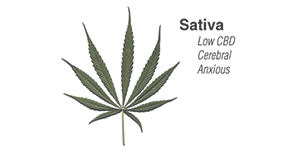

Cannabidiol [kah-nuh-bi-dye-awl] (CBD) is a cannabinoid found in Cannabis. It is a major constituent of the plant, representing up to 40% in its extracts. It has displayed sedative effects in animal tests. Some research, however, indicates that CBD can increase alertness. It may decrease the rate of THC clearance from the body, perhaps by interfering with the metabolism of THC in the liver. Medically, it has been shown to relieve convulsion, inflammation, anxiety, and nausea, as well as inhibit cancer cell growth. Recent studies have shown cannabidiol to be as effective as atypical antipsychotics in treating schizophrenia.
A Cannabis Indica plant may have a CBD/THC ratio 4:-5 times that of Cannabis sativa. Marijuana with relatively high ratios of CBD:THC is less likely to induce anxiety than vice versa. This might partial be due to CBD’s antagonist effects at the cannabidanoid receptor, compared to THC’s partial agonist effect. The relatively large amount of CBD contained in Cannabis indica, means, compared to a sativa, the effects are modulated significantly. The effects of Sativa are well known for its cerebral high, hence used daytime as medical cannabis, while Indica are well known for its sedative effects and preferred night time as medical cannabis.
Posted in Drugs, Health |
1 Comment »
April 17, 2012
Electric Daisy Carnival is an annual electronic dance music festival held in the South West United States on the last weekend of June. The first Electric Daisy Carnival was held in 1997 at the Shrine Expo Hall in Southern California. The name usage was acquired by Insomniac’s partner Philip Blaine. This refers to the name borrowed from Steve Kool-Aid’s original creation from several years prior whom Philip knew through his colleague Gary (Steve’s partner) at 1500 Records.
In 2010, the event drew criticism from local authorities and promoters alike after minors gained entrance and numerous people were taken to the hospital by paramedics, and as well after an underage (15 year old female) attendee who died of an overdose of ecstasy. The city of Los Angeles began to consider banning all raves from being held in the city. The Coliseum Commission put a moratorium on booking any future events, pending the outcome of the use of new security and safety provisions. Those new provisions include a minimum age of 18 on all future events and the presence of on-site doctors.
Posted in Art, Drugs, Money |
Leave a Comment »
April 17, 2012
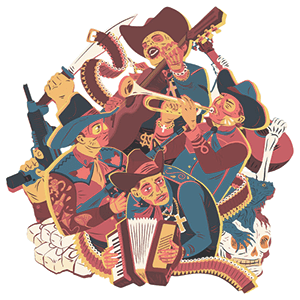
A Narcocorrido [nahr-koh-koh-ree-doh] is a type of Mexican music and song tradition which evolved out of the norteño folk corrido tradition. This type of music is heard on both sides of the US–Mexican border. It uses a danceable, accordion-based polka as a rhythmic base. The first corridos that focus on drug smugglers dated to the 1930s. Early corridos (non-narco) go back as far to the Mexican Revolution of 1910, telling the stories of revolutionary fighters. Music critics have compared narcocorrido music to gangster rap. Narcocorrido lyrics refer to particular events and include real dates and places. The lyrics tend to speak approvingly of illegal criminal activities such as murder, torture, racketeering, extortion, drug smuggling, illegal immigration, and sometimes political protest due to government corruption.
Among the earliest exponents of narcocorrido music were Los Alegres de Teran, who recorded many. In the 1980s, Rosalino ‘Chalino’ Sánchez contributed to narcocorridos. Known throughout Mexico as ‘l Pelavacas’ (‘Cow Skin Peeler’), El Indio (The Indian, from his corrido ‘El Indio Sánchez’), and ‘Mi Compa’ (‘My Friend’), Sánchez was a Mexican immigrant living in Los Angeles. He then began distributing his music. His lyrics composed of heartbreak, revolution, and socioeconomic issues. Soon he was selling mass copies. Chalino Sánchez was murdered in 1992 after a concert in Culiacán. In death, he became a legend and one of the most influential musicians to emerge from California, he was known throughout Mexico and United States as El Rey del Corrido (‘The King of the Corrido’).
Posted in Art, Death, Drugs |
1 Comment »
April 17, 2012

The terms empathogen [em-path-uh-jen] and entactogen are used to describe a class of psychoactive drugs that produce distinctive emotional and social effects similar to those of MDMA (‘Ecstasy’) characterized by increased empathy (the ability to understand and share the feelings of another). Putative members of this class include 2C-B, 2C-I, MDMA, MDA, MDEA, MBDB, 2C-T-7, and 2C-T-2, among others.
The chemical structure of many entactogens contains a substituted amphetamine core, and most belong to the phenethylamine class of psychoactive drugs, although several (AET and AMT) are tryptamines. When referring to MDMA and its counterparts, the term ‘MDxx’ is often used with the exception of MDPV.
read more »
Posted in Drugs, Health, Language |
Leave a Comment »
April 17, 2012

The Second Summer of Love is a name given to the period in 1988-89 in Britain, during the rise of acid house music and the euphoric explosion of unlicensed MDMA (‘Ecstasy’)-fuelled rave parties. The term generally refers to the summers of both 1988 and 1989, when electronic dance music and MDMA exploded in popularity, culminating in mass free parties and the era of the rave.
LSD was also widely available and popular again. The music of this era fused dance beats with a psychedelic, 1960s flavor, and the dance culture drew parallels with the hedonism and freedom of the ‘Summer of Love’ in San Francisco two decades earlier. Similarities with the Sixties included fashions such as Tie-dye. The smiley logo is synonymous with this period in the UK.
Posted in Drugs, Love, World |
Leave a Comment »
April 17, 2012

Madchester was a music scene that developed in Manchester, England, towards the end of the 1980s and into the early 1990s. The music that emerged from the scene mixed alternative rock, psychedelic rock, and dance music. Artists associated with the scene included New Order, The Stone Roses, Happy Mondays, Inspiral Carpets, Northside, 808 State, James, The Charlatans, The Fall, and A Guy Called Gerald.
At that time, the Haçienda nightclub was a major catalyst for the distinctive musical ethos in the city that was called the ‘Second Summer of Love.’ The music scene in Manchester immediately before the Madchester era had been dominated by bands such as The Smiths, New Order, The Fall and James. These bands were to become a significant influence on the Madchester scene.
read more »
Posted in Art, Drugs, World |
Leave a Comment »
April 17, 2012

Neo-psychedelia is music that emulates or is heavily influenced by the psychedelic music of the 1960s. It began to be revived among British post-punk bands of the later 1970s and early 1980s and was taken up by groups including bands of the Paisley Underground and Madchester scenes, as well as occasional interest from mainstream artists and bands into the new millennium.
Neo-psychedelic acts borrowed a variety of elements from 1960s psychedelic music. Some emulated the psychedelic pop of bands like The Beatles and early Pink Floyd, others adopted the jangly guitars of folk rock bands like the Byrds-influenced guitar rock, or distorted free-form jams and sonic experimentalism of late 1960s acid rock. Some neo-psychedelia has been explicitly focused on drug use and experiences, while other bands have used it to accompany surreal or political lyrics.
read more »
Posted in Art, Drugs, World |
Leave a Comment »
April 10, 2012
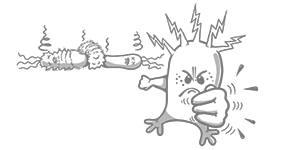

Triclosan [trik-loh-san] is an antibacterial and antifungal agent found in consumer products, including toothpaste, soaps, detergents, toys, and surgical cleaning treatments. In 2016, the FDA announced that effective September 2017, it would prohibit the sale of ‘consumer antiseptic washes’ containing triclosan or 18 other ingredients marketed as antimicrobials due to the FDA’s findings of the lack of efficacy in these products.
Despite being used in many consumer products, beyond its use in toothpaste to prevent gingivitis, there is no evidence according to the FDA that triclosan provides an extra benefit to health in other consumer products. A comprehensive analysis from the University of Michigan School of Public Health indicated that plain soaps are just as effective as consumer-grade antibacterial soaps with triclosan in preventing illness and removing bacteria from the hands.
read more »
Posted in Drugs, Health, Money |
Leave a Comment »
April 10, 2012
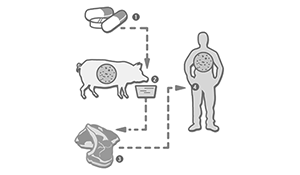

Antibiotic overuse is a contributing factor to the creation of multidrug-resistant bacteria, informally called ‘super bugs’: relatively harmless bacteria can develop resistance to multiple antibiotics and cause life-threatening infections. Though antibiotics are required to treat severe bacterial infections, misuse has contributed to a rise in bacterial resistance. The overuse of fluoroquinolone (a family of antibiotics) and other antibiotics fuels antibiotic resistance in bacteria, which can inhibit the treatment antibiotic-resistant infections. Their excessive use in children with otitis media (ear infection) has given rise to a breed of bacteria resistant to antibiotics entirely.
Widespread use of fluoroquinolones as a first-line antibiotic has led to decreased antibiotic sensitivity, with negative implications for serious bacterial infections such as those associated with cystic fibrosis, where quinolones are among the few viable antibiotics. Antibiotics have no effect on viral infections such as the common cold. They are also ineffective against sore throats, which are usually viral and self-resolving. Most cases of bronchitis (90–95%) are viral as well, passing after a few weeks—the use of antibiotics such as ofloxacin against bronchitis is superfluous and can put the patient at risk of suffering adverse reactions.
read more »
Posted in Drugs, Food, Health |
Leave a Comment »


 The Daily Omnivore