June 19, 2012

A Malthusian catastrophe [mal-thoo-zee-uhn] would be a forced return to subsistence-level conditions due to population growth outpacing agricultural production. Population and growth size has a negative impact on the environment. Later formulations consider economic growth limits as well. The term is also commonly used in discussions of oil depletion. Based on the work of political economist Thomas Malthus (1766–1834), theories of Malthusian catastrophe are very similar to the Iron Law of Wages (real wages always tend toward the minimum wage necessary to sustain the life of the worker).
The main difference is that the Malthusian theories predict what will happen over several generations or centuries, whereas the Iron Law of Wages predicts what will happen in a matter of years and decades. The Industrial Revolution enabled the modern world to break out of the Malthusian growth model, however, various limited resources which may soon limit human population growth because of a widespread belief in the importance of prosperity for every individual and the rising consumption trends of large developing nations such as China and India.
read more »
Posted in Food, Money, World |
Leave a Comment »
June 13, 2012

A fat tax is a surcharge placed upon fattening foods, beverages, or individuals. As an example of Pigovian taxation (a tax levied on a market activity that generates negative externalities), a fat tax aims to discourage unhealthy diets and offset the economic costs of obesity. A related idea is to tax foods that are linked to increased risk of coronary heart disease. Numerous studies suggest that as the price of a food decreases, individuals gets fatter. In fact, eating behavior may be more responsive to price increases than to nutritional education. Estimates suggest that a 1 cent per ounce tax on sugar-sweetened beverages may reduce the consumption of those beverages by 25%.
However, there is also evidence that obese individuals are less responsive to changes in the price of food than normal-weight individuals. To implement a fat tax, it is necessary to specify which food and beverage products will be targeted. This must be done with care, because a carelessly chosen food tax can have surprising and perverse effects. For instance, consumption patterns suggest that taxing saturated fat would induce consumers to increase their salt intake, thereby putting themselves at greater risk for cardiovascular related death. Taxation of sodium has been proposed as a way of reducing salt intake and the resulting health problems.
read more »
Posted in Food, Health, Money, Politics |
Leave a Comment »
June 13, 2012
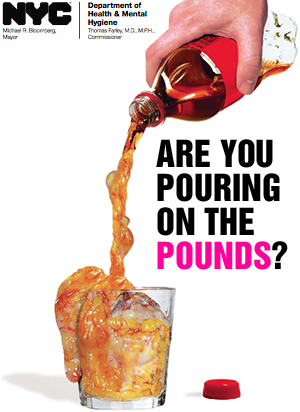
A soda tax is a surcharge on soft drinks. It may focus on sugar-sweetened beverages (soda sweetened with sugar, corn syrup, or other caloric sweeteners and other carbonated and uncarbonated drinks, and sports and energy drinks). As an example of Pigovian taxation (a tax levied on a market activity that generates negative externalities), it may aim to discourage unhealthy diets and offset the economic costs of obesity.
France is in the process of introducing a tax on sugary drinks for 2012; following introduction, soft drinks are estimated to be up to 3.5% more expensive. The city of Richmond, California has placed a soda tax on its 2012 ballot. Soda consumption has been noted as a contributing factor to the obesity epidemic and medical costs related to obesity. In 1994, an early soda tax was introduced by Kelly D. Brownell, Director of the Rudd Center for Food Policy and Obesity at Yale. In 2009, 33 US states had a sales tax on soft drinks. Support for a soda tax has been higher when pollsters say the money will go towards health care.
read more »
Posted in Food, Health, Money, Politics |
Leave a Comment »
June 13, 2012
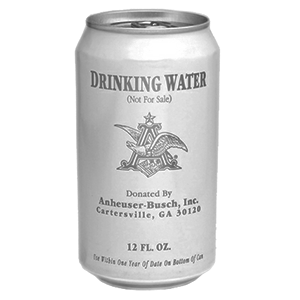
Canned water is drinking water packaged in tin cans or beverage cans, a less common alternative to bottled water. Canned water is used primarily where storage or distribution systems are set up for cans, or when canning systems are used to make emergency water supplies.
Anheuser-Busch has donated more than 68.5 million cans of water. Water was stored in steel cans, lined with plastic bags, under the United States Civil Defense program. Approximately twelve million 17.5-US-gallon (66 L) cans were deployed, and could hold water for more than ten years.
Posted in Food, Health |
Leave a Comment »
May 30, 2012
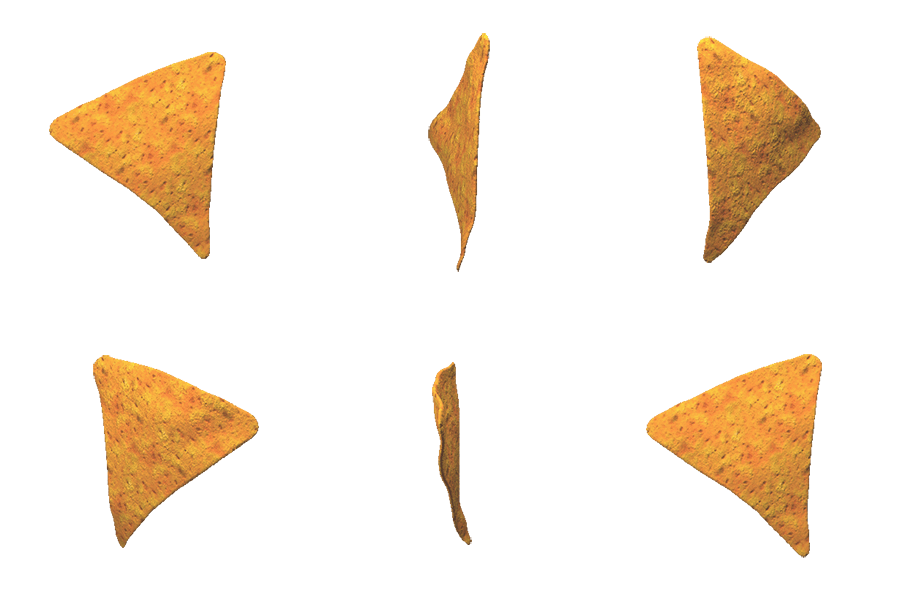
Doritos is a brand of seasoned tortilla chips founded by Arch West and produced since 1964 by Frito-Lay (a division of PepsiCo). The original product was made at the Casa de Fritos location at Disneyland in Anaheim. Using unused tortillas, the company-owned restaurant cut them up and fried them and added basic seasoning. Arch West was the Vice President of Marketing of Frito-Lay at the time, and noticed the popularity.
He made a deal with Alex Foods in 1964, the provider of many items for Casa de Fritos at Disneyland, and produced the chips for a short time regionally, before it was overwhelmed by the volume, and Frito-Lay moved the production in-house to its Tulsa plant. ‘Doritos’ were first available in 1966, the first tortilla chip to be launched nationally in the United States.
read more »
Posted in Food, Money |
2 Comments »
May 21, 2012
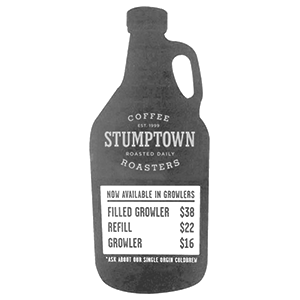
Cold brew or cold press refers to the process of steeping coffee grounds in room temperature water for an extended period. It is also sometimes referred to as Toddy coffee which is a trademarked cold brewing system. The cold-press process requires grinding coffee beans at a relatively coarse setting (typically as fine as possible to still be filtered) and soaking those grounds in cold water for a prolonged period of time, usually 12 hours or more. The grounds must be filtered out of the cold water after they have been steeped using a paper coffee filter, a fine metal sieve, or a French press.
The result is a coffee concentrate that is often diluted with water or milk, and can be served hot, over ice, or blended with ice and other ingredients such as chocolate. Cold brewed coffee naturally seems sweeter due to its lower acidity. Because the coffee beans in cold-press coffee never come into contact with heated water, the process of leaching flavor from the beans produces a different chemical profile than conventional brewing methods. Cold brew coffee is a type of iced coffee, but this latter term also refers to coffee that is brewed hot and then chilled.
Posted in Food |
1 Comment »
May 16, 2012
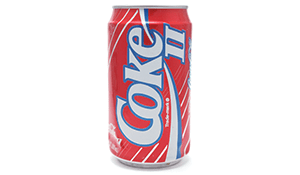

New Coke was the reformulation of Coca-Cola introduced in 1985; it originally had no separate name of its own, and was simply known as ‘the new taste of Coca-Cola’ until 1992 when it was renamed Coca-Cola II. The American public’s reaction to the change was negative and the new cola was a major marketing failure.
The subsequent reintroduction of Coke’s original formula, re-branded as ‘Coca-Cola Classic,’ resulted in a significant gain in sales, leading to speculation that the introduction of the New Coke formula was just a marketing ploy.
read more »
Posted in Food, Humor, Money |
Leave a Comment »
May 16, 2012


Crystal Pepsi was a caffeine-free soft drink made by PepsiCo from 1992 to 1993 in the United States, Canada, and for a short time in Australia. Crystal Pepsi was sold for a longer time in Europe.
In the early 1990s, a marketing fad equating clarity with purity began with the remake of Ivory soap from its classic milky solution; the idea spread to many companies, including PepsiCo. Its marketing slogan was ‘You’ve never seen a taste like this.’ A large marketing campaign was launched, for which the company invented the world’s first photo-realistic, computer-generated bus wrap printing. A series of television advertisements featuring Van Halen’s hit song ‘Right Now’ during Super Bowl XXVII.
read more »
Posted in Food, Humor, Money |
1 Comment »
May 16, 2012

Vernors Ginger Soda is America’s oldest surviving soft drink. It was created in 1866 by James Vernor, a Detroit pharmacist. According to company legend, prior to the start of the American Civil War, while a clerk at the Higby & Sterns drugstore in Detroit, James Vernor experimented with flavors in an attempt to duplicate a popular ginger ale imported from Ireland.
When Vernor was called off to serve in the war, he stored the syrup base of 19 ingredients, including ginger, vanilla, and other natural flavorings, in an oak cask. Vernor joined the Michigan Cavalry in 1862 as a hospital steward. After returning from battle four years later, he opened the keg and found the drink inside had been changed by the aging process in the wood. It was like nothing else he had ever tasted, and he purportedly declared it ‘Deliciously different,’ which remains the drink’s motto to this day.
read more »
Posted in Food |
Leave a Comment »
May 14, 2012
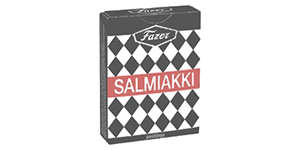

Liquorice [lik-uh-rish] or licorice is the root of Glycyrrhiza glabra (a legume) from which a somewhat sweet flavor can be extracted. It is native to southern Europe and parts of Asia, and is not related to anise, star anise, or fennel, which are the sources of similar-tasting compounds. The word ‘liquorice’ is derived from the Greek ‘glukurrhiza’ (‘sweet root’).
The flavor of liquorice comes mainly from a sweet-tasting compound called anethole, an aromatic, unsaturated ether compound also found in anise, fennel, and several other herbs. Much of the sweetness in liquorice comes from glycyrrhizin, a compound 30 to 50 times sweeter than sucrose (table sugar).
read more »
Posted in Drugs, Food, Health |
Leave a Comment »
May 13, 2012

Gauche [gohsh] caviar [kav-ee-ahr] (‘Caviar left’) is a pejorative French term to describe someone who claims to be a socialist while living in a way that contradicts socialist values. The expression is a political neologism dating from the 1980s and implies a degree of hypocrisy. It is broadly similar to the English ‘champagne socialist,’ the American ‘Limousine liberal,’ the German ‘Salonkommunist,’ the Italian ‘Radical Chic,’ and the Danish ‘Kystbanesocialist’ (referring to well-off coastal neighborhoods north of Copenhagen). French encyclopedia ‘Petit Larousse’ defines ‘left caviar’ as a pejorative expression for a, ‘Progressivism combined with a taste for society life and its accoutrements.’
The term was once prevalent in Parisian circles, applied deprecatingly to those who professed allegiance to the Socialist Party, but who maintained a far from proletariat lifestyle that distinguished them from the working-class base of the French Socialist Party. It was often employed by detractors of former French President François Mitterrand. In early 2007, French politician Ségolène Royal was identified with the ‘gauche caviar’ when it was revealed that she had been avoiding paying taxes. The description damaged her campaign for the French presidency. The weekly French news magazine, ‘Le Nouvel Observateur,’ has been described as the ‘quasi-official organ of France’s ‘gauche caviar.”
Posted in Food, Money, Politics |
Leave a Comment »
May 11, 2012

The grapefruit is a subtropical citrus tree known for its sour fruit, an 18th-century hybrid of a pomelo and an orange first bred in Barbados. When found, it was named the ‘forbidden fruit.’ The flesh is segmented and acidic, varying in color depending on the cultivars, which include white, pink, and red pulps of varying sweetness. The grapefruit was known as the shaddock until the 19th century. Its current name alludes to clusters of the fruit on the tree, which often appear similar to grapes. Botanically, it was not distinguished from the pomelo until the 1830s, when it was given the name Citrus paradisi. Its true origins were not determined until the 1940s.
Grapefruit mercaptan, a sulfur-containing terpene, is one of the substances which has a strong influence on the taste and odor of grapefruit, compared with other citrus fruits. Grapefruit can have a number of interactions with drugs, often increasing the effective potency of compounds. In particular grapefruit and bitter oranges are known to interact with statins (a type of choloesterol drug). Because of this unique property, grapefruit has a very bitter taste when mixed with milk or similar dairy products. Grapefruit is an excellent source of many nutrients and phytochemicals that contribute to a healthy diet.
Posted in Drugs, Food, Health |
Leave a Comment »


 The Daily Omnivore