May 20, 2011

Squash (also called ‘cordial’) is a concentrated fruit-based syrup made from fruit juice, water, and sugar (or other sweetener). Modern squashes may also contain flavoring and coloring. Some traditional cordials also contain herbal extracts, most notably elderflower. Squash must be mixed with a certain amount of water or club soda before drinking.
Citrus fruits (particularly orange and lemon) or a blend of fruits and berries are commonly used as the base of squash. Popular blends are apple with blackcurrant, raspberry with pomegranate, and orange or peach with mango. Less popular single-fruit squashes are also produced, such as lime, pineapple, pomegranate, raspberry, and strawberry.
read more »
Posted in Food, World |
Leave a Comment »
May 17, 2011


Barbecue [bahr-bi-kyoo] (BBQ; ‘barbie’ in Australia and New Zealand; ‘braai’ in South Africa) is a special type of grill. It is also a way to prepare meat which is then cooked with that instrument. Barbecue cooking means to cook very slowly. It is not as hot or fast as standard grilling. Some meats must be cooked slowly to be tender, and easy to chew. Sometimes, meat may be slowly cooked for 8 to 24 hours in a barbecue. People in the United States barbecue chicken, beef and pork, depending on the part of the country.
Barbecuing is very popular in the Central and Southern U.S., especially in Texas with beef and Kansas City with pork. In the United States barbecued meat is usually covered in barbecue sauce, a type of thick, dark red sauce that often contains spices, tomatoes, and honey. Very often, American barbecue grills get heat from hickory wood. In California, it was common to barbecue beef in a hole in the ground rather than a grill. This is called a ‘pit barbecue.’
read more »
Posted in Food, Language, World |
Leave a Comment »
May 17, 2011
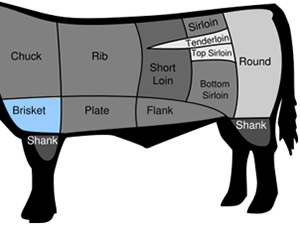

Brisket [bris-kit] is a cut of meat from the breast or lower chest of a cow. The beef brisket is one of the eight beef primal cuts. The brisket muscles include the superficial and deep pectorals. As cattle do not have collar bones, these muscles support about 60% of the body weight of standing/moving cattle. This requires a significant amount of connective tissue, so the resulting meat must be cooked thoroughly to tenderize the connective tissue.
The term derives from Old Norse ‘brjósk,’ meaning cartilage. The cut overlies the sternum, ribs and connecting costal cartilages. Popular brisket recipes in the Southern United States include rubbing with a spice rub or marinating the meat, then cooking slowly over indirect heat from charcoal or wood. This is a form of smoking the meat. Additional basting of the meat is often done during the cooking process.
read more »
Posted in Food, Language, World |
1 Comment »
May 17, 2011


Burnt ends are flavorful pieces of meat cut from the point half of a smoked brisket. A traditional part of Kansas City Barbecue, burnt ends are considered a delicacy in barbecue cooking. Either the entire brisket is cooked whole, then the point end removed and cooked further, or the point and flat are separated prior to cooking. Due to the higher fat content of the brisket point, it takes longer to fully cook to tender and render out fat and collagen. This longer cooking gave rise to the name. Sometimes when the flat is done, the point is returned to the smoker for further cooking. Some cooks re-season the point at this time.
Kansas City style burnt ends are usually served cubed with sauce either on top or on the side. A ‘proper’ burnt end should display a modest amount of ‘bark’ or char on at least one side. Burnt ends can be served alone (sometimes smothered in barbecue sauce) or in sandwiches, as well as in a variety of other dishes, including baked beans and gumbo.
Posted in Food |
Leave a Comment »
May 10, 2011


The New Orleans Jazz & Heritage Festival, often known as Jazz Fest, is a celebration of the music and culture of New Orleans and Louisiana held yearly since 1970. Use of the term ‘Jazz Fest’ can also include the days surrounding the Festival and the many shows at unaffiliated New Orleans nightclubs scheduled during the Festival event weekends. The festival celebrates the indigenous music and culture of New Orleans and Louisiana, so the music encompasses every style associated with the city and the state: blues, R&B, gospel, Cajun music, zydeco, Afro-Caribbean, folk, Latin, rock, rap, country, bluegrass and everything in between. And of course there is lots of jazz, both contemporary and traditional.
Jazz Fest is currently held during the day, between the hours of 11am and 7pm at the Fair Grounds Race Course, a horse track, on the last weekend in April (from Friday through Sunday) and the first weekend in May (Thursday through Sunday). The Festival also features a wide variety of vendors with local foods and crafts. The official food policy of the Festival is ‘no carnival food.’ Indeed, there are more than seventy food booths, all with unique food items, including but not limited to: crawfish beignets, cochon de lait (suckling pig) sandwiches, alligator sausage po’ boys, boiled crawfish, softshell crabs, crawfish Monica and many other dishes. All food vendors are locally owned small businesses.
Posted in Art, Food |
1 Comment »
May 2, 2011
Sandwiches That You Will Like is a 2002 PBS documentary by American film director, Rick Sebak. The unique sandwich offerings of cities across the United States are shown.
The sandwiches showcased are: Tripe, The Elvis, Beef on weck, Roast beef, French dip, Italian beef, Loose meat, Cheesesteak, Hoagie, Pig ears and snouts, Brain, St. Paul, Bánh mì, Primanti, Chipped ham, Hot Brown, Lobster roll, Po’ boy, Muffuletta, Barbecue, Falafel, and Pastrami.
Posted in Food |
1 Comment »
May 2, 2011

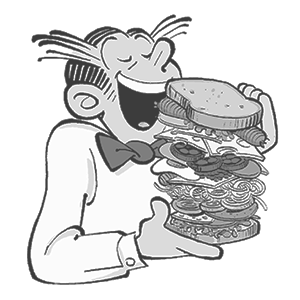
A Dagwood is a tall, multi-layered sandwich made with a variety of meats, cheeses and condiments. It was named after Dagwood Bumstead, a central character in the comic strip Blondie, who is frequently illustrated making enormous sandwiches. According to Blondie scripter Dean Young, his father, Chic Young, began drawing the huge sandwiches in the comic strip during 1936. Though the actual contents of Chic Young’s Dagwood sandwich remain obscure, it obviously contains large quantities and varieties of cold cuts, sliced cheese and vegetables, plus additional slices of bread. An olive pierced by a toothpick or wooden skewer usually crowns the edible superstructure.
In May 1999, a counter-service restaurant named Blondie’s opened at Universal Orlando’s Islands of Adventure, serving a traditional Dagwood-style sandwich. Blondie’s bills itself as ‘Home of the Dagwood Sandwich.’ A Blondie-themed restaurant chain, Dagwood’s Sandwich Shoppe, was founded in 2006. The Dagwood is sold as a 1.5-pound sandwich with three slices of deli bread, hard salami, pepperoni, cappicola, mortadella, deli ham, cotto salami, cheddar, Provolone, red onion, green leaf lettuce, tomato, fresh and roasted red bell peppers, mayo, mustard and a secret Italian olive salad oil.
Posted in Food, Humor |
Leave a Comment »
April 26, 2011

A pizza farm is an educational visitor attraction consisting of a small farm on a circular region of land partitioned into plots shaped like pizza wedges.
The farm’s segments produce ingredients that can be used in pizza, such as wheat for the crust, tomatoes or herbs, pork for pepperoni, dairy cows for cheese, and even trees for pizza oven firewood. Certain farms may even have access to coal or natural gas deposits that can be used as alternative pizza oven heating fuels.
Posted in Education, Food, Money |
Leave a Comment »
April 26, 2011

Garlic fingers are an Atlantic Canadian dish, similar to a pizza in shape and size and made with the same type of dough. Instead of the traditional tomato sauce and toppings it is garnished with melted butter, garlic and sometimes cheese. Seasonings, such as parsley or bacon bits, may also be added.
It is often eaten as a side dish with pizza, dipped in donair (normally served on a donaer kebab) or marinara sauce. Instead of being cut in triangular slices, they are presented in thin strips, or ‘fingers.’ The dish is also popular in Wisconsin, where they are known as pizza fries.
Posted in Food, Language, World |
Leave a Comment »
April 25, 2011

A podstakannik (Russian: ‘thing under the glass’) is a tea glass holder. The primary purpose of podstakanniks is to be able to hold a very hot glass of tea, which is usually consumed right after it is brewed. It is a traditional way of serving and drinking tea in Russia, Ukraine, Belarus, and other post-Soviet states.
Podstakanniks appeared in Russian tea culture in the late 18th century, when drinking tea became common in Russia. Very soon podstakanniks became not just practical utensils, but also works of art, just like samovars (urns) that were used for boiling water. Expensive podstakanniks for the rich and the elite were made of silver, however they were not very practical, since they would get quite hot very quickly due to the high thermal conductivity of silver.
Posted in Food, Money, World |
Leave a Comment »
April 25, 2011


A zarf is a holder, usually of ornamental metal, for a coffee cup without a handle. Although coffee was probably discovered in Ethiopia, it was in Turkey at around the thirteenth century that it became popular as a beverage. As with the serving of tea in China and Japan, the serving of coffee in Turkey was a complex, ritualized process.
It was served in small cups without handles (known as fincan), which were placed in holders known as zarf to protect the cup and also the fingers of the drinker from the hot fluid. Cups were typically made of porcelain, but also of glass and wood.
Posted in Art, Food, Language |
Leave a Comment »
April 25, 2011
Shakedown street is the area of a Jam Band (e.g. Phish, Widespread Panic) parking lot where the vending takes place. It is named after the Grateful Dead song of the same name and has been popular since the early 1980s. In the Deadhead community, and other likeminded musical scenes, an interesting tailgating culture evolved. More than just a party for fans, it is a way for the faithful to sell wares which in turn fund their tickets and gas to the next concert in order to spend weeks, months, or even entire tours on the road.
Along with the more traditional fare, there is a large selection of vegetarian food such as egg rolls, burritos, pizza, and falafel. Certain illicit foods like hash brownies and ‘ganja gooballs’ are also often found among the foods in the parking lots. Other products available for the tailgaters include handmade jewellery, bumper stickers, t-shirts, or drug paraphernalia.
Posted in Drugs, Food, Money |
Leave a Comment »




 The Daily Omnivore