February 27, 2011

Maoz is a chain of falafel fast food restaurants, serving purely vegetarian fare and promoting the ‘vegetarian lifestyle.’ The chain was founded by a husband and wife, Nahman Milo and Sima Bar-On, Israelis, who were living in Amsterdam. The first restaurant opened in 1991, and the first store outside The Netherlands opened in 1996. There are now 22 franchises globally, located in the Netherlands, The United States, France, Spain, the United Kingdom, Australia, and India.
Originally, restaurants offered only falafel, but the menu in some locations has since been expanded to include other vegetarian items, such as pommes frites (Belgian-style french fries). Muma Vegetarian is a copycat restaurant in Los Angeles.
Posted in Food, Money, World |
Leave a Comment »
February 24, 2011
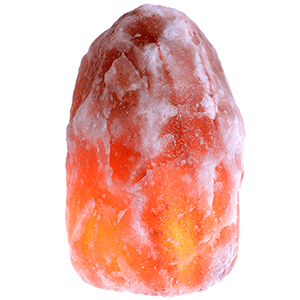
Himalayan salt is a marketing term for Halite (commonly known as rock salt) from Pakistan. It is mined in the Khewra Salt Mines, the second largest salt mine in the world, located about 300 km from the Himalayas, and about 160 kilometres from Islamabad, in the foothills of the Salt Range. The salt sometimes comes out in a reddish or pink color, with some crystals having an off-white to transparent color. It is commonly used for cooking similar to regular table salt, brine, and bath products.
Rock salts mined in several parts of the world, including Hawaii, Utah, Bolivia, the Murray-Darling basin of Australia, Peru, and Poland are marketed as Himalayan salt or pink salt. The color results from iron oxide. More recently, large crystal rocks are also used as Salt lamps. A salt lamp is a lamp carved from a larger salt crystal, often colored, with an incandescent bulb or a candle inside. The lamps give an attractive glow and are suitable for use as nightlights or for ambient mood lighting.
Posted in Food, Language, Money |
Leave a Comment »
February 24, 2011

The Marula is a medium-sized dioecious tree, indigenous to Africa. The fruits are used in the liqueur Amarula. The distribution of this species throughout Africa has followed the Bantu people in their migrations, as it has been an important item in their diet since time immemorial. When ripe, the fruits have a light yellow skin, with white flesh, rich in vitamin C, are succulent, tart with a strong and distinctive flavor.
The marula fruit is also eaten by various animals in Southern Africa. In the movie ‘Animals Are Beautiful People’ by Jamie Uys, released in 1974, some scenes portray elephants, warthogs and monkeys becoming intoxicated from eating fermented marula fruit. Later research showed that these scenes were improbable and, in all probability, staged. Elephants would need a huge amount of fermented marulas to have any effect on them, and the amount of water drunk by elephants each day would also dilute the effect.
Posted in Drugs, Food, Science |
Leave a Comment »
February 22, 2011
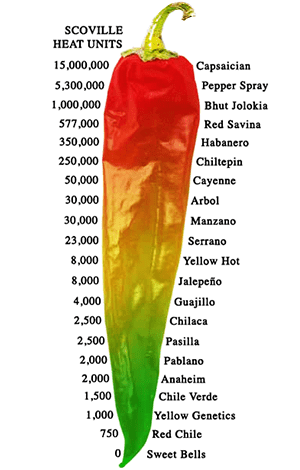
The Scoville scale is a measurement of the spicy heat (or piquance) of foods. The number of Scoville heat units (SHU) indicates the amount of capsaicin (a chemical compound that stimulates chemoreceptor nerve endings in the skin, especially the mucous membranes) present. The scale is named after its creator, American pharmacist Wilbur Scoville who developed it in 1912. The chilis with the highest rating on the Scoville scale exceed one million Scoville units, and include specimens of naga jolokia.
Posted in Food, Science |
Leave a Comment »
February 21, 2011

Hi-C is a juice drink made by the Minute Maid division of The Coca-Cola Company. Hi-C was created by Niles Foster in 1946. By 1958 it had become an American supermarket staple, available nationwide. Foster’s original formula contained orange juice concentrate, peel oil and orange essences, sugar, water, citric acid and ascorbic acid (vitamin C). The name ‘Hi-C’ stressed the vitamin content. Hot-packed in enamel-lined 56-ounce cans, the product needed no refrigeration before opening.
Grape, the second flavor introduced, evolved naturally from the fact that the Geneva, Ohio, co-packer was also processing fresh grapes. Apple and cherry drinks were introduced as a result of the fresh fruit processing operations at the Paw Paw, Michigan, co-packer plant. The contract packing concept is still used today by the Coca-Cola Foods Division. In 1987, Ecto-Cooler was a product tie-in with the cartoon series ‘The Real Ghostbusters,’ based on the 1984 live-action film.
Posted in Food, Money |
Leave a Comment »
February 21, 2011

A slush or a slushie is a flavored frozen drink. Frozen carbonated beverages, typified by the Slurpee or ICEE, are made by freezing a carbonated drink. These machines are complicated and expensive, and notably require a carbon dioxide supply. They make a very fine and ‘dry’ slush. Frozen uncarbonated beverages are made by freezing a non-carbonated juice or liquid. These machines do not require a pressure chamber, and so are much cheaper and easier to maintain. They make a slightly wetter slush. They are notable in the wide variety of drinks they create, including coffee-flavored ices and alcoholic drinks like margaritas and daiquiris.
Conventional slush drinks, typified by the Slush Puppie, use a single slurry made by freezing a sweetened base, similar to apple juice. This slurry is mixed at serving time with a flavoring syrup. These drinks are notable in that the flavored syrup can be drawn out of the drink, leaving a relatively-unflavoured base ice behind. ‘Instant’ slush drinks (beverages that turn to slush upon opening) are formed via supercooling (e.g. Slush-It!, the Chill Chamber which allows businesses to store beverages at below freezing temperatures, and supercooled Sprite from Coca-Cola which required special vending machines).
Posted in Food, Language, Money |
Leave a Comment »
February 21, 2011

EcoBot refers to a class of robots that can remain self-sustainable by collecting their energy from waste in the environment. The only by-product from this process is carbon dioxide, which would have been produced from biodegradation in the first place. EcoBots do not employ any other form of conventional power supply and do not require any form of initial charging from an external source. Instead, they are powered directly by the on-board microbial fuel cells (MFCs).
EcoBot-I, was developed in 2002 at Bristol Robotics Laboratory (U.K.); it utilized sugar as the fuel to perform phototaxis (move towards the light). EcoBot-II (2004) was the first robot in the world to perform sensing, information processing, communication and phototaxis, by utilizing unrefined biomass (e.g. dead flies, rotten fruits and crustacean shells). EcoBot-II operated continuously for 12 days after having been fed with 8 houseflies.
Posted in Food, Technology |
Leave a Comment »
February 21, 2011

Gastrobot (literally ‘robot with stomach’) was a term coined in 1998 by the University of South Florida Institute’s director, Dr. Stuart Wilkinson. A gastrobot is a machine that derives all its energy from the digestion of food (a mixture of carbohydrates and protein). These molecules are obtained through a microbial fuel cell (MFC) which then converts the food into gases and other potential energy. The gases and liquids are used to help fuel things such as a hydrogen fuel cell which help create more energy, along with other gases that help power the mechanics of the gastrobot.
The future of these robots supposedly is for certain types of so called ‘start and forget’ missions on an ecological plateau which would be Earth at the current period in time. Their optic sensors may have artificial intelligence software that allows them to determine what is edible for consumption and energy conversion. Possible future commercial uses would be a self powered lawnmower that would obtain energy for itself from the cellulose in the grass cuttings.
Posted in Food, Technology |
Leave a Comment »
February 17, 2011

The Alamo Drafthouse is an American cinema chain founded in 1997 in Austin, Texas, United States. It has screens in nine locations across Texas and one in Winchester, Virginia. The company began as a second-run movie theater, and distinguished itself by the food and drink service offered inside the theater, including cold beer. The seating is arranged with rows of cabaret style tables in front of each row of seats, with an aisle between each row to accommodate waiter service. Customers write their orders on slips of paper, which are picked up by black-clad waiters moving quietly between the rows.
Posted in Art, Food, Money |
Leave a Comment »
February 13, 2011

When In-N-Out Burger (a fast food chain in the U.S. south west) first opened in 1948, the company provided only a basic menu of burgers, fries and beverages. Instead of a broad menu like its competitors, In-N-Out has become known for its Secret Menu, unadvertised variations on its burgers that are based on customer preferences, such as the popular ‘animal style’: a mustard cooked beef patty with extra spread (thousand island dressing) and grilled onions. French fries can also be has ‘animal style.’ ‘Protein Style,’ introduced in the 1970s, replaces the bun with large leaves of lettuce; while the ‘Flying Dutchman’ is a 2×2 (two burger patties and two slices of cheese) with no bun, no vegetables, and no spread.
Posted in Food, Money |
Leave a Comment »
February 13, 2011
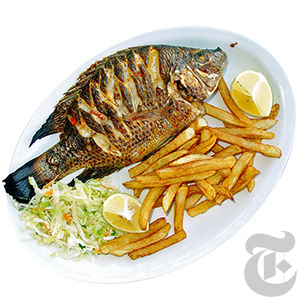
Tilapia [tuh-lah-pee-uh] is the common name for nearly a hundred species of fish. Tilapia inhabit a variety of fresh water habitats including shallow streams, ponds, rivers and lakes. Historically they have been of major importance in artisan fishing in Africa and the Middle East, and are of increasing importance in aquaculture. China is the largest Tilapia producer in the world, followed by Egypt.
read more »
Posted in Food, Health, Money |
Leave a Comment »
February 13, 2011
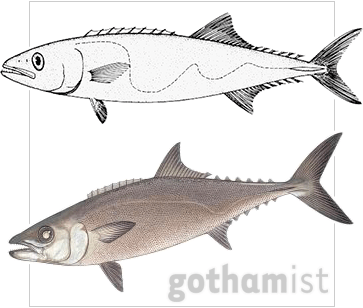
The escolar [es-kuh-lahr] is a species of fish found in deep tropical and temperate waters around the world. It is also known as Snake Mackerel, and sometimes marketed as ‘butterfish,’ ‘oilfish,’ ‘white tuna,’ ‘walu,’ or ‘codfish,’ a controversial practice due to potential health problems related with consumption of the fish. Like its relative the oilfish, escolar cannot metabolize the wax esters naturally found in its diet. This gives the escolar an oil content of 14–25% in its flesh. These wax esters may cause gastrointestinal distress in humans called ‘steatorrhea,’ the onset of which may occur between 30 minutes and 36 hours following consumption.
Symptoms may include stomach cramps, bright orange oil in stool, diarrhea, headaches, nausea, vomiting, and anal leakage. Because of the possible effects of consumption, escolar has been banned from consumption in Japan since 1977, as the Japanese government considers it toxic. It has also been banned in Italy. In 1999, the Swedish and Danish National Food Administrations informed fish trade associations and fish importing companies about the problems escolar and related fish could cause if not prepared properly and issued recommendations.
Posted in Food, Health, Science |
Leave a Comment »




 The Daily Omnivore