May 6, 2013

A paracosm [par-uh-kozm] is a detailed imaginary world, or fantasy world, involving humans and/or animals, or perhaps even fantasy or alien creations. Commonly having its own geography, history, and language, it is an experience that is often developed during childhood and continues over a long period of time: months or even years.
The concept was first described by a researcher for the BBC, Robert Silvey, with later research by British psychiatrist Stephen A. MacKeith, and British psychologist David Cohen. The term was coined by Ben Vincent, a participant in Silvey’s 1976 study and a self-professed ‘paracosmist.’
read more »
Posted in Art, Health, Language |
Leave a Comment »
May 6, 2013

Fantasy prone personality (FPP) is a disposition or personality trait in which a person experiences a lifelong extensive and deep involvement in fantasy. This disposition is an attempt, at least in part, to better describe the popular term ‘overactive imagination,’ or ‘living in a dream world.’
An individual with this trait (termed a fantasizer) may have difficulty differentiating between fantasy and reality and may experience hallucinations, as well as self-suggested psychosomatic symptoms. Three closely related psychological constructs are daydreaming, psychological absorption (in which a person becomes absorbed in their mental imagery), and eidetic memory (photographic memory).
read more »
Posted in Health |
1 Comment »
May 1, 2013
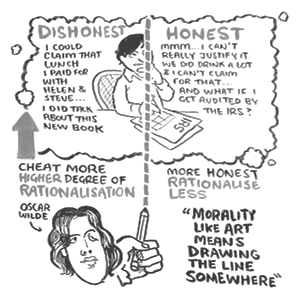
In psychology and logic, rationalization (also known as making excuses) is an unconscious defense mechanism in which perceived controversial behaviors or feelings are logically justified and explained in a rational or logical manner in order to avoid any true explanation, and are made consciously tolerable – or even admirable and superior – by plausible means.
Rationalization encourages irrational or unacceptable behavior, motives, or feelings and often involves ad hoc hypothesizing. This process ranges from fully conscious (e.g. to present an external defense against ridicule from others) to mostly subconscious (e.g. to create a block against internal feelings of guilt).
read more »
Posted in Health |
Leave a Comment »
May 1, 2013
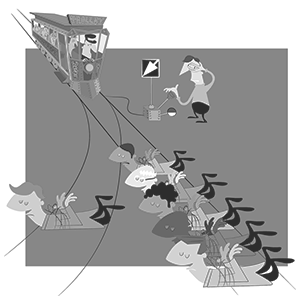
The trolley problem is a thought experiment in ethics, first introduced by British philosopher Philippa Foot in 1967, but also extensively analyzed by philosophers Judith Jarvis Thomson, Peter Unger, and Frances Kamm as recently as 1996. Outside of the domain of traditional philosophical discussion, the trolley problem has been a significant feature in the fields of cognitive science and, more recently, of neuroethics. It has also been a topic on various TV shows dealing with human psychology.
The general form of the problem is this: Person A can take an action which would benefit many people, but in doing so, person B would be unfairly harmed. Under what circumstances would it be morally just for Person A to violate Person B’s rights in order to benefit the group?
read more »
Posted in Death, Health, Philosophy |
2 Comments »
April 24, 2013

Bad faith is a philosophical concept used by existentialists Jean-Paul Sartre and Simone de Beauvoir to describe the phenomenon where a human being under pressure from societal forces adopts false values and disowns his/her innate freedom to act authentically. It is closely related to the concepts of self-deception and ressentiment (an assignment of blame for one’s frustration).
A critical claim in existentialist thought is that individuals are always free to make choices and guide their lives towards their own chosen goal or ‘project.’ The claim holds that individuals cannot escape this freedom, even in overwhelming circumstances. For instance, even an empire’s colonized victims possess choices: to submit to rule, to negotiate, to act in complicity, to commit suicide, to resist nonviolently, or to counter-attack.
read more »
Posted in Health, Philosophy |
Leave a Comment »
April 17, 2013
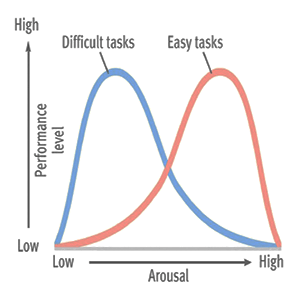
The Yerkes–Dodson law is an empirical relationship between arousal and performance, originally developed by psychologists Robert M. Yerkes and John Dillingham Dodson in 1908. The law dictates that performance increases with physiological or mental arousal, but only up to a point. When levels of arousal become too high, performance decreases. The process is often illustrated graphically as a curvilinear, inverted U-shaped curve which increases and then decreases with higher levels of arousal.
Research has found that different tasks require different levels of arousal for optimal performance. For example, difficult or intellectually demanding tasks may require a lower level of arousal (to facilitate concentration), whereas tasks demanding stamina or persistence may be performed better with higher levels of arousal (to increase motivation).
read more »
Posted in Health, Science |
4 Comments »
April 16, 2013
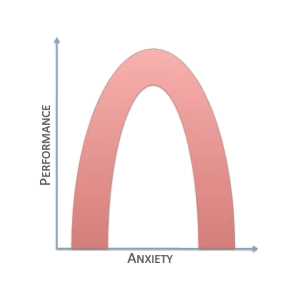
Atychiphobia [at-i-kuh-foh-bee-uh] (‘atyches’ meaning ‘unfortunate’) is the abnormal, unwarranted, and persistent fear of failure. As with many phobias, atychiphobia often leads to a constricted lifestyle, and is particularly devastating for its effects on a person’s willingness to attempt certain activities. A person afflicted with atychiphobia considers the possibility of failure so intense that they choose not to take the risk.
Oftentimes this person will subconsciously undermine their own efforts so that they no longer have to continue to try. Because effort is proportionate to the achievement of personal goals and fulfillment, this unwillingness to try, which arises from the perceived inequality between the possibilities of success and failure, holds the atychiphobic back from a life of meaning and the realization of potential.
read more »
Posted in Health |
Leave a Comment »
April 16, 2013

The biophilia [bahy-oh-fil-ee-uh] hypothesis suggests that there is an instinctive bond between human beings and other living systems. American biologist Edward O. Wilson introduced and popularized the hypothesis in his book, ‘Biophilia’ (1984). He defines ‘biophilia’ as ‘the urge to affiliate with other forms of life.’
The term literally means ‘love of life or living systems.’ It was first used by German sociologist Erich Fromm to describe a psychological orientation of being attracted to all that is alive and vital. Wilson uses the term in the same sense when he suggests that biophilia describes ‘the connections that human beings subconsciously seek with the rest of life.’ He proposed the possibility that the deep affiliations humans have with nature are rooted in our biology. Unlike phobias, which are the aversions and fears that people have of things in the natural world, philias are the attractions and positive feelings that people have toward certain habitats, activities, and objects in their natural surroundings.
read more »
Posted in Health, Science |
Leave a Comment »
April 9, 2013

In psychology-related slang, control freak is a derogatory term for a person who attempts to dictate how everything around them is done. The phrase was first used in the late 1960s — an era when great stress was laid on the principle of ‘doing one’s own thing’ and letting others do the same.
Control freaks are often perfectionists defending themselves against their own inner vulnerabilities in the belief that if they are not in total control they risk exposing themselves once more to childhood angst. Such persons manipulate and pressure others to change so as to avoid having to change themselves, and use power over others to escape an inner emptiness. When a control freak’s pattern is broken, ‘the Controller is left with a terrible feeling of powerlessness … But feeling their pain and fear brings them back to themselves.’
read more »
Posted in Health, Money |
1 Comment »
April 2, 2013

Manshiyat Naser, also known as Garbage City, is a slum settlement at the base of Mokattam Hill on the outskirts of Cairo.
Its economy revolves around the collection and recycling of the city’s garbage. Although the area has streets, shops, and apartments as other areas of the city, it lacks infrastructure and often has no running water, sewage, or electricity.
read more »
Posted in Health, Money, World |
Leave a Comment »
March 23, 2013

Hypomania [hahy-puh-mey-nee-uh] (literally, ‘below mania’) is a milder former of mania (elevated mood) and is a state characterized by persistent and pervasive elevated (euphoric) or irritable temperament . It is most often associated with the bipolar spectrum. Many who are in a hypomanic state are extremely energetic, talkative, confident, and assertive. They may have a flight of ideas and feel creative.Many people also experience signature hypersexuality.
While hypomania often generates productivity and creativity, it can become troublesome if the subject engages in risky behaviors. Individuals in a hypomanic state have a decreased need for sleep, are extremely outgoing and competitive, and have a great deal of energy. However, unlike with full mania, those with hypomanic symptoms are often fully functioning.
read more »
Posted in Health |
Leave a Comment »
March 23, 2013

Numerous studies have demonstrated correlations between creative occupations and mental illnesses, including bipolar disorder and schizophrenia. The association between bipolar disorder and creativity first appeared in literature in the 1970s, but the idea of a link between ‘madness’ and ‘genius’ is much older, dating back at least to the time of Aristotle. The Ancient Greeks believed that creativity came from the gods, and in particular the Muses, the goddesses of arts and sciences, and the nine daughters of Zeus, the king of the gods.
The idea of a complete work of art emerging without conscious thought or effort was reinforced by the views of the Romantic era. It has been proposed that there is a particular link between creativity and bipolar disorder, whereas major depressive disorder appears to be significantly more common among playwrights, novelists, biographers, and artists. Psychotic individuals are said to display a capacity to see the world in a novel and original way, literally, to see things that others cannot.
read more »
Posted in Art, Health |
Leave a Comment »



 The Daily Omnivore