December 19, 2012

Autism friendly means awareness of social engagement and environmental factors affecting people on the autism spectrum, with modifications to communication methods and physical space to better suit individual’s unique and special needs. Individuals on the autism spectrum take in information from their five senses as do neurotypical people, but they are not able to process it as quickly and can become overwhelmed by the amount of information that they are receiving and withdraw as a coping mechanism.
They may experience difficulty in public settings due to inhibited communication, social interaction or flexibility of thought development. Knowing about these differences and how to react effectively helps to create a more inclusive society. It also better suits the needs of the growing number of individuals with autism, Asperger syndrome (high functioning autism), or other disorders on the autism spectrum.
read more »
Posted in Health, Money |
Leave a Comment »
December 19, 2012

Autism [aw-tiz-uhm] is a neurological disorder characterized by a profound withdrawal from contact with people, repetitive behavior, and fear of change in the environment. The emotional disorder affects the brain’s ability to receive and process information.
People who have autism find it difficult to act in a way that other people think is ‘normal,’ and they find it difficult to talk to other people, to look at other people, and often do not like being touched by other people. A person who has autism seems to be turned inwards. They may talk only to themselves, rock themselves backwards and forwards, and laugh at their own thoughts. They do not like any type of change and may find it very difficult to learn a new behavior like using a toilet or going to school.
read more »
Posted in Health |
1 Comment »
December 13, 2012

Psychohistory [sahy-koh-his-tuh-ree] is the study of the psychological motivations of historical events. It attempts to combine the insights of psychotherapy with the research methodology of the social sciences to understand the emotional origin of the social and political behavior of groups and nations, past and present. Its subject matter is childhood and the family (especially child abuse), and psychological studies of anthropology and ethnology.
Psychohistory derives many of its concepts from areas that are perceived to be ignored by conventional historians as shaping factors of human history, in particular, the effects of childbirth, parenting practice, and child abuse. The historical impact of incest, infanticide and child sacrifice are considered. Psychohistory holds that human societies can change between infanticidal and non-infanticidal practices and has coined the term ‘early infanticidal childrearing’ to describe abuse and neglect observed by many anthropologists.
read more »
Posted in Education, Health, Politics |
Leave a Comment »
December 12, 2012

The hormonal theory of sexuality holds that, just as exposure to certain hormones plays a role in fetal sex differentiation, such exposure also influences the sexual orientation that emerges later in the adult. Prenatal hormones may be seen as the primary determinant of adult sexual orientation, or a co-factor with genes, biological factors and/or environmental and social conditions. Differences in brain structure that come about from hormones and genes interacting on developing brain cells are believed to be the basis of sex differences in countless behaviors, including sexual orientation.
Prenatal factors that affect or interfere with the interaction of these hormones on the developing brain can influence later sex-typed behavior in children. This hypothesis is originated from countless experimental studies in non-human mammals, yet the argument that similar effects can be seen in human neurobehavioral development is a much debated topic among scholars. Recent studies, however, have provided evidence in support of prenatal androgen exposure influencing childhood sex-typed behavior.
read more »
Posted in Health, Science, Sex |
Leave a Comment »
December 12, 2012
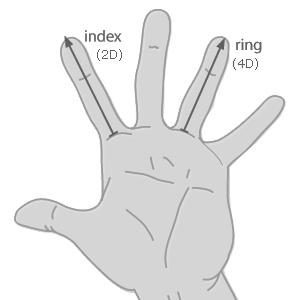
The digit ratio (the ratio of the lengths of different fingers) is possibly affected by exposure to androgen hormones (e.g. testosterone) while in the uterus. The index to ring finger ratio (2D:4D) in particular has been suggested as a crude measure for prenatal androgen exposure, with lower 2D:4D ratios pointing to higher androgen exposure.
A longer index finger will result in a ratio higher than 1, while a longer ring finger will result in a ratio of less than 1. The 2D:4D digit ratio is sexually dimorphic: while the second digit is typically shorter in both females and males, the difference between the lengths of the two digits is greater in males than females.
read more »
Posted in Health, Science, Sex |
Leave a Comment »
December 12, 2012

Male pregnancy is the incubation of one or more embryos or fetuses by male members of any species. In nearly all sexually reproducing animal species, offspring are ordinarily carried by the female until birth, but in fish of the Syngnathidae family (pipefish and seahorses), males perform this function. They may possess a brood pouch on the trunk or tail (in other species, the eggs are merely attached to the male’s trunk or tail when the female lays them).
Fertilization may take place in the pouch or in the water before implantation, but in either case, syngnathids’ male pregnancy ensures them complete confidence of paternity. After implantation in or on the brood pouch or brood patch, the male incubates the eggs. Many species osmoregulate the brood pouch fluid to maintain proper pH for the developing embryos.
read more »
Posted in Health, Science, Sex |
1 Comment »
December 12, 2012

In Feminist psychology the terms womb envy and vagina envy denote the unexpressed anxiety that some men feel in natural envy of the biological functions of women (pregnancy, parturition, breast feeding) — emotions which impel their social subordination of women, and to drive themselves to succeed in perpetuating their names via material legacies.
Each term is analogous to the concept of female penis envy, derived from the theory of psychosexual development, presented in Freudian psychology; they address the gender role social dynamics underlying the ‘envy and fascination with the female breasts and lactation, with pregnancy and childbearing, and vagina envy [that] are clues to a femininity complex of men, which is defended against by psychological and sociocultural means.’
read more »
Posted in Health, Sex |
Leave a Comment »
December 11, 2012

Trypophobia [try-poe-phobia] (sometimes called repetitive pattern phobia) is fear of or revulsion from clustered geometric shapes, especially small holes. It is not recognized in the Diagnostic and Statistical Manual of Mental Disorders, however thousands of people claim to be fearful of objects with small holes, such as beehives, ant holes, and lotus seed heads.
Research is limited and Arnold Wilkins and Geoff Cole, who claim to be the first to scientifically investigate, believe the reaction to be based on a biological revulsion, rather than a learned cultural fear. The term was coined in 2005, a combination of the Greek ‘trypo’ (punching, drilling or boring holes) and phobia.
Posted in Health, Science |
4 Comments »
December 6, 2012

Cannabinoids [kuh-nab-uh-noid] are a class of diverse chemical compounds that activate cannabinoid receptors (molecules on the surface of a cells in the brain and throughout the body, which receive chemical signals). After the receptor is engaged, multiple intracellular signal pathways are activated; researchers are still unraveling the precise mechanism at work.
Cannabinoid receptors are activated by endocannabinoids (produced naturally in the body), phytocannabinoids (found in plants), and synthetic cannabinoids (produced chemically in a lab). The most notable cannabinoid is the phytocannabinoid tetrahydrocannabinol (THC), the primary psychoactive compound of cannabis. However, there are known to exist dozens of other cannabinoids with varied effects. Before the 1980s, it was often speculated that cannabinoids produced their physiological and behavioral effects via nonspecific interaction with cell membranes, instead of interacting with specific membrane-bound receptors.
read more »
Posted in Drugs, Health, Science |
Leave a Comment »
December 3, 2012

Deprogramming is an attempt to force a person to abandon allegiance to a religious, political, economic, or social group. The person in question is may be taken against his/her will, which has led to controversies over freedom of religion, kidnapping, and civil rights, as well as the violence which is sometimes involved. Deprogramming is often commissioned by relatives, including parents of adult offspring, who object to someone’s membership in an organization or group.
It was started in the 1970s in the United States by Ted Patrick (widely considered to be the ‘father of deprogramming’). In addition to the ethics and legality, the efficacy of deprogramming has been questioned by scholars, as well as by members of the Christian countercult movement. Similar actions, when done without force, are called ‘exit counseling.’ Sometimes the word deprogramming is used in a wider (and/or ironic or humorous sense), to mean the freeing of someone (often oneself) from any previously uncritically assimilated idea.
read more »
Posted in Health, Philosophy, Politics |
Leave a Comment »
December 3, 2012

Mind control (also known as brainwashing, coercive persuasion, or menticide) refers to the use of unethically manipulative methods to persuade others to conform to the wishes of the manipulator(s), often to the detriment of the person being manipulated. The term has been applied to any tactic, psychological or otherwise, which can be seen as subverting an individual’s sense of control over their own thinking, behavior, emotions or decision making.
Theories of brainwashing and of mind control were originally developed to explain how totalitarian regimes appeared to succeed systematically in indoctrinating prisoners of war through propaganda and torture techniques. These theories were later expanded and modified by psychologists including Margaret Singer, to explain a wider range of phenomena, especially conversions to cults (new religious movements, NRMs). A third-generation theory proposed by sociologist Ben Zablocki focused on the utilization of mind control to retain members of NRMs.
read more »
Posted in Health, Philosophy, Politics |
1 Comment »
December 3, 2012

Love bombing is a tactic often employed by cults (or any religious, political or other group of like-minded individuals) as a way of luring prospective members. Current members typically ‘love bomb’ potential or desired new recruits by showering them with affection, praise, and offers of friendship.
Cult awareness experts warn that this seemingly kind and welcoming practice is often the first step in a mind control (‘brainwashing’) process that leads to religious conversion or involvement with a group that may be harmful to its membership or to society. While most people can discern such cynical ploys from honest offers of fellowship, anyone caught at a vulnerable time in his or her life (following a divorce, death, loss of job or any major life change) or suffering from insecurities could fall under the spell of a charismatic leader and the true believers who inevitably surround such a person.
read more »
Posted in Health, Love, Philosophy |
1 Comment »


 The Daily Omnivore