July 5, 2012

Labeling theory holds that deviance is not inherent to an act, but instead focuses on the tendency of majorities to negatively label minorities or those seen as deviant from standard cultural norms. It was developed by sociologists during the 1960s; Howard Saul Becker’s book ‘Outsiders’ was particularly influential. The theory is concerned with how the self-identity and behavior of individuals may be determined or influenced by the terms used to describe or classify them.
It is associated with the concepts of self-fulfilling prophecy and stereotyping. Unwanted descriptors or categorizations – including terms related to deviance, disability, or diagnosis of a mental disorder – may be rejected on the basis that they are merely ‘labels,’ often with attempts to adopt a more constructive language in its place. A stigma is defined as a powerfully negative label that changes a person’s self-concept and social identity.
read more »
Posted in Health, Language, Politics |
Leave a Comment »
July 2, 2012

Connectionism [kuh-nek-shuh-niz-uhm] is the theory that the connections (such as between brain cells) mediate thought and govern behavior. It is a set of approaches in the fields of artificial intelligence and cognitive science that model mental or behavioral phenomena as the emergent processes of interconnected networks of simple units. There are many forms of connectionism, but the most common forms use neural network models (artificial brains).
The central connectionist principle is that mental phenomena can be described by interconnected networks of simple and often uniform units. The form of the connections and the units can vary from model to model. For example, units in the network could represent neurons and the connections could represent synapses. Neural networks are able to learn by themselves, unlike normal computers, which cannot do anything for which they are not programmed.
read more »
Posted in Health, Science, Technology |
Leave a Comment »
July 2, 2012
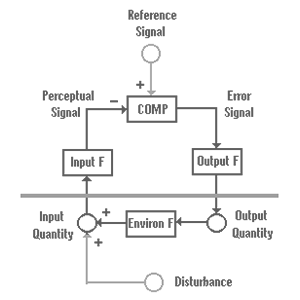
Perceptual control theory (PCT) is a model of behavior based on the principles of negative feedback (when the output of a system acts to oppose changes to the input of a system, acting to stabilize it). It differs in a number of respects from standard engineering control theory, which deals with the behavior of dynamical systems like feedback loops. From the PCT perspective, an organism controls neither its own behavior, nor external environmental variables, but rather its own perceptions.
According to the standard catch-phrase of the field, ‘behavior is the control of perception.’ While the adoption of PCT in the scientific community has not been widespread, it has been applied to a number of areas, and has led to a method of psychotherapy called the Method of Levels.
read more »
Posted in Health, Science, Technology |
Leave a Comment »
June 29, 2012
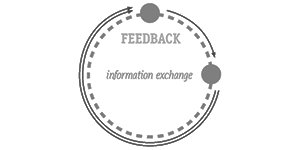

Cybernetics [sahy-ber-net-iks] is the theory of communication and control based on regulatory feedback. This is the original definition of the term; in popular culture the term refers to the study of cyborgs and robotic implants and prosthetics. Cybernetics is only applicable when the system being analyzed is involved in a closed signal loop; that is, where action by the system causes some change in its environment and that change is fed to the system via information (feedback) that enables the system to change its behavior.
A very simple model of cybernetics is that of a central heating system with four elements: a Sensor (to test the system’s environment); a Goal (the specification of the desired state of the system); Error Detection (a method for finding the difference between the present state and the goal state); and an Effector (operations the system can make to get the environment closer to the goal). A more complicated example is the Honda android ASIMO, which uses sensors and sophisticated algorithms to avoid obstacles and navigate stairs.
read more »
Posted in Health, Science, Technology |
Leave a Comment »
June 29, 2012

In control theory (a theory of sociology that examines controls on societal order), affect control theory proposes that individuals maintain affective meanings through their actions and interpretations of events. The activity of social institutions occurs through maintenance of culturally based affective meanings. Besides a denotative meaning, every concept has an affective meaning, or connotation, that varies along three dimensions: Evaluation (goodness versus badness); Potency (powerfulness versus powerlessness); and Activity (liveliness versus torpidity).
Affective meanings can be measured with semantic differentials yielding a three-number profile indicating how the concept is positioned on evaluation, potency, and activity (EPA). American psychologist Charles E. Osgood demonstrated that an elementary concept conveyed by a word or idiom has a normative affective meaning within a particular culture. A stable affective meaning derived either from personal experience or from cultural inculcation is called a sentiment, or fundamental affective meaning.
read more »
Posted in Health, Science |
Leave a Comment »
June 29, 2012
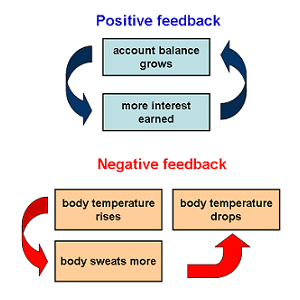
Negative feedback occurs when the output of a system acts to oppose changes to the input of a system, acting to stabilize it. The classic example is a central heating system which cuts off when a (suitably placed) temperature sensor hits a pre-set mark. The negative feedback part is the thermostat. Negative feedback is a basic concept of cybernetics (the theory of communication and control based on regulatory feedback in animals and machines).
In biology negative feedback is known as homeostasis (the property of a system, either open or closed, that regulates its internal environment and tends to maintain a stable, constant condition). Virtually all aspects of living systems involve homeostasis (e.g. blood pressure, glucose level, liver functions, cell division). The disruption of feedback loops can lead to undesirable results: in the case of blood glucose levels, if negative feedback fails, the glucose levels in the blood may begin to rise dramatically, thus resulting in diabetes.
read more »
Posted in Health, Science, Technology |
Leave a Comment »
June 27, 2012

The human microbiome is the collection of microorganisms (such as bacteria and fungi) which live on and inside humans (on the skin, in the saliva and mouth, in the eyes, and in the gut and the rest of the gastrointestinal tract). Foreign microbes outnumber human cells in the body a wide margin; humans have about 100 trillion cells, and carry ten times as many microorganisms in the intestines alone.
Some of these organisms are useful for humans. However, most have no known effect; they are just symbionts and are referred to as the normal ‘flora.’ Studies in 2009 asked whether our health is damaged if we reduce this biota (collection of organisms in an ecosystem), which is certainly the case with gut flora (which can be restored by a ‘fecal transplant.’
read more »
Posted in Health, Science |
1 Comment »
June 15, 2012

In cultural anthropology, a guilt society is the concept that the primary method of social control in a given society is the inculcation of feelings of guilt for behaviors that the individual believes to be undesirable. The US is a guilt society, in contrast to Japan, a shame society. A prominent feature of guilt societies is the provision of sanctioned releases from guilt for certain behaviors either before the fact, as when one condemns sexuality but permits it conditionally in the context of marriage, or after the fact. There is a clear opportunity in such cases for authority figures to derive power, monetary and/or other advantages, etc. by manipulating the conditions of guilt and the forgiveness of guilt.
Paul Hiebert characterizes the guilt society as follows: ‘Guilt is a feeling that arises when we violate the absolute standards of morality within us, when we violate our conscience. A person may suffer from guilt although no one else knows of his or her misdeed; this feeling of guilt is relieved by confessing the misdeed and making restitution. True guilt cultures rely on an internalized conviction of sin as the enforcer of good behavior, not, as shame cultures do, on external sanctions. Guilt cultures emphasize punishment and forgiveness as ways of restoring the moral order; shame cultures stress self-denial and humility as ways of restoring the social order.’
Posted in Health, Politics, World |
Leave a Comment »
June 14, 2012

In cultural anthropology, a shame society is the concept that, in a given society, the primary device for gaining control over children and maintaining social order is the inculcation of shame and the complementary threat of ostracism.
A shame society is contrasted with a guilt society in which control is maintained by creating and continually reinforcing the feeling of guilt (and the expectation of punishment now or in the hereafter) for certain condemned behaviors.
read more »
Posted in Health, Politics, World |
Leave a Comment »
June 13, 2012

A fat tax is a surcharge placed upon fattening foods, beverages, or individuals. As an example of Pigovian taxation (a tax levied on a market activity that generates negative externalities), a fat tax aims to discourage unhealthy diets and offset the economic costs of obesity. A related idea is to tax foods that are linked to increased risk of coronary heart disease. Numerous studies suggest that as the price of a food decreases, individuals gets fatter. In fact, eating behavior may be more responsive to price increases than to nutritional education. Estimates suggest that a 1 cent per ounce tax on sugar-sweetened beverages may reduce the consumption of those beverages by 25%.
However, there is also evidence that obese individuals are less responsive to changes in the price of food than normal-weight individuals. To implement a fat tax, it is necessary to specify which food and beverage products will be targeted. This must be done with care, because a carelessly chosen food tax can have surprising and perverse effects. For instance, consumption patterns suggest that taxing saturated fat would induce consumers to increase their salt intake, thereby putting themselves at greater risk for cardiovascular related death. Taxation of sodium has been proposed as a way of reducing salt intake and the resulting health problems.
read more »
Posted in Food, Health, Money, Politics |
Leave a Comment »
June 13, 2012

A soda tax is a surcharge on soft drinks. It may focus on sugar-sweetened beverages (soda sweetened with sugar, corn syrup, or other caloric sweeteners and other carbonated and uncarbonated drinks, and sports and energy drinks). As an example of Pigovian taxation (a tax levied on a market activity that generates negative externalities), it may aim to discourage unhealthy diets and offset the economic costs of obesity.
France is in the process of introducing a tax on sugary drinks for 2012; following introduction, soft drinks are estimated to be up to 3.5% more expensive. The city of Richmond, California has placed a soda tax on its 2012 ballot. Soda consumption has been noted as a contributing factor to the obesity epidemic and medical costs related to obesity. In 1994, an early soda tax was introduced by Kelly D. Brownell, Director of the Rudd Center for Food Policy and Obesity at Yale. In 2009, 33 US states had a sales tax on soft drinks. Support for a soda tax has been higher when pollsters say the money will go towards health care.
read more »
Posted in Food, Health, Money, Politics |
Leave a Comment »
June 13, 2012

Canned water is drinking water packaged in tin cans or beverage cans, a less common alternative to bottled water. Canned water is used primarily where storage or distribution systems are set up for cans, or when canning systems are used to make emergency water supplies.
Anheuser-Busch has donated more than 68.5 million cans of water. Water was stored in steel cans, lined with plastic bags, under the United States Civil Defense program. Approximately twelve million 17.5-US-gallon (66 L) cans were deployed, and could hold water for more than ten years.
Posted in Food, Health |
Leave a Comment »


 The Daily Omnivore