April 18, 2012

A food desert is any area in the industrialized world where healthy, affordable food is difficult to obtain. Food deserts are prevalent in rural as well as urban areas and are most prevalent in low-socioeconomic minority communities. They are associated with a variety of diet-related health problems. Food deserts are also linked with supermarket shortage.
The food desert concept was first introduced in the United Kingdom in the early 1990s to examine disparities in food pricing and to describe geographical areas with limited access to retail grocery stores. A food desert is a food environment unsupportive of health; it is defined by barriers which restrict access to healthful foods. Barriers may include lack of access to food retailers, availability of nutritious foods, or affordability of foods. Research has defined food deserts quantitatively or by neighborhood characteristics such as economic and social barriers.
read more »
Posted in Food, Health, Money |
1 Comment »
April 17, 2012
Katie Piper (b. 1983) is a former model and television presenter from the UK. Piper had hoped to have a full-time career in the media, but in 2008 sulfuric acid was thrown in her face. The attack, which blinded Piper in one eye, was arranged by Piper’s ex-boyfriend, Daniel Lynch, and carried out by an accomplice, Stefan Sylvestre. Lynch and Sylvestre were arrested and are serving life sentences in prison for their crimes.
Surgeons removed all the skin from her face before rebuilding it with a skin substitute and then a skin graft. The procedure was the first of its kind to be completed in a single operation. In 2009, Piper chose to give up her anonymity and attempt to increase awareness about burn victims. The Channel 4 documentary ‘Katie: My Beautiful Face’ was first aired that autumn.
Posted in Health, Politics |
Leave a Comment »
April 17, 2012

The terms empathogen [em-path-uh-jen] and entactogen are used to describe a class of psychoactive drugs that produce distinctive emotional and social effects similar to those of MDMA (‘Ecstasy’) characterized by increased empathy (the ability to understand and share the feelings of another). Putative members of this class include 2C-B, 2C-I, MDMA, MDA, MDEA, MBDB, 2C-T-7, and 2C-T-2, among others.
The chemical structure of many entactogens contains a substituted amphetamine core, and most belong to the phenethylamine class of psychoactive drugs, although several (AET and AMT) are tryptamines. When referring to MDMA and its counterparts, the term ‘MDxx’ is often used with the exception of MDPV.
read more »
Posted in Drugs, Health, Language |
Leave a Comment »
April 13, 2012

Miso [mee-soh] is a traditional Japanese seasoning produced by fermenting rice, barley and/or soybeans, with salt and the fungus kōjikin, the most typical miso being made with soy. The result is a thick paste used for sauces and spreads, pickling vegetables or meats, and mixing with dashi soup stock to serve as miso soup called ‘misoshiru,’ a Japanese culinary staple. High in protein and rich in vitamins and minerals, miso played an important nutritional role in feudal Japan.
Miso is still very widely used in Japan, both in traditional and modern cooking, and has been gaining world-wide interest. Miso is typically salty, but its flavor and aroma depend on various factors in the ingredients and fermentation process. There is a very wide variety of miso available. Different varieties of miso have been described as salty, sweet, earthy, fruity, and savory. The traditional Chinese analogue of miso is known as dòujiàng.
read more »
Posted in Food, Health, World |
1 Comment »
April 10, 2012
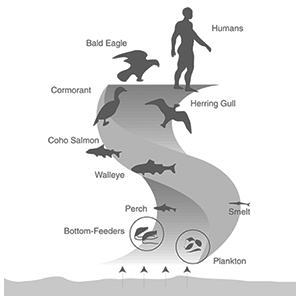
Bioaccumulation refers to the accumulation of substances, such as pesticides, or other organic chemicals in an organism. Bioaccumulation occurs when an organism absorbs a toxic substance at a rate greater than that at which the substance is lost. Thus, the longer the biological half-life of the substance the greater the risk of chronic poisoning, even if environmental levels of the toxin are not very high.
Bioconcentration is a related but more specific term, referring to uptake and accumulation of a substance from water alone. By contrast, bioaccumulation refers to uptake from all sources combined (e.g. water, food, air, etc.).
read more »
Posted in Food, Health, Politics |
Leave a Comment »
April 10, 2012


Triclosan [trik-loh-san] is an antibacterial and antifungal agent found in consumer products, including toothpaste, soaps, detergents, toys, and surgical cleaning treatments. In 2016, the FDA announced that effective September 2017, it would prohibit the sale of ‘consumer antiseptic washes’ containing triclosan or 18 other ingredients marketed as antimicrobials due to the FDA’s findings of the lack of efficacy in these products.
Despite being used in many consumer products, beyond its use in toothpaste to prevent gingivitis, there is no evidence according to the FDA that triclosan provides an extra benefit to health in other consumer products. A comprehensive analysis from the University of Michigan School of Public Health indicated that plain soaps are just as effective as consumer-grade antibacterial soaps with triclosan in preventing illness and removing bacteria from the hands.
read more »
Posted in Drugs, Health, Money |
Leave a Comment »
April 10, 2012
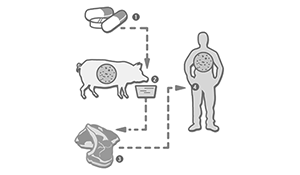

Antibiotic overuse is a contributing factor to the creation of multidrug-resistant bacteria, informally called ‘super bugs’: relatively harmless bacteria can develop resistance to multiple antibiotics and cause life-threatening infections. Though antibiotics are required to treat severe bacterial infections, misuse has contributed to a rise in bacterial resistance. The overuse of fluoroquinolone (a family of antibiotics) and other antibiotics fuels antibiotic resistance in bacteria, which can inhibit the treatment antibiotic-resistant infections. Their excessive use in children with otitis media (ear infection) has given rise to a breed of bacteria resistant to antibiotics entirely.
Widespread use of fluoroquinolones as a first-line antibiotic has led to decreased antibiotic sensitivity, with negative implications for serious bacterial infections such as those associated with cystic fibrosis, where quinolones are among the few viable antibiotics. Antibiotics have no effect on viral infections such as the common cold. They are also ineffective against sore throats, which are usually viral and self-resolving. Most cases of bronchitis (90–95%) are viral as well, passing after a few weeks—the use of antibiotics such as ofloxacin against bronchitis is superfluous and can put the patient at risk of suffering adverse reactions.
read more »
Posted in Drugs, Food, Health |
Leave a Comment »
April 9, 2012

In sexuality, the refractory period is the recovery phase after (normally male) orgasm during which it is physiologically impossible for an individual to have additional orgasms. Most men are unable to maintain or achieve an erection during this time, and many perceive a psychological feeling of ‘satiation’ and are temporarily uninterested in further sexual activity. The penis may be hypersensitive and further sexual stimulation may even feel painful during this time frame.
The refractory period varies widely among individuals and across species, ranging from minutes to days. An increased infusion of the hormone oxytocin during ejaculation is believed to be chiefly responsible for the refractory period and the amount by which oxytocin is increased may affect the length of each refractory period. Another chemical which is considered to be responsible for this effect is prolactin, which represses dopamine, which is responsible for sexual arousal.
read more »
Posted in Drugs, Health, Sex |
Leave a Comment »
April 9, 2012


Orgasm (from Greek: ‘to swell’) is the sudden discharge of accumulated sexual tension during the sexual response cycle, resulting in rhythmic muscular contractions in the pelvic region characterized by an intense sensation of pleasure. Experienced by males and females, orgasms are controlled by the involuntary, or autonomic, limbic system.
They are often associated with other involuntary actions, including muscular spasms in multiple areas of the body, a general euphoric sensation, and, frequently, body movements and vocalizations are expressed. The period after orgasm (known as a refractory period) is often a relaxing experience, attributed to the release of the neurohormones oxytocin and prolactin.
read more »
Posted in Health, Sex |
1 Comment »
April 9, 2012


Food faddism refers to idiosyncratic diets and eating patterns that promote short-term weight loss, usually with no concern for long-term weight maintenance, which enjoy temporary popularity. The term ‘food fad’ may also be used with a neutral connotation to describe the short term popularity among restaurants and consumers of an ingredient, dish, or preparation technique.
‘Fad diet’ is a term of popular media, not science. Some so-called fad diets may make pseudo-scientific claims, but others labeled ‘fad’ are based on science. According to one definition, fad diets claim to be scientific but do not follow the scientific method in establishing their validity. Among the scientific shortcomings of the claims made in support of fad diets: not being open to revisions, whereas real science is; and observations that prompt explanations are used as evidence of the validity of the explanation.
read more »
Posted in Food, Health, Money |
Leave a Comment »
April 9, 2012

Yo-yo dieting, also known as ‘weight cycling,’ is a term coined by Kelly D. Brownell, Ph.D., at Yale University. In this process, the dieter is initially successful in the pursuit of weight loss but is unsuccessful in maintaining the loss long-term and begins to gain the weight back. The dieter then seeks to lose the regained weight, and the cycle begins again.
The reasons for yo-yo dieting are varied but often include embarking upon a hypocaloric diet that was initially too extreme. At first the dieter may experience elation at the thought of their rejection of food. Over time, however, the limits imposed by such extreme diets cause effects such as depression or fatigue that make the diet impossible to sustain. Ultimately, the dieter reverts to their old eating habits, now with the added emotional effects of failing to lose weight by restrictive diet. Such an emotional state leads many people to eating more than they would have before dieting, causing them to rapidly regain weight.
Posted in Food, Health |
Leave a Comment »
April 6, 2012

Bromo-DragonFLY is a psychedelic hallucinogenic drug related to phenethylamine (a chemical found in chocolate, which like amphetamine, causes the release of norepinephrine and dopamine in the brain). It is considered an extremely potent hallucinogen, only slightly less potent than LSD, with a normal dose in the region of 200 μg to 800 μg, and it has an extremely long duration (up to several days).
It is explicitly illegal only in Finland, Sweden, Norway, and Denmark, although it may be considered a controlled substance analogue under US and Australian drug laws. The compound was first synthesized in the lab of American pharmacologist David E. Nichols in 1998. As with the earlier and less potent dihydrofuran series of compounds nicknamed FLY, Bromo-DragonFLY was named after its superficial structural resemblance to a dragonfly.
read more »
Posted in Drugs, Health, Politics |
Leave a Comment »



 The Daily Omnivore