May 6, 2015
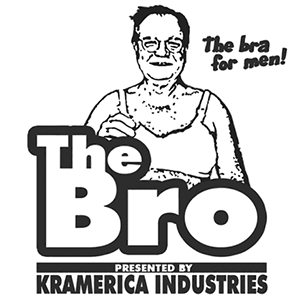
A male bra (also known as a compression bra, compression vest, or gynecomastia vest) is a brassiere worn by a man. Adolescent boys and middle-aged men sometimes develop breasts (gynecomastia). Although there are options for treating gynecomastia, some elect surgery to reduce their breasts or wear a male bra, which typically flatten rather than lift. Other men wear bras for cross-dressing, for sexual purposes such as transvestic fetishism or feminization, or as a form of submission to their partner.
Additionally, some male athletes – more specifically runners – may choose to wear a sports bra under their shirts in order to prevent a common medical condition called jogger’s nipple, also known as nipple chafing. This condition is caused by excessive rubbing of wet sweat-soaked material over one’s nipples. In an episode ‘Seinfeld,’ titled ‘The Doorman,’ Kramer invented a male bra, which he called a ‘bro,’ for Frank Costanza, who was said to have very large breasts. Frank initially decided to market the invention, but disagreed on the name, instead wanting to call it a ‘Manssiere.’
Posted in Health, Humor, Sex |
Leave a Comment »
May 5, 2015
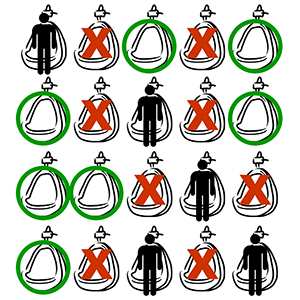
Male Restroom Etiquette is a 2006 American short subject created by humorist Phil R. Rice and produced by his company Zarathustra Studios. The film is a mockumentary about unwritten rules of behavior in male restrooms and is intended to be a parody of educational and social guidance films. The film was made using the machinima technique of recording video footage from computer games, namely ‘The Sims 2’ and ‘SimCity 4.’ In the short, the narrator states that increased cultural diversity has necessitated the exposition of previously unwritten rules regarding the use of malerestrooms.
According to these rules, males should use restrooms as quickly as possible, maximize physical separation from each other when using urinals, flush urinals when they contain concentrated urine, avoid stalls with unflushed toilets, and avoid eye contact and communication with others. The film depicts a scenario in which excess communication leads to a mess in the restroom and thus deficient hygiene and homeostasis, the latter of which is in the lowest tier in Maslow’s hierarchy of needs. As the scenario continues, the restroom occupants turn to violence, leading to police and biological hazard team involvement that closes the restroom. Forced to go elsewhere, other men repeat the scenario, eventually leading to complete societal breakdown.
Posted in Games, Humor |
1 Comment »
April 28, 2015

An anti-proverb or a ‘perverb’ is the transformation of a standard proverb for humorous effect. Paremiologist (proverb scholar) Wolfgang Mieder defines them as ‘parodied, twisted, or fractured proverbs that reveal humorous or satirical speech play with traditional proverbial wisdom.’ They have also been defined as ‘an allusive distortion, parody, misapplication, or unexpected contextualization of a recognized proverb, usually for comic or satiric.’
To have full effect, an anti-proverb must be based on a known proverb. For example, ‘If at first you don’t succeed, quit’ is only funny if the hearer knows the standard proverb ‘If at first you don’t succeed, try, try again.’ Anti-proverbs are used commonly in advertising, such as ‘Put your burger where your mouth is’ from Red Robin. Anti-proverbs are also common on T-shirts, such as ‘Taste makes waist’ and ‘If at first you don’t succeed, skydiving is not for you.’
read more »
Posted in Humor, Language |
2 Comments »
April 21, 2015

Project Blue Book was one of a series of systematic studies of unidentified flying objects (UFOs) conducted by the United States Air Force. It started in 1952, and it was the third study of its kind (the first two were projects ‘Sign’ in 1947 and ‘Grudge’ in 1949). A termination order was given for the study in 1969. Project Blue Book had two goals: To determine if UFOs were a threat to national security, and To scientifically analyze UFO-related data. Thousands of UFO reports were collected, analyzed and filed.
As the result of the ‘Condon Report’ (1968), which concluded there was nothing anomalous about UFOs, Project Blue Book was ordered shut down in 1970. Ultimately, Project Blue Book stated that UFOs sightings were generated as a result of: hysteria, fraud, hoaxes, and misidentification. The Air Force continues to provide the following summary of its investigations: ‘There was no evidence indicating that sightings categorized as ‘unidentified’ were extraterrestrial vehicles.’
read more »
Posted in Humor, Technology, War |
Leave a Comment »
April 10, 2015
In terms of fiction, a quibble [kwib-uhl] is a plot device, used to fulfill the exact verbal conditions of an agreement in order to avoid the intended meaning. Typically quibbles are used in legal bargains and, in fantasy, magically enforced ones. In one of the best known examples, William Shakespeare used a quibble in ‘The Merchant of Venice.’ Portia saves Antonio in a court of law by pointing out that the agreement called for a pound of flesh, but no blood, and therefore Shylock can collect only if he sheds no blood.
A ‘pact with the Devil’ commonly contains clauses that allow the devil to quibble over what he grants, and equally commonly, the maker of the pact finds a quibble to escape the bargain. In Norse mythology, Loki, having bet his head with Brokk and lost, forbids Brokk to take any part of his neck, saying he had not bet it; Brokk is able only to sew his lips shut.
read more »
Posted in Humor, Language, Politics |
1 Comment »
April 2, 2015

Stone Soup is an old folk story in which hungry strangers trick the local people of a town to share their food: a good confidence trick that benefits the group from combining their individual resources. The story is usually told as a lesson in cooperation, especially amid scarcity. In varying traditions, the stone has been replaced with other common inedible objects, and therefore the fable is also known as button soup, wood soup, nail soup, and axe soup. In the story, some hungry travellers come to a village carrying nothing more than an empty cooking pot. Upon their arrival, the villagers are unwilling to share any of their food stores with them.
The travellers go to a stream and fill the pot with water, drop a large stone in it, and place it over a fire. One of the villagers becomes curious and asks what they are doing. The travellers answer that they are making ‘stone soup,’ which tastes wonderful, but could use a little bit of garnish to improve the flavor. The villager does not mind parting with a few carrots to help them out, so that gets added to the soup. Another villager walks by, inquiring about the pot, and the travellers again mention their stone soup which has not reached its full potential yet. The villager hands them a little bit of seasoning to help them out. More and more villagers walk by, each adding another ingredient. Finally, a delicious and nourishing pot of soup is enjoyed by all.
read more »
Posted in Art, Food, Humor |
Leave a Comment »
March 25, 2015
Basic bitch (or simply ‘basic’) is a slang term in American popular culture used to pejoratively describe people who like popular, mainstream products or music. Interpretations of the term vary and its use has been criticized for being an overly vague and a misogynistic insult. Their male counterparts are usually termed ‘basic bros.’
The term was created by comedian Lil’ Duval in 2010. Over the next two years, it appeared in several American rap songs. In the songs ‘Hard in the Paint’ by Tyga and ‘I’m a Human Being’ by Lil Wayne, the singers insist that they are not basic bitches, while in the song ‘Basic Bitch’ by The Game, the singer warns others to avoid basic bitches because they are ‘fake.’ In 2011, rapper Kreayshawn debuted her song ‘Gucci Gucci,’ which included the chorus: ‘Gucci Gucci, Louis Louis, Fendi, Fendi Prada … basic bitches wear that shit so I don’t even bother.’
read more »
Posted in Humor, Language |
Leave a Comment »
March 14, 2015

Wrap rage, also called package rage, is the common name for heightened levels of anger and frustration resulting from the inability to open hard-to-openpackaging, particularly some heat-sealed plastic blister packs and clamshells. People suffer thousands of injuries per year, such as cut fingers and sprained wrists, from tools used to open packages and from packaging itself, and in some cases damage the items they are trying to free from packaging. Easy-opening systems are available to improve package opening convenience.
Packaging sometimes must be made difficult to open. For example, regulations dictate that some over-the-counter drugs have tamper resistance to deter unauthorized opening prior to the intended customer and be in child-resistant packaging. Other packages are intentionally made difficult to open to reduce package pilferage and shoplifting. Hard plastic blister packs also protect the products while they are being shipped. In addition, using transparent plastic allows customers to view products directly before purchasing them.
Posted in Humor, Money |
Leave a Comment »
February 21, 2015

Wim Delvoye (b. 1965 ) is a Belgian neo-conceptual artist known for his inventive and often shocking projects. Much of his work is focused on the body, and he is perhaps best known for his digestive machine, Cloaca, which he unveiled at the Museum voor Hedendaagse Kunst, Antwerp, after eight years of consultation with experts in fields ranging from plumbing to gastroenterology. In a comment on the Belgians’ love of fine dining, Cloaca is a large installation that turns food into feces, allowing Delvoye to explore the digestive process. The food begins at a long, transparent mouth, travels through a number of enzyme filled, machine-like assembly stations, and ends in hard matter which is separated from liquid through a cylinder. Delvoye collects and sells the realistically smelling output, suspended in small jars of resin at his Ghent studio.
When asked about his inspiration, Delvoye stated that everything in modern life is pointless. The most useless object he could create was a machine that serves no purpose at all, besides the reduction of food to waste. Previously, Delvoye claimed that he would never sell a Cloaca machine to a museum as he could never trust that the curator would maintain the installation properly. However after two years of discussion with David Walsh, Delvoye agreed to construct a custom Cloaca built specifically for the Museum of Old and New Art in Hobart, Tasmania. The new installation is suspended from the museum ceiling in a room custom-built for it.
Posted in Art, Health, Humor |
Leave a Comment »
February 6, 2015

Pet Rock was a collectible conceived by advertising executive Gary Dahl. In April 1975, he was in a bar listening to his friends complain about their pets. This gave him the idea for the perfect ‘pet,’ one that would not need to be fed, walked, bathed, or groomed; and would not die, become sick, or be disobedient. His friends thought he was joking, but Dahl bought a load of smooth stones from Mexico’s Rosarito Beach for about a penny a stone. He marketed them like live pets, in custom cardboard boxes, complete with straw and breathing holes for the ‘animal.’ The fad lasted about six months. Dahl sold 1.5 million Pet Rocks for $4 each and became a millionaire.
A 32-page official training manual titled ‘The Care and Training of Your Pet Rock’ was included, which was the real product: it was full of gags, puns and jokes. It contained several commands that could be taught to the new pet. While ‘sit’ and ‘stay’ were effortless to accomplish, ‘roll over’ usually required a little extra help from the trainer (as did ‘attack’). The owners also found that potty-training their pet rocks was easy, given that they were, in fact, rocks. Dahl continued to work in advertising but avoided interviews for years, because ‘a bunch of wackos’ harassed him with lawsuits and threats. He said in 1988, ‘Sometimes I look back and wonder if my life wouldn’t have been simpler if I hadn’t done it.’
Posted in Humor, Money |
Leave a Comment »
February 5, 2015

John Titor is the name used on several bulletin boards during 2000 and 2001 by a poster claiming to be a time traveler from 2036. In these posts, Titor made numerous predictions about events in the near future, a number of them vague, but some quite specific, starting with events in 2004. He described a drastically changed future in which the United States had broken into five smaller regions, the environment and infrastructure had been devastated by a nuclear attack, and most other world powers had been destroyed.
In his online postings, Titor claimed to be an American soldier from 2036, based in Tampa in Hillsborough County, Florida, who was assigned to a governmental time-travel project. Purportedly, Titor had been sent back to 1975 to retrieve an IBM 5100 computer which he said was needed to ‘debug’ various legacy computer programs in 2036; a reference to the UNIX year 2038 problem. The IBM 5100 runs the APL and BASIC programming languages. Titor had been selected for this mission specifically, given that his paternal grandfather was directly involved with the assembly and programming of the 5100. Titor claimed to be on a stopover in the year 2000 for ‘personal reasons,’ to collect pictures lost in the (future) civil war and to visit his family, of whom he spoke often.
read more »
Posted in Humor |
Leave a Comment »
January 31, 2015

To see a man about a dog (or see a man about a horse) is an English language colloquialism, usually used as a way to say one needs to apologize for one’s imminent departure or absence – generally euphemistically to conceal one’s true purpose, such as going to use the toilet or going to buy a drink (particularly during Prohibition). The original, non-facetious meaning was probably to place or settle a bet on a racing dog.
The earliest confirmed publication is the 1866 Dion Boucicault play ‘Flying Scud’ in which a character knowingly breezes past a difficult situation saying, ‘Excuse me Mr. Quail, I can’t stop; I’ve got to see a man about a dog.’ In a listing for a 1939 revival on the NBC Radio program ‘America’s Lost Plays,’ ‘Time’ magazine observed that the phrase was the play’s ‘claim to fame.’
Posted in Humor, Language |
Leave a Comment »


 The Daily Omnivore