March 21, 2016

Manspreading, or man-sitting, is the practice of sitting in public transport with legs wide apart, thereby covering more than one seat. Both this posture and usage of the term ‘manspreading’ have caused some internet criticism, and debates. The term first appeared in public debate when a feminist anti-manspreading campaign was started on Tumblr in 2013. The Oxford English Dictionary added it as a word in August 2015.
The Metropolitan Transportation Authority in New York and Sound Transit of Seattle instituted poster campaigns encouraging respectful posture when other passengers have to stand due to crowding on buses and trains. The MTA campaign carried slogans like ‘Dude, stop the spread please!’
read more »
Posted in Humor, Politics |
Leave a Comment »
March 20, 2016

‘You have two cows‘ is a joke comparing political systems that circulated throughout the US since around 1936 under the title ‘Parable of the Isms.’ A column in ‘The Chicago Daily Tribune’ in 1938 attributes a version involving socialism, communism, fascism and New Dealism to an address by lawyer Silas Strawn to the Economic Club of Chicago in 1935.
The joke always begins with ‘You have two cows…’ followed by a political system and its effect on the cows. For example, ‘socialism’ (the government takes one and gives it to your neighbor), ‘communism’ (you give them to the government, and the government then gives you some milk), fascism (you give them to the government, and the government then sells you some milk), and capitalism (you sell one and buy a bull).
Posted in Humor, Money, Politics |
1 Comment »
March 17, 2016


Witzelsucht [vit-sel-zuhkt] (from the German ‘witzeln,’ meaning ‘to joke or wisecrack,’ and ‘sucht,’ meaning ‘addiction or yearning’) is a set of rare neurological symptoms characterized by a tendency to make puns, or tell inappropriate jokes or pointless stories in socially inappropriate situations. A less common symptom is hypersexuality, the tendency to make sexual comments at inappropriate times or situations. Patients do not understand that their behavior is abnormal, therefore are nonresponsive to others’ reactions. This disorder is most commonly seen in patients with frontal lobe damage, particularly right frontal lobe tumors or trauma.
Those with the condition often show no emotional reaction to humor, whether produced by themselves or others. This lack of responsiveness is due to dissociation between their cognitive and affective responses to humorous stimuli. That is, even when a patient understands that a joke is funny (based on quantitative brain activity), they do not respond with laughter, or even a smile. While they have grasped the cognitive basis of humor, they do not affectively respond. This also considered a cognitive component of empathy, affecting ability to take the perspective of others; hence why patients often do not respond to humor produced by other people.
read more »
Posted in Health, Humor, Sex |
1 Comment »
March 15, 2016

The swan dress is an iconic dress resembling a white swan worn by the Icelandic artist Björk in 2001 at the 73rd Academy Awards. Created by Macedonian fashion designer Marjan Pejoski, the dress is modeled after a swan and at the ceremony Björk mimicked laying an egg on the red carpet. She later said: “I was very aware when I went to the Academy Awards that it would probably be my first and last time. So I thought my input should really be about fertility, and I thought I’d bring some eggs.”
It was described by film critic Emanuel Levy as ‘A giant swan dress, a full-body stocking that was covered with a giant swan whose neck wrapped around her with its head and beak resting on her breasts.’ She had two copies of the dress produced, given that it could not be taken to the dry cleaners. She later wore that dress on the cover of her 2001 record album ‘Vespertine’ and variations of it many times on the ‘Vespertine World Tour.’
read more »
Posted in Art, Humor |
1 Comment »
March 10, 2016

Shoe-throwing (also called shoeing) and showing the sole of one’s shoe as an insult are forms of protest in many parts of the world. Posters of George W. Bush’s face have long appeared through the Middle East with shoes attached to them, and some people have called former Secretary of State Condoleezza Rice ‘kundara,’ meaning ‘shoe.’ Shoeing received widespread attention after Muntadhar al-Zaidi threw his shoes at then President George W. Bush during a 2008 press conference in Baghdad.
‘This is a farewell kiss from the Iraqi people, you dog!’ yelled al-Zaidi in Arabic as he threw his first shoe towards the president. ‘This is for the widows and orphans and all those killed in Iraq!’ he shouted as he threw his second shoe. President Bush ducked twice, avoiding being hit by the shoes. Since the al-Zaidi incident, copycat incidents in Europe, North America, India, China, Hong Kong, Iran, Turkey, and Australia have been reported. Shoes are considered unclean in the Arab World, but Matthew Cassel of ‘The Electronic Intifada’ has expressed the opinion that the Western media overplayed the phenomenon as being ‘Arab’ in particular.’
Posted in Humor, Politics, War |
Leave a Comment »
February 26, 2016


A reduced-gravity aircraft is a type of fixed-wing aircraft that provides brief near-weightless environments for training astronauts, conducting research and making gravity-free movie shots. Versions of such airplanes, officially nicknamed ‘Weightless Wonders,’ were operated by the NASA Reduced Gravity Research Program.
The aircraft gives its occupants the sensation of weightlessness by following an elliptic flight path relative to the center of the Earth. While following this path, the aircraft and its payload are in free fall at certain points of its flight path. The aircraft is used in this way to demonstrate to astronauts what it is like to orbit the Earth. There are 25 seconds of weightlessness out of 65 seconds of flight in each parabola. The airplane typically flies about 40–60 parabolic maneuvers. In about two thirds of the passengers, these flights produce nausea due to airsickness, giving the plane its nickname ‘vomit comet.
Posted in Humor, Technology |
Leave a Comment »
February 3, 2016
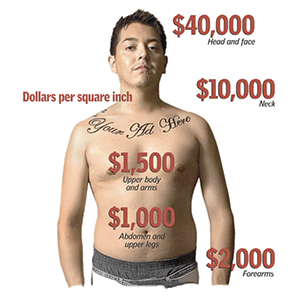
Forehead Advertising is a type of nontraditional advertising that involves using a person’s forehead as advertising space. John Carver and his London Creative Agency, CUNNING, is credited with inventing the concept in 2003 with ForeheADS. In a 2004 CUNNING campaign, forty young adults were paid $11 per hour to wear temporary tattoos on their foreheads for a 2004 campaign promoting the launch of the Scion tC for Toyota. A short lived startup in Rhode Island, Headvertise, offered up to $150 per week for wearing a temporary logo tattoo on one’s forehead. It was last reported that 64 students had featured ads on their foreheads for companies such as Roommates.com.
Forehead advertising made headlines in early 2005 when a 20-year-old man, Andrew Fischer, auctioned his forehead for advertising space on eBay. The winning company, SnoreStop, bid $37,375 to display their logo via temporary tattoo on his forehead for 30 days. Later that year forehead advertising moved beyond temporary tattoos. Kari Smith auctioned her forehead for advertising space on eBay for an asking price of $10,000. GoldenPalace.com, a Canadian Internet gambling company, paid $10,000 for Smith to permanently tattoo ‘GoldenPalace.com’ on her forehead. GoldenPalace.com has also advertised its logo via temporary and permanent tattoos on the backs of boxers, bellies of pregnant women, women’s legs, and the chest of a swimsuit model.
read more »
Posted in Humor, Money |
1 Comment »
February 2, 2016

Catvertising is the use of cats in advertising. The tongue-in-cheek portmanteau was coined in the late 1990s, and enjoyed a spike in popularity beginning 2011 as a result of a parody of commercialization of cat viral videos by the advertising agency st. john in Toronto.
The video was part of a series of spoofs beginning with ‘Pink Ponies: A Case Study,’ then ‘Catvertising,’ and finally ‘Buyral’ (a blend of ‘buy’ and ‘viral’). A University of Arizona marketing team competes under the name ‘Catvertising.’
Posted in Humor, Money |
Leave a Comment »
December 17, 2015

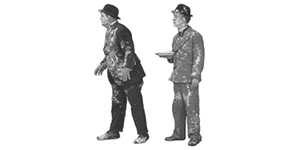
Pieing is the act of throwing a pie at a person or people. This may be a simple practical joke, but can be a political action when the target is an authority figure, politician, or celebrity and can be used as a means of protesting against the target’s political beliefs, or against perceived arrogance or vanity. Perpetrators generally regard the act as a form of ridicule to embarrass and humiliate the victim. In most or all jurisdictions, pieing is punishable as battery, and may constitute assault as well.
In pieing, the goal is usually to humiliate the victim while avoiding actual injury. For this reason the pie is traditionally of the cream variety without a top crust, and is rarely if ever a hot pie. In Britain, a pie in the context of throwing is traditionally referred to as a ‘custard pie.’ An aluminum pie pan or paper plate filled with whipped cream or shaving foam can substitute for a real pie. Pieing and pie fights are a staple of slapstick comedy, and pie ‘tosses’ are also common charity fundraising events, especially in schools.
read more »
Posted in Food, Humor, Politics |
1 Comment »
December 12, 2015

Smell-O-Vision was a system that released odor during the projection of a film so that the viewer could ‘smell’ what was happening in the movie. The technique was created by inventor Hans Laube and made its only appearance in the 1960 film ‘Scent of Mystery,’ produced by Mike Todd, Jr., son of film producer Mike Todd. The process injected 30 odors, such as freshly-baked bread, pipe tobacco, and salty ocean air, into a movie theater’s seats when triggered by the film’s soundtrack.
The use of scents in conjunction with film dates back to 1906, before the introduction of sound. In this first instance, a 1958 issue of ‘Film Daily’ claims that Samuel Roxy Rothafel of the Family Theatre in Forest City, Pennsylvania, placed a wad of cotton wool that had been soaked in rose oil in front of an electric fan during a newsreel about the Rose Bowl Game. Arthur Mayer installed an in-theater smell system in Paramount’s Rialto Theater on Broadway in 1933, which he used to deliver odors during a film. However, it would take over an hour to clear the scents from the theater, and some smells would linger for days afterward.
read more »
Posted in Art, Humor, Technology |
Leave a Comment »
December 2, 2015
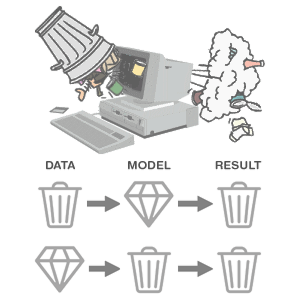
Garbage in, garbage out (GIGO) in the field of computer science or information and communications technology refers to the fact that computers, since they operate by logical processes, will unquestioningly process unintended, even nonsensical, input data (‘garbage in’) and produce undesired, often nonsensical, output (‘garbage out’). The principle applies to other fields as well.
The underlying principle was noted by the inventor of the first programmable computing device design: ‘On two occasions I have been asked, ‘Pray, Mr. Babbage, if you put into the machine wrong figures, will the right answers come out?’ … I am not able rightly to apprehend the kind of confusion of ideas that could provoke such a question.’
read more »
Posted in Humor, Language, Technology |
Leave a Comment »
November 24, 2015
Headis (Header Table Tennis) is a hybrid game that combines table tennis with soccer. Players strike a 7-inch rubber ball with their head. Physically headis is more comparable to badminton than to table tennis, but the rules are closer to table tennis with a few exceptions. Volleys (striking the ball before it hits the player’s own side) are allowed, as well as touching the table with any part of the body. Each game is played to 11 points and up to 2 sets, although a player must be ahead by two points to win each set.
The sport was invented in 2006 by René Wegner, a Saarbrücken sports science student at the time, at the ‘Wesch,’ a swimming pool in Kaiserslautern, Germany. The soccer field was occupied, which was why he and a friend started heading the ball back and forth at the table tennis table. In 2008 headis became part of the sports program at the University of Saarbrücken.
Posted in Games, Humor |
Leave a Comment »



