May 29, 2014

A Beer mile is a drinking race combining running and speed drinking. Typically, the event takes place on a standard 400 meter or 1/4 mile running track. Each lap must be preceded by the drinking of a standard amount of beer, typically a 12-ounce can. Rules vary by region. One custom requires runners to prove they have finished their beer by inverting it over their heads before commencing a lap.
The standard rules published by BeerMile.com are based on the most common rules used in North America. They specify that any competitor who vomits prior to finishing the race must complete a penalty lap immediately following the fourth lap. The penalty lap does not require the drinking of an additional beer. The standard rules also dictate that the beer be consumed directly from the pour of the can (i.e. tampering with the cans, such as ‘shotgunning,’ is not allowed). The beer used for the competition must also be full-strength, or at least 5.0% ABV. Hard ciders and other alcoholic beverages are generally not allowed.
read more »
Posted in Drugs, Games, Humor |
Leave a Comment »
May 28, 2014


‘Thank God for Mississippi’ is a common adage in the US, particularly in the south, that is generally used when discussing rankings of states (e.g. educational achievement, overall health, poverty rate, quality of life). Since the state of Mississippi generally ranks at the bottom of such lists, residents of other states ranking near the bottom frequently proclaim, ‘Thank God for Mississippi,’ for sparing them from the shame of finishing in last place.
The saying has been attributed since before the induction of Alaska and Hawaii as states in 1959, and is especially common in Alabama, which shares significant cultural and historical ties with its neighbor and former Mississippi Territory co-constituent. Its use is also noted in nearby Arkansas and other frequently low-ranking states such as West Virginia and Texas.
Posted in Humor, Politics |
Leave a Comment »
April 24, 2014

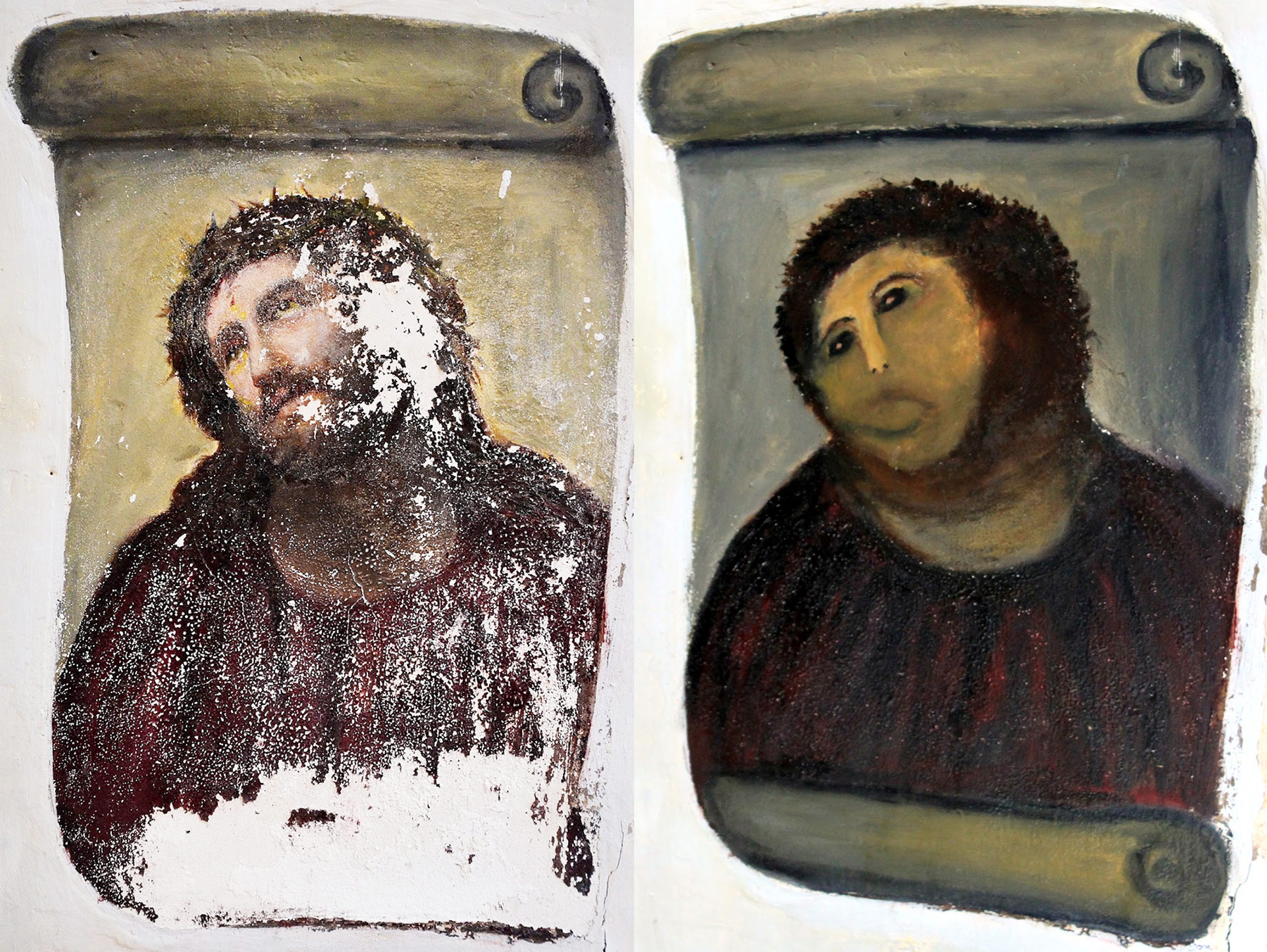
The ‘Ecce Homo‘ [ech-ey hoh-moh] (‘Behold the Man’) in the Sanctuary of Mercy church of Borja, Zaragoza is a fresco of about 1930 by the Spanish painter Elías García Martínez depicting Jesus crowned with thorns. Both the subject and style are typical of traditional Catholic art.
Press accounts agree that the original painting was of little artistic importance, and its fame derives from a botched attempt at restoration.
read more »
Posted in Art, Humor, Philosophy |
Leave a Comment »
April 22, 2014
Religious satire is a form of satire (humor that points out the shortcomings of institutions of power) targeted at religious beliefs. From the earliest times, at least since the plays of Aristophanes in the fourth century BCE, religion has been one of the three primary topics of literary satire, along with politics and sex.
Satire which targets the clergy is a type of political satire, while religious satire is that which targets religious beliefs. It can be the result of agnosticism or atheism, but it can also have its roots in belief itself. According to religious theorist Robert Kantra, in religious satire, man attempts to violate the divine—it is an effort to play God, in whole or in part—whether under the banner of religion or of humanity. Religious satire surfaced during the Renaissance, with works by Chaucer, Erasmus, and Durer.
read more »
Posted in Art, Humor, Philosophy |
Leave a Comment »
April 3, 2014

Normcore is an emerging cultural trend focusing on ‘coolness that opts into sameness.’ It is in response to hipster subculture. Jeremy Lewis, the founder of fashion website ‘Garmento’ calls normcore ‘one facet of a growing anti-fashion sentiment.’
K-hole, a creative trend forecasting collective based in New York City is cited as coining the phrase. Normcore is an anti-trendy trend.
Posted in Art, Humor |
Leave a Comment »
April 2, 2014
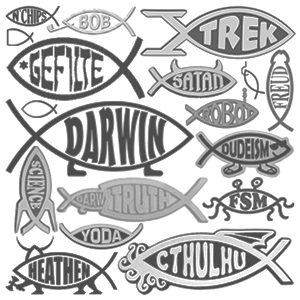
Ichthys [ik-thees], from the Koine Greek word for fish, is a symbol consisting of two intersecting arcs, the ends of the right side extending beyond the meeting point so as to resemble the profile of a fish, used by early Christians as a secret Christian symbol and now known colloquially as the ‘sign of the fish’ or the ‘Jesus fish.’
It is sometimes a subject of satire, especially when adorning the bumpers or trunks of automobiles. The most notable is the ‘Darwin Fish,’ an ichthys symbol with ‘evolved’ legs and feet attached. Rhetorical scholar Thomas Lessl conducted a survey of users of the Darwin fish emblem. Based on their responses, he interprets the symbol as scientific ‘blackface,’ a parody that is one part mockery and one part imitation. While users frequently explain the symbol as a rebuke against Creationism, Lessl suggests that the emblem represents a metaphor for cultural progress.
read more »
Posted in Humor, Philosophy |
1 Comment »
March 31, 2014

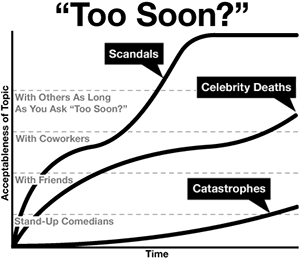
9/11 humor is black comedy or off-color humor that aims to make light of the September 11, 2001 terrorist attacks. A number of scholars have studied the ways in which humor has been used to deal with the trauma of the event. Researcher Bill Ellis found jokes about the attacks from Americans the day afterwards, and sociologist Giselinde Kuipers found jokes on Dutch websites a day later. Kuipers had collected around 850 online jokes about 9/11, Osama Bin Laden, and the Afghanistan war by 2005.
An early public attempt at 9/11 humor was made by Gilbert Gottfried just a few weeks after the attacks. During a comedy roast at the Friars Club his 9/11 gags ellicited angry shouts of ‘too soon.’ Gottfried improvised and performed ‘The Aristocrats’ routine (a famously vulgar joke), which got great applause from the crowd.
read more »
Posted in Death, Humor, War |
Leave a Comment »
March 30, 2014

The Rock-afire Explosion is an animatronic robot band that played in Showbiz Pizza Place from 1980 to 1990, and in various Showbiz Pizza locations between 1990 and 1992 as Showbiz rebranded and the band was steadily replaced by Chuck E. Cheese characters. The characters in The Rock-afire Explosion were various animals ranging from a dog to a gorilla. They would perform medleys of classic rock, pop, and country music, as well as original compositions.
The show was a pioneer in commercial animatronics in the 1980s, featuring life-sized characters capable of facial expression; some were even programmed in such a way that they could actually play simple melodies on musical instruments. The show was created and manufactured by noted inventor Aaron Fechter, through his company Creative Engineering, Inc. in Orlando, Florida; in addition to overseeing the production of the animatronics, Fechter also provided the voices for several characters.
read more »
Posted in Art, Humor |
Leave a Comment »
March 27, 2014

Out of hacker culture, and especially the artificial intelligence community at MIT, there have sprung a number of humorous short stories about computer science dubbed hacker koans [koh-ahns]; most of these are recorded in an appendix to the Jargon File (a glossary of computer programmer slang). Most do not fit the usual pattern of koans, but they do tend to follow the form of being short, enigmatic, and often revealing an epiphany.
One notable example, titled ‘Uncarved block,’ describes an exchange between professor Marvin Minsky and student Jerry Sussman: ‘In the days when Sussman was a novice, Minsky once came to him as he sat hacking at the PDP-6. ‘What are you doing?’, asked Minsky. ‘I am training a randomly wired neural net to play Tic-tac-toe,’ Sussman replied. ‘Why is the net wired randomly?’, asked Minsky. ‘I do not want it to have any preconceptions of how to play,’ Sussman said. Minsky then shut his eyes. ‘Why do you close your eyes?’ Sussman asked his teacher. ‘So that the room will be empty.’ At that moment, Sussman was enlightened.’
read more »
Posted in Humor, Philosophy, Technology |
Leave a Comment »
March 14, 2014


Although clowns are originally comic performers and characterized to humor and entertain people, the image of the evil clown is a development in popular culture, in which the playful trope is rendered disturbing through the use of horror elements and dark humor.
Philosopher Wolfgang M. Zucker points out the similarities between a clown’s appearance and the cultural depictions of demons and other infernal creatures, noting ‘[the clown’s] chalk-white face in which the eyes almost disappear, while the mouth is enlarged to a ghoulish bigness looks like the mask of death.’
read more »
Posted in Humor |
1 Comment »
March 12, 2014
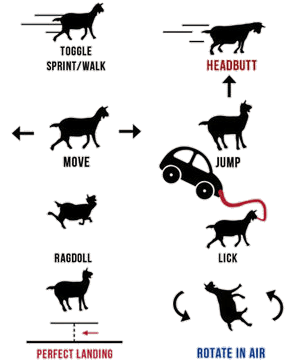
Goat Simulator is a third-person perspective game in which the player controls a goat. There does not appear to be any kind of storyline or plot. The player is free to explore the game’s world as a goat, destroying things in the environment, running, jumping, and biting. According to the developers, Coffee Stain Studios: ‘Goat Simulator is like an old school skating game, except instead of being a skater, you’re a goat, and instead of doing tricks, you wreck stuff.’
The game boasts the fact that various glitches and bugs have been intentionally left in the game, as to add to the light-hearted entertainment value. Another gameplay feature is the ability to ‘lick’ objects with the goat’s absurdly long tongue, which will then stick to the goat’s tongue and can be carried and swung around to provide an alternate method of wreaking havoc on the game environment.
Posted in Games, Humor |
Leave a Comment »
March 12, 2014

Surgeon Simulator 2013, a humorous medical sim, was initially created in a 48-hour period for the 2013 ‘Global Game Jam’ (the four developers spent an additional 48 days building the commercial version). The game is played in first-person perspective. A mouse is used to control the surgeon’s hand (holding the right button rotates the hand; the left button grabs items). Gameplay consists of various surgical procedures, for example a heart transplant. Extra modes are available after completion of the early operations, such as performing an operation in a moving ambulance with surgical instruments bouncing around at random, and operating in outer space where instruments float.
Reception for the game has been positive, with critics stating that although the game was hard to control, this difficulty was ‘part of the appeal.’ Ars Technica commented upon the narrator’s voice over, saying that it ‘belies the ridiculousness that unfolds as he flops and flails his way through surgery.’ ‘Rock, Paper, Shotgun, praised the game’s humor and fun, and said ”Surgeon Simulator 2013′ is not a brilliant game. But it is a brilliant joke. In the form of a game. It’s an idea that is a clean magnitude of awesome above 90% of what will be released this year because it is so absurd.’
Posted in Games, Health, Humor |
Leave a Comment »