March 18, 2013
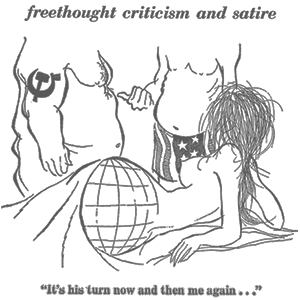
The Realist was a pioneering magazine of ‘social-political-religious criticism and satire, ‘intended as a hybrid of a grown-ups version of ‘Mad’ and Lyle Stuart’s anti-censorship monthly ‘The Independent.’ Edited and published by journalist and stand-up comedian Paul Krassner, and often regarded as a milestone in the American underground or countercultural press of the mid-20th century, it was a nationally-distributed newsstand publication as early as 1959.
Publication was discontinued in 2001. First published in the spring of 1958 in New York City in the offices of ‘Mad,’ ‘The Realist’ appeared on a fairly regular schedule during the 1960s and then on an irregular schedule after the early 1970s. In 1984, it was revived as a much smaller newsletter. Articles and cartoons from the magazine were collected in a book, ‘The Best of the Realist.’
read more »
Posted in Humor, Language, Politics |
Leave a Comment »
March 18, 2013
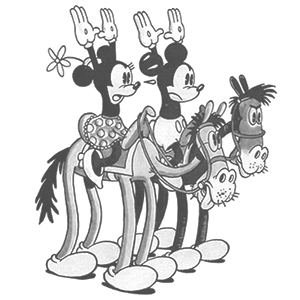
The Air Pirates were a group of cartoonists who created two issues of an underground comic called ‘Air Pirates Funnies’ in 1971, leading to a famous lawsuit by The Walt Disney Company. Founded by Dan O’Neill, the group also included Shary Flenniken, Bobby London, Gary Hallgren, and Ted Richards. The collective shared a common interest in the styles of past masters of the comic strip, and in creating their stories for the collective each set out to imitate the style of an old time cartoonist.
Flenniken emulated Clare Briggs and H. T. Webster in her ‘Trots and Bonnie’ comics, London’s strip ‘Dirty Duck’ paid homage to the style of George Herriman’s ‘Krazy Kat,’ Richards’ ‘Dopin’ Dan’ was supposed to be influenced by Bud Fisher but showed more similarity to Mort Walker’s ‘Beetle Bailey,’ and Gary Hallgren drew a strip called ‘Pollyanna Pals’ in the style of Cliff Sterrett’s ‘Polly and Her Pals.’ The original Air Pirates were a gang of Mickey Mouse antagonists of the 1930s; O’Neill regarded Mickey Mouse as a symbol of conformist hypocrisy in American culture, and therefore a ripe target for satire.
read more »
Posted in Art, Humor, Politics |
Leave a Comment »
March 13, 2013
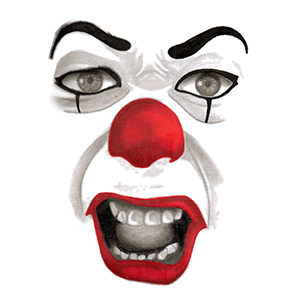
Coulrophobia [kool-ruh-foh-bee-uh] is a fear of clowns. The term is of recent origin, probably dating from the 1980s, and according to one analyst, ‘has been coined more on the Internet than in printed form because it does not appear in any previously published, psychiatric, unabridged, or abridged dictionary.’ However, the author later notes, ‘regardless of its less-than-verifiable etymology, coulrophobia exists in several lists.’ The prefix ‘coulro-‘ may be a neologism derived from an Ancient Greek word meaning ‘stilt-walker,’ although the concept of a clown as a figure of fun was unknown in classical Greek culture, stiltwalking was practiced.
According to a psychology professor at California State University, Northridge, young children are ‘very reactive to a familiar body type with an unfamiliar face.’ A study conducted by the University of Sheffield found that the children did not like clown décor in the hospital or physicians’ office settings. The survey was about children’s opinions on décor for an upcoming hospital redesign. Dr Penny Curtis, a researcher, stated ‘We found that clowns are universally disliked by children. Some found the clown images to be quite frightening and unknowable.’
Posted in Health, Humor, Language |
1 Comment »
March 12, 2013

‘Codex Alera‘ is a fantasy book series by novelist Jim Butcher. The series chronicles the coming-of-age of a young man named Tavi in the realm of Alera, an empire similar to Rome, on the world of Carna. Every Aleran has some degree of command over elemental forces or spirits called furies, save for Tavi, who is considered unusual for his lack of one. As the aging First Lord struggles to maintain his hold on a realm on the brink of civil war, Tavi must use all of his intelligence to save Alera.
The inspiration for the series came from a bet Jim was challenged to by a member of the Delray Online Writer’s Workshop. The challenger bet that Jim could not write a good story based on a lame idea, and Jim countered that he could do it using two lame ideas of the challenger’s choosing. The ‘lame’ ideas given were ‘Lost Roman Legion,’ and ‘Pokémon.’
Posted in Art, Humor, Language |
Leave a Comment »
March 11, 2013

The Kiss Kasket is an item of merchandise licensed by the rock band Kiss. It is an actual casket, decorated with a Kiss logo and pictures of the band members. In introducing the Kiss Kasket, Simmons quipped, ‘I love livin’, but this makes the alternative look pretty damn good.’ The Kiss Kasket went on sale in 2001. Pantera guitarist Dimebag Darrell was buried in a Kiss Kasket.
In 2010, Kissonline.com announced a new licensing agreement between Kiss and Eternal Image Inc. (a public company engaged in the design, manufacturing, and marketing of officially licensed memorial products) to design, manufacture, and market a limited edition line of official KISS branded memorial products. The line will reportedly include caskets, cremation urns, bronze memorials, memorial prayer cards, registry books, memorial candles, and pet cremation urns—all designed after the famous rock band’s iconic images.
Posted in Death, Humor, Money |
Leave a Comment »
March 11, 2013

Lock On is a style of street art, where artists create installations by attaching sculptures to public furniture using lengths of chain and old bike locks. The sculptures are often arranged to give the impression that they are interacting with surroundings.
The Lock On style is a ‘non destructive’ form of underground art. Artist Tejn is considered the ‘founder’ of the style. Taking scrap metal from urban areas, he welds the material to create sculptures which he ‘returns to the street’ as art. The genre was introduced when he started placing his welded iron sculptures, chained and locked, throughout Copenhagen and Berlin.
Posted in Art, Humor |
Leave a Comment »
March 9, 2013

Neurowear is a gadget project organization in Japan founded on the concept of the ‘Augumented Human Body.’ The group’s first project, known as necomimi (‘cat ears’) is a headband with a brain wave sensor and motorized cat shaped ears programmed to turn up or down based on the wearer’s thoughts. It runs for 4 hours on 4 AAA batteries and has interchangeable Cat, Dog, and Devil Horn ears. ‘Brain Disco’ is a collaboration between neurowear and Qosmo that measures audience ‘attention.’ The DJ must hold the audience’s ‘attention’ or get ejected. The first Brain Disco experiment was held in July 2012 at Gallery KATA Ebisu.
neurowear demonstrated their new prototype Shippo (‘tail’) at the Tokyo Game Show in September 2012. Shippo was developed with Kiluck Inc. Kiluck failed to fund a similar tail ‘Tailly’ on Kickstarter but is trying again on Indiegogo. The tail wags like a dog based on the user’s mood communicated from the headset wirelessly via Bluetooth. neurowear also showed an iPhone app that uploads the user’s mood to social media complete with geotagging. neurowear presented ‘Neuro Turntable’ in late 2012.
Posted in Games, Humor, Technology |
Leave a Comment »
March 9, 2013
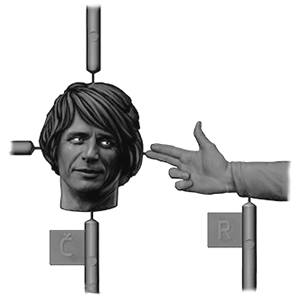
David Černý [chair-nee] (b. 1967) is a controversial Czech sculptor. He gained notoriety in 1991 by painting a Soviet tank pink, to serve as a war memorial in central Prague.
As the Monument to Soviet tank crews was still a national cultural monument at that time, his act of civil disobedience was considered ‘hooliganism’ and he was briefly arrested. Another of his conspicuous contributions to Prague is ‘Tower Babies,’ a series of cast figures of crawling infants attached to Žižkov Television Tower. For the 2012 Summer Olympics Černý created ‘London Booster’ – a double decker bus with mechanical arms for doing push-ups.
read more »
Posted in Art, Humor, Money |
Leave a Comment »
March 9, 2013
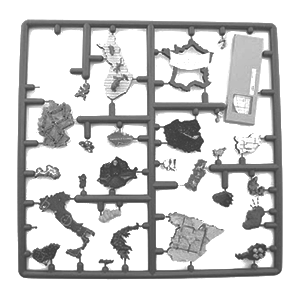
‘Entropa‘ is a 2009 sculpture by Czech artist David Černý. The project was commissioned by the Czech Republic to mark the occasion of its presidency of the Council of the European Union, and was originally designed as a collaboration for 27 artists and artist groups from all member countries of the European Union.
However, as a hoax, Černý and three of his assistants created a satirical and controversial piece that depicted pointed stereotypes of the EU member nations. Fake artist profiles were also created by Černý and his accomplices, complete with invented descriptions of their supposed contributions. The sculpture was originally on display in the Justus Lipsius building in Brussels.
read more »
Posted in Art, Humor, World |
Leave a Comment »
March 7, 2013

The Style Invitational, or Invite, is a long-running humor contest that ran first in the Style section of the Sunday ‘Washington Post’ before moving to Saturday’s Style and later returning to the Sunday paper. Started in 1993, it has run weekly, except for a hiatus in late 1999. In that time, it has had two anonymous head judges who select winning entries: ‘The Czar’ abdicated in late 2003, leaving the contest in the hands of his former associate, ‘The Empress.’
The humor ranges from an intellectual vein to a less mature style, and frequently touches on sophisticated political or historical allusions. While the contest theme changes every week, some popular contests are periodically repeated. The S.I. has a loyal following of self-proclaimed ‘Losers,’ who refer to having a contest entry published as ‘getting ink.’
read more »
Posted in Games, Humor, Language |
1 Comment »
March 7, 2013
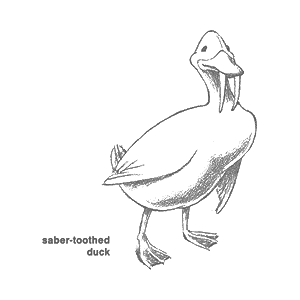
‘Science Made Stupid: How to Discomprehend the World Around Us’ is a book written and illustrated by Tom Weller in 1985. The winner of the 1986 Hugo Award for Best Non-Fiction Book, it is a parody of a junior high or high school-level science textbook. Though currently out-of-print, high-resolution scans are available online, as well as an abridged transcription, both of which have been endorsed by Weller.
Highlights of the book include a satirical account of the creationism vs. evolution debate and Weller’s drawings of fictional prehistoric animals (e.g., the duck-billed mastodon.) Weller released a companion volume, ‘Culture Made Stupid’ (also spelled ‘Cvltvre Made Stvpid’), which satirizes literature and the humanities.
Posted in Education, Humor, Science |
1 Comment »
March 5, 2013
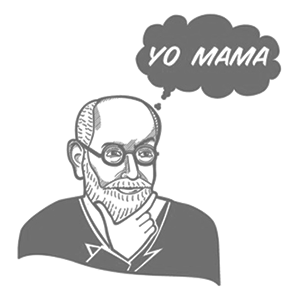
Sigmund Freud noticed that humor, like dreams, can be related to unconscious content. In the 1905 book ‘The Joke and Its Relation to The Unconscious,’ as well as in the 1928 journal article ‘Humor,’ Freud distinguished contentious jokes from non-contentious or silly humor. In fact, he sorted humor into three categories that could be translated as: joke, comic, and mimetic (imitation).
In Freud’s view, jokes (the verbal and interpersonal form of humor) happened when the conscious allowed the expression of thoughts that society usually suppressed or forbade. The superego (conscience) allowed the ego (self) to generate humor. A benevolent superego allowed a light and comforting type of humor, while a harsh superego created a biting and sarcastic type of humor. A very harsh superego suppressed humor altogether.
read more »
Posted in Health, Humor, Language |
Leave a Comment »


 The Daily Omnivore