February 19, 2013

Jejemon is a pop culture phenomenon in the Philippines. According to ‘Urban Dictionary,’ a Jejemon is a person ‘who has managed to subvert the English language to the point of incomprehensibility.’ ‘The Philippine Daily Inquirer’ describes Jejemons as a ‘new breed of hipster who have developed not only their own language and written text but also their own subculture and fashion.’ Short-hand typing was first popularized by text messaging (limited to 160 characters per text). As a result, an ‘SMS language’ developed in which words were shortened in order to fit the 160-character limit.
The Jejemons are said to be the new jologs, a term used for Filipinos of the lower income class. The sociolect of the Jejemons, called Jejenese, is derived from English, Filipino and their code-switched variant, Taglish. It has its own, albeit unofficial, orthography, known as Jejebet, which uses the Filipino variant of the Roman alphabet, Arabic numerals and other special characters. Words are created by rearranging letters in a word, alternating capitalization, with an over-usage of the letters H, X or Z, and silent letters. It has similarities with Leetspeak, primarily the alphanumeric nature of its writing.
Posted in Humor, Language, World |
Leave a Comment »
February 19, 2013


Jediism is a religion based on the philosophical and spiritual ideas of the Jedi as depicted in the science fiction film ‘Star Wars.’ It has no founder or central structure, but was the most selected ‘alternative faith’ in a census of England and Wales. Jediism became accepted as a religion following the Jedi census phenomenon in 2001 and the preceding email campaign to put ‘Jedi’ in answer to the census religion classification question.
The phenomenon attracted the attention of sociologist of religion Adam Possamai who analyzed it in the framework of what he dubs ‘hyper-real religion’ (religions inspired by popular culture). Jediism believers align themselves with the moral code demonstrated by the fictional Jedi. According to the Temple of the Jedi Order website, Jediism is a syncretistic religion, incorporating beliefs from various religious philosophies including Christianity, Sufism (Islam), Stoicism, Buddhism, Taoism, and Shintoism.
read more »
Posted in Humor, Philosophy |
Leave a Comment »
February 18, 2013

‘Harlem Shake‘ is a song recorded by American DJ and producer Baauer. It was released as a free digital download by Mad Decent imprint label Jeffree’s in 2012. The song incorporates samples of growling-lion sounds and Plastic Little’s 2001 song ‘Miller Time,’ specifically its line ‘then do the Harlem shake.’
In 2013, a user-submitted video set to ‘Harlem Shake’ became a viral hit on YouTube. The song features an undulating synth, harsh snares, and a mechanical bassline. It is categorized by Resident Advisor’s Andrew Ryce as a hip hop and bass song, while David Wagner of ‘The Atlantic’ describes its music as trap, a sub-genre with stylistic origins in EDM and Southern hip hop.
read more »
Posted in Art, Games, Humor |
Leave a Comment »
February 15, 2013

A hi-top fade is a style of haircut where hair on the sides is cut off or kept very short and hair on the top of the head is very long (in contrast, a low fade is when hair on the top is kept shorter). The hi-top has been a trend symbolizing the Golden Era of hip hop and urban contemporary music during the late 1980s and the early 1990s. The hi-top fade was common among young African Americans between 1986 to 1993 and to a lesser extent in the mid-1990s (1994-1996).
The style fell completely out of fashion by 1997, though it has slowly made a return in the public eye in the late 2000s. In the hip hop community throughout the mid-1980s, young African-Americans leaned towards Jheri curls or simple haircuts without tapers or fades of any sort.
read more »
Posted in Art, Humor |
Leave a Comment »
February 13, 2013

The Heart Attack Grill is an American hamburger restaurant in Las Vegas (formerly located in Chandler, Arizona). It has courted controversy by serving high-calorie menu items with deliberately provocative names coupled with waitresses in sexually provocative clothing. The establishment is a hospital theme restaurant: waitresses (‘nurses’) take orders (‘prescriptions’) from the customers (‘patients’).
A tag is wrapped on the patient’s wrist showing which foods they order and a ‘doctor’ examines the ‘patients’ with a stethoscope. The menu includes ‘Single,’ ‘Double,’ ‘Triple,’ and ‘Quadruple Bypass’ hamburgers, ranging from a half pound to two pounds of beef (up to about 8,000 calories), all-you-can-eat ‘Flatliner Fries’ (cooked in pure lard), beer and tequila (shots are served in four ounce novelty syringes.), ‘butter-fat Shakes,’ and soft drinks such as Jolt and Mexican-bottled Coca-Cola made with real sugar. Customers over 350 lb in weight eat for free if they weigh in with a doctor or nurse before each burger. Beverages and to-go orders are excluded and sharing food is also not allowed for the free food deal.
Posted in Food, Health, Humor |
1 Comment »
February 8, 2013
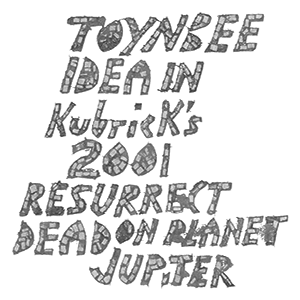
The Toynbee tiles are messages of unknown origin found embedded in asphalt of streets in about two dozen major cities in the United States and four South American capitals. Since the 1980s, several hundred tiles have been discovered. They are generally about the size of an American license plate (roughly 30 cm by 15 cm), but sometimes considerably larger. They contain some variation on the following inscription: ‘TOYNBEE IDEA, IN MOViE `2001, RESURRECT DEAD, ON PLANET JUPITER.’
Some of the more elaborate tiles also feature cryptic political statements or exhort readers to create and install similar tiles of their own. The material used for making the tiles was long a mystery, but evidence has emerged that they may be primarily made of layers of linoleum and asphalt crack-filling compound. Toynbee-tile enthusiasts believe that a native Philadelphian created the tiles because of the large number that appear in the city, their apparent age, and the variety of carving styles.
read more »
Posted in Humor |
Leave a Comment »
February 7, 2013
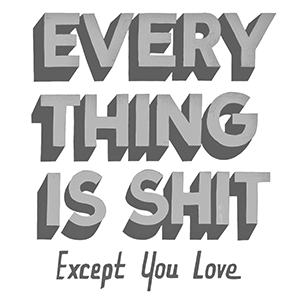
Sturgeon’s revelation, commonly referred to as Sturgeon’s law, is an adage commonly cited as ‘ninety percent of everything is crap.’ It is derived from quotations by Theodore Sturgeon, an American science fiction author.
The phrase was derived from Sturgeon’s observation that while science fiction was often derided for its low quality by critics, it could be noted that the majority of examples of works in other fields could equally be seen to be of low quality and that science fiction was thus no different in that regard to other art.
read more »
Posted in Humor, Language |
Leave a Comment »
February 6, 2013

Dan Hibiki is a video game character from Capcom’s ‘Street Fighter’ series of fighting games. Introduced in 1995 as a secret character in ‘Street Fighter Alpha,’ Dan is consistently portrayed as an arrogant, overconfident, yet utterly feeble character. Shortly after the release of ‘Street Fighter II’ in 1991, rival company SNK released their own fighting game, ‘Art of Fighting.’
The principal character of this series, Ryo Sakazaki, bore a resemblance in appearance and name to ‘Street Fighter’ mascots Ryu, as well as other aesthetic similarities to Ken, wearing an orange gi and sporting blonde hair. In humorous retaliation, ‘Street Fighter II’ co-designer Akiman drew an artwork of Sagat holding a defeated opponent by the head during the release of ‘Street Fighter II: Champion Edition.’ The defeated opponent wore an attire similar to Ryo’s: an orange karate gi with a torn black shirt underneath and geta sandals; but had long dark hair tied to a ponytail like Robert Garcia, another character from the ‘Art of Fighting’ series. This character design would become the basis of Dan.
read more »
Posted in Games, Humor |
Leave a Comment »
February 5, 2013
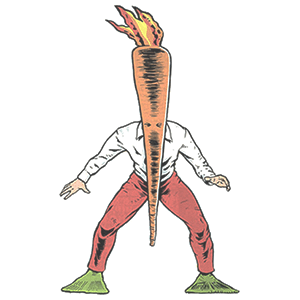
Flaming Carrot Comics is a comic book series by cartoonist Bob Burden. The title character first appeared in ‘Visions’ #1, a magazine published by the Atlanta Fantasy Fair in 1979. ‘Flaming Carrot’ can be seen as a parody of various aspects of the superhero genre (though his origin story is much the same as that of Don Quixote).
‘The Flaming Carrot’ origin states that ‘having read 5,000 comics in a single sitting to win a bet, this poor man suffered brain damage and appeared directly thereafter as — the Flaming Carrot!’ Carrot, who lives in Palookaville, a neighborhood of Iron City, has staved off at least three alien invasions, a Communist take over, flying dead dogs, the Man in the Moon, Death itself, and a cloned horde of evil marching Hitler’s boots. Possessing no real super powers, the Carrot wins the day through sheer grit, raw determination, blinding stupidity, and bizarre luck.
read more »
Posted in Art, Humor, Language |
Leave a Comment »
February 4, 2013
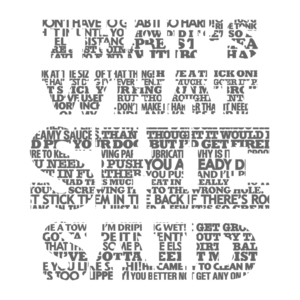
A double entendre is a figure of speech in which a spoken phrase is devised to be understood in either of two ways. Typically one of the interpretations is rather obvious whereas the other is more subtle. The more subtle of the interpretations may have a humorous, ironic, or risqué purpose. It may also convey a message that would be socially awkward, or even offensive, to state directly (the Oxford English Dictionary describes a double entendre as being used to ‘convey an indelicate meaning’).
A double entendre may exploit puns to convey the second meaning. Double entendres generally rely on multiple meanings of words, or different interpretations of the same primary meaning. They often exploit ambiguity and may be used to introduce it deliberately in a text. Sometimes a homophone (i.e. a different spelling that yields the same pronunciation) can be used as a pun as well as a ‘double entendre’ of the subject.
read more »
Posted in Humor, Language, Sex |
Leave a Comment »
February 4, 2013
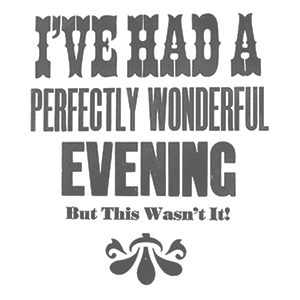
A paraprosdokian [par-uh-pros-doke-ee-uhn] is a figure of speech in which the latter part of a sentence or phrase is surprising or unexpected in a way that causes the reader or listener to reframe or reinterpret the first part. It is frequently used for humorous or dramatic effect, sometimes producing an anticlimax. For this reason, it is extremely popular among comedians and satirists. Some paraprosdokians not only change the meaning of an early phrase, but they also play on the double meaning of a particular word, creating a form of syllepsis.
‘Paraprosdokian’ comes from Greek for ‘against ‘expectation.’ Canadian linguist and etymology author William Gordon Casselman argues that, while the word is now in wide circulation, it is not a term of classical (or medieval) Greek or Latin rhetoric, but a late 20th century neologism. However, it occurs—with the same meaning—in Greek rhetorical writers of the 1st century BCE and the 1st and 2nd centuries CE.
Posted in Humor, Language |
2 Comments »
January 28, 2013

Mary Roach is an American author, specializing in popular science. She currently resides in Oakland, California. To date, she has published four books: ‘Stiff: The Curious Lives of Human Cadavers’ (2003), ‘Spook: Science Tackles the Afterlife’ (2005), ‘Bonk: The Curious Coupling of Science and Sex’ (2008) and ‘Packing for Mars: The Curious Science of Life in the Void’ (2010). Roach was raised in Etna, New Hampshire.
She received a bachelor’s degree in psychology from Wesleyan University in 1981. After college, Roach moved to San Francisco and spent a few years working as a freelance copy editor. She worked as a columnist, and also worked in public relations for a brief time. Her writing career began while working part-time at the San Francisco Zoological Society, producing press releases on topics such as elephant wart surgery.
read more »
Posted in Humor, Language, Science |
Leave a Comment »



