April 19, 2012

Dykes to Watch Out For (sometimes DTWOF) was a comic strip by Alison Bechdel, which ran from 1983 to 2008, and was one of the earliest ongoing representations of lesbians in popular culture and has been called ‘as important to new generations of lesbians as landmark novels like Rita Mae Brown’s ‘Rubyfruit Jungle’ (1973) and Lisa Alther’s ‘Kinflicks’ (1976) were to an earlier one.’
DTWOF chronicled the lives, loves, and politics of a fairly diverse group of characters (most of them lesbians) living in a medium-sized city in the United States, featuring both humorous soap opera storylines and biting topical commentary. The strip was carried in ‘Funny Times’ and a number of gay and lesbian newspapers. According to Bechdel, her strip was ‘half op-ed column and half endless, serialized Victorian novel.’ Characters reacted to contemporary events, including going to the Michigan Womyn’s Festival, Gay Pride parades, and protest marches and having heated discussions about day-to-day events, political issues and the way lesbian culture was changing.
Posted in Humor, Politics, Sex |
Leave a Comment »
April 19, 2012

Pornochanchada is the name given to a genre of sexploitation films produced in Brazil that was popular during the 1970s and early 1980s. ‘Chanchada’ means ‘light comedy’ in Portuguese. Pornochanchadas were initially produced in the downtown quarter of São Paulo that was nicknamed ‘Boca do Lixo’ (‘Garbage Mouth’). The genre was usually seen as a part of low-budget films produced there, collectively known as ‘cinema da Boca’ (‘movies of the Mouth’).
Later, there were productions in Rio de Janeiro as well, creating the sub-genre ‘pornochanchada carioca,’ which was to find its star in Alba Valeria during early 1980s. Pornochanchadas were generally in line with ‘sex comedies’ produced in other countries, but also featured some Brazilian peculiarities. Despite conditions of strict censorship in Brazil in that era, the state-run film company Embrafilme was generally eager to support pornochanchadas, because they weren’t critical of the government and did not depict explicit sex.
Posted in Humor, Sex, World |
Leave a Comment »
April 19, 2012

Bavarian porn is a campy subgenre of softcore porn comedy. The apogee of the genre was the late 1960s and early 1970s, corresponding roughly to the chancellorship of Willy Brandt, but these films continued to be produced up to about 1980. Today they live on as staples of late night European cable and satellite channels. Alois Brummer was the producer of many of these films.
After some ‘Report’ movies (so-called documentaries about ‘German housewifes’ or ‘schools for girls,’ as a reaction to serious documentaries about sexual items in Germany’s late 60’s) he became produced a number of films, which were mainly situated in the Alpes. Director Franz Marischka got the idea from a newspaper article in 1972 about wealthy female tourists in Bavaria who tried to seduce local young men or the landlord of the inn where they were staying.
read more »
Posted in Humor, Sex, World |
Leave a Comment »
April 18, 2012

Keep Austin Weird is the slogan adopted by the Austin Independent Business Alliance to promote small businesses in Austin, Texas. The phrase has long been believed to have been coined in 2000 by Red Wassenich, who says he made the comment after giving a pledge to an Austin radio station. He later began printing bumper stickers, and now operates the website keepaustinweird.com and published ‘Keep Austin Weird: A Guide to the Odd Side of Town.’ Despite a challenge from Wassenich, the slogan was later trademarked by Outhouse Designs and used to market T-shirts, hats, and mugs. A recently released book on the topic, ‘Weird City,’ discusses the cultural evolution of the movement as well as its commercialization and socio-political significance.
Austin is the self-proclaimed ‘live music capital of the world’ and the people of Austin reflect a friendly, accepting culture of artistic and individual expression that maintains the city as a vibrant and eclectic creative center and haven for an LGBT community, intellectual community, community of naturalists and environmentalists, and for subcultures and people(s) who are not mainstream. In a mostly conservative Texas, Austin is ‘Weird’ because of that and because it continues to be liberal and progressive politically, socially, in culture, in the arts and in music, among other things. ‘Keep Austin Weird’ moves beyond a mere slogan, to reflect the dynamics that encompass Austin.
Posted in Humor, Money, Politics |
Leave a Comment »
April 16, 2012

The Residents are an American art collective best known for avant-garde music and multimedia works. The first official release under the name of The Residents was in 1972, and the group has since released over sixty albums, numerous music videos and short films, three CD-ROM projects and ten DVDs. They have undertaken seven major world tours and scored multiple films. Throughout the group’s existence, the individual members have ostensibly attempted to operate under anonymity, preferring instead to have attention focused on their art output.
Much outside speculation and rumor has focused on this aspect of the group. In public, the group appears silent and costumed, often wearing eyeball helmets, top hats and tuxedos – a long-lasting costume now recognized as their signature iconography. Their albums generally fall into two categories: deconstructions of Western popular music, or complex conceptual pieces, composed around a theme, theory or plot. They are noted for surrealistic lyrics and sound, disregard for conventional music composition, and the over the top, theatrical spectacle of their live performances.
read more »
Posted in Art, Humor |
Leave a Comment »
April 10, 2012

Dr. Horrible’s Sing-Along Blog is a 2008 musical tragicomedy miniseries in three acts, produced exclusively for Internet distribution. Filmed and set in Los Angeles, the show tells the story of Dr. Horrible (played by Neil Patrick Harris), an aspiring supervillain; Captain Hammer (Nathan Fillion), his nemesis; and Penny (Felicia Day), their shared love interest.
The movie was written by writer/director Joss Whedon, his brothers Zack Whedon (a television writer) and Jed Whedon (a composer), and Jed’s wife, actress Maurissa Tancharoen. The team wrote the musical during the 2007–2008 Writers Guild of America strike. The idea was to create something small and inexpensive, yet professionally done, in a way that would circumvent the issues that were being protested during the strike.
Posted in Art, Humor, Money |
1 Comment »
April 10, 2012

The Second City is an improvisational comedy enterprise which originated in Chicago’s Old Town neighborhood. The Second City Theatre opened in late 1959 and has since expanded its presence to several other cities, including Toronto and Los Angeles.
The Second City has produced television programs in both the United States and Canada including ‘SCTV,’ ‘Second City Presents’, and ‘Next Comedy Legend,’ as well as being heavily involved in the creation of the satirical 1969 science fiction film ‘The Monitors.’ Since its debut, the Second City has consistently been a starting point for comedians, award winning actors, directors, and others in show business.
read more »
Posted in Art, Games, Humor |
Leave a Comment »
April 10, 2012

The Compass Players (or Compass Theater) was a cabaret revue show started by alumni, dropouts and hangers-on from the University of Chicago from 1955-1958 in Chicago and St. Louis. Several of the members went on to form The Second City Theater in 1959. Founded by David Shepherd, the original idea was to produce a new play derived through improvisation from outlines (in the tradition of the Italian commedia dell’arte) or scenarios written by members of the ensemble.
Shepherd turned to director Paul Sills to head this venture based on his experience working with Sills on an earlier Chicago theater effort. He noticed that Sills in rehearsal employed theater games, structures designed to create spontaneous theatrical play between actors that had been developed and named by Sills’ mother, Viola Spolin (who would later author the ‘bible’ of theater games, ‘Improvisation for the Theatre’).
read more »
Posted in Art, Games, Humor |
Leave a Comment »
April 10, 2012
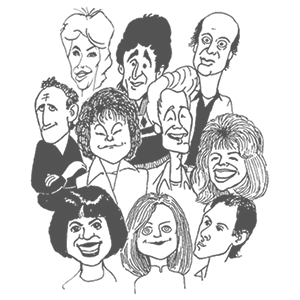
Viola Spolin (1906 — 1994) was an important innovator of the American theater in the 20th century. She created directorial techniques to help actors to be focused in the present moment and to find choices improvisationally, as if in real life. These acting exercises she later called ‘Theater Games’ and formed the first body of work that enabled other directors and actors to create improvisational theater.
Her book, ‘Improvisation for the Theater,’ which published these techniques, includes her philosophy, as well as her teaching and coaching methods and is considered the ‘bible of improvisational theater.’ Spolin’s contributions were seminal to the improvisational theater movement in the U.S. She is considered to be the mother of Improvisational theater. Her work has influenced American theater, television and film by providing new tools and techniques that are now used by actors, directors and writers.
read more »
Posted in Art, Games, Humor |
Leave a Comment »
April 10, 2012


The Groundlings are an improvisational comedy troupe based in Los Angeles formed by Gary Austin in 1974. It uses an improv format influenced by Viola Spolin to produce sketches and improvised scenes. Its name is taken from ‘Hamlet’: ‘…to split the ears of the groundlings, who for the most part are capable of nothing but inexplicable dumbshows and noise.’ The Groundlings School holds new sessions every six weeks with over 300 students per session, with over 2,000 students per year going through the program. The competitive program consists of 4 levels (Basic, Intermediate, Writing Lab and Advanced).
Participants must be successfully advanced from each level by the instructor. After completing the Advanced level, one may be voted into the Sunday Company, which performs every Sunday at 7:30pm. Members of the Main Company are selected from members of the Sunday Company. The Main Company (now capped at no more than 30 members at any time) collectively acts as the organization’s artistic director, democratically making business and creative decisions as a group. Notable alumni include: Adam Carolla, Abby Elliott, Jimmy Fallon, Will Ferrell, Will Forte, Ana Gasteyer, Kathy Griffin, Rachael Harris, Phil Hartman, Cheryl Hines, Chris Kattan, Lisa Kudrow, Jon Lovitz, Pat Morita, Conan O’Brien, Cheri Oteri, Paul Reubens, Maya Rudolph, Dax Shepard, and Kristen Wiig.
Posted in Art, Humor, Language |
Leave a Comment »
April 6, 2012

Squidward Tentacles is a fictional character on the television cartoon series ‘SpongeBob SquarePants.’ He is voiced by Rodger Bumpass. Squidward appears in 270 episodes of the series, second only to SpongeBob’s 305. Unlike most characters in the series, Squidward is generally grumpy, tactless, short-tempered, sarcastic, and narcissistic. He dislikes many things, including his consistently annoying neighbors SpongeBob and Patrick, his job at the Krusty Krab, and is constantly aloof towards the citizens of Bikini Bottom. He is very open about his dissatisfaction with his job, and has frequently displayed unprofessional behavior such as sleeping at his counter, failing to clean his workplace, and reading art magazines instead of attending to customers.
Squidward enjoys playing his clarinet (at an elementary level with frequent missed notes and poor intonation, though Squidward considers himself a brilliant musical prodigy), modern dance, abstract art, relaxing, public radio, select television programs, and just about anything else that he considers ‘fancy.’ He does not like anyone, except his mother. Although Squidward likes to consider himself as above the mundane and often immature activities of his peers, he has constantly exhibited an unhealthy obsession with and dedication to such activities when exposed to them.
Posted in Art, Humor |
Leave a Comment »
April 6, 2012
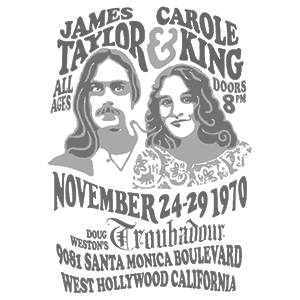
The Troubadour is a nightclub located in West Hollywood, founded in 1957 by Doug Weston. It was a major center for folk music in the 1960s, and subsequently for singer-songwriters and rock.
The Troubadour played an important role in the careers of Elton John, Linda Ronstadt, Hoyt Axton, the Eagles, The Byrds, Joni Mitchell, James Taylor, Carole King, Bonnie Raitt, J.D. Souther, Jackson Browne, Van Morrison, Buffalo Springfield and other prominent and successful performers, who played performances there establishing their future fame.
read more »
Posted in Art, Humor, Money |
Leave a Comment »



