February 6, 2012
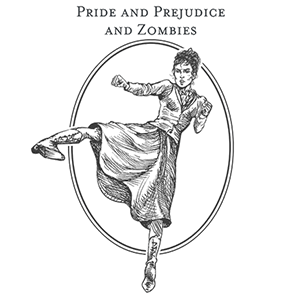
A mashup novel is a work of fiction which combines a pre-existing text, often a classic work of fiction, with a certain popular genre such as vampire or zombie narratives. ‘Pride and Prejudice and Zombies,’ which combines Jane Austen’s classic novel ‘Pride and Prejudice’ with elements of modern zombie fiction, is arguably the first, and certainly one of the most famous and successful works in the genre, and has been credited with spawning a rash of imitations. The term ‘Mashup’ was borrowed from the world of computers and music. Mashup books are seen as distinct from parody novels like ‘Bored of the Rings,’ and parallel novels like ‘The Wind Done Gone’ or ‘Wicked’ since they do not merely make fun of the original text, or tell an alternative version of it, but also introduce the themes and characteristics of a wholly different genre.
While most works in this genre (or cross-genre trend) rely on fictional texts as their basis, other works like ‘Abraham Lincoln, Vampire Hunter’ superimpose the popular genres over historical figures and events. A more recent phenomenon within the genre is the combination of more than two original works, or genres, as in the case of ‘Robinson Crusoe (The Eerie Adventures of the Lycanthrope),’ which combines the original novel with elements borrowed from the works of H.P. Lovecraft as well as the popular genre of werewolf fiction, and is accordingly attributed to three authors – Daniel Defoe, H.P. Lovecraft, and Peter Clines.
Posted in Art, Humor, Language |
Leave a Comment »
February 3, 2012
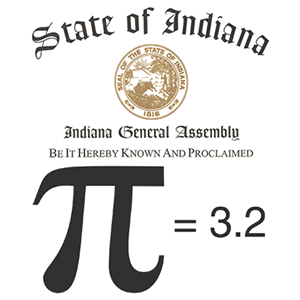
The Indiana Pi Bill is the popular name for bill #246 of the 1897 sitting of the Indiana General Assembly, one of the most famous attempts to establish scientific truth by legislative fiat. Despite that name, the main result claimed by the bill is a method to square the circle, rather than to establish a certain value for the mathematical constant π (pi), the ratio of the circumference of a circle to its diameter. However, the bill does contain text that appears to dictate various incorrect values of π, such as 3.2.
The bill never became law, due to the intervention of a mathematics professor who happened to be present in the legislature. The impossibility of squaring the circle using only compass and straightedge, suspected since ancient times, was rigorously proved in 1882 by Ferdinand von Lindemann. Better approximations of π than those inferred from the bill have been known since ancient times.
read more »
Posted in Humor, Politics, Science |
1 Comment »
February 2, 2012
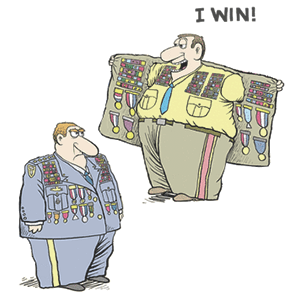
One-upmanship is the art or practice of successively outdoing a competitor. The term originated as the title of a book by Stephen Potter, published in 1952 as a follow-up to ‘The Theory and Practice of Gamesmanship (or the Art of Winning Games without Actually Cheating)’ (1947) and ‘Lifemanship’ titles in his series of tongue-in-cheek self-help books, and film and television derivatives, that teach various ‘ploys’ to achieve this. In that context, the term refers to a satiric course in the gambits required for the systematic and conscious practice of ‘creative intimidation,’ making one’s associates feel inferior and thereby gaining the status of being ‘one-up’ on them.
This satire of self-help style guides manipulates traditional stuffy British conventions for the gamester, all life being a game, who understands that if you’re not one-up, you’re one-down. Potter’s unprincipled principles apply to almost any possession, experience or situation, deriving maximum undeserved rewards and discomforting the opposition. Viewed seriously, it is a phenomenon of group dynamics that can have significant effects in the management field: for instance, manifesting in office politics. The term has been extended to a generic, often punning, extension upmanship used for any assertion of superiority: for instance, Native Upmanship.
Posted in Games, Humor |
1 Comment »
January 31, 2012
15 minutes of fame is short-lived, often ephemeral, media publicity or celebrity of an individual or phenomenon. The expression was coined by Andy Warhol, who said in 1968 that ‘In the future, everyone will be world-famous for 15 minutes.’ The phenomenon is often used in reference to figures in the entertainment industry or other areas of popular culture, such as reality TV and YouTube. It is believed that the statement was an adaption of a theory of Marshall McLuhan, explaining the differences of media, where TV differs much from other media using contestants.
The expression is a paraphrase of a line in Warhol’s catalog for a 1968 exhibit at the Moderna Museet in Stockholm. In 1979 Warhol reiterated his claim, ‘…my prediction from the sixties finally came true: In the future everyone will be famous for 15 minutes.’ Becoming bored with continually being asked about this particular statement, Warhol attempted to confuse interviewers by changing the statement variously to ‘In the future 15 people will be famous’ and ‘In 15 minutes everybody will be famous.’
read more »
Posted in Art, Humor, Language |
Leave a Comment »
January 30, 2012

The walk of shame refers to where a person must walk past strangers or peers alone for an embarrassing reason before reaching a place of privacy. Most commonly, it occurs the morning after a night out at a bar, dance club, or party.
People undertaking the walk of shame are understood to have spent the night at the house, apartment, or dorm of a sexual partner (or perceived sexual partner), particularly a one night stand. The topic is often the subject of college newspaper commentary. The ‘walker’ may often be identified by his or her disheveled appearance and incongruous evening attire, particularly on Saturday or Sunday mornings.
Posted in Humor, Sex |
1 Comment »
January 24, 2012

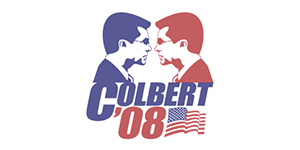
Americans for a Better Tomorrow, Tomorrow (also known as the Colbert Super PAC) is a United States political action committee (PAC) established by Stephen Colbert, who portrays a conservative political pundit on the television series ‘The Colbert Report.’ As a super PAC the organization can raise unlimited sums of money from corporations, unions and other groups, as well as wealthy individuals. Speaking in character, Colbert said the money will be raised not only for political ads, but also ‘normal administrative expenses, including but not limited to, luxury hotel stays, private jet travel, and PAC mementos from Saks Fifth Avenue and Neiman Marcus.’
During the January 12, 2012 episode of The Colbert Report, Colbert announced his plans to form an exploratory committee to lay the groundwork for his possible candidacy for ‘President of the United States of South Carolina.’ In the process, he transferred control of the Super PAC to Jon Stewart, renaming it The Definitely Not Coordinating With Stephen Colbert Super PAC.
read more »
Posted in Humor, Money, Politics |
Leave a Comment »
January 19, 2012
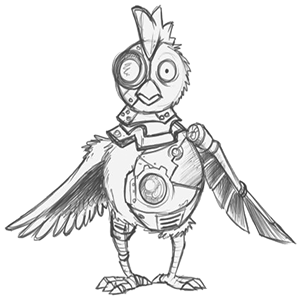
Astrochicken is the name given to a thought experiment expounded by theoretical physicist Freeman Dyson. In his book ‘Disturbing the Universe’ (1979), Dyson contemplated how humanity could build a small, self-replicating automaton that could explore space more efficiently than a manned craft could. He attributed the idea to John von Neumann, based on a lecture von Neumann gave in 1948 entitled ‘The General and Logical Theory of Automata.’ Dyson expanded on von Neumann’s automata theories and added a biological component to them.
Astrochicken, Dyson explained, would be a one-kilogram spacecraft unlike any before it. It would be a creation of the intersection of biology, artificial intelligence and modern microelectronics—a blend of organic and electronic components. Astrochicken would be launched by a conventional spacecraft, like an egg being laid into space.
read more »
Posted in Humor, Language, Technology |
Leave a Comment »
January 16, 2012


‘Slaughterhouse-Five, or The Children’s Crusade: A Duty-Dance with Death’ is a 1969 satirical novel by Kurt Vonnegut about World War II experiences and journeys through time of a soldier called Billy Pilgrim.
The work is also known under the lengthy title: ‘Slaughterhouse-Five, or The Children’s Crusade: A Duty Dance with Death, by Kurt Vonnegut, a Fourth-Generation German-American Now Living in Easy Circumstances on Cape Cod [and Smoking Too Much], Who, as an American Infantry Scout Hors de Combat, as a Prisoner of War, Witnessed the Fire Bombing of Dresden, Germany, ‘The Florence of the Elbe,’ a Long Time Ago, and Survived to Tell the Tale. This Is a Novel Somewhat in the Telegraphic Schizophrenic Manner of Tales of the Planet Tralfamadore, Where the Flying Saucers Come From. Peace.’
read more »
Posted in Humor, Language, War |
Leave a Comment »
January 15, 2012
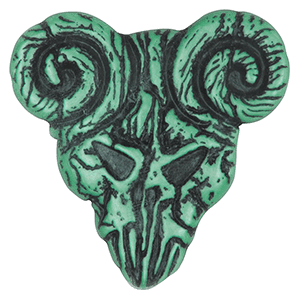
Tenacious D is an American rock band that was formed in Los Angeles in 1994. Composed of lead vocalist and guitarist Jack Black and lead guitarist and vocalist Kyle Gass, the band has released two albums – ‘Tenacious D’ (2001) and ‘The Pick of Destiny’ (2006). The band’s studio releases and live performances feature a full band lineup, including such musicians as guitarist John Konesky, bassist John Spiker and Bad Religion drummer Brooks Wackerman.
The band originally performed as an acoustic duo, which gained popularity in 1999 when they starred in their eponymous television series and began to support large rock acts. Tenacious D’s music showcases Black’s theatrical vocal delivery and Gass’s acoustic guitar playing abilities. Critics have described their fusion of vulgar absurdist comedy with rock music as ‘mock rock.’ Their songs discuss the duo’s purported musical and sexual prowess, as well as their friendship and cannabis usage in a style that music critics have compared with the storyteller-style lyrics of rock opera.
read more »
Posted in Art, Humor |
Leave a Comment »
January 15, 2012
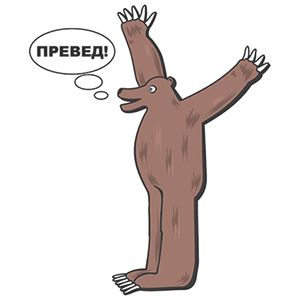
Preved is a term used in Russian Internet slang (Padonkaffsky jargon); it is a meme which developed out of a heavily-circulated picture, and consists of choosing alternative spellings for words for comic effect. The picture, a modified version of John Lurie’s watercolor ‘Bear Surprise,’ features a man and a woman having sex in the clearing of a forest, being surprised by a bear calling ‘Surprise!’ with its paws raised. In later Russian adaptations, the bear shouts ‘Preved!’ (a deliberate misspelling of ‘privet,’ ‘hi!’).
The word and the bear image have found their way into the mainstream mass media, such as a poster for the Russian edition of ‘Newsweek.’ In 2006 at an online conference, Vladimir Putin was asked: ‘PREVED, Vladimir Vladimirovich! How do you regard MEDVED?’ No answer was given, but the Associated Press, informing on the questions collection process, reportedly interpreted it as a reference to then-vice-prime-minister Dmitry Medvedev. It was the most popular question asked at the conference (the third most popular question was ‘How does one patch KDE2 under FreeBSD?’).
Posted in Humor, Sex, World |
Leave a Comment »
January 12, 2012

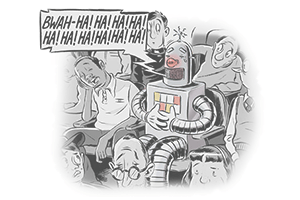
A claque [klak] (French for ‘clap’) is an organized body of professional applauders in French theatres and opera houses. Members of a claque are called ‘claqueurs.’
Hiring people to applaud dramatic performances was common in classical times. For example, when the emperor Nero acted, he had his performance greeted by an encomium (speech of praise) chanted by five thousand of his soldiers. This inspired the 16th-century French poet Jean Daurat to develop the modern claque. Buying a number of tickets for a performance of one of his plays, he gave them away in return for a promise of applause.
read more »
Posted in Art, Humor, Money |
1 Comment »
January 12, 2012

A peanut gallery is an audience that heckles the performer. The term originated in the days of vaudeville (1880s) as a nickname for the cheapest (and ostensibly rowdiest) seats in the theater; the least expensive snack served at the theater would often be peanuts, which the patrons would sometimes throw at the performers on stage to show their disapproval.
The phrases ‘no comments from the peanut gallery’ or ‘quiet in the peanut gallery’ are extensions of the name. ‘Peanut gallery’ may also refer to a social network audience that passively observes a syndicated web feed.
read more »
Posted in Humor, Language, Money |
Leave a Comment »


 The Daily Omnivore