February 29, 2012
Wim Delvoye (b. 1965) is a Belgian neo-conceptual artist known for his inventive and often shocking projects. Much of his work is focused on the body. He repeatedly links the attractive with the repulsive, creating work that holds within it inherent contradictions. He has an eclectic oeuvre, exposing his interest in a range of themes, from bodily function, to the Catholic Church, and numerous subjects in between.
Though Delvoye started tattooing pig skins taken from slaughterhouses in the United States in 1992, he began to tattoo live pigs in 1997. He ultimately moved the operation to an Art Farm in China in 2004 where restrictions regarding animal welfare were less strict. The pigs have been inked with a diverse array of designs, including the trivial, such as skulls and crosses, to Louis Vuitton designs, to designs dictated by the pig’s anatomy. Delvoye described the process of tattooing a live pig, ‘we sedate it, shave it and apply Vaseline to its skin.’ As another manifestation of contradiction in Delvoye’s art, he owns a pig farm though he is a practicing vegetarian.
Posted in Art, Humor |
Leave a Comment »
February 27, 2012
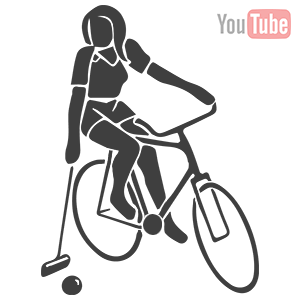
Cycle polo is a team sport invented in Ireland in 1891 by retired cyclist Richard J. Mecredy. It is similar to traditional polo, except that bicycles are used instead of horses. In recent years, an alternate form of the game known as ‘Hardcourt Bike Polo’ or ‘Urban Bike Polo’ has grown in popularity. In this variation, teams composed of three to five players compete on tennis courts, street hockey rinks, or whatever other surfaces are available.
The rules vary slightly by city. In the case of a ‘foot down’ or ‘dab’ (touching the ground with one’s foot) the player must ‘tap out’ by riding to mid-court and hitting a designated area with their mallet. There is usually a tap-out located on either side of the court. In order to score, the offensive player must hit the ball across the goal line using the narrow end of the mallet – this is called a ‘shot’ or ‘hit’ – hitting the ball across the goal line with the wide end of the mallet is called a ‘shuffle.’
Posted in Games, Humor |
Leave a Comment »
February 27, 2012
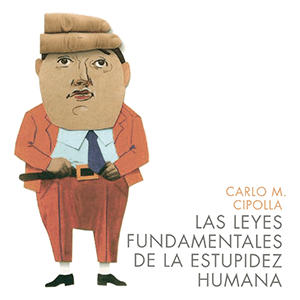
Stupidity is a lack of intelligence, understanding, reason, wit, or sense. It may be innate, assumed, or reactive – ‘being ‘stupid with grief’ as a defence against trauma,’ a state marked with ‘grief and despair…making even simple daily tasks a hardship.’ The root word ‘stupid,’ which can serve as an adjective or noun, comes from the Latin verb ‘stupere,’ for ‘being numb’ or ‘astonished,’ and is related to ‘stupor’ (in Roman culture ”the stupidus of the mimes’ was a sort of professional buffoon – the ‘fall-man,’ the eternal he-who-gets-kicked.’ The word entered the English language in the 16th century; since then, stupidity has become a pejorative appellation for human misdeeds, whether purposeful or accidental, due to absence of mental capacity.
The modern English word ‘stupid’ has a broad range of application, from being slow of mind (indicating a lack of intelligence, care or reason), dullness of feeling or sensation (torpidity, senseless, insensitivity), or lacking interest or point (vexing, exasperating). It can either infer a congenital lack of capacity for reasoning, or a temporary state of daze or slow-mindedness.
read more »
Posted in Education, Health, Humor |
Leave a Comment »
February 23, 2012
Jewish humor is self-deprecating, crude, and often anecdotal humor originating in Eastern Europe, which took root in the United States over the last hundred years. Beginning with vaudeville, and continuing through radio, stand-up comedy, film, and television, a disproportionately high percentage of American and Russian comedians have been Jewish.
Jewish humor is rooted in several traditions. The first is the intellectual and legal methods of the Talmud, which uses elaborate arguments and situations often seen as so absurd as to be humorous in order to tease out the meaning of religious law. There is an egalitarian tradition among the Jewish communities of Eastern Europe in which the powerful were often mocked subtly, rather than attacked overtly—as Saul Bellow once put it, ‘oppressed people tend to be witty.’ Jesters known as badchens used to poke fun at prominent members of the community during weddings, creating a good-natured tradition of humor as a levelling device.
read more »
Posted in Humor, Philosophy, Politics |
1 Comment »
February 22, 2012
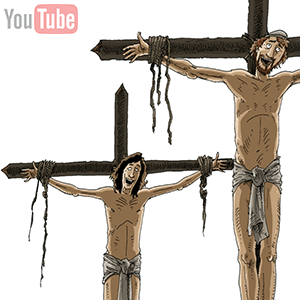
Gallows humor is a type of humor that still manages to be funny in the face of, and in response to, a hopeless situation. It arises from stressful, traumatic, or life-threatening situations, often in circumstances such that death is perceived as impending and unavoidable. The genre developed in Central Europe, and then moved to the US as part of Jewish humor. Gallows humor is offered by the person affected by the dramatic situation, an aspect that is missing in the derivative called black comedy. It is rendered with the German expression ‘Galgenhumor,’ and is comparable to the French ‘rire jaune’ (‘sickly smile’), and the Belgian Dutch ‘groen lachen’ (‘laugh desperately’). Italian comedian Daniele Luttazzi discussed gallows humor focusing on the particular type of laughter that it arouses, and said that grotesque satire, as opposed to ironic satire, is the one that most often arouses this kind of laughter.
In the Weimar era Kabaretts, this genre was particularly common; Karl Valentin and Karl Kraus were the major masters of it. Sigmund Freud in his 1927 essay ‘Humour (Der Humor)’ puts forth the following theory of the gallows humor: ‘The ego refuses to be distressed by the provocations of reality, to let itself be compelled to suffer. It insists that it cannot be affected by the traumas of the external world; it shows, in fact, that such traumas are no more than occasions for it to gain pleasure.’ Gallows humor has the social effect of strengthening the morale of the oppressed and undermines the morale of the oppressors. ‘To be able to laugh at evil and error means we have surmounted them.’
Posted in Death, Humor, Language |
Leave a Comment »
February 22, 2012

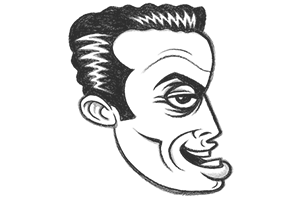
Blue comedy is comedy that is off-color, risqué, indecent or profane, largely about sex. It often contains profanity and/or sexual imagery that may shock and offend some audience members. ‘Working blue’ refers to the act of performing this type of material. A ‘blue comedian’ or ‘blue comic’ is a comedian who usually performs blue, or is known mainly for his or her blue material. Blue comedians often find it difficult to succeed in mainstream media.
Many comedians who are normally family-friendly might choose to work blue when off-camera or in an adult-oriented environment; Bob Saget exemplifies this dichotomy. A recording survives of one Masquers roast from the 1950s with Jack Benny, George Jessel, George Burns, and Art Linkletter all using highly risque material and, in some cases, obscenities. In the 1970s, CBS aired the ground-breaking sitcom ‘All in the Family,’ based on the British series ‘Till Death Us Do Part,’ which featured a ‘lovable’ bigot, Archie Bunker. The character’s dialogue usually contained racial prejudices and ethnic slurs, as well as derogatory comments against Jews, gays and women’s rights, but in a guise of blue humor against his own bigotry.
Posted in Humor, Politics, Sex |
1 Comment »
February 22, 2012
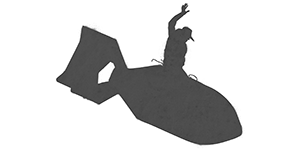

A black comedy is a comic work that employs black humor or gallows humor. The definition of black humor is problematic; it has been argued that it corresponds to the earlier concept of gallows humor (humor that still manages to be funny in the face of, and in response to, a hopeless situation); and that, as humor has been defined since Freud as a comedic act that anesthetizes an emotion, all humor is ‘black humor.’ The term ‘black humor’ (from the French ‘humour noir’) was coined by the Surrealist theoretician André Breton in 1935, to designate a sub-genre of comedy and satire in which laughter arises from cynicism and skepticism, often relying on topics such as death.
In black humor, topics and events that are usually regarded as taboo, specifically those related to death, are treated in an unusually humorous or satirical manner while retaining their seriousness; the intent of black comedy, therefore, is often for the audience to experience both laughter and discomfort, sometimes simultaneously.
read more »
Posted in Humor, Language, War |
Leave a Comment »
February 21, 2012

Everybody Draw Mohammed Day was an event held on 20 May 2010 in support of free speech and freedom of artistic expression of those threatened by violence for drawing representations of the Islamic Prophet Muhammad. It began as a protest against censorship of an American television show, ‘South Park,’ ‘201’ by its distributor, Comedy Central, in response to death threats against some of those responsible for two segments broadcast in April. Observance of the day began with a drawing posted on the Internet on April 20, 2010, accompanied by text suggesting that ‘everybody’ create a drawing representing Muhammad, on May 20, 2010, as a protest against efforts to limit freedom of speech. U.S. cartoonist Molly Norris of Seattle created the artwork. Depictions of Muhammad are explicitly forbidden by a few hadiths (sayings of and about Muhammad), though not by the Qur’an.
South Park episodes ‘200’ and ‘201,’ broadcast in April 2010, featured a character in a bear costume, who various other characters stated was Muhammad. The ‘South Park’ episode sparked statements from the extremist website Revolution Muslim, which posted a picture of the partially decapitated body of the Dutch filmmaker, Theo van Gogh, with a statement declaring that Parker and Stone could meet a similar fate. Comedy Central self-censored the episode when it was broadcast by removing the word ‘Muhammad’ and a speech about intimidation and fear from the episode.
Posted in Humor, Philosophy, Politics |
1 Comment »
February 20, 2012
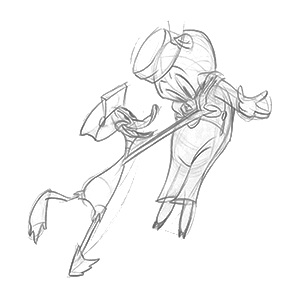
Baby Bottleneck is a 1945 Warner Brothers Looney Tunes theatrical cartoon short released in 1946 and directed by Bob Clampett and written by Warren Foster. In the short, there is a baby boom in the postwar US; an overworked stork (a clear Jimmy Durante reference) gets drunk in the ‘Stork Klub.’ A mix up results in babies getting sent to the wrong parents (such as a baby Hippopotamus to a Scottish Terrier).
To clear up the confusion, Porky Pig is brought in to manage the factory, with Daffy Duck as his assistant. The babies are seen going through a conveyor belt (to the tune of Raymond Scott’s famous ‘Powerhouse’) and getting sent by various animals, while Daffy mans the phones, making quick references to Bing Crosby, Eddie Cantor, and the Dionne Quintuplets.
read more »
Posted in Art, Humor |
Leave a Comment »
February 20, 2012


The Ren & Stimpy Show, often simply referred to as Ren & Stimpy, is an American animated television series, created by Canadian animator John Kricfalusi for Nickelodeon. The series focuses on the titular characters: Ren Höek, a psychotic chihuahua, and Stimpson J. Cat, a good-natured, dimwitted cat. The show premiered in 1991, on the same day as the debut of ‘Rugrats’ and ‘Doug,’ the three of which comprised the original Nicktoons. The show ran for five seasons on the network.
Throughout its run, the show was controversial for its off-color humor, black comedy, toilet humor, sexual innuendo, and violence, all of which contributed to the production staff’s altercations with Nickelodeon’s Standards and Practices department. The show developed a cult following during and after its run. It was pioneering for satirical animated shows like ‘Beavis and Butt-head’ and ‘South Park.’
read more »
Posted in Art, Humor, Money |
1 Comment »
February 20, 2012
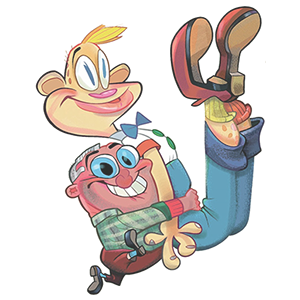
George Liquor (often taking his epithet as George Liquor, American), most famous for his appearances on ‘The Ren and Stimpy Show,’ is a cartoon character created by John Kricfalusi and is a mascot for Kricfalusi’s defunct animation studio, Spümcø. Kricfalusi portrayed George Liquor as a patriotic, outspoken, politically conservative blowhard. Kricfalusi described Liquor as his favorite character to animate.
Kricfalusi described George Liquor as ‘the greatest American’ who is so conservative ‘that he thinks the Republicans are Commies.’ George harbors a deep antipathy for the political left; in one issue of Spümcø’s ‘Comic Book,’ George Liquor becomes enraged after a fish calls him a Democrat. George is a middle-aged, crass, religious, ultra-patriotic American who favors his nephew, Jimmy The Idiot Boy, and tries to teach Jimmy how to be ‘a Real Man.’
read more »
Posted in Art, Humor, Money |
Leave a Comment »
February 20, 2012


Michael John Kricfalusi [kris-fuh-loo-see] better known as John K., is a Canadian animator. He is creator of ‘The Ren & Stimpy Show,’ its adults-only spin-off ‘Ren & Stimpy ‘Adult Party Cartoon,” ‘The Ripping Friends’ animated series, and ‘Weekend Pussy Hunt,’ an interactive web-based cartoon, as well as the founder of animation studio Spümcø.
He spent his early childhood in Germany and Belgium, while his father served in the Canadian air force. At age seven he returned with his family to Canada. Having moved in the middle of a school season, he spent much of his time that year at home, watching Hanna-Barbera cartoons and drawing them. Kricfalusi’s interest in Golden Age animation crystallized during his stay at Sheridan College, where an acquaintance of his held weekly screenings of old films and cartoons, among them the cartoons of Bob Clampett and Tex Avery, which left a deep impression on him.
read more »
Posted in Art, Humor, Money |
Leave a Comment »




