January 30, 2012

The walk of shame refers to where a person must walk past strangers or peers alone for an embarrassing reason before reaching a place of privacy. Most commonly, it occurs the morning after a night out at a bar, dance club, or party.
People undertaking the walk of shame are understood to have spent the night at the house, apartment, or dorm of a sexual partner (or perceived sexual partner), particularly a one night stand. The topic is often the subject of college newspaper commentary. The ‘walker’ may often be identified by his or her disheveled appearance and incongruous evening attire, particularly on Saturday or Sunday mornings.
Posted in Humor, Sex |
1 Comment »
January 24, 2012
Americans for a Better Tomorrow, Tomorrow (also known as the Colbert Super PAC) is a United States political action committee (PAC) established by Stephen Colbert, who portrays a conservative political pundit on the television series ‘The Colbert Report.’ As a super PAC the organization can raise unlimited sums of money from corporations, unions and other groups, as well as wealthy individuals. Speaking in character, Colbert said the money will be raised not only for political ads, but also ‘normal administrative expenses, including but not limited to, luxury hotel stays, private jet travel, and PAC mementos from Saks Fifth Avenue and Neiman Marcus.’
During the January 12, 2012 episode of The Colbert Report, Colbert announced his plans to form an exploratory committee to lay the groundwork for his possible candidacy for ‘President of the United States of South Carolina.’ In the process, he transferred control of the Super PAC to Jon Stewart, renaming it The Definitely Not Coordinating With Stephen Colbert Super PAC.
read more »
Posted in Humor, Money, Politics |
Leave a Comment »
January 19, 2012
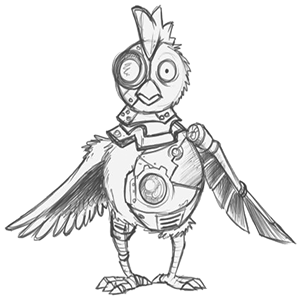
Astrochicken is the name given to a thought experiment expounded by theoretical physicist Freeman Dyson. In his book ‘Disturbing the Universe’ (1979), Dyson contemplated how humanity could build a small, self-replicating automaton that could explore space more efficiently than a manned craft could. He attributed the idea to John von Neumann, based on a lecture von Neumann gave in 1948 entitled ‘The General and Logical Theory of Automata.’ Dyson expanded on von Neumann’s automata theories and added a biological component to them.
Astrochicken, Dyson explained, would be a one-kilogram spacecraft unlike any before it. It would be a creation of the intersection of biology, artificial intelligence and modern microelectronics—a blend of organic and electronic components. Astrochicken would be launched by a conventional spacecraft, like an egg being laid into space.
read more »
Posted in Humor, Language, Technology |
Leave a Comment »
January 16, 2012


‘Slaughterhouse-Five, or The Children’s Crusade: A Duty-Dance with Death’ is a 1969 satirical novel by Kurt Vonnegut about World War II experiences and journeys through time of a soldier called Billy Pilgrim.
The work is also known under the lengthy title: ‘Slaughterhouse-Five, or The Children’s Crusade: A Duty Dance with Death, by Kurt Vonnegut, a Fourth-Generation German-American Now Living in Easy Circumstances on Cape Cod [and Smoking Too Much], Who, as an American Infantry Scout Hors de Combat, as a Prisoner of War, Witnessed the Fire Bombing of Dresden, Germany, ‘The Florence of the Elbe,’ a Long Time Ago, and Survived to Tell the Tale. This Is a Novel Somewhat in the Telegraphic Schizophrenic Manner of Tales of the Planet Tralfamadore, Where the Flying Saucers Come From. Peace.’
read more »
Posted in Humor, Language, War |
Leave a Comment »
January 15, 2012
Tenacious D is an American rock band that was formed in Los Angeles in 1994. Composed of lead vocalist and guitarist Jack Black and lead guitarist and vocalist Kyle Gass, the band has released two albums – ‘Tenacious D’ (2001) and ‘The Pick of Destiny’ (2006). The band’s studio releases and live performances feature a full band lineup, including such musicians as guitarist John Konesky, bassist John Spiker and Bad Religion drummer Brooks Wackerman.
The band originally performed as an acoustic duo, which gained popularity in 1999 when they starred in their eponymous television series and began to support large rock acts. Tenacious D’s music showcases Black’s theatrical vocal delivery and Gass’s acoustic guitar playing abilities. Critics have described their fusion of vulgar absurdist comedy with rock music as ‘mock rock.’ Their songs discuss the duo’s purported musical and sexual prowess, as well as their friendship and cannabis usage in a style that music critics have compared with the storyteller-style lyrics of rock opera.
read more »
Posted in Art, Humor |
Leave a Comment »
January 15, 2012
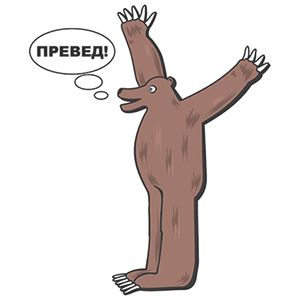
Preved is a term used in Russian Internet slang (Padonkaffsky jargon); it is a meme which developed out of a heavily-circulated picture, and consists of choosing alternative spellings for words for comic effect. The picture, a modified version of John Lurie’s watercolor ‘Bear Surprise,’ features a man and a woman having sex in the clearing of a forest, being surprised by a bear calling ‘Surprise!’ with its paws raised. In later Russian adaptations, the bear shouts ‘Preved!’ (a deliberate misspelling of ‘privet,’ ‘hi!’).
The word and the bear image have found their way into the mainstream mass media, such as a poster for the Russian edition of ‘Newsweek.’ In 2006 at an online conference, Vladimir Putin was asked: ‘PREVED, Vladimir Vladimirovich! How do you regard MEDVED?’ No answer was given, but the Associated Press, informing on the questions collection process, reportedly interpreted it as a reference to then-vice-prime-minister Dmitry Medvedev. It was the most popular question asked at the conference (the third most popular question was ‘How does one patch KDE2 under FreeBSD?’).
Posted in Humor, Sex, World |
Leave a Comment »
January 12, 2012

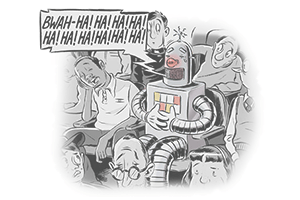
A claque [klak] (French for ‘clap’) is an organized body of professional applauders in French theatres and opera houses. Members of a claque are called ‘claqueurs.’
Hiring people to applaud dramatic performances was common in classical times. For example, when the emperor Nero acted, he had his performance greeted by an encomium (speech of praise) chanted by five thousand of his soldiers. This inspired the 16th-century French poet Jean Daurat to develop the modern claque. Buying a number of tickets for a performance of one of his plays, he gave them away in return for a promise of applause.
read more »
Posted in Art, Humor, Money |
1 Comment »
January 12, 2012

A peanut gallery is an audience that heckles the performer. The term originated in the days of vaudeville (1880s) as a nickname for the cheapest (and ostensibly rowdiest) seats in the theater; the least expensive snack served at the theater would often be peanuts, which the patrons would sometimes throw at the performers on stage to show their disapproval.
The phrases ‘no comments from the peanut gallery’ or ‘quiet in the peanut gallery’ are extensions of the name. ‘Peanut gallery’ may also refer to a social network audience that passively observes a syndicated web feed.
read more »
Posted in Humor, Language, Money |
Leave a Comment »
January 11, 2012
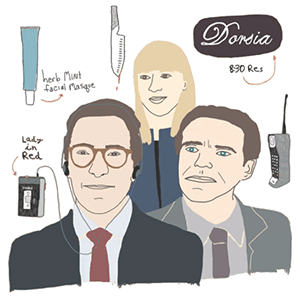
Yuppie [yuhp-ee] (short for ‘young urban professional’ or ‘young upwardly mobile professional’) is a term that refers to a member of the upper middle class or upper class in their 20s or 30s. It first came into use in the early-1980s and largely faded from American popular culture in the late-1980s, due to the 1987 stock market crash and the early 1990s recession. However it has seen a small revival in the 2000s and 2010s.
Yuppies are derided for their conspicuous personal consumption and hunger for attention social status among their peers. Cornell University economist Robert H. Frank, author of ‘Luxury Fever,’ has remarked, ‘When people were denouncing yuppies, they had considerably lower incomes than yuppies, so the things yuppies spent their money on seemed frivolous and unnecessary from their vantage point.’ Pro-skateboarder and businessman Tony Hawk has said that yuppies give ‘us visions of bright V-neck sweaters with collars underneath, and all that was vile in the eighties,’ and he has remarked as well as that a ‘bitchin’ tattoo cannot hide your inner desire to be Donald Trump.’
read more »
Posted in Humor, Language, Money |
1 Comment »
January 11, 2012
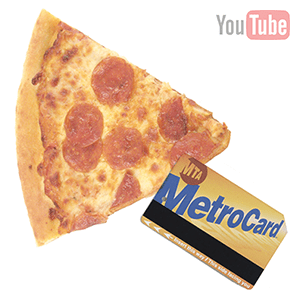
The New York Pizza Connection, or Pizza Principle, is a humorous but generally historically accurate ‘economic law’ proposed by native New Yorker Eric M. Bram. He noted in 1980 that from the early 1960s the price of a slice of pizza ‘matched, with uncanny precision, the cost of a New York City Subway ride.’ The term ‘Pizza Connection’ referring to this phenomenon was coined in early 2002 by ‘New York Times’ columnist Clyde Haberman. He predicted the cost of a slice of pizza would increase by as high as two dollars in midtown Manhattan.
In 2003 ‘The New Yorker’ magazine proclaimed the validity of the Pizza Connection (which they renamed the pizza principle) in accurately predicting the rise of the subway fare to $2.00 the week before. They also quoted Mr. Bram (by then a patent attorney) as warning that since the New York City Transit Authority had announced the discontinuation of the subway token itself in favor of the variable-fare cost MetroCard, the direct correlation between the cost of an off-the-street slice of cheese pizza and the cost of a subway token might not continue to hold. However, in 2005, and again in 2007, Haberman noted the price of a slice was again rising, and, citing the Pizza Connection, worried that the subway fare might soon rise again. The fare did indeed rise to $2.25 in 2009 and again in 2011 to $2.50.
Posted in Food, Humor, Money |
Leave a Comment »
January 10, 2012
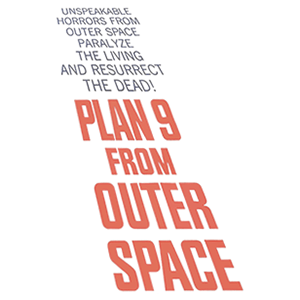
Unintentional humor is the act of making other people laugh without actually meaning to. There are several different kinds of unintentional humor that arise out of various situations. It is possible for unintentional humor to arise when two different well-meaning people contribute independent pieces of information, but in combination, they contradict each other. A misstep in the (in)appropriate environment is often considered humorous, that is the tension or embarrassment it creates is released by laughter. Examples are misspeaks or falls by a famous individual, catching somebody at an official event with inappropriate manners or embarrassing body noises.
Some books, movies, and other literary works end up being unintentionally funny because they are comically clichéd or overwrought, despite appearing to be earnest and serious efforts by their creators. Examples are ‘so bad they’re good’ movies, such as ‘Plan 9 from Outer Space,’ and the style of bad writing celebrated by the Bulwer-Lytton Fiction Contest (where entrants are invited ‘to compose the opening sentence to the worst of all possible novels’).
Posted in Humor |
Leave a Comment »
January 10, 2012
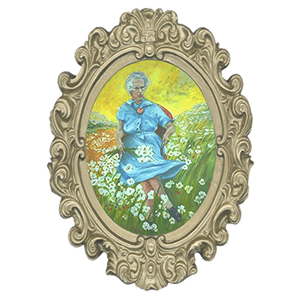
The Museum of Bad Art (MOBA) is a privately owned museum whose stated aim is ‘to celebrate the labor of artists whose work would be displayed and appreciated in no other forum.’ It has branches in Dedham and Somerville, outside Boston. Its permanent collection includes 500 pieces of ‘art too bad to be ignored,’ 25 to 35 of which are on public display at any one time.
Explaining the reasoning behind the museum’s establishment, co-founder Jerry Reilly said in 1995: ‘While every city in the world has at least one museum dedicated to the best of art, MOBA is the only museum dedicated to collecting and exhibiting the worst.’ To be included in MOBA’s collection, works must be original and have serious intent, but they must also have significant flaws without being boring; curators are not interested in displaying deliberate kitsch.
read more »
Posted in Art, Humor |
1 Comment »



