January 5, 2012
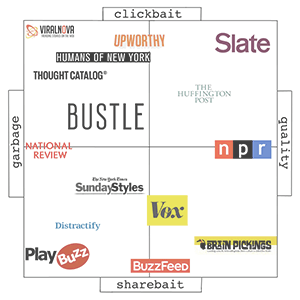
Betteridge’s Law of Headlines is an adage that states, ‘Any headline which ends in a question mark can be answered by the word ‘no.” It is based on a point made by journalist Ian Betteridge about sensational headlines that end in a question mark: ‘The reason why journalists use that style of headline is that they know the story is probably bullshit, and don’t actually have the sources and facts to back it up, but still want to run it.’ The maxim trends towards being universally true because of a simple principle of headline writing: if a story has enough sources to have a high chance of accuracy, a headline will be assertive. If sources are weak, or only a single source is found, headline writers will hedge their bets by posing the headline as a question.
It was among UK journalist Andrew Marr’s suggestions for how to read a newspaper if you really want to know what is going on: ‘If the headline asks a question, try answering ‘no.’ Is This the True Face of Britain’s Young? (Sensible reader: No.) Have We Found the Cure for AIDS? (No; or you wouldn’t have put the question mark in.) Does This Map Provide the Key for Peace? (Probably not.) A headline with a question mark at the end means, in the vast majority of cases, that the story is tendentious or over-sold. It is often a scare story, or an attempt to elevate some run-of-the-mill piece of reporting into a national controversy and, preferably, a national panic. To a busy journalist hunting for real information a question mark means ‘don’t bother reading this bit.”
Posted in Humor, Language, Money |
Leave a Comment »
January 4, 2012


The Missionary Church of Kopimism is a congregation of file sharers which hold that copying information as a sacred virtue. The sect, which is based in Sweden, is petitioning the Swedish government to have their church officially recognized as a religion.
The sect’s followers are called Kopomists from ‘copy me.’ According to the church, ‘In our belief, communication is sacred.’
Posted in Humor, Money, Philosophy |
Leave a Comment »
January 2, 2012
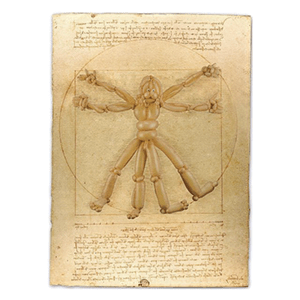
Balloon modelling is the shaping of special modelling balloons into almost any given shape, often a balloon animal. People who create balloon animals and other twisted balloon sculptures are called Twisters, Balloon Benders and Balloon Artists. Twisters often perform in restaurants, at birthday parties, fairs and at public and private events or functions. Two of the primary design styles are single balloon modelling, which restricts itself to the use of one balloon per model, and multiple balloon modelling, which uses more than one balloon.
Each style has its own set of challenges and skills, but few twisters who have reached an intermediate or advanced skill level limit themselves to one style or another. Depending on the needs of the moment, they might easily move between the one-balloon or multiple approaches, or they might even incorporate additional techniques such as ‘weaving’ and ‘stuffing.’ Modelling techniques have evolved to include a range of very complex moves, and a highly specialized vocabulary has emerged to describe the techniques involved and their resulting creations.
Posted in Art, Humor |
Leave a Comment »
January 2, 2012
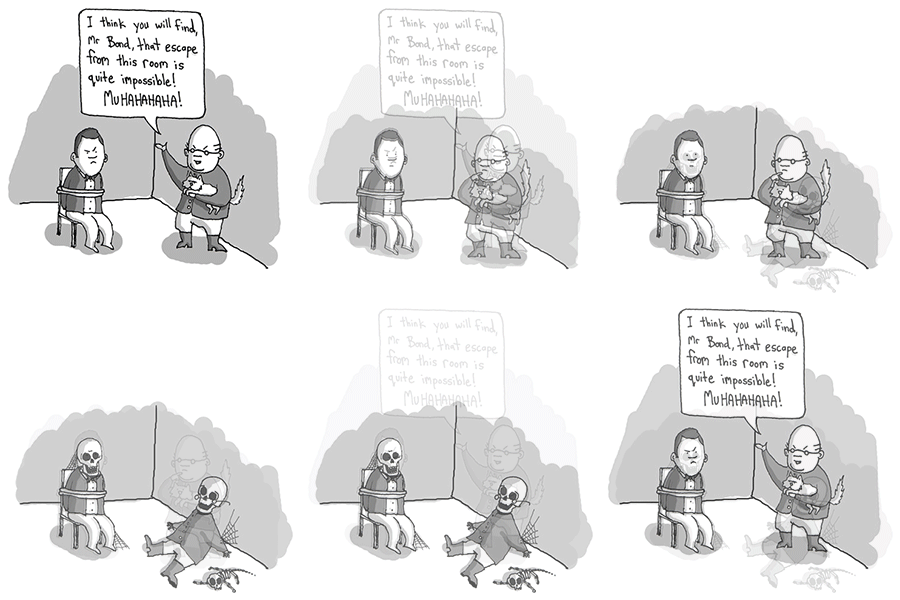
A deathtrap is a literary and dramatic plot device in which a villain, who has captured the hero or another sympathetic character, attempts to use an elaborate and usually sadistic method of murdering him/her. It is often used as a means to create dramatic tension in the story and to have the villain reveal important information to the hero, confident that the hero will shortly not be able to use it. It may also be a means to show the hero’s resourcefulness in escaping, or the writer’s ingenuity at devising a last-minute rescue or deus ex machina.
This plot device is generally believed to have been popularized by movie serials and 19th century theatrical melodramas. A well known example is the cliché of the moustache-twirling villain leaving the heroine tied to railroad tracks. Its use in the James Bond film series and superhero stories is well known.
read more »
Posted in Death, Humor, Language |
1 Comment »
January 2, 2012
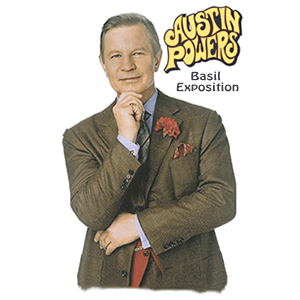
When the presentation of information in fiction becomes wordy, it is sometimes referred to as an ‘information dump.’ It is expressed by characters in dialogue or monologue and sometimes referred to as ‘idiot lectures.’ They are sometimes placed at the beginning of stories as a means of establishing the premise of the plot.
They also appear in science fiction, but it is considered poor writing when characters explain things to each other that they would already know. For example, if you need to call someone, you don’t stop to explain to a colleague that you are now going to use a device controlled with digital circuits to use radio waves to transmit your voice. Why? Because your contemporaries already know how cellular radio telephones work.
read more »
Posted in Art, Humor, Language |
Leave a Comment »
December 30, 2011
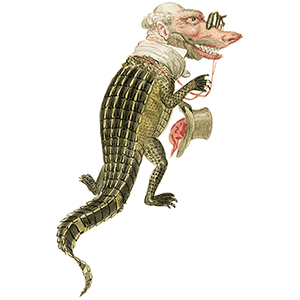
A krewe [kroo] is an organization that puts on a parade and or a ball for the Carnival season. The term is best known for its association with New Orleans Mardi Gras, but is also used in other Carnival celebrations around the Gulf of Mexico, such as the Gasparilla Pirate Festival in Tampa, Florida, and Springtime Tallahassee as well as in La Crosse, Wisconsin and at the Saint Paul Winter Carnival in Minnesota. The word is thought to have been coined in the early 19th century by an organization calling themselves Ye Mistick Krewe of Comus, as an archaic affectation; with time it became the most common term for a New Orleans Carnival organization. The Mystick Krewe of Comus itself was inspired by a Mobile mystic society (a Carnival social organization), with annual parades in Mobile, Alabama, called the Cowbellion de Rakin Society that dated from 1830.
Krewe members are assessed fees in order to pay for the parade and/or ball. Fees can range from thousands of dollars a year per person for the most elaborate parades to as little as $20 a year for smaller marching clubs. Criteria for krewe membership varies similarly, ranging from exclusive organizations largely limited to relatives of previous members to other organizations open to anyone able to pay the membership fee. Krewes with low membership fees may also require members to work to help build and decorate the parade floats and make their own costumes; higher priced krewes hire professionals to do this work. Parading krewe members are usually responsible for buying their own throws, the trinkets thrown to parade spectators according to Mobile and New Orleans tradition.
Posted in Games, Humor |
Leave a Comment »
December 28, 2011

Wife Acceptance Factor (WAF) refers to design elements that increase the likelihood a wife will approve the purchase of expensive consumer electronics products such as home theater systems and personal computers. Stylish, compact, unobtrusive forms and appealing colors are commonly considered WAF. The term is a tongue-in-cheek play on electronics jargon such as ‘form factor’ and ‘power factor’ and derives from the gender stereotype that men are predisposed to appreciate gadgetry and performance criteria whereas women must be wooed by visual and aesthetic factors.
Larry Greenhill first used the term in 1983, writing for ‘Stereophile’ magazine, but Greenhill credited fellow reviewer and music professor Lewis Lipnick with the coining of the term. Lipnick himself traces the origin to the 1950s when hi-fi loudspeakers were so large that they overwhelmed most living rooms. Lipnick’s wife, actress Lynn-Jane Foreman, arrived at a different term: Marriage Interference Factor (MIF). Foreman suggested that audiophile husbands should balance their large and ugly electronic acquisitions with gifts to the wife made on the basis of similar expense, with opera tickets, jewelry and vacations abroad among the suggestions.
Posted in Humor, Money, Technology |
1 Comment »
December 23, 2011

In Living Color was an American sketch comedy television series, which ran on the Fox Network from 1990 to 1994. Brothers Keenen and Damon Wayans created, wrote, and starred in the program. The show was produced by Ivory Way Productions. The show was taped before a live studio audience in Hollywood.
The title of the series was inspired by the NBC announcement of broadcasts being presented ‘in living color’ during the 1950s and 1960s, prior to popularization of color television. It also refers to the fact that most of the show’s cast was African-American, unlike other sketches comedy shows like ‘Saturday Night Live’ whose casts are usually mostly white.
read more »
Posted in Art, Humor |
Leave a Comment »
December 23, 2011


Tim and Eric Awesome Show, Great Job! is an American sketch comedy television series, created by and starring Tim Heidecker and Eric Wareheim, which premiered in 2007 on Cartoon Network’s ‘Adult Swim’ and ran until 2010. The program features surrealistic and often satirical humor (at points anti-humor), public-access television-style musical acts, bizarre faux-commercials, and editing and special effects chosen to make the show appear camp. The program has featured a wide range of actors such as Will Ferrell, John C. Reilly and Zach Galifianakis, as well as alternative comedians like Neil Hamburger, and television actors like Alan Thicke, celebrity look-alikes and impressionists.
The creators of the show have described it as ‘the nightmare version of television.’ The show expands the genre of the live-action material featured in Heidecker and Wareheim’s previous show ‘Tom Goes to the Mayor,’ such as Gibbons, the ‘Channel 5 Married News Team,’ and the Cinco Corporation with its variety of inefficient and tasteless products. New recurring characters and sketches include ‘Uncle Muscles Hour,’ a Public-access television variety program hosted by a gravelly-voiced ‘Weird Al’ Yankovic and Channel 5 News Correspondent Dr. Steve Brule, played by John C. Reilly.
Posted in Art, Humor |
1 Comment »
December 20, 2011

‘Series of tubes‘ is a phrase coined originally as an analogy by then Senator Ted Stevens (R-Alaska) to describe the Internet in the context of opposing network neutrality.
In 2006, he used this metaphor to criticize a proposed amendment to a committee bill that would have prohibited Internet service providers such as AT&T and Verizon Communications from charging fees to give some companies higher priority access to their networks or their customers. This metaphor has been widely ridiculed as demonstrating Stevens’s poor understanding of the Internet, despite the fact that he was in charge of regulating it.
read more »
Posted in Humor, Politics, Technology |
1 Comment »
December 20, 2011


‘Monkey Tennis‘ is a British pop culture phrase, first used in the late 1990s and popular throughout the 2000s. Originating as a joke in a television sitcom, it has come to be commonly used as an example of the hypothetical lowest common denominator television program that it is possible to make.
The term originates from the opening episode of the sitcom ‘I’m Alan Partridge,’ originally broadcast on BBC Two in 1997. In one scene the eponymous character of Partridge, a failed chat show host, desperately attempts to pitch program ideas to uninterested BBC executive who cancelled his first series. After failing to interest him in ideas plucked from thin air such as ‘Arm Wrestling With Chas & Dave,’ ‘Youth Hostelling with Chris Eubank,’ ‘Inner-City Sumo’ and ‘Cooking in Prison,’ Partridge comes up with a final spur-of-the-moment suggestion, ‘Monkey Tennis?,’ which is met with similar disdain.
Posted in Art, Humor, Money |
Leave a Comment »
December 17, 2011


The terms Google bomb and Googlewashing refer to practices, such as creating large numbers of links, that cause a web page to have a high ranking for searches on unrelated or off topic keyword phrases, often for comical or satirical purposes. In contrast, search engine optimization is the practice of improving the search engine listings of web pages for relevant search terms.
Google bombs date back as far as 1999, when a search for ‘more evil than Satan himself’ resulted in the Microsoft homepage as the top result. Some of the most famous Google bombs are also expressions of political opinions (e.g. ‘liar’ leading to Tony Blair or ‘miserable failure’ leading to the White House’s biography of George W. Bush).
read more »
Posted in Humor, Money, Technology |
Leave a Comment »



