December 13, 2011


Wok racing was developed by the German TV host Stefan Raab. Modified Chinese woks are used to make timed runs down an Olympic bobsled track. There are competitions for one-person-woksleds and four-person-woksleds, the latter using four woks per sled. Wok racing was inspired by a bet on a German TV show in 2003. Participants are mostly b-list celebrities. The typical racing woks are the ordinary round-bottomed Chinese pans, usually directly imported from China. The only modifications are that the bottom is reinforced with an epoxy filling and the edges of the wok are coated with polyurethane foam to avoid injuries.
Four-person woksleds consist of two pairs of woks, each of them is held together by a rounded frame. The two pairs are connected by a coupling. Due to the rather risky nature of the sport the participants wear heavy protective gear, usually similar to ice hockey equipment. To further reduce friction and the risk of injuries, the athletes wear ladles under their feet. To improve performance, the underside of the woks are often heated with a blowlamp before the race.
Posted in Games, Humor, World |
Leave a Comment »
December 13, 2011
Zoobomb is a weekly bicycling activity in Portland, Oregon during which participants ride bicycles rapidly downhill in the city’s West Hills. Zoobomb began in 2002. Participants carry their bikes on MAX Light Rail to the Washington Park station next to the Oregon Zoo. From there, participants take the elevator to the surface and then ride their bikes down the hills in the vicinity. This process is often repeated several times throughout the night. ‘The people that are going 35-mph-plus have backgrounds in BMX, mountain biking, bike messengering or downhill skateboarding. I don’t know that people showing up for the first time understand this.’
There is an emphasis on unusual bicycles, first and foremost the children’s bicycles or ‘minibikes,’ but extending to tall bikes, swing bikes, choppers, non-functional bicycles, skateboards, etc. The event is treated in a very lighthearted fashion, including a large amount of socializing between rides. Riders often dress up in costume or decorate their bicycles. Though many riders bring their own bicycles, the participants maintain a ‘Zoobomb pile,’ a tower of minibikes anchored to a bicycle rack at the Zoobomb meeting point for riders to borrow. The pile has become a local landmark.[3][5]A legally blind person ‘The Blind Bomber’ regularly attends (on a tandem bike, behind a sighted rider). Though not technically a race, there is some prestige in getting down the hill first.
Posted in Games, Humor |
Leave a Comment »
December 13, 2011

Kinetic sculpture races are organized contests of human-powered amphibious all-terrain works of art. The original event, the Kinetic Grand Championship in Humboldt County, California, is also called the ‘Triathlon of the Art World’ because art and engineering are combined with physical endurance during a three day cross country race that includes sand, mud, pavement, a bay crossing, a river crossing and major hills.
The concept of kinetic sculpture racing originated in Ferndale, California in 1969 when local sculptor Hobart Brown ‘improved’ the appearance of his son’s tricycle by welding on two additional wheels and other embellishments. Seeing this ‘Pentacycle,’ fellow artist Jack Mays challenged him to a race.
read more »
Posted in Art, Games, Humor |
Leave a Comment »
December 13, 2011

The Idiotarod is a shopping cart race in which teams of five ‘idiots’ tie themselves to a (sometimes modified) shopping cart and run through the streets of a major metropolitan area. The race usually features people in costumes and themed floats. The races are fun competitions where sabotage, costume, and presentation are rewarded. Sabotage such as tripping competitors, throwing marbles or large obstacles in their paths, and the spreading of misinformation such as false route information are common.
The Idiotarod is named after the Iditarod, a 1,000 mile dog-sledding race in Alaska. Idiotarods take place in Austin, Boston, Chicago, Denver, New York City, Phoenix, Portland, Salt Lake City, Seattle, St. Louis, Toronto, Los Angeles, Vancouver and Washington, D.C. though the original race was founded in San Francisco in 1994 as the ‘Urban Iditarod.’
Posted in Games, Humor |
Leave a Comment »
December 13, 2011

The Fools Guild is a Los Angeles organization themed around the medieval and renaissance idea of the Court jester. It’s central activity is producing three annual parties on Halloween, New Year’s Eve, and April Fool’s Day.
The Guild was born in 1979 at the Renaissance Pleasure Faire of Southern California, where the original improvisational team met while performing as jesters, jugglers, pass-the-hat-acts, and mimes. In 1982 they moved to West Hollywood, renting a house with a giant main room and very high ceilings, where the Fools began to host parties, workshops and other performance-centered events. Very quickly a social club of comedic performers evolved and the house became known as the Guild Hall.
read more »
Posted in Humor, Language |
Leave a Comment »
December 13, 2011
The Cacophony Society is ‘a randomly gathered network of free spirits united in the pursuit of experiences beyond the pale of mainstream society.’ It was started in 1986 by surviving members of the now defunct Suicide Club of San Francisco, a secret society devoted to urban exploration and anarchic pranks. Cacophony has been described as an indirect culture jamming outgrowth of the Dada movement, and the Situationists. One of its central concepts is the ‘Trip to the Zone,’ inspired by the 1979 Film ‘Stalker’ by Andrey Tarkovskiy.
According to self-designated members of the Society, ‘you may already be a member.’ The anarchic nature of the Society means that membership is left open-ended and anyone may sponsor an event, though not every idea pitched garners attendance by members. Cacophony events often involve costumes and pranks in public places and sometimes going into places that are off limits to the public. Cacophonists have been known to regale Christmas shoppers with improved Christmas carols while dressed as Santa Claus, and later invite strippers to sit on Santa’s lap at their annual SantaCon event.
read more »
Posted in Games, Humor |
1 Comment »
December 13, 2011
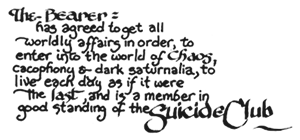
The Suicide Club was a secret society in San Francisco credited as the first modern extreme urban exploration (urbex) society, and also known for anarchic group pranks. The club was founded by Gary Warne in 1977 as a course he taught at the ‘Communiversity’ in San Francisco, part of the Free School Movement, and it lasted until shortly before Warne’s death in 1983.
Events generally started and ended in Warne’s used paperback bookstore, Circus of the Soul. The name of the Suicide Club was inspired by three stories written by Robert Louis Stevenson, where men who want to die belong to a club, where each evening one of them is randomly selected for death. The name belied the gentle albeit zany nature of its members, who had a predilection towards light-hearted practical jokes.
read more »
Posted in Games, Humor |
Leave a Comment »
December 13, 2011

SantaCon is a mass gathering of people dressed in Santa Claus costumes parading publicly on streets and in bars in cities around the world. The focus is on spontaneity and creativity, while having a good time and spreading cheer and goodwill. Sometimes known as Naughty Santas, Cheapsuit Santas, Santarchy, Santapalooza, and Santa Rampage, SantaCon incorporates elements of a flash mob in the context of cheerful bawdy and harmless behavior, the singing of naughty Christmas carols, and the giving of small gifts to strangers. In 2005, a more violent version of the event occurred when participants in New Zealand rioted, looting stores, throwing bottles at passing cars, and assaulting security guards.
In 1994, the Suicide Club (a secret society in San Francisco credited as the first modern extreme urban exploration society, and also known for anarchic group pranks) staged the first ‘Santarchy,’ which was later adopted as Santacon by offshoot the Cacophony Society (a randomly gathered network of free spirits united in the pursuit of experiences beyond the pale of mainstream society). Influenced by the surrealist movement, Discordianism, and other subversive art currents, the Cacophonists celebrated the Yule season in a distinctly anti-commercial manner, by mixing guerrilla street theater and pranksterism.
Posted in Games, Humor, Philosophy |
Leave a Comment »
December 8, 2011
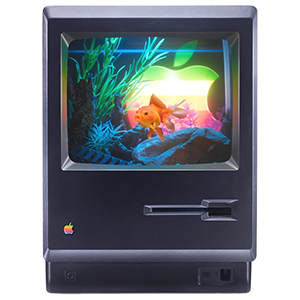
A Macquarium is an aquarium made to sit within the shell of an Apple Macintosh computer. The term was coined by computer writer Andy Ihnatko. In the early 1990s several Mac models in this form factor (the Macintosh 128K, Macintosh 512K and Macintosh Plus) were becoming obsolete, and Ihnatko considered that turning one into an aquarium might be ‘the final upgrade’ — as well as an affordable way to have a color Compact Mac.
He has mentioned in interviews that he had seen previous, overly-complex attempts at Macintosh aquariums at trade shows that among other drawbacks suffered from noticeable water level lines across the ‘screen’ that spoiled the illusion of a ‘really good screensaver,’ which drove him to design a version without a visible water line and which allowed the external case of the donor Mac to remain intact.
Posted in Humor, Technology |
Leave a Comment »
December 7, 2011

Emoji [ih-moh-jee] is the Japanese term for the picture characters or emoticons used in Japanese electronic messages and webpages. Originally meaning pictograph, the word literally means ‘e’ (‘picture) ‘moji’ (‘letter’). The characters are used much like emoticons elsewhere, but a wider range is provided, and the icons are standardized and built into mobile devices. Some emoji are very specific to Japanese culture, such as a bowing (apologizing) businessman, a face wearing a face mask, or a group of emoji representing popular foods (e.g. ramen noodles, rice balls). The three main Japanese phone operators, NTT DoCoMo, au, and SoftBank Mobile (formerly Vodafone), have each defined their own variants of emoji.
Although typically only available in Japan, the characters and code required to use emoji are, thanks to the nature of software development, often present in many phones’ software. As a result, some phones, such as the Apple iPhone, allow access to the symbols without requiring a Japanese operator. Emoji have also started appearing in emailing services such as Gmail (accessed via Google Labs) in 2009.
Posted in Humor, Language, Technology |
Leave a Comment »
December 1, 2011

The Jheri [jer-ee] curl is a hairstyle that was common and popular in the African American community especially during the 1970s and 1980s. Invented by and named for Jheri Redding, the Jheri curl gave the wearer a glossy, loosely curled look. It was touted as a ‘wash and wear’ style that was easier to care for than the other popular chemical treatment of the day, the relaxer. A Jheri curl was a two-part application that consisted of a softener (often called a ‘rearranging cream’) to loosen the hair and a solution to set the curls. The rearranging cream used pungent chemicals, causing the naturally tight curls to loosen and hang. The loose hair was then set and a chemical solution was then added to the hair to permanently curl it.
Perming the hair was time and labor-intensive and expensive to maintain. The harsh mix of chemicals required for the process caused the wearer’s natural hair to become extremely brittle and dry. To maintain the look of the Jheri curl, users were required to apply a curl activator spray and heavy moisturizers daily and to sleep with a plastic cap on their heads to keep the hairstyle from drying out. The activator in particular had the undesirable side effect of being very greasy; this would often stain clothing and furniture. The hairstyle went out of fashion by the late 1980s and was replaced in part with the hi-top fade haircut.
Posted in Art, Humor, Money |
Leave a Comment »
November 30, 2011
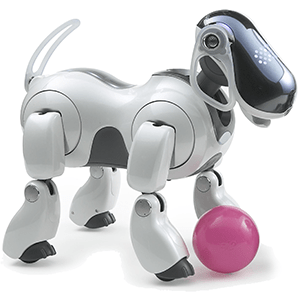
Roblog is a neologism for a blog written by a robot with no human intervention. Roblogs were made possible with a new generation of robots which are capable of uploading images and texts automatically to the Web. The first roblogs to appear, late 2005, were written by AIBO robots, the dog-like robotic pets once manufactured by Sony.
AIBO diaries are roblogs produced by AIBO model ERS-7, running a bundled software called Mind in either version 2 or 3. Depending on the language of the Mind software, the AIBO blogs in either English or Japanese. To be able to blog on its own, an ERS-7M2 or ERS-7M3 must be linked to the Internet through its Wi-Fi connection capability, and its e-mail sending capability must be correctly configured, for which an SMTP server not requiring authentication nor alternate ports is needed. Posts, consisting of pictures taken with the AIBO’s color camera built into its nose, are then sent by e-mail to the blog.
Posted in Humor, Technology |
Leave a Comment »


 The Daily Omnivore